Washington Strawberry
Apple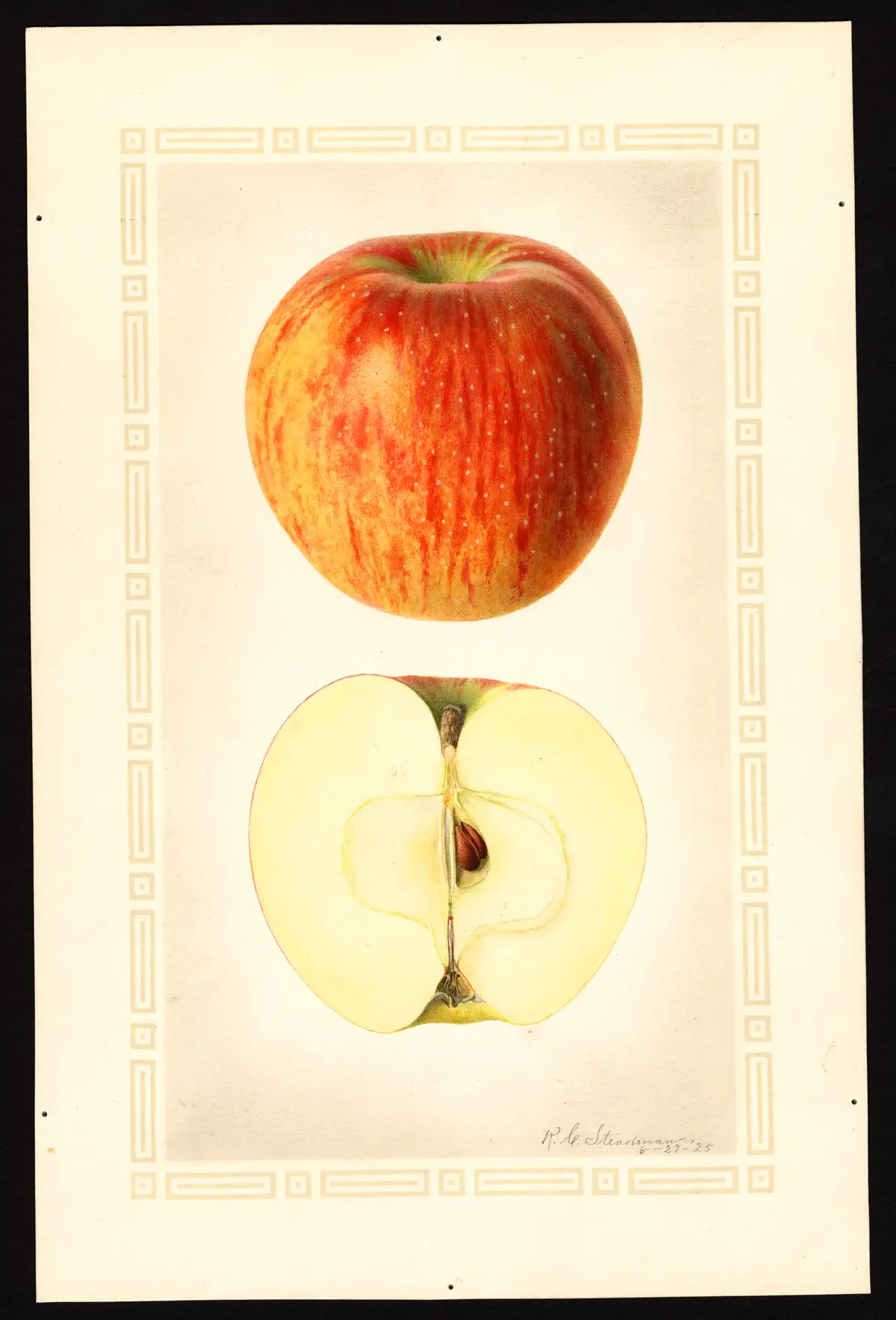
USDA Pomological Watercolor Collection
Washington Strawberry
Origin / History
Washington Strawberry originated on the farm of Job Whipple, Union Springs, Washington County, New York. It was first exhibited at the Fair of the State Agricultural Society in Syracuse in 1849, and was included in the catalogue of the American Pomological Society in 1869. Bunyard notes it was introduced from America in 1812 (though this date appears inconsistent with the 1849 first exhibition reported elsewhere) and adds that in England it is known as "Washington Strawberry" because there are other varieties called Washington. Beach observes that, although the variety has been known for half a century and disseminated to some extent across the continent, it has failed to establish itself in the commercial orchards of New York and is but little known among New York fruit growers. Hedrick notes its culture is confined to eastern New York and nearby regions. Bunyard remarks that "it has hardly the dessert quality attributed to it by Dr. Hogg and now figures rarely except as an exhibition fruit."
Tree
Tree medium to large, vigorous to moderately vigorous, hardy, healthy, moderately long-lived. Form rather flat, spreading, open, upright spreading (Downing, Budd-Hansen); Bunyard reports it "makes a wide spreading tree." Foliage dense (Budd-Hansen). Comes into bearing rather early and is a reliable cropper, an early and abundant bearer, yielding good crops biennially or almost annually. The fruit hangs well to the tree.
Young wood reddish (Downing). Twigs below medium to short, straight or nearly so, rather slender to stout with large terminal buds; internodes medium or below. Bark clear brownish-red or with more or less olive-green, lightly streaked with scarf-skin; pubescent. Lenticels scattering, small to medium, round or somewhat elongated, slightly raised. Buds medium to large, broad, plump, obtuse, free or nearly so, pubescent; Downing describes buds as "prominent, rounded."
Leaf (Bunyard): large, long, very dark, much upfolded, undulated, shallow serrate.
Fruit
Size: Large (Downing, Budd-Hansen, Bunyard, Lowther); rather large (Thomas); medium to large or very large (Beach); medium to large (Hedrick). Bunyard gives dimensions of 3 by 2½ inches. Beach notes the fruit is "somewhat variable in size," and Hedrick emphasizes that fruits are "extremely variable in size, color, and quality as grown in different localities — a fatal fault for a market apple and a serious one for a home variety."
Form: Roundish conical, flattened at base (Downing); roundish conical to roundish oblong conical, flattened at base (Budd-Hansen); roundish-conic, slightly oblate (Thomas); globular, usually inclined to conic, base rounding or sometimes flattened, nearly regular, sides often a little unequal (Beach); globular, conic, base rounding or sometimes flattened, regular, sides often unequal (Hedrick); oval oblong, flattened at top (Bunyard). Lowther codes form as "re."
Stem: Short (Downing); short (Budd-Hansen); rather short (Bunyard); short and rather thick or sometimes long (Beach); short, sometimes long, thick (Hedrick).
Cavity: Thinly russeted (Downing); narrow, deep, with a little brownish russet (Budd-Hansen); deep (Thomas); narrow, deep (Bunyard); below medium to medium, acute to somewhat acuminate, rather shallow to deep, narrow to moderately broad, occasionally lipped, often somewhat furrowed, usually thinly russeted (Beach); acute, shallow, narrow, occasionally lipped, often furrowed, thinly russeted (Hedrick).
Calyx: Closed, segments rather long, reflexed (Downing); nearly closed, segments rather long, divergent (Budd-Hansen); closed (Bunyard); below medium to rather large, usually somewhat open; lobes a little separated and broad at the base, narrow above, long, acute to acuminate (Beach); large, open; lobes separated and broad at the base, narrow above, long, acute (Hedrick).
Basin: Abrupt, deep, furrowed (Downing); rather narrow, abrupt, deep, corrugated (Budd-Hansen); broad, deep (Bunyard); small to medium, narrow to moderately wide, medium in depth, abrupt, somewhat furrowed, wrinkled (Beach); small, narrow, abrupt, furrowed, wrinkled (Hedrick).
Skin: Yellow, shaded, splashed, and mottled with rich red or crimson (Downing); surface yellow, mostly covered with shaded and mottled rich red, with bright crimson splashes and stripes (Budd-Hansen); striped and splashed with deep crimson on yellow (Thomas); pale yellow, only slightly greasy, dark red flush and bold broken stripes (Bunyard); rather thin, tough, smooth, somewhat waxy, greenish or yellow, washed and mottled with red, conspicuously splashed and striped with bright carmine and overspread with thin bloom — prevailing effect striped red (Beach); thin, tough, smooth, waxy, yellow, washed and mottled with red, conspicuously splashed and striped with carmine and overspread with thin bloom — prevailing effect striped red (Hedrick). Color summarized as "yellow-red" by Lowther. Beach notes "fairly uniform in shape but somewhat variable in size" with "pretty good color." Dots: many, light (Budd-Hansen); numerous, russet or whitish and rather conspicuous, often submerged (Beach); numerous, russet or white, conspicuous, often submerged (Hedrick).
Flesh / Flavor: Yellow, a little coarse, crisp, tender, juicy, brisk subacid; very good (Downing). Yellow, a little coarse, brisk sub-acid (Thomas). Yellow, somewhat coarse, crisp, tender, juicy, brisk subacid, very good (Budd-Hansen). Tender, fairly juicy, subacid, no flavour (Bunyard). Whitish tinged with yellow, firm, rather fine to a little coarse, crisp, tender, very juicy, pleasant subacid, sprightly, good to very good (Beach). Yellow, firm, fine, crisp, tender, juicy, pleasant subacid, sprightly, good to very good (Hedrick). Lowther rates quality as "very good." Beach summarizes the fruit as "smooth, of good size and pretty good color … desirable for either dessert or culinary uses." Hedrick states "at its best, Washington Strawberry is a fine dessert and culinary apple."
Core / Seeds: Tube funnel-shaped (Budd-Hansen). Beach: calyx tube rather large, wide, cone-shape with core lines meeting, sometimes becoming funnel-form with clasping core lines; stamens basal or nearly so; core below medium to above, axile or sometimes abaxile; cells not uniformly developed, usually symmetrical and more or less open, sometimes closed; core lines meeting if the calyx tube is cone-shape, clasping if it is funnel-form; carpels variable, ovate to broadly obcordate, sometimes a little emarginate, often tufted; seeds dark, medium in size, rather long, somewhat acute, often many are abortive. Hedrick: calyx-tube large, wide, cone-shape; stamens basal; core axile, sometimes abaxile; cells not uniformly developed, usually symmetrical, open, sometimes closed; core-lines meeting; carpels ovate or broadly obcordate, sometimes emarginate, often tufted; seeds dark, long, acute, often many are abortive.
Season
September, October (Downing, Thomas, Budd-Hansen); early autumn (Lowther); October to December (Bunyard); September or October into early winter (Beach); from September to early winter (Hedrick). Beach notes the variety is "quite variable in season in different years and in different localities," and that "some portion of the fruit may be kept in fair condition into the winter or sometimes through the winter." In ordinary storage its commercial limit is October, and in cold storage November. Beach further observes its season "is rather short, and it begins to mature at a time when the markets are filled with other fruits."
Uses
Desirable for either dessert or culinary uses (Beach); fine dessert and culinary apple at its best (Hedrick); both kitchen and market (Lowther); culinary (Bunyard). Beach concludes it is "a good variety for home use, but evidently is not wanted in market." Bunyard reports that in England it "now figures rarely except as an exhibition fruit."
Subtypes / Variants
Not described in source.
Other
Lowther's table coding includes a "Division reports" value of "Q*."
Book Sources
Described in 7 period pomological works
- Beach, The Apples of New York Vol. 2 (1905)
- Budd & Hansen, Systematic Pomology (1914)
- Downing, Fruits and Fruit Trees of America (1900)
- Hedrick, Cyclopedia of Hardy Fruits (1922)
- Thomas, The American Fruit Culturist (1903)
- Bunyard, A Handbook of Hardy Fruits (1920) — listed as Washington
- Lowther (ed.), Encyclopedia of Practical Horticulture (1914) — listed as Washington (Strawberry)
USDA Nomenclature (1905)
From W.H. Ragan, Nomenclature of the Apple, USDA Bulletin No. 56
Possibly identical with: Washington
Nursery Catalog Sources
Found in 3 catalogs (1900–1913) from Illinois
- Central Experimental Farm , Dominion Department of Agriculture, Agassiz, British Columbia (under test; Bulletin No. 3, Second Series) — 1900
- Benjamin Buckman (personal inventory) , Farmingdale , Illinois — 1901
- Benjamin Buckman (personal inventory) , Farmingdale , Illinois — 1913
View original book sources (7)
— A.J. Downing, The Fruits and Fruit Trees of America (1900)Washington Strawberry.
Originated on the farm of Job Whipple, Union Springs, Washington Co., N. Y. Tree hardy, vigorous, upright spreading, an early and abundant bearer. Young wood reddish. Buds prominent, rounded.
Fruit large, roundish conical, flattened at base, yellow, shaded, splashed, and mottled with rich red, or crimson. Stalk short. Cavity thinly russeted. Calyx closed. Segments rather long, reflexed. Basin abrupt, deep, furrowed. Flesh yellow, a little coarse, crisp, tender, juicy, brisk subacid. Very good. September, October.
— S.A. Beach, The Apples of New York, Vol. 2 (1905)WASHINGTON STRAWBERRY.
REFERENCES. 1. N. Y. Agr. Soc. Trans., 1849:117. 2. Mag. Hort., 23:26. 1857. 3. Hovey, Ib., 24:79. 1858. fig. 4. Am. Pom. Soc. Cat., 1869. 5. Downing, 1869:396. fig. 6. Thomas, 1875:205. 7. Downing, 1881:11, index, app. 8. Barry, 1883:341. 9. Wickson, 1889:244. 10. Lyon, Mich. Hort. Soc. Rpt., 1890:298. 11. Bailey, An. Hort., 1892:252. 12. Burnett, La. Sta. Bul., 27:926. 1894. 13. Powell and Fulton, U. S. B. P. I. Bul., 48:60. 1903. 14. Budd-Hansen, 1903:107. fig. 15. Farrand, Mich. Sta. Bul., 205:47. 1903. 16. Beach and Clark, N. Y. Sta. Bul., 248:150. 1904.
SYNONYMS. Juniata (7). WASHINGTON (2, 3). Washington of Maine (7). Washington County Seedling (2). WASHINGTON STRAWBERRY (1, 4, 5, 6, 7, 8, 9, 10, 11, 12, 13, 15, 16). WASHINGTON Strawberry (14). Washington Strawberry (3).
Fruit smooth, of good size and pretty good color, fairly uniform in shape but somewhat variable in size, desirable for either dessert or culinary uses. It is quite variable in season in different years and in different localities. As fruited at this Station it comes in season in September or October, and some portion of the fruit may be kept in fair condition into the winter or sometimes through the winter. In ordinary storage its commercial limit is October, and in cold storage November (13, 16). The fruit hangs well to the tree. The tree is vigorous, hardy, healthy, moderately long-lived, comes into bearing rather early and is a reliable cropper, yielding good crops biennially or almost annually. It is a good variety for home use, but evidently is not wanted in market. Its season is rather short, and it begins to mature at a time when the markets are filled with other fruits.
Historical. Washington Strawberry was first exhibited at the Fair of the State Agricultural Society in Syracuse in 1849 (1, 3). It originated on the farm of Job Whipple, Union Springs, Washington county, N. Y. (1). It was included in the catalogue of the American Pomological Society in 1869 (4). It is still listed by nurserymen and has been disseminated to some extent in various parts of the continent. Although it has been known for a half century it has failed to establish itself in the commercial orchards of this state and is but little known among New York fruit growers.
TREE.
Tree medium to large, vigorous to moderately vigorous. Form rather flat, spreading, open. Twigs below medium to short, straight or nearly so, rather slender to stout with large terminal buds; internodes medium or below. Bark clear brownish-red or with more or less olive-green, lightly streaked with scarf-skin; pubescent. Lenticels scattering, small to medium, round or somewhat elongated, slightly raised. Buds medium to large, broad, plump, obtuse, free or nearly so, pubescent.
FRUIT.
Fruit medium to large or very large. Form globular, usually inclined to conic, base rounding or sometimes flattened, nearly regular; sides often a little unequal. Stem short and rather thick or sometimes long. Cavity below medium to medium, acute to somewhat acuminate, rather shallow to deep, narrow to moderately broad, occasionally lipped, often somewhat furrowed, usually thinly russeted. Calyx below medium to rather large, usually somewhat open; lobes a little separated and broad at the base, narrow above, long, acute to acuminate. Basin small to medium, narrow to moderately wide, medium in depth, abrupt, somewhat furrowed, wrinkled. Skin rather thin, tough, smooth, somewhat waxy, greenish or yellow, washed and mottled with red, conspicuously splashed and striped with bright carmine and overspread with thin bloom. Dots numerous, russet or whitish and rather conspicuous, often submerged. Prevailing effect striped red. Calyx tube rather large, wide, cone-shape with core lines meeting, sometimes becoming funnel-form with clasping core lines. Stamens basal or nearly so. Core below medium to above, axile or sometimes abaxile; cells not uniformly developed, usually symmetrical and more or less open, sometimes closed; core lines meeting if the calyx tube is cone-shape, clasping if it is funnel-form. Carpels variable, ovate to broadly obcordate, sometimes a little emarginate, often tufted. Seeds dark, medium in size, rather long, somewhat acute; often many are abortive. Flesh whitish tinged with yellow, firm, rather fine to a little coarse, crisp, tender, very juicy, pleasant subacid, sprightly, good to very good. Season from September or October into early winter.
— Granville Lowther (ed.), Encyclopedia of Practical Horticulture (1914)Washington (Strawberry). Size: large. Form: "re". Color: yellow-red. Quality: very good. Use: both kitchen and market. Season: early autumn. Division reports: "Q*".
— John J. Thomas, The American Fruit Culturist (1903)Washington Strawberry. Rather large, roundish-conic, slightly oblate; striped and splashed with deep crimson on yellow; cavity deep; flesh yellow, a little coarse, brisk sub-acid. Growth vigorous. September, October. Origin, Washington County, N. Y.
— J.L. Budd & N.E. Hansen, American Horticultural Manual, Part II: Systematic Pomology (1914)Washington Strawberry. — Origin, Washington Co., New York, on the farm of Job Whipple; tree vigorous, upright, spreading, foliage dense, an early and abundant bearer.
Fruit large, roundish conical, to roundish oblong conical, flattened at base; surface yellow, mostly covered with shaded and mottled rich red, with bright crimson splashes and stripes; dots many, light; cavity narrow, deep, with a little brownish russet; stem short; basin rather narrow, abrupt, deep, corrugated; calyx nearly closed; segments rather long, divergent; tube funnel-shaped; flesh yellow, somewhat coarse, crisp, tender, juicy, brisk subacid, very good. September, October.
— E.A. Bunyard, A Handbook of Hardy Fruits (1920)WASHINGTON. Culinary, October to December, large, 3 by 2½, oval oblong, flattened at top. Colour, pale yellow, only slightly greasy, dark red flush and bold broken stripes. Flesh, tender, fairly juicy, subacid, no flavour. Eye, closed, in a broad, deep basin. Stem, rather short in a narrow, deep cavity. Growth, makes a wide spreading tree. Leaf, large, long, very dark, much upfolded, undulated, shallow serrate. Origin, raised in Washington County, U.S.A., on the farm of Job Whipple, and first exhibited in 1849. Introduced from America, in 1812. This is known in America as Washington Strawberry, there being other varieties called Washington. It has hardly the dessert quality attributed to it by Dr. Hogg and now figures rarely except as an exhibition fruit.
Watson's New Nonsuch : see Thorle.
— U.P. Hedrick, Cyclopedia of Hardy Fruits (1922)WASHINGTON STRAWBERRY. Juniata. At its best, Washington Strawberry is a fine dessert and culinary apple. Unfortunately, the fruits are extremely variable in size, color, and quality as grown in different localities — a fatal fault for a market apple and a serious one for a home variety. The tree is vigorous, hardy, healthy, bears early, lives long, is productive, and altogether very satisfactory. The variety originated on the farm of Job Whipple, Union Springs, New York, and its fruit was first exhibited in 1849. Its culture is confined to eastern New York and nearby regions.
Tree medium to large, vigorous, spreading, open.
Fruit medium to large, globular, conic, base rounding or sometimes flattened, regular, sides often unequal; stem short, sometimes long, thick; cavity acute, shallow, narrow, occasionally lipped, often furrowed, thinly russeted; calyx large, open; lobes separated and broad at the base, narrow above, long, acute; basin small, narrow, abrupt, furrowed, wrinkled; skin thin, tough, smooth, waxy, yellow, washed and mottled with red, conspicuously splashed and striped with carmine and overspread with thin bloom; dots numerous, russet or white, conspicuous, often submerged; prevailing effect striped red; calyx-tube large, wide, cone-shape; stamens basal; core axile, sometimes abaxile; cells not uniformly developed, usually symmetrical, open, sometimes closed; core-lines meeting; carpels ovate or broadly obcordate, sometimes emarginate, often tufted; seeds dark, long, acute, often many are abortive; flesh yellow, firm, fine, crisp, tender, juicy, pleasant subacid, sprightly; good to very good; from September to early winter.