Sops Of Wine
Apple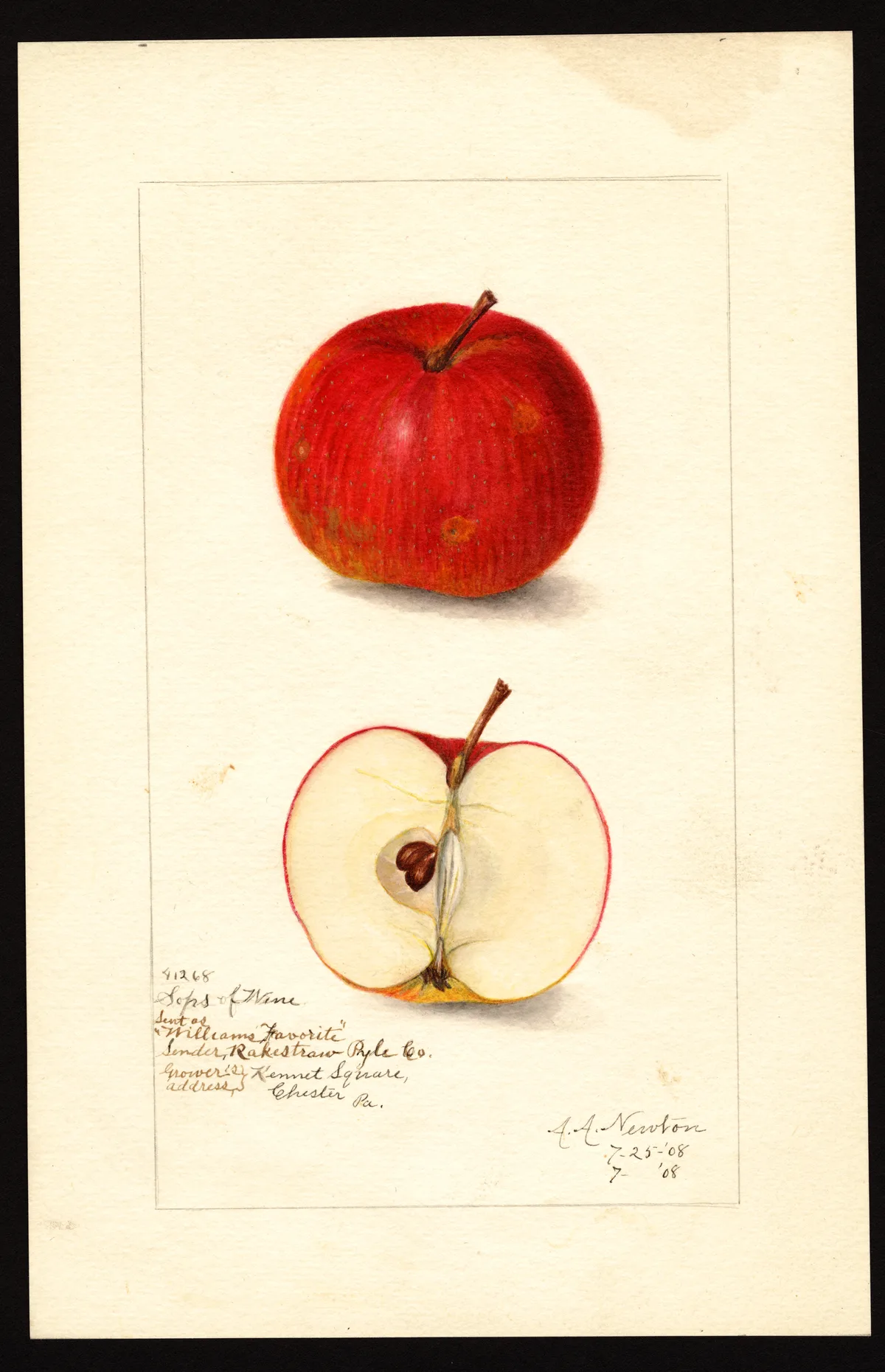
USDA Pomological Watercolor Collection
Sops Of Wine
Origin / History
An ancient/old English variety (Budd-Hansen; Bunyard; Hedrick), described as "Foreign" by Elliott and "European" by Warder. Known in Europe since 1688, when it was described by Ray, and grown in America for nearly two centuries (Hedrick). Bunyard identifies it as "the Old English apple so called," noting that "there are many red fleshed apples to which this name has been applied." By Hedrick's time it was grown only on the Atlantic seaboard and was rapidly passing from cultivation. Downing calls it "an old but very nice little dessert Apple." Esteemed historically for its peculiar pink flesh, as a curiosity for dessert (Elliott); Beach assesses it as "of little value except as a dessert apple for family use."
Tree
Vigorous (Elliott; Warder; Budd-Hansen; Bunyard; Central Experimental Farm); upright and spreading (Budd-Hansen); spreading (Warder); large, vigorous, upright, dense (Hedrick). An early bearer (Elliott; Budd-Hansen) and an abundant bearer (Downing; Budd-Hansen); productive (Warder); fertile (Bunyard). Beach: "a good grower, comes into bearing rather young and is a biennial or nearly annual cropper."
Fruit
Size
Medium or small (Elliott); small to medium (Warder); small (Downing); medium (Budd-Hansen; Lowther; Bunyard — 2¾ by 2 inches); medium to large, uniform in shape but not in size (Hedrick); medium (Central Experimental Farm).
Form
Roundish (Elliott; Downing); round, slightly conic, regular (Warder; Budd-Hansen); round or round-conic, ribbed, sides unequal (Hedrick); round, slightly flattened (Bunyard); flat (Lowther); conical (Central Experimental Farm).
Stem / Cavity
Stem short, slender (Elliott; Hedrick); stem long (Warder — "long, red"; Budd-Hansen — "long"); stem medium (Bunyard). Cavity medium, wavy, somewhat browned (Warder); cavity obtuse, wavy, slightly russeted (Budd-Hansen); cavity acute, deep, narrow, sometimes furrowed, with thin radiating russet rays (Hedrick); "very deep cavity" (Bunyard).
Calyx / Basin
Calyx with broad segments (Elliott); eye small, closed (Warder); calyx closed, segments long, broad, connivent (Budd-Hansen); calyx small, closed or slightly open, lobes short (Hedrick); eye a little open (Bunyard). Basin shallow, slightly furrowed (Elliott); basin shallow, plaited (Warder); basin wide, smooth, shallow (Budd-Hansen); basin shallow, narrow, furrowed, wrinkled (Hedrick); basin even, shallow (Bunyard).
Skin / Color
A dark crimson apple (Beach). Light red, nearly covered with bright purplish red, in streaks, yellowish in shade with yellow specks, whitish bloom (Elliott). Surface smooth, mixed red, shaded dark red throughout; dots small, scattered, yellow (Warder). Crimson red, stained and striped with purplish crimson (Downing). Surface smooth, unctuous at maturity, rich yellow, almost or wholly covered with rich dark red, mixed and shaded, with heavy darker stripes and splashes overlaid with thin white bloom, a handsome fruit; dots distinct, many, gray and yellow (Budd-Hansen). Skin thin, tender, roughened, greenish-yellow overspread with purplish-red, mottled, irregularly splashed and sometimes indistinctly striped with dark carmine, overspread with thin bloom; dots small, few, light russet or yellow (Hedrick). Color yellow-red (Lowther). Greenish-yellow almost covered with dark crimson flush (Bunyard). Skin green, nearly covered with dull red, and sprinkled with gray dots (Central Experimental Farm).
Flesh / Flavor
Flesh yellowish, stained with pink, juicy, mild, sub-acid; "very good" (Elliott). Flesh yellow, fine grained, tender, juicy; flavor acid to sub-acid, agreeable; quality good to very good; use, dessert (Warder). Flesh white, stained with pink, crisp, juicy, pleasant subacid; good (Downing). Flesh yellowish white, stained with red, fine-grained, moderately juicy, mild, pleasant subacid, good to very good (Budd-Hansen). Flesh fine, stained with red (Beach). Flesh yellow often stained with pink, soft, fine, juicy, aromatic, mild, pleasant subacid; good (Hedrick). Flesh tender, white, much stained with red; flavourless (Bunyard). Flesh white, crisp, not juicy, of pleasant flavour, quality good (Central Experimental Farm). Quality good (Lowther). Bunyard: "It is of no particular merit."
Core / Seeds
Core and seeds, medium (Elliott). Core distinctly marked with a red line, wide, oval, closed, meeting the eye; seeds numerous, pointed, brown (Warder). Core closed, meeting, core outline red; cells round, axile, slit; tube conical; stamens median or marginal; seeds large, pointed, few (Budd-Hansen). Calyx-tube short, wide, cone-shape; stamens marginal; core of medium size, abaxile; cells usually symmetrical but not uniformly developed, open; core-lines meeting; carpels broad-ovate, concave, mucronate, tufted; seeds large, wide, plump, obtuse (Hedrick).
Season
August to September (Elliott; Warder; Beach); August to October (Downing; Hedrick); late July, early August, in central Iowa (Budd-Hansen); last of August (Central Experimental Farm); autumn (Lowther); October to December (Bunyard). Bunyard classes it as culinary; Hedrick describes it as dessert, culinary, and cider.
Uses
Dessert (Elliott; Warder; Downing; Beach — "dessert apple for family use"); culinary (Bunyard); dessert, culinary, and cider (Hedrick); both kitchen and market (Lowther).
Subtypes / Variants
Not described in source.
Other
Lowther (Encyclopedia of Practical Horticulture, 1914) reports station distribution: "Reported by 9 stations in the Northern Division (also reported in more than one division), 13 stations in the Central Division (also reported in more than one division), and 9 stations in the Southern Division (also reported in more than one division)." Central Experimental Farm at Agassiz BC noted the tree was planted Spring 1894.
Book Sources
Described in 9 period pomological works
- Beach, The Apples of New York Vol. 2 (1905)
- Warder, American Pomology: Apples (1867)
- Budd & Hansen, Systematic Pomology (1914)
- Hedrick, Cyclopedia of Hardy Fruits (1922)
- Downing, Fruits and Fruit Trees of America (1900)
- Elliott, The Western Fruit Book (1865)
- Lowther (ed.), Encyclopedia of Practical Horticulture (1914)
- Thomas, The American Fruit Culturist (1903) — listed as Sops-of Wine
- Bunyard, A Handbook of Hardy Fruits (1920) — listed as SOPS IN WINE
Nursery Catalog Sources
Found in 16 catalogs (1886–1921) from Alabama, Arkansas, California, Illinois, Missouri, Oregon, Washington
- Huntsville Wholesale Nurseries (Jessie S. Moss , Proprietor; W.F. Heikes, Manager), Huntsville , Alabama — 1886 — listed as Hominy, or Sops of Wine
- California Nursery Co. , Niles , California — 1889
- Palouse Nursery and Pleasant Dale Fruit Farm , Colfax, Washington Territory (situated two miles northeast of Colfax) - undated (single-page broadside flyer; "Washington Territory" suggests pre — 1889
- Sherwood Hall Nursery Co. , Timothy Hopkins (Menlo Park Nurseries), San Francisco / Menlo Park , California — 1893
- The Vineland Nurseries (Kelsey & Co. , Proprietors), St. Joseph, Missouri (Office: 13th and Atchison Sts., 2 Blocks East of the Citizens St. Car Line) — 1894
- Brown Brothers Co. , Continental Nurseries, Rochester, NY (also operated from Toronto, Canada) — 1899
- Central Experimental Farm , Dominion Department of Agriculture, Agassiz, British Columbia (under test; Bulletin No. 3, Second Series) — 1900
- Yarbrough Bros. , Stephens , Arkansas — 1901 — listed as Hominy, or Sops of Wine
- Brown Brothers Co. , Continental Nurseries, Rochester, NY (also operated from Toronto, Canada) — 1901
- Mountain Grove Nurseries (Tippin & Moore , Proprietors; Geo. T. Tippin, J. W. Tippin, J. C. Moore), Mountain Grove , Missouri — 1901
- Benjamin Buckman (personal inventory) , Farmingdale , Illinois — 1901
- Phoenix Nursery Company (W. E. Rossney , President; Sidney Tuttle, Vice-President), Bloomington , Illinois — 1904
- Vineland Nurseries Company , Clarkston , Washington — 1912
- Benjamin Buckman (personal inventory) , Farmingdale , Illinois — 1913
- Union Nurseries , J.B. Weaver & Sons, Union , Oregon — 1915
- Benedict Nursery Co. , Portland , Oregon — 1921
View original book sources (10)
— F.R. Elliott, The Western Fruit Book (1865)Sops of Wine. Sops in Wine. | Sapson. | Bennington.
Foreign. Tree, vigorous early bearer; esteemed for its peculiar pink flesh, as a curiosity for dessert. Fruit, medium or small, roundish; light red, nearly covered with bright purplish red, in streaks, yellowish in shade with yellow specks, whitish bloom; stem, short, slender; calyx, with broad segments; basin, shallow, slightly furrowed; core and seeds, medium; flesh, yellowish, stained with pink, juicy, mild, sub-acid; "very good." August to September.
— John A. Warder, American Pomology: Apples (1867)Fig. 233.—SOPS OF WINE.
Sops of Wine.
European. Tree vigorous, spreading, productive.
Fruit small to medium, round, slightly conic, regular; Surface smooth, mixed red, shaded dark red throughout; Dots small, scattered, yellow.
Basin shallow, plaited; Eye small, closed.
Cavity medium, wavy, somewhat browned; Stem long, red.
Core distinctly marked with a red line, wide, oval, closed, meeting the eye; Seeds numerous, pointed, brown; Flesh yellow, fine grained, tender, juicy; Flavor acid to sub-acid, agreeable; Quality good to very good; Use, dessert; Season, August and September.
— A.J. Downing, The Fruits and Fruit Trees of America (1900)Sapson. Sapsonvine. An old but very nice little dessert Apple. Tree an abundant bearer. Fruit small, roundish, crimson red, stained and striped with purplish crimson. Flesh white, stained with pink, crisp, juicy, pleasant subacid. Good. August to October.
— John J. Thomas, The American Fruit Culturist (1903)Sops-of Wine, p. 302.
— S.A. Beach, The Apples of New York, Vol. 2 (1905)SOPS OF WINE.
REFERENCES,
- Ray, 1688:No. 21. 2. Knoop, 8:45. 1758. 3. Kenrick, 1832:28. 4. Ib., 1835:98. 5. Floy-Lindley, 1833:25. 6. Downing, 1845:77. 7. Cole, 1849:103. 8. Thomas, 1849:141. 9. Emmons, Nat. Hist. N. Y., 3:11, 33. 1851. 10. Barry, 1851:282. 11. Hovey, Mag. Hort., 18:545. 1852. fig. 12. Elliott, 1854:157. 13. Gregg, 1857:39. 14. Hooper, 1857:85. 15. Am. Pom. Soc. Cat., 1862. 16. Warder, 1867:615. fig. 17. Downing, 1869:356. 18. Horticulturist, 27:309. 1872. fig. 19. Fitz, 1872:121, 174. 20. Downing, 1872:10 index, app. 21. Montreal Hort. Soc. Rpt., 1879:22. 22. Downing, 1881:11 index, app. 23. Ib., 1881:12 index, app. 24. Hogg, 1884:215. 25. Hoskins, Rural N. Y., 47:662. 1888. figs. 26. Lyon, Mich. Hort. Soc. Rpt., 1890:296. 27. Bailey, An. Hort., 1892:249. 28. Hoskins, Rural N. Y., 53:248. 1894. 29. Burrill and McCluer, Ill. Sta. Bul., 45:325. 1896. 30. Waugh, Vt. Sta. An. Rpt., 14:309. 1901. 31. Budd-Hansen, 1903:177. fig.
SYNONYMS. Bell's Early? (17). Bell's Favorite (20). Bennington (17, 18). Dodge's Early Red (17). Early Washington (22). Hominy (17, 19). Horning (29). Pie Apple (10). Red Shropsavine† (17). RODE WYN APPEL (2). Rode Wyn Appel (5, 6, 9). SAPSON (3). Sapson (6, 9, 11, 12, 18). Sapsonvine (3). Shropshirevine (23). SOPS IN WINE (1, 24). Sops in Wine (5, 6, 9, 11, 12, 18). SOPS OF WINE (4, 5, 6, 7, 8, 9, 10, 11, 12, 13, 14, 15, 16, 17, 18, 19, 20, 21, 22, 23, 25, 26, 27, 28, 29, 30, 31). Sops of Wine (24). Strawberry (30). Warden's Pie Apple (17, 18). Washington (17, 18).
A dark crimson apple; flesh fine, stained with red; in season in August and September. The tree is a good grower, comes into bearing rather young and is a biennial or nearly annual cropper. Of little value except as a dessert apple for family use.
— J.L. Budd & N.E. Hansen, American Horticultural Manual, Part II: Systematic Pomology (1914)Sops of Wine. — An ancient English variety; tree vigorous, upright, spreading, an early and abundant bearer.
Fruit medium, round, slightly conic, regular; surface smooth, unctuous at maturity, rich yellow, almost or wholly covered with rich dark red, mixed and shaded, with heavy darker stripes and splashes overlaid with thin white bloom, a handsome fruit; dots distinct, many, gray and yellow; cavity obtuse, wavy, slightly russeted; stem long; basin wide, smooth, shallow; calyx closed: segments long, broad, connivent. Core closed, meeting, core outline red; cells round, axile, slit; tube conical; stamens median or marginal; seeds large, pointed, few; flesh yellowish white, stained with red, fine-grained, moderately juicy, mild, pleasant subacid, good to very good. Late July, early August, in central Iowa.
— Granville Lowther (ed.), Encyclopedia of Practical Horticulture (1914)Sops of Wine (23). Size: medium. Form: flat. Color: yellow-red. Quality: good. Use: both kitchen and market. Season: autumn. Reported by 9 stations in the Northern Division (also reported in more than one division), 13 stations in the Central Division (also reported in more than one division), and 9 stations in the Southern Division (also reported in more than one division).
— E.A. Bunyard, A Handbook of Hardy Fruits (1920)SOPS IN WINE. Fl. and Pom., 1882, 105. (Sapson, Sapsovine.) Culinary, October to December, medium, 2¾ by 2, round, slightly flattened. Colour, greenish-yellow almost covered with dark crimson flush. Flesh, tender, white, much stained with red; flavourless. Eye, a little open in an even shallow basin. Stem, medium in a very deep cavity. Growth, vigorous; fertile. There are many red fleshed apples to which this name has been applied. This I believe to be the Old English apple so called. It is of no particular merit.
— U.P. Hedrick, Cyclopedia of Hardy Fruits (1922)SOPS OF WINE. Bennington. Early Washington. Strawberry. This is an old English dessert, culinary, and cider apple, known in Europe since 1688, when it was described by Ray, and grown in America for nearly two centuries. The crimson apples are handsome, well-flavored, and have fine-grained flesh, which is white stained with red. It is grown only on the Atlantic seaboard and even there is rapidly passing from cultivation. Tree large, vigorous, upright, dense. Fruit medium to large, uniform in shape but not in size, round or round-conic, ribbed, sides unequal; stem short, slender; cavity acute, deep, narrow, sometimes furrowed, with thin radiating russet rays; calyx small, closed or slightly open; lobes short; basin shallow, narrow, furrowed, wrinkled; skin thin, tender, roughened, greenish-yellow overspread with purplish-red, mottled, irregularly splashed and sometimes indistinctly striped with dark carmine, overspread with thin bloom; dots small, few, light russet or yellow; calyx-tube short, wide, cone-shape; stamens marginal; core of medium size, abaxile; cells usually symmetrical but not uniformly developed, open; core-lines meeting; carpels broad-ovate, concave, mucronate, tufted; seeds large, wide, plump, obtuse; flesh yellow often stained with pink, soft, fine, juicy, aromatic, mild, pleasant subacid; good; August to October.
— Central Experimental Farm, Central Experimental Farm, Agassiz BC — Catalogue of Fruit Trees under Test (Bulletin No. 3, 1900) (1900)Planted Spring 1894. Tree a vigorous grower. Fruit of medium size, conical. Skin green, nearly covered with dull red, and sprinkled with gray dots. Flesh white, crisp, not juicy, of pleasant flavour, quality good. Season last of August.