Domine
Apple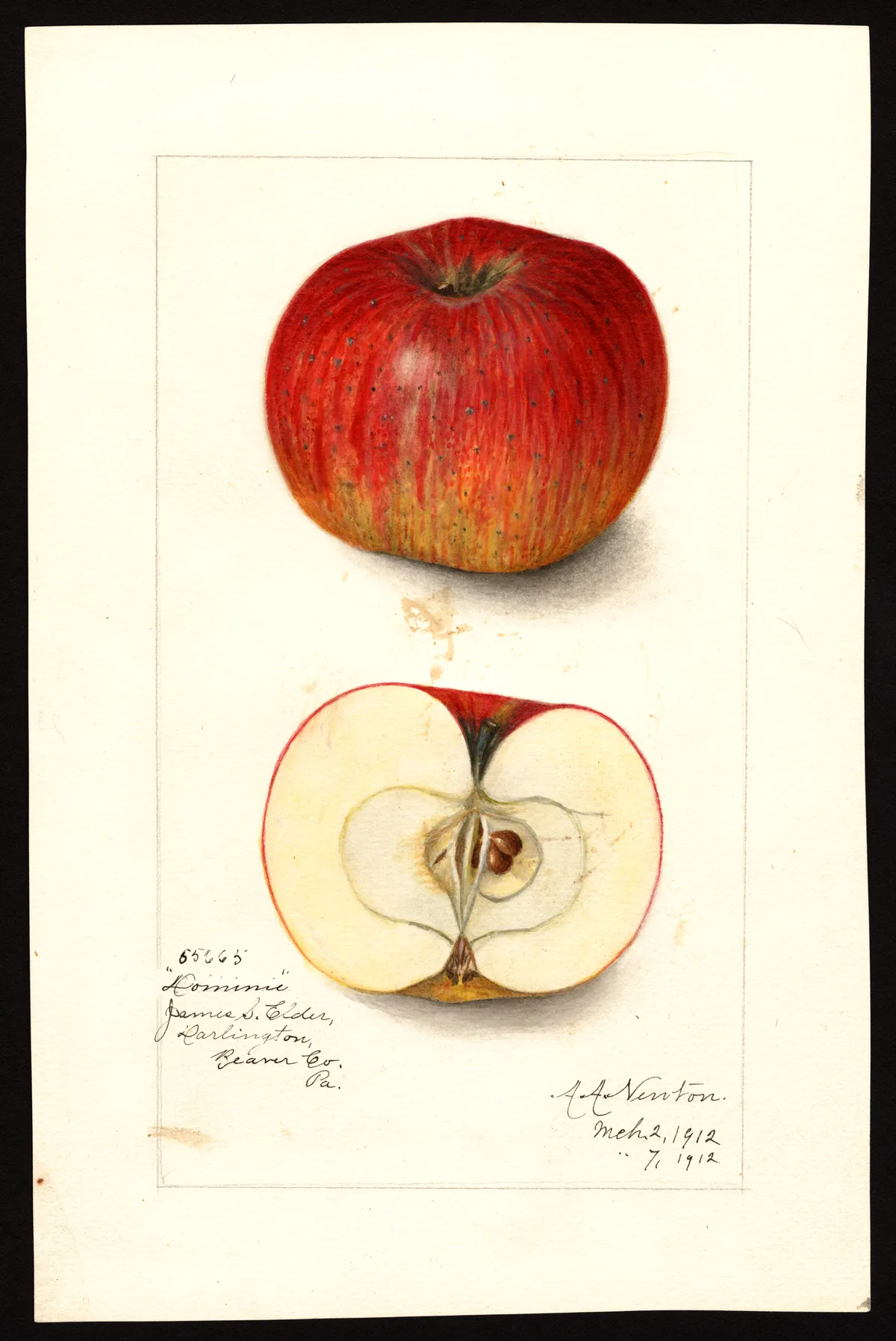
USDA Pomological Watercolor Collection
Domine
Origin / History
Origin uncertain. Most American sources suppose it to be a native of this country (Warder; Downing; Beach; Budd-Hansen gives the origin as New York). Elliott states that it probably came originally from Maryland. Downing notes that the variety does not appear to be described by any foreign author; Coxe says that he received it from England, but the apple Coxe describes and figures does not appear to be the Domine of American orchards, and Downing reports never having met with Coxe's apple in any collection in America — Beach concurs that the Domine of American cultivation is evidently not identical with the Domine described by Coxe (Fruit Trees, 1817:115). Hedrick reports that the variety has been grown in America at least since 1820, its culture being confined for the most part to the Middle Atlantic states. Downing notes it was extensively planted in the orchards on the Hudson and west. Beach observes that it has been more extensively planted along the Hudson than in any other part of the state, but was, by 1905, no longer grown there as much as formerly. Hedrick describes it as "one of the choicely good apples rapidly passing from cultivation, but still to be found in many old orchards."
Downing notes that Domine so much resembles the Rambo externally that the two are often confounded together, and the outline of the Rambo may be taken as nearly a fac-simile of Domine. Downing distinguishes the two: Domine is of a livelier color, and the flavor and season of the two fruits are very distinct — the Rambo being rather a high-flavored early winter or autumn apple, while the Domine is a sprightly, juicy, long-keeping winter fruit. Budd-Hansen and Beach echo this comparison. Beach places it as "a striped apple of the Rambo class which much resembles Rambo in appearance," noting that while it does not rank as high in quality, it is a much better keeper.
Bunyard's English entry under the name "Domino" — described as a culinary apple of the Codlin type, September to October, much grown around London and probably from the Midland Counties — appears to refer to a distinct English variety; included here as it appeared in his Handbook under a closely related name.
Tree
Vigorous to moderately vigorous (Beach); strong, vigorous grower (Elliott); very thrifty (Warder); upright, vigorous, very productive and an early bearer (Budd-Hansen); upright-spreading with long, spreading branches (Hedrick). An early, good bearer, profitable, an orchard sort succeeding finely in most soils in the West (Elliott). Hardy, upright, vigorous and productive (Warder). Thomas notes it is tender at the West.
Form upright spreading "with a straggling, open head and bearing its fruit crowded along the smaller branches" (Warder, quoted in Beach). Warder describes the tree as making long, stout, brown shoots, which branch from the ends, and form spurs along their sides, so that the tree has a straggling, open head. Branches long, stout, spreading, "very liable to be broken by the heavy crops of fruit" (Lyon, quoted in Beach); Hedrick likewise notes that the branches break easily when heavy crops set. Downing characterizes the trees as among "the most rapid growers and prodigious early bearers that we know — the branches being literally weighed down by the rope-like clusters of fruit." Shoots long, diverging (Elliott); shoots very long, vigorous, diverging (Thomas). Young wood smooth, lively light brown (Downing).
Twigs above medium to long, moderately stout; internodes long. Bark smooth, clear reddish-brown, sometimes with a slight undertone of yellowish-green uniformly overlaid with a thin scarf-skin, rather pubescent. Lenticels rather inconspicuous, raised, moderately numerous, above medium, generally roundish. Buds above medium, roundish to acute, free or nearly so, quite pubescent (Beach).
Foliage large and long, with a peculiar curl or folding upwards, so as to show the underside of the leaves (Warder). Leaves long, drooping and characteristically twisted (Beach; Hedrick); leaves drooping, coarsely serrate (Thomas).
Bearing habits: an early bearer (Elliott; Budd-Hansen; Downing), productive (Warder; Thomas; Budd-Hansen). Beach notes that in western New York, although in some seasons it is very productive, it is not as reliable a bearer as some of the kinds which outrank it in the commercial orchards, and often the color is not well developed. Hedrick notes the tree is "not very productive." Warder notes that the stem is easily separated from the fruit but holds firmly to the tree, hence care is needed in picking the fruit.
Fruit
Size
Medium to large (Elliott); large (Warder); medium size (Downing); rather large (Thomas; Budd-Hansen); medium-sized (Lowther); usually about medium in size, sometimes large or very large (Beach); medium, sometimes large (Hedrick). Beach notes that when well grown it is large and of good color, but too often the fruit sets so abundantly that it does not average much above medium size.
Form
Flat (Elliott; Downing); large, flat, regular, sometimes unequal (Warder); roundish oblate (Thomas; Lowther); regular, oblate (Budd-Hansen); usually oblate, sometimes inclined to oblong and distinctly flattened at the base, sides often somewhat unequal, ribbed (Beach); oblate, sometimes oblong and distinctly flattened at the base, sides often unequal, ribbed (Hedrick).
Stem / Stalk
Long, slender, inclining to one side (Elliott); long and slender (Downing); three-fourths of an inch long (Thomas); medium to long, slender at its insertion into the fruit, easily separated from the fruit but holding firmly to the tree (Warder); medium, rather slender, curved (Budd-Hansen); medium to long, slender at the base (Beach); medium to long, slender (Hedrick).
Cavity
Wide (Elliott); wide (Downing); wide, deep, acute (Thomas); wide, wavy, brown (Warder); regular, very wide and deep, with large stellate russet patch (Budd-Hansen); obtuse, wide, deep, often distinctly furrowed, usually with outspreading brown russet rays (Beach); obtuse, wide, deep, often furrowed, usually with outspreading brown-russet rays (Hedrick).
Calyx / Eye
Calyx small (Elliott; Downing), in a broad basin, moderately sunk (Downing). Eye medium to small, closed (Warder). Calyx closed; segments connivent (Budd-Hansen). Calyx below medium to large, closed or slightly open; lobes long, acute (Beach). Calyx closed or open; lobes long, acute (Hedrick). Calyx tube funnel-shape with a wide limb and short truncate cylinder; stamens median to marginal (Beach); stamens marginal (Budd-Hansen); stamens median (Hedrick).
Basin
Broad (Elliott); broad, moderately sunk (Downing); deep, obtusely ribbed (Thomas); rather shallow, folded or plaited (Warder); wide, medium deep, slightly ribbed (Budd-Hansen); pubescent, rather shallow to moderately deep, wide or compressed, abrupt, usually distinctly furrowed (Beach); pubescent, shallow to deep, wide or compressed, abrupt, usually furrowed (Hedrick).
Skin / Surface
Greenish yellow, with stripes and splashes of bright red and large russet specks (Elliott). Surface yellowish-green, nearly covered with mixed red, and striped indistinctly with carmine, often vein-russeted (Warder). Skin lively greenish yellow in the shade, with stripes and splashes of bright red in the sun, and pretty large russet specks (Downing). Surface with narrow and distinct stripes of light red, on whitish yellow ground; dots or specks large, rough (Thomas). Surface greenish yellow in shade, mostly covered with splashed and striped bright red in sun, overlaid with whitish (Budd-Hansen). Green and red skin (Lowther). Skin thick, tough, smooth, bright, whitish-yellow or green mottled and splashed with deep pinkish-red, striped with bright carmine and overlaid with thin whitish bloom (Beach). Skin thick, tough, smooth, bright, yellow or green mottled and splashed with deep pinkish-red, striped with bright carmine and overlaid with thin bloom (Hedrick).
Dots
Large russet specks (Elliott; Downing). Scattered, yellow and gray, large (Warder). Large, rough (Thomas). Distinct, many, very large, some scattered irregular russet specks with light bases (Budd-Hansen). Pale or yellow, numerous toward the basin, but toward the cavity they are scattering, large, often irregular and with russet center (Beach). Pale, numerous toward the basin, toward the cavity scattering, large, irregular and with russet center (Hedrick).
Flesh / Flavor
White, tender, juicy; "very good" (Elliott). Light yellow, breaking, tender, juicy; flavor slightly sub-acid, rich; good, for table, kitchen, or market (Warder). White, exceedingly tender and juicy, with a sprightly pleasant, though not high flavor (Downing). White, firm, mild sub-acid, spicy, fine flavored (Thomas). Whitish, very tender, juicy, pleasant, rich sprightly subacid, very good (Budd-Hansen). Whitish or tinged with light yellow, very firm, breaking, somewhat coarse, tender, juicy, mild subacid with a peculiar aromatic flavor, good to very good (Beach). Yellow, firm, breaking, coarse, tender, juicy, mild subacid with a peculiar aromatic flavor; good to very good (Hedrick). Lowther rates quality "very good."
Hedrick characterizes the apple as "commonplace in color and size, but the quality is good, its juiciness and sprightliness making it one of the most refreshing of fruits, while, at the same time, it is rich in flavor." Beach notes it is chiefly valued for dessert, being generally considered inferior for culinary uses, except possibly for baking.
Core and Seeds
Core medium (Elliott); regular, somewhat open, scarcely meeting the eye (Warder); core open, barely clasping; axis short; cells ovate, entire; tube conical (Budd-Hansen); core small, somewhat abaxile; cells usually symmetrical, closed or partly open; core lines nearly meeting or clasping; carpels broadly elliptical, slightly emarginate (Beach); core small, abaxile; cells symmetrical, closed or partly open; core-lines meeting or clasping; carpels broadly elliptical, emarginate (Hedrick). Axis often short (Warder).
Seeds abundant, purplish brown (Elliott); numerous, pointed, plump (Warder); many, long-pointed, plump (Budd-Hansen); numerous, large, plump, moderately narrow, long, acute, dark (Beach); numerous, large, plump, narrow, long, acute, dark (Hedrick).
Season
November to April (Elliott); December and January, keeping until spring in the North (Warder); excellent from December till April (Downing); keeps through winter (Thomas); winter (Lowther); December to April (Budd-Hansen); November to March; commercial limit February (Beach); November to March (Hedrick); January and April (Veitch). Bunyard's English "Domino" is September to October (a likely distinct English variety; see Origin/History).
Uses
For table, kitchen, or market (Warder). Both kitchen and market (Lowther). Chiefly valued for dessert; generally considered inferior for culinary uses, except possibly for baking (Beach). Profitable orchard sort (Elliott). Large and handsome; good flavour, good keeping; valuable for market, in many places a good regular stowing productive variety for sale, in many places a good grower (Veitch).
Subtypes / Variants
Not described in source.
Other
Warder's plate is labeled "Fig. 89.—DOMINE." Thomas cites "Fig. 412." Lowther reports the variety from 2 stations in the Northern Division, 14 stations in the Central Division, and 1 station in the Southern Division; an asterisk on each division figure indicates the variety is reported in more than one division. Beach's references include 21 historical citations spanning 1831 to 1904.
Book Sources
Described in 9 period pomological works
- Warder, American Pomology: Apples (1867)
- Beach, The Apples of New York Vol. 1 (1905)
- Downing, Fruits and Fruit Trees of America (1900)
- Budd & Hansen, Systematic Pomology (1914)
- Elliott, The Western Fruit Book (1865)
- Hedrick, Cyclopedia of Hardy Fruits (1922)
- Thomas, The American Fruit Culturist (1903)
- Bunyard, A Handbook of Hardy Fruits (1920) — listed as DOMINO
- Lowther (ed.), Encyclopedia of Practical Horticulture (1914) — listed as Dominie
Nursery Catalog Sources
Found in 15 catalogs (1864–1921) from Alabama, California, England, Illinois, Oregon, Virginia
- St. Helena Nursery , Howell's Prairie, Marion County , Oregon — 1864 — listed as Red Streak
- Fancher Creek Nursery , Fresno , California — 1886 — listed as Dominie
- California Nursery Co. , Niles , California — 1889 — listed as Dominie
- Sherwood Hall Nursery Co. , Timothy Hopkins (Menlo Park Nurseries), San Francisco / Menlo Park , California — 1893 — listed as Dominie
- The Vineland Nurseries (Kelsey & Co. , Proprietors), St. Joseph, Missouri (Office: 13th and Atchison Sts., 2 Blocks East of the Citizens St. Car Line) — 1894 — listed as Dominie
- Woodburn Nurseries , Woodburn, Marion Co. , Oregon — 1894 — listed as Dominie
- The Salem Nursery (John A. Francis , Proprietor), Salem , Virginia — 1897 — listed as Dominie
- Alabama Nursery Co. , Huntsville , Alabama — 1900 — listed as Dominie
- Central Experimental Farm , Dominion Department of Agriculture, Agassiz, British Columbia (under test; Bulletin No. 3, Second Series) — 1900 — listed as Dominie
- George Bunyard & Co. , Royal Nurseries, Maidstone, Kent , England — 1900 — listed as Domino
- Benjamin Buckman (personal inventory) , Farmingdale , Illinois — 1901 — listed as Dominie
- James Veitch & Sons , Ltd., Royal Exotic Nursery, Chelsea, London (also Coombe Wood, Langley, and Feltham) , England — 1911 — listed as Domino
- Benjamin Buckman (personal inventory) , Farmingdale , Illinois — 1913 — listed as Dominie
- Union Nurseries , J.B. Weaver & Sons, Union , Oregon — 1915 — listed as Dominie
- Benedict Nursery Co. , Portland , Oregon — 1921 — listed as Dominie
View original book sources (10)
— F.R. Elliott, The Western Fruit Book (1865)DOMINE.
Wells, | English Winter, | Striped E. J. Greening, Hogan, | Red Streak, of some, | Well Apple.
Origin, uncertain. Tree, strong, vigorous grower ; shoots, long, diverging ; early, good bearer, profitable, orchard sort. West ; succeeding finely in most soils. Fruit, medium to large, flat, greenish yellow, with stripes and splashes of bright red and large russet specks ; stem, long, slender, inclining to one side ; cavity, wide ; calyx, small ; basin, broad ; core, medium ; seeds, abundant, purplish brown ; flesh, white, tender, juicy ; "very good." November to April.
— John A. Warder, American Pomology: Apples (1867)Domine.
Supposed to be a native of this country; origin unknown. Tree very thrifty, making long, stout, brown shoots, which branch from the ends, and form spurs along their sides, so that the tree has a straggling, open head, and bears its fruit crowded along the smaller branches. It is hardy, upright, vigorous and productive. Foliage large and long, with a peculiar curl or folding upwards, so as to show the underside of the leaves.
Fruit large, flat, regular, sometimes unequal; Surface yellowish-green, nearly covered with mixed red, and striped indistinctly with carmine, often vein-russeted; Dots scattered, yellow and gray, large.
Basin rather shallow, folded or plaited; Eye medium to small, closed.
Cavity wide, wavy, brown; Stem medium to long, slender at its insertion into the fruit, and easily separated from it, but holding firmly to the tree; hence care is needed in picking the fruit.
Core regular, somewhat open, scarcely meeting the eye;
Fig. 89.—DOMINE.
Axis often short; Seeds numerous, pointed, plump; Flesh light yellow, breaking, tender, juicy; flavor slightly sub-acid, rich; good, for table, kitchen, or market; Season December and January, keeping until spring in the North.
— A.J. Downing, The Fruits and Fruit Trees of America (1900)DOMINE. Wells. Striped R. I. Greening. English Beauty of Pa. Cheat. Cling Tight.
This Apple, extensively planted in the orchards on the Hudson and west, so much resembles the Rambo externally, that the two are often confounded together, and the outline of the latter fruit (see Rambo) may be taken as nearly a fac-simile of this. The Domine is, however, of a livelier color, and the flavor and season of the two fruits are very distinct, — the Rambo being rather a high-flavored early winter or autumn apple, while the Domine is a sprightly, juicy, long-keeping winter fruit.
Fruit of medium size, flat. Skin lively greenish yellow in the shade, with stripes and splashes of bright red in the sun, and pretty large russet specks. Stalk long and slender, planted in a wide cavity and inclining to one side. Calyx small, in a broad basin, moderately sunk. Flesh white, exceedingly tender and juicy, with a sprightly pleasant, though not high flavor. Young wood of a smooth, lively light brown, and the trees are very hardy, and the most rapid growers and prodigious early bearers that we know — the branches being literally weighed down by the rope-like clusters of fruit.
The Domine does not appear to be described by any foreign author. Coxe says that he received it from England, but the apple he describes and figures does not appear to be ours, and we have never met with it in any collection here. It is highly probable that this is a native fruit.
It is excellent from December till April.
— John J. Thomas, The American Fruit Culturist (1903)Domine.* (Wells, of Ohio.) Rather large, roundish oblate; surface with narrow and distinct stripes of light red, on whitish yellow ground; dots or specks large, rough; stalk three-fourths of an inch long; cavity wide, deep, acute; basin deep, obtusely ribbed; flesh white, firm, mild sub-acid, spicy, fine flavored. Fig. 412. Shoots very long, vigorous, diverging, leaves drooping, coarsely serrate. Productive. Keeps through winter. Tender at the West. New York.
— S.A. Beach, The Apples of New York, Vol. 1 (1905)DOMINE.
REFERENCES. 1. Cat. Hort. Soc. London, 1831. 2. Downing, 1845:107. 3. Kirkland, Horticulturist, 2:545. 1847. 4. Thomas, 1849:165, 173. 5. Humrickhouse, Mag. Hort., 15:27. 1849. fig. 6. Phoenix, Horticulturist, 4:470. 1850. 7. Emmons, Nat. Hist. N. Y., 3:68. 1851. fig. 8. Hooper, 1857:96. 9. Elliott, 1858:130, 161. 10. Am. Pom. Soc. Cat., 1862. 11. Warder, 1867:430. fig. 12. Downing, 1872:147. fig. 13. Barry, 1883:345. 14. Lyon, Mich. Hort. Soc. Rpt., 1890:290. 15. Bailey, An. Hort., 1892:237. 16. Rural N. Y., 54:744. 1895. 17. Ill. Sta. Bul., 45:319. 1896. 18. Richman, Utah Sta. Bul., 45:16. 1896. 19. Waugh, Vt. Sta. An. Rpt., 14:292. 1901. 20. Budd-Hansen, 1903:70. fig. 21. Beach and Clark, N. Y. Sta. Bul., 248:117. 1904.
SYNONYMS. Cheat (12). Cling Tight (12). DOMINI (6). DOMINIE (4, 10, 16, 17, 18, 19). English Beauty of Pa. (12). English Rambo of some (12). English Red Streak (12, 13, 21). English Winter Red Streak of some (9). Hogan (9, 12). Holland Pippin, incorrectly (19). Ramboulrette (3). Striped R. I. Greening (9, 12). Well Apple (9). WELLS (4, 7, 8, 9). Wells (12, 21). WILLIAMSON (7).
A striped apple of the Rambo class which much resembles Rambo in appearance. While it does not rank as high in quality it is a much better keeper, its season extending till March; commercial limit, February. When well grown it is large and of good color, but too often the fruit sets so abundantly that it does not average much above medium size. In western New York, although in some seasons it is very productive, it is not as reliable a bearer as are some of the kinds which outrank it in the commercial orchards, and often the color is not well developed. It has been more extensively planted along the Hudson than in any other part of the state, but it is not now grown so much there as it was formerly. It is chiefly valued for dessert, being generally considered inferior for culinary uses, except possibly for baking.
It is evidently not identical with the Domine described by Coxe.¹
Historical. Origin uncertain. Supposed to be a native of this country (11, 12). Elliott states that it probably came originally from Maryland (9).
TREE.
Tree is vigorous to moderately vigorous, “with long, stout, spreading branches which are very liable to be broken by the heavy crops of fruit” (14). Form upright spreading “with a straggling, open head and bearing its fruit crowded along the smaller branches” (11). Twigs above medium to long, moderately stout; internodes long. Bark smooth, clear reddish-brown, sometimes with a slight undertone of yellowish-green uniformly overlaid with a thin scarf-skin, rather pubescent. Lenticels rather inconspicuous, raised, moderately numerous, above medium, generally roundish. Buds above medium, roundish to acute, free or nearly so, quite pubescent. Leaves long, drooping and characteristically twisted.
FRUIT.
Fruit usually about medium in size, sometimes large or very large. Form usually oblate, sometimes inclined to oblong and distinctly flattened at the base, sides often somewhat unequal, ribbed. Stem medium to long, slender at the base. Cavity obtuse, wide, deep, often distinctly furrowed, usually with outspreading brown russet rays. Calyx below medium to large, closed or slightly open; lobes long, acute. Basin pubescent, rather shallow to moderately deep, wide or compressed, abrupt, usually distinctly furrowed.
Skin thick, tough, smooth, bright, whitish-yellow or green mottled and splashed with deep pinkish-red, striped with bright carmine and overlaid with thin whitish bloom. Dots pale or yellow, numerous toward the basin, but toward the cavity they are scattering, large, often irregular and with russet center.
Calyx tube funnel-shape with a wide limb and short truncate cylinder. Stamens median to marginal.
Core small, somewhat abaxile; cells usually symmetrical, closed or partly open; core lines nearly meeting or clasping. Carpels broadly elliptical, slightly emarginate. Seeds numerous, large, plump, moderately narrow, long, acute, dark.
Flesh whitish or tinged with light yellow, very firm, breaking, somewhat coarse, tender, juicy, mild subacid with a peculiar aromatic flavor, good to very good.
Season November to March.
¹Fruit Trees, 1817:115.
— J.L. Budd & N.E. Hansen, American Horticultural Manual, Part II: Systematic Pomology (1914)Domine. — Origin, New York; closely resembles Rambo externally, but the latter is a choice early winter or autumn variety while Domine is a sprightly, juicy, long-keeping, winter fruit. Tree upright, vigorous, very productive and an early bearer.
Fruit rather large, regular, oblate, surface greenish yellow in shade, mostly covered with splashed and striped bright red in sun, overlaid with whitish; dots distinct, many, very large, some scattered irregular russet specks with light bases; cavity regular, very wide and deep, with large stellate russet patch; stem medium, rather slender, curved; basin wide, medium deep, slightly ribbed; calyx closed; segments connivent. Core open, barely clasping; axis short; cells ovate, entire; tube conical; stamens marginal; seeds many, long-pointed, plump; flesh whitish, very tender, juicy, pleasant, rich sprightly subacid, very good. December to April.
— Granville Lowther (ed.), Encyclopedia of Practical Horticulture (1914)Dominie is a medium-sized, roundish oblate fruit with green and red skin. Quality is very good. Use is both kitchen and market. Season is winter. Reported by 2 stations in the Northern Division, 14 stations in the Central Division, and 1 station in the Southern Division; the asterisk on each division figure indicates the variety is reported in more than one division.
— E.A. Bunyard, A Handbook of Hardy Fruits (1920)DOMINO. Culinary, September to October, medium, 2½ by 2¼, oblong, rounded, irregular. Colour, pale yellowish green with occasional faint flush. Flesh, yellowish-white, crisp, acid. Eye, closed in a moderately deep broad ribbed basin. Stem, short in a narrow fairly deep cavity. Growth, upright, compact and twiggy; very fertile. Leaf, pale, long oval, shallow serrate, flat, twisted, falls early. Origin, unrecorded; much grown around London; probably from the Midland Counties. A useful fruit of the Codlin type.
— U.P. Hedrick, Cyclopedia of Hardy Fruits (1922)DOMINE. English Red Streak. Domine is one of the choicely good apples rapidly passing from cultivation, but still to be found in many old orchards. The apple is commonplace in color and size, but the quality is good, its juiciness and sprightliness making it one of the most refreshing of fruits, while, at the same time, it is rich in flavor. The tree, unfortunately, is not very productive, and its branches break easily when heavy crops do set. The origin of Domine is uncertain, but it has been grown in America at least since 1820, its culture being confined for the most part to the Middle Atlantic states.
Tree vigorous, upright-spreading, with long, spreading branches. Leaves long, drooping and characteristically twisted. Fruit medium, sometimes large, oblate, sometimes oblong and distinctly flattened at the base, sides often unequal, ribbed; stem medium to long, slender; cavity obtuse, wide, deep, often furrowed, usually with outspreading brown-russet rays; calyx closed or open; lobes long, acute; basin pubescent, shallow to deep, wide or compressed, abrupt, usually furrowed; skin thick, tough, smooth, bright, yellow or green mottled and splashed with deep pinkish-red, striped with bright carmine and overlaid with thin bloom; dots pale, numerous toward the basin, toward the cavity scattering, large, irregular and with russet center; calyx-tube funnel-shape with a wide limb and short truncate cylinder; stamens median; core small, abaxile; cells symmetrical, closed or partly open; core-lines meeting or clasping; carpels broadly elliptical, emarginate; seeds numerous, large, plump, narrow, long, acute, dark; flesh yellow, firm, breaking, coarse, tender, juicy, mild subacid with a peculiar aromatic flavor; good to very good; November to March.
— James Veitch & Sons, Veitch's Fruit Trees (1911) (1911)DOMINIE. (Large and handsome; good flavour, good keeping; valuable for market, in many places a good regular stowing productive variety for sale, in many places a good grower). Jan. & Apl.