Wine
Apple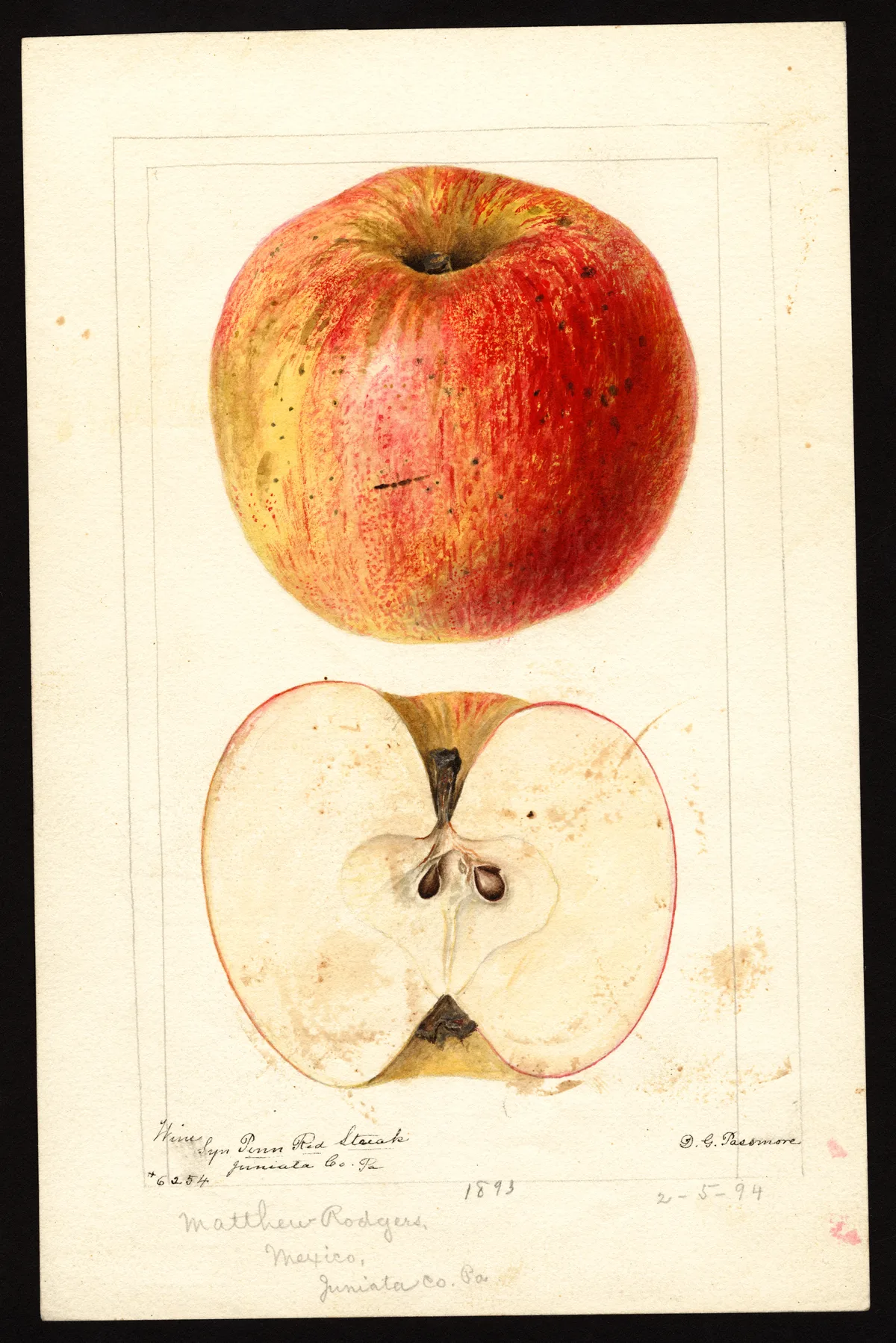
USDA Pomological Watercolor Collection
Wine
Origin / History
Wine is an American apple, a native of the State of Delaware (Elliott; Downing; Beach; Budd-Hansen). Coxe published the first known description in 1817, noting that in the state and county of Delaware it was called the Hays Winter, and in some places in New Jersey, the Fine Winter and Large Winter Red. According to Coxe, the original cultivator of this apple made admirable cider by throwing about one shovel full of sandy loam into a pressing, which had an effect in lessening the acidity and made a clear, sweet liquor — a "novel mode of fining." Coxe judged it probably as saleable an apple as any sold in the Philadelphia market.
Warder (1867) describes the variety as "another index of the source of population in a western county," noting it was a favorite fruit with those who knew it, for either market or kitchen, for which its size and form rendered it peculiarly attractive. In 1849 the Committee on Fruits for the N.Y. State Agricultural Society added Wine to the list previously recommended for general dissemination and cultivation. Beach reports that Wine has been extensively disseminated and is very popular where well known, though it appears less well adapted to conditions in New York and is now seldom if ever planted there; in regions farther south and west it has long been a favorite. Thomas notes that "there are several spurious varieties under this name," and Beach repeats the warning that "as there are many spurious varieties sold as the Wine apple, cultivators must be cautious of whom they purchase their trees." Beach further notes that Wine is quite distinct from the Twenty Ounce, which is known to some under the name of the Wine Apple, and that the name Wine has also been applied to two other varieties.
Tree
The tree is uncommonly large and handsome (Coxe; Warder), with a spreading and very open head (Warder; Budd-Hansen). It is thrifty (Elliott; Downing), vigorous, hardy, and productive (Beach quoting N.Y. State Ag. Soc. 1849). From its spreading form it does not require much trimming (Coxe). Young shoots are smooth grayish reddish brown (Downing); Elliott describes the shoots as rather slender and spreading. The leaves are small (Coxe; Elliott; Downing; Warder; Budd-Hansen), and Warder and Budd-Hansen specifically note them as small, curled, and mealy, making the foliage appear rather meagre and displaying the splendid, evenly distributed fruit to good advantage. The N.Y. State Ag. Soc. (1849) adds that the leaves are easily recognized. It bears abundantly (Coxe; Downing — "a most abundant bearer"), carrying heavy crops (Budd-Hansen).
Fruit
Size
Medium to large (Elliott), rather above medium size — in rich soils large (Downing), rather large, often quite large (Thomas), rather large (Budd-Hansen), uncommonly large (Coxe), large (Warder; Beach; Lowther). Elliott notes that strong, heavy clay loams produce the largest fruit, while best quality is grown on sandy loam.
Form
Round, flat at the ends (Coxe); round flattened (Elliott); roundish, slightly flattened (Thomas); regular, nearly round, a little flattened at the ends (Downing); large, globular-oblate, flattened or truncate, regular, occasionally unequal and lop-sided (Warder); roundish, truncated, regular, rarely unequal and inclined (Budd-Hansen); globular and slightly oblate (N.Y. State Ag. Soc. 1849); round (Lowther). Both ends deeply indented (Coxe).
Surface / Skin
The skin is smooth (Downing; Warder; Budd-Hansen), of a lively deep red over a yellow ground, or more frequently with a few indistinct stripes of yellow (Downing). Coxe describes it as a lively red, streaked and spotted with a small portion of yellow, with the stalk end frequently of a russet colour. Elliott: light pale yellow ground, mostly overspread and striped with lively red, with russet about the cavity of the stem. Warder: yellow, more or less covered with mixed and broken stripes of red, splashed with crimson. Thomas: obscurely striped and mottled with red on yellow ground. Budd-Hansen: yellow, mostly covered with bright mixed deep red, with crimson stripes. N.Y. State Ag. Soc. (1849): deep rich red, striped and dashed with yellow, often quite indistinctly, and frequently a yellowish russet around the base of the stem. Lowther: yellow-red. Beach summarizes it as a large and rather attractive red apple.
Dots
Scattered, large, gray (Warder); large, gray, few (Budd-Hansen).
Stem / Stalk
Very short (Coxe); short (Elliott; Downing; Warder; Budd-Hansen); quite short (Thomas); short and thick (Warder; Budd-Hansen). The N.Y. State Ag. Soc. (1849) notes the stem seldom or never rises above the outline of the fruit.
Cavity
Both ends deeply indented (Coxe). Acuminate or narrow, deep (Elliott); deep, acuminate (Thomas); round, smooth, with a little russet around it (Downing); acute, regular, brown (Warder); deep, regular, acute, with stellate russet (Budd-Hansen); deep, round and smooth (N.Y. State Ag. Soc. 1849).
Calyx / Eye
Calyx large (Elliott; Thomas); calyx open (Budd-Hansen), with segments divergent (Budd-Hansen). Eye small, closed, or open from breaking of the calyx (Warder); eye large and set in a deep and broad basin (N.Y. State Ag. Soc. 1849).
Basin
Broad, open, slightly plaited (Elliott); large (Thomas); rather shallow, wide, abrupt (Warder); rather shallow, wide, nearly smooth, abrupt (Budd-Hansen); deep and broad (N.Y. State Ag. Soc. 1849).
Flesh / Flavor
Yellowish (Elliott); yellowish white (Downing; Thomas; Budd-Hansen); yellow (Warder). Texture is crisp (Elliott; Downing; Budd-Hansen); firm, breaking, juicy (Warder); firm, juicy, crisp (Budd-Hansen); crisp, but tender and juicy (N.Y. State Ag. Soc. 1849). Flavor: rich and pleasant (Coxe); vinous, sub-acid (Elliott); rather vinous, rich, and pleasant (Downing); rich sub-acid (Thomas); acid to sub-acid, rich (Warder); rich, pleasant subacid (Budd-Hansen); rich and sprightly vinous, acid (N.Y. State Ag. Soc. 1849). Quality good to very good (Downing; Budd-Hansen; Beach); good, for market and kitchen (Warder); very good (Lowther). Beach calls it of a flavor peculiarly agreeable to most persons.
Core / Seeds
Core small (Elliott; Downing); medium, regular, closed (Warder); closed, small, turbinate, meeting, with cells obovate, entire; tube funnel-shaped; stamens median (Budd-Hansen); large (N.Y. State Ag. Soc. 1849). Seeds large (Elliott); numerous, large, angular (Warder); large, plump, not many (Budd-Hansen).
Season
Ripens in October and keeps well through the fall and winter (Coxe); November to February (Elliott); November and December (Warder); October to March (Downing); early winter (Thomas); midwinter (Budd-Hansen); winter (Lowther). Beach: in season from late October to March or April. The N.Y. State Ag. Soc. (1849): ripe in October and keeps in fine condition until March.
Uses
An admired table fruit, excellent for cooking as well as for cider (Coxe). Good to very good for dessert use (Beach). A favorite fruit for either market or kitchen use (Warder; Beach), for which its size and form render it peculiarly attractive. Equally well adapted to the dessert and kitchen, and makes most delicious cider (N.Y. State Ag. Soc. 1849, via Beach). Lowther lists use as both kitchen and market. Coxe notes that the original cultivator made admirable cider by adding about one shovel full of sandy loam to a pressing to reduce acidity and clarify the liquor.
Subtypes / Variants
Not described in source, beyond repeated warnings that "there are several spurious varieties under this name" (Thomas; echoed by Beach).
Other
Lowther's regional adaptability ratings (1914): Northern Division 3* (reported as adapted to more than one division); Central Division 12* (reported as adapted to more than one division). Elliott summarizes that Wine has been extensively disseminated, and everywhere successful, with strong heavy clay loams producing the largest fruit while best quality comes from sandy loam.
Book Sources
Described in 8 period pomological works
- Warder, American Pomology: Apples (1867)
- Beach, The Apples of New York Vol. 1 (1905)
- Downing, Fruits and Fruit Trees of America (1900)
- Thomas, The American Fruit Culturist (1903)
- Coxe, A View of the Cultivation of Fruit Trees (1817)
- Budd & Hansen, Systematic Pomology (1914)
- Elliott, The Western Fruit Book (1865)
- Lowther (ed.), Encyclopedia of Practical Horticulture (1914)
Nursery Catalog Sources
Found in 9 catalogs (1894–1913) from Illinois, Missouri, Oregon
- Woodburn Nurseries , Woodburn, Marion Co. , Oregon — 1894 — listed as Pennsylvania Red Streak
- Central Experimental Farm , Dominion Department of Agriculture, Agassiz, British Columbia (under test; Bulletin No. 3, Second Series) — 1900 — listed as Pennsylvania Red Streak
- Mountain Grove Nurseries (Tippin & Moore , Proprietors; Geo. T. Tippin, J. W. Tippin, J. C. Moore), Mountain Grove , Missouri — 1901 — listed as Pennsylvania Red Streak
- Benjamin Buckman (personal inventory) , Farmingdale , Illinois — 1901 — listed as Pennsylvania Red Streak
- Stark Bros. Nurseries & Orchards Co. , Louisiana , Missouri — 1906 — listed as Pennsylvania Red Streak
- Stark Bros. Nurseries & Orchards Co. , Louisiana , Missouri — 1910 — listed as Pennsylvania Red Streak
- Stark Bros. Nurseries & Orchards Co. , Louisiana , Missouri — 1911 — listed as Pennsylvania Red Streak
- Stark Bros. Nurseries & Orchards Co. , Louisiana , Missouri — 1912 — listed as Pennsylvania Red Streak
- Benjamin Buckman (personal inventory) , Farmingdale , Illinois — 1913 — listed as Pennsylvania Red Streak
View original book sources (8)
— William Coxe, A View of the Cultivation of Fruit Trees (1817)NO. 34. WINE APPLE.
An uncommonly large, fair, handsome red apple ; the form is round, flat at the ends : the skin is a lively red, streaked and spotted with a small portion of yellow : the stalk end frequently of a russet colour, both ends deeply indented ; the stalk very short, the taste is rich and pleasant, an admired table fruit, and excellent for cooking as well as for cider ; it ripens in October, and keeps well through the fall and winter. The tree is uncommonly large and handsome, the leaves small, it bears abundantly ; from its spreading form, it does not require much trimming ; it is probably as saleable an apple as any sold in the Philadelphia market : in the state and county of Delaware it is called the Hays Winter ; and in some places in New-Jersey, the fine Winter, and large Winter Red : I have been informed, that the original cultivator of this apple, made admirable cider by throwing about one shovel full of sandy loam into a pressing, which had an effect in lessening the acidity, and made a clear, sweet liquor, by this novel mode of fining.
— F.R. Elliott, The Western Fruit Book (1865)Wine.
Wine Apple, | Hay's Winter, | Hollow Crown Pearmain. Hay's Winter Wine, | Winter Wine, |
American : native of Delaware. Extensively disseminated, and everywhere successful. Strong, heavy clay loams produce the largest fruit, while best quality are grown on sandy loam. Tree, thrifty ; shoots, rather slender, spreading ; foliage small.
Fruit, medium to large ; form, round flattened ; color, light pale yellow ground, mostly overspread and striped with lively red, russet about cavity of stem ; stem, short ; cavity, acuminate or narrow, deep ; calyx, large ; basin, broad, open, slightly plaited ; flesh, yellowish, crisp, vinous, sub-acid ; core, small ; seeds, large. November to February.
— John A. Warder, American Pomology: Apples (1867)Wine.—[Coxe.]
HAYS' WINTER—PENNSYLVANIA RED STREAK.
This handsome large apple is another index of the source of population in a western county. It is a favorite fruit with those who know it, either for market or the kitchen, for which its size and form render it peculiarly attractive.
Tree very large and handsome, spreading and very open head; leaves small, curled, and mealy, making the foliage appear rather meagre, and displaying the splendid fruit, which is evenly distributed.
Fruit large, globular-oblate, flattened or truncate, regular, occasionally unequal and lop-sided; Surface smooth, yellow, more or less covered with mixed and broken stripes of red, splashed with crimson; Dots scattered, large, gray.
Basin rather shallow, wide, abrupt; Eye small, closed, or open from breaking of the calyx.
Cavity acute, regular, brown; Stem short, thick.
Core medium, regular, closed; Seeds numerous, large, angular; Flesh yellow, firm, breaking, juicy; Flavor acid to sub-acid, rich; Quality good, for market and kitchen; Season, November and December.
— A.J. Downing, The Fruits and Fruit Trees of America (1900)Wine. Hay's Winter. Winter Wine. Pennsylvania Red Streak. English Red Streak, incorrectly.
The Wine Apple is a very handsome, and an admirable winter fruit, a most abundant bearer, and a hardy tree. It is a native of Delaware. The tree has small leaves, grows thriftily, and makes a fine spreading head. Young shoots smooth grayish reddish brown.
Fruit rather above medium size — in rich soils large ; form regular, nearly round, a little flattened at the ends. Skin smooth, of a lively deep red over a yellow ground, or more frequently with a few indistinct stripes of yellow. Stalk short, inserted in a round, smooth cavity, with a little russet around it. Flesh yellowish white, juicy, and crisp, with a rather vinous, rich, and pleasant flavor. Good to very good. Core small. October to March.
— John J. Thomas, The American Fruit Culturist (1903)Wine. (Hays' Apple, Hays Winter.) Rather large, often quite large, roundish, slightly flattened; obscurely striped and mottled with red on yellow ground; stalk quite short; cavity deep, acuminate; calyx large, open; basin large; flesh yellowish white, with a rich sub-acid flavor. Early winter. There are several spurious varieties under this name. Delaware.
— S.A. Beach, The Apples of New York, Vol. 1 (1905)WINE.
REFERENCES. 1. Coxe, 1817:121. fig. 2. Thacher, 1822:140. 3. (?)Wilson, 1828:136. 4. Fessenden, 1828:131. 5. Kenrick, 1832:54. 6. Floy-Lindley, 1833:87. 7. Mag. Hort., 1:364. 1835. 8. Manning, 1838:55. 9. Ib., Mag. Hort., 7:51. 1841. 10. Downing, 1845:143. 11. N. Y. Agr. Soc. Trans., 1849:354. fig. 12. Thomas, 1849:175. 13. Cole, 1849:120. 14. Emmons, Nat. Hist. N. Y., 3:63. 1851. 15. Am. Pom. Soc. Cat., 1852. 16. Elliott, 1854:116. fig. 17. Gregg, 1857:60. 18. Hooper, 1857:43, 96. 19. Warder, 1867:466. 20. Fitz, 1872:143, 150. 21. Barry, 1883:357. 22. Lyon, Mich. Hort. Soc. Rpt., 1890:300. 23. Bailey, An. Hort., 1892:252. 24. Munson, Me. Sta. Rpt., 1893:134. 25. Budd-Hansen, 1903:206. 26. Bruner, N. C. Sta. Bul., 182:23. 1903.
SYNONYMS. Fine Winter (1, 2, 5, 6). Hays (21, 25, 26). Hays Apple (5, 11, 12, 14, 18). Hays Wine (24). Hays Winter (1, 2, 6, 10, 11, 12, 13, 16, 17, 18, 19, 22). Hays Winter Wine (16). Hollow Crown Pearmain (16). Large Winter Red (1, 2, 5). Pennsylvania Redstreak (19). Pennsylvania Red Streak (21, 24, 25). WINE APPLE (1, 2, 5, 6, 7, 8, 9, 10, 11, 14, 17). Wine Apple (16). Winter Wine (16, 21).
Wine is a large and rather attractive red apple of good to very good quality for dessert use. It is in season from late October to March or April. Coxe published the following description of it in 1817 (1). "An uncommonly large, fair, handsome red apple; the form is round, flat at the ends: the skin is a lively red, streaked and spotted with a small portion of yellow: the stalk end frequently of a russet colour, both ends deeply indented; the stalk very short, the taste is rich and pleasant, an admired table fruit, and excellent for cooking as well as for cider; it ripens in October, and keeps well through the fall and winter. The tree is uncommonly large and handsome, the leaves small, it bears abundantly; from its spreading form, it does not require much trimming—it is probably as saleable an apple as any sold in the Philadelphia market: in the state and county of Delaware it is called Hays Winter; and in some places in New-Jersey, the Fine Winter, and Large Winter Red."
In 1849 the Committee on Fruits for the N. Y. State Agricultural Society added Wine to the list previously recommended for general dissemination and cultivation and gave the following description of the variety (11). "Fruit large; form globular and slightly oblate; color of a deep rich red, striped and dashed with yellow, often quite indistinctly, and frequently a yellowish russet around the base of the stem; texture crisp, but tender and juicy; flesh yellowish-white; flavor rich and sprightly vinous, acid. Core large; stem short, seldom or ever rising above the outline of the fruit, and inserted in a deep, round and smooth cavity; eye large and set in a deep and broad basin; season, ripe in October and keeps in fine condition until March. Its growth is thrifty and vigorous, making a beautiful tree, it is also hardy and productive, its leaves are small and easily recognized." The Wine apple is richly entitled to a place on our list, for it is not only beautiful in appearance but it is hardy, productive and of a flavor which is peculiarly agreeable to most persons; it is also equally well adapted to the dessert and kitchen, and makes most delicious cider; in fact we could not recommend to our agricultural population a more useful fruit. It originated in the State of Delaware and is very popular where well known. As there are many spurious varieties sold as the Wine apple, cultivators must be cautious of whom they purchase their trees."
In regions farther south and west it has long been a favorite fruit for either market or kitchen use for which its size and form render it peculiarly attractive (19). It appears less well adapted to the conditions existing in this state for although it has long been known here it has established itself in but comparatively few localities and is now seldom if ever planted.
This is quite distinct from the Twenty Ounce which is known to some under the name of the Wine Apple. The name Wine has also been applied to two other varieties.¹
— J.L. Budd & N.E. Hansen, American Horticultural Manual, Part II: Systematic Pomology (1914)Wine (Hays; Pennsylvania Red Streak). — Origin, Delaware; tree very large, spreading, very open, with small, curled, mealy leaves, displaying the heavy crops of fruit to good advantage.
Fruit rather large, roundish, truncated, regular, rarely unequal, and inclined; surface smooth, yellow, mostly covered with bright mixed deep red, with crimson stripes; dots large, gray, few; cavity deep, regular, acute, with stellate russet; stem short, thick; basin rather shallow, wide, nearly smooth, abrupt; calyx open; segments divergent. Core closed, small, turbinate, meeting; cells obovate, entire; tube funnel-shaped; stamens median; seeds large, plump, not many; flesh yellowish white, firm, juicy, crisp, rich, pleasant subacid, good to very good. Midwinter.
— Granville Lowther (ed.), Encyclopedia of Practical Horticulture (1914)Wine (88): size large; form round; color yellow-red; quality very good; use both kitchen and market; season winter; Northern Division 3* (reported as adapted to more than one division); Central Division 12* (reported as adapted to more than one division).