Bullock
Apple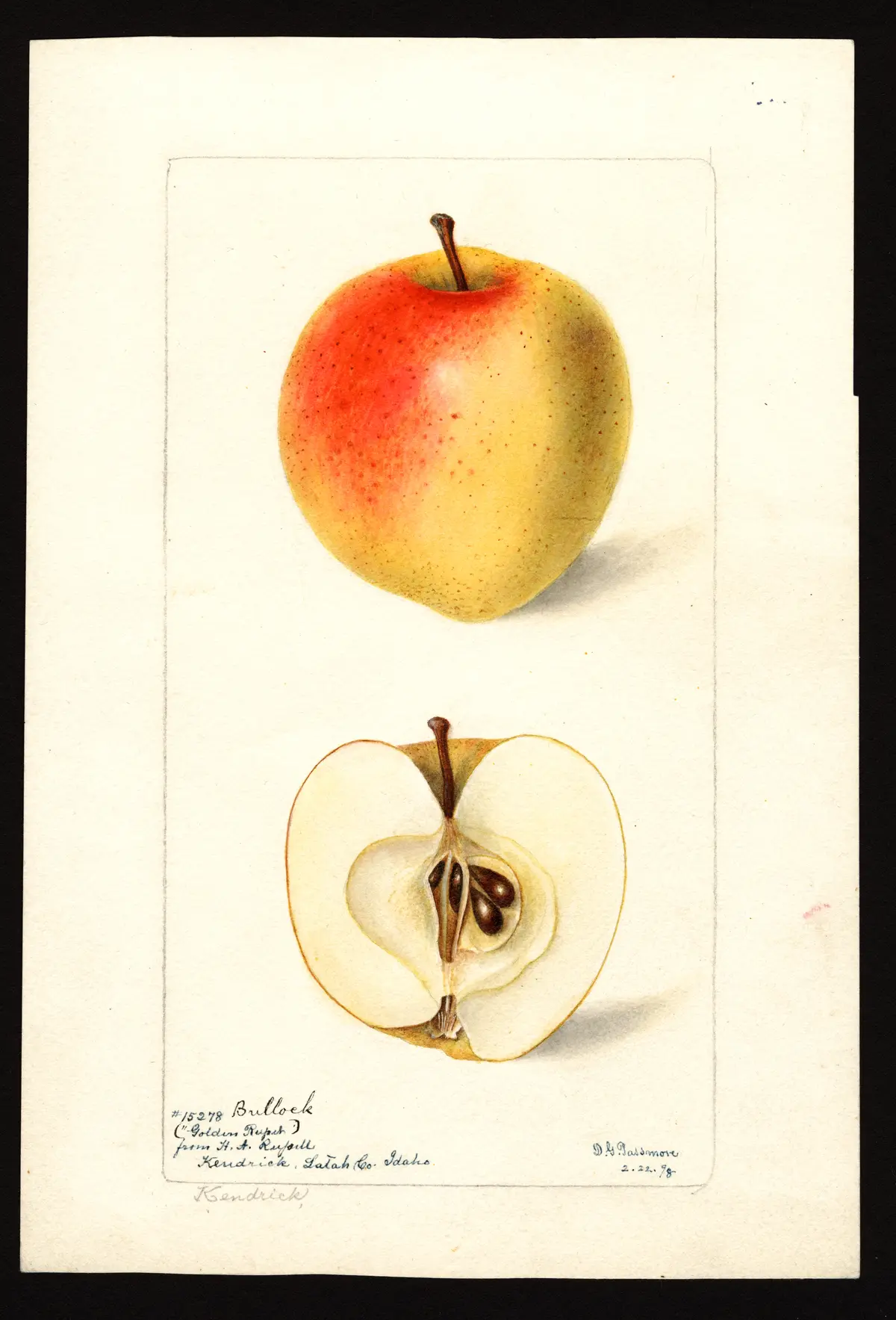
USDA Pomological Watercolor Collection
Bullock
Origin / History
Bullock originated in Burlington County, New Jersey, more than a century before Beach wrote in 1905 — Coxe described it in 1817 as one of the finest apples in New Jersey in autumn and early winter. In 1826 Buel characterized it as "tender, juicy and high flavored; among the best fruit for table." A. J. Downing called it "one of the most delicious and tender apples," with flesh resembling more in texture that of a buttery pear than that of an ordinary apple. Thomas remarked that it is too small to become popular. Hedrick noted that it was one of the favorite dessert apples of a century before his 1922 writing, and continued in favor until Downing's time.
The variety has been known in New England and the West as "Golden Russet," and to distinguish it from the English Golden Russet, Downing called it "American Golden Russet." Because there are so many Golden Russets, Beach preferred to follow the Catalogue of the American Pomological Society and Hovey in retaining Coxe's original name to reduce confusion. The uncouth name "Sheep-nose" (used by Coxe) was, per Downing, nearly obsolete by his time except in New Jersey. The variety has been favorably known in the West and the South, and as far north as Ontario and Quebec. By Hedrick's time (1922), its culture was restricted to the seaboard of the Middle Atlantic states; Beach noted it was still grown to a limited extent in some portions of New York state, particularly in the Hudson and Champlain valleys.
It may be recommended for the home orchard but has not been found profitable as a commercial sort — Warder notes the fruit is very apt to be imperfect, and the best he had seen were from the South and from sandstone soils. Beach and Hedrick both report it succeeds best on sandy or gravelly soil. Some nurserymen have reported that when grown on clay soil the bark of the trees is apt to split at the collar, and for this reason they prefer not to grow the trees in the nursery on their own trunks.
Tree
Tree not large but a fairly strong, vigorous grower (Warder: "vigorous"; Beach: "not large but a fairly strong grower"; Hedrick: "not large but vigorous"). Form upright or roundish/round-topped/round-headed. Foliage large, healthy (Warder). Shoots upright, dull reddish or grayish brown (Downing, Budd-Hansen). Twigs short to medium, moderately stout, rather blunt at tip, nearly straight; internodes medium. Bark dull brownish-red or olive-green with a grayish hue due to the rather heavy scarf-skin; slightly pubescent. Lenticels only moderately numerous, inconspicuous, raised, below medium, elongated. Buds small to medium, moderately projecting, acute, sparingly pubescent, free.
Fruit
Size: Small to medium, generally below medium (Warder: "small to medium"; Downing: "below medium size"; Beach: "below medium"; Budd-Hansen: "medium or below"; Hedrick: "small or medium").
Form: Roundish-conic to ovate (Warder: "round-conic, regular when perfect"; Downing: "roundish-ovate"; Beach: "roundish conic to ovate, pretty regular in outline, uniform"; Budd-Hansen: "roundish, somewhat conical"; Hedrick: "round-conic to ovate, regular in outline, uniform").
Stem: Long, slender.
Cavity: Sources vary on depth. Warder: "acute, regular." Budd-Hansen: "rather shallow, acute, regular." Beach: "acuminate to acute, moderately deep to deep, rather narrow, funnel-shape or compressed." Hedrick: "acuminate, deep, narrow, funnel-shape or compressed."
Calyx: Small, closed.
Basin: Shallow, narrow. Warder: "shallow, regular." Downing: "rather narrow basin." Budd-Hansen: "shallow, regular, rather narrow." Beach: "small, often oblique, rather shallow, narrow, wrinkled, not ridged." Hedrick: "small, often oblique, shallow, narrow, wrinkled."
Skin: Surface smooth, pale yellow or greenish-yellow (Warder: "yellow"; Downing: "dull yellow"; Beach: "pale yellow or greenish-yellow"; Budd-Hansen: "greenish yellow to orange or golden"; Hedrick: "pale yellow"), more or less overspread, sprinkled, marbled, or splashed with thin russet. Budd-Hansen notes the fruit is "often with distinct bronzed blush"; Warder noted it is "sometimes faintly blushed."
Dots: Numerous, small, obscure, russet (Beach, Hedrick); Warder calls them "minute"; Budd-Hansen calls them "obscure, few, minute."
General appearance: Attractive (Beach), though Downing notes it is "neither handsome nor large" and Hedrick observes the fruits "with their modest russet skins, are not striking enough to attract much attention now."
Flesh / flavor: Flesh slightly tinged with yellow / yellowish, firm, fine-grained, crisp, very tender, juicy, with an agreeable rich, aromatic, mild subacid, spicy flavor. Warder describes it as "very fine grained, tender, when fully ripe almost melting, like a pear, juicy, becoming dry when over ripe; Flavor sub-acid, rich, aromatic." Downing: "yellowish, very tender, juicy, with a mild, rich, spicy flavor." Beach: "slightly tinged with yellow, firm, fine, crisp, very tender, juicy with an agreeable rich, aromatic, mild subacid flavor." Budd-Hansen: "yellowish, very tender, juicy, mild, rich, spicy, aromatic subacid." Hedrick: "yellow, firm, fine, crisp, very tender, juicy with an agreeable rich, aromatic, mild subacid flavor"; also "rich, spicy, refreshing flavor." A defining quality across sources is that the flesh resembles in texture that of a buttery pear more than that of an ordinary apple. Quality: very good to best (Warder: "Quality very best"; Downing: "Best"; Beach and Hedrick: "very good to best"; Budd-Hansen: "best").
Core / seeds: Sources differ on core size and openness. Warder: "Core medium, closed, meeting the eye; Seeds numerous, pointed." Budd-Hansen: "Core closed, clasping; seeds many, pointed." Beach: "Core medium to rather large, axile, slightly open; core lines nearly meeting. Carpels roundish. Seeds rather large, plump." Hedrick: "core large, axile, open; core-lines nearly meeting; carpels round; seeds large, plump."
Season
October to January (Downing, Beach, Budd-Hansen, Hedrick). Warder gives season as November and December.
Uses
Dessert / table apple — Warder: "Use, dessert"; Buel (per Beach): "among the best fruit for table"; Hedrick: "one of the favorite dessert apples." Recommended for the home orchard but not profitable as a commercial sort.
Subtypes / Variants
Not described in source.
Other
Not described in source.
Book Sources
Described in 5 period pomological works
- Beach, The Apples of New York Vol. 1 (1905)
- Budd & Hansen, Systematic Pomology (1914)
- Warder, American Pomology: Apples (1867) — listed as American Golden Russet
- Downing, Fruits and Fruit Trees of America (1900) — listed as American Golden Russet
- Hedrick, Cyclopedia of Hardy Fruits (1922)
Nursery Catalog Sources
Found in 7 catalogs (1850–1918) from Massachusetts, Missouri, Oregon
- Azell Bowditch (Nursery / Fruit Catalog) , Boston , Massachusetts — 1850 — listed as American Golden Russet
- St. Helena Nursery , Howell's Prairie, Marion County , Oregon — 1864 — listed as American Golden Russet
- Milwaukie-Canby Nurseries , Canby, OR (and Milwaukie, OR) — 1893 — listed as American Golden Russet
- Stark Bros. Nurseries & Orchards Co. , Louisiana , Missouri — 1898 — listed as American Golden Russet
- Central Experimental Farm , Dominion Department of Agriculture, Agassiz, British Columbia (under test; Bulletin No. 3, Second Series) — 1900 — listed as American Golden Russet
- Stark Bros. Nurseries & Orchards Co. , Louisiana , Missouri — 1912 — listed as American Golden Russet
- Stark Bros. Nurseries & Orchards Co. , Louisiana , Missouri — 1918 — listed as American Golden Russet
View original book sources (5)
— John A. Warder, American Pomology: Apples (1867)American Golden Russet. BULLOCK'S PIPPIN, ETC.
This delicious table apple is a universal favorite with all who can appreciate delicacy of flavor and fineness of flesh in an apple, and yet it is not a profitable variety for orchard planting, because the fruit is very apt to be imperfect. The best I have seen were from the South, and sandstone soils.
Tree vigorous, upright, round-headed, small; Foliage large, healthy.
Fruit small to medium, round-conic, regular when perfect; Surface smooth, yellow, covered with thin russet, sometimes faintly blushed; Dots minute.
Basin shallow, regular; Eye small, closed.
Cavity acute, regular; Stem long, slender.
Core medium, closed, meeting the eye; Seeds numerous, pointed; Flesh yellowish, very fine grained, tender, when fully ripe almost melting, like a pear, juicy, becoming dry when over ripe; Flavor sub-acid, rich, aromatic; Quality very best; Use, dessert; Season, November and December.
— A.J. Downing, The Fruits and Fruit Trees of America (1900)American Golden Russet. Golden Russet. Bullock's Pippin. Sheep Nose. Little Pearmain.
The American Golden Russet is one of the most delicious and tender Apples, its flesh resembling more in texture that of a buttery Pear than that of an ordinary Apple. It is widely cultivated at the West and in New England as the Golden Russet, and though neither handsome nor large, is still a universal favorite, from its great productiveness and admirable flavor. The uncouth name of Coxe, Sheep-nose, is nearly obsolete, except in New Jersey, and we therefore adopt the present one, to which it is well entitled. The tree is thrifty, with upright shoots, dull reddish grayish brown.
Fruit below medium size, roundish-ovate, dull yellow, sprinkled with a very thin russet. Stalk rather long and slender. Calyx closed, and set in a rather narrow basin. Flesh yellowish, very tender, juicy, with a mild, rich, spicy flavor. Best. October to January.
— S.A. Beach, The Apples of New York, Vol. 1 (1905)BULLOCK.
REFERENCES. 1. Coxe, 1817:125. 2. Thacher, 1822:122. 3. Buel, N. Y. State Bd. of Agr. Memoirs, 3:476. Cat. No. 34. 1826. 4. Cat. Hort. Soc. London, 1831:35. 5. Kenrick, 1833:33. 6. Manning, 1838:54. 7. Dittrich, Syst. Handb. der Obstk., 1:504. 1839. 8. Downing, 1845:131. 1847. col. pl. 9. Thomas, 1849:178. fig. 10. Mag. Hort., 15:250. 1849. 11. Emmons, Nat. Hist. N. Y., 3:94. 1851. fig., col. pl. No. 52. 12. Am. Pom. Soc. Cat., 1852. 13. Mag. Hort., 19:126. 1853. 14. Biedenfeld, 1854:223. 15. Mag. Hort., 21:300, 398. 1855. 16. Hooper, 1857:11, 20. 17. Elliott, 1858:71. fig. 18. Flotow, Ill. Handb. der Obstk., 1:337. 1859. 19. Warder, 1867:521. 20. Regel, 1:440. 1868. 21. Mas, Le Verger, 4:33. col. pl. 22. Lauche, 1: col. pl. No. 73. 1882. 23. Barry, 1883:341. 24. Hogg, 1884:7. 25. Lyon, Mich. Hort. Soc. Rpt., 1890:288. 26. Bailey, An. Hort., 1892:236. 27. Munson, Me. Sta. An. Rpt., 1893:132. 28. Ont. Fr. Stas. An. Rpt., 2:32. 1895. 29. N. C. Bd. of Agr. Bul., 1900:6. 30. Waugh, Vt. Sta. An. Rpt., 14:286. 1901. 31. Macoun, Can. Dept. Agr. Bul., 37:42. 1901. 32. Budd-Hansen, 1903:57. fig.
SYNONYMS. AMERICAN GOLDEN RUSSET (9, 16, 19, 20, 21, 23, 24, 25, 26, 28, 30, 31). American Golden Russet (17, 27, 29, 32). Bullock (30). BULLOCK'S PEPPING (18, 22). Bullock's Pippin (8). BULLOCK'S PIPPIN (1, 2, 9, 10, 13, 15, 16, 17, 21). Fall Winesap (17), erroneously. GOLDEN RUSSET (5, 6). Golden Russet (8, 9, 17). GOLDEN RUSSET, AMERICAN (8). Little Pearmain (17). PIPPIN BULLOK (7, 14). SHEEPNOSE (1). Sheepnose (8, 9, 17). SHEEP'S NOSE (4). SHEEP'S SNOUT (2).
Early in the last century Coxe described this as one of the finest apples in New Jersey in autumn and early winter (1). In 1826 Buel characterized it as "tender, juicy and high flavored; among the best fruit for table" (3). A. J. Downing called it "one of the most delicious and tender apples" (8). Thomas remarks that it is too small to become popular (9). The fruit is below medium size, light yellow, marbled with thin russet. Flesh yellowish, very tender, with a mild, rich, spicy, slightly subacid flavor. It is still grown to a limited extent in some portions of the state, particularly in the Hudson and Champlain valleys. It may be recommended for the home orchard, but it has not been found profitable as a commercial sort. Some have found that it succeeds best on sandy or gravelly soil. Some nurserymen have reported that when grown on clay soil the bark of the trees is apt to split at the collar, and for this reason they prefer not to grow the trees in the nursery on their own trunks.
Historical. Originated in Burlington county, New Jersey, more than a century ago (1). It has been favorably known in the West and the South (19) and as far north as Ontario and Quebec (31). In New England and the West it has been known as Golden Russet (5, 6, 8). To distinguish it from the English Golden Russet, Downing called it American Golden Russet (8). There are so many Golden Russets we prefer to follow the Catalogue of the American Pomological Society (12) and Hovey (10) and retain Coxe's name Bullock, believing this will be less liable to lead to confusion.
TREE.
Tree not large but a fairly strong grower. Form upright or roundish. Twigs short to medium, moderately stout, rather blunt at tip, nearly straight; internodes medium. Bark dull brownish-red or olive-green with a grayish hue due to the rather heavy scarf-skin; slightly pubescent. Lenticels only moderately numerous, inconspicuous, raised, below medium, elongated. Buds small to medium, moderately projecting, acute, sparingly pubescent, free.
FRUIT.
Fruit below medium. Form roundish conic to ovate, pretty regular in outline, uniform. Stem long, slender. Cavity acuminate to acute, moderately deep to deep, rather narrow, funnel-shape or compressed. Calyx rather small, closed. Basin small, often oblique, rather shallow, narrow, wrinkled, not ridged. Skin attractive, pale yellow or greenish-yellow, more or less overspread and splashed with thin russet. Dots numerous, small, obscure, russet. General appearance attractive. Core medium to rather large, axile, slightly open; core lines nearly meeting. Carpels roundish. Seeds rather large, plump. Flesh slightly tinged with yellow, firm, fine, crisp, very tender, juicy with an agreeable rich, aromatic, mild subacid flavor; very good to best.
Season October to January.
— J.L. Budd & N.E. Hansen, American Horticultural Manual, Part II: Systematic Pomology (1914)Bullock (American Golden Russet). — A delicious apple, with flesh more like a buttery pear than that of an ordinary apple. An old New Jersey variety mentioned by Coxe in 1817. Tree thrifty, shoots upright, dull reddish, grayish brown.
Fruit medium or below, roundish, somewhat conical; surface greenish yellow to orange or golden, with more or less of very thin russet, often with distinct bronzed blush; dots obscure, few, minute; cavity rather shallow, acute, regular; stem long, slender; basin shallow, regular, rather narrow; calyx closed. Core closed, clasping; seeds many, pointed; flesh yellowish, very tender, juicy, mild, rich, spicy, aromatic subacid, best. October to January.
— U.P. Hedrick, Cyclopedia of Hardy Fruits (1922)BULLOCK. Bullock's Pippin. Golden Russet.
Bullock was one of the favorite dessert apples of a century ago, and continued in favor until Downing's time. He speaks of it as "one of the most delicious and tender of apples." The fruits are small, and, with their modest russet skins, are not striking enough to attract much attention now, but its rich, spicy, refreshing flavor makes it too good an apple to be wholly lost. It succeeds best in sandy or gravelly soils. Bullock originated in Burlington County, New Jersey, more than a century ago. Its culture is restricted to the seaboard of the Middle Atlantic states.
Tree not large but vigorous, upright or round-topped. Fruit small or medium, round-conic to ovate, regular in outline, uniform ; stem long, slender ; cavity acuminate, deep, narrow, funnel-shape or compressed ; calyx small, closed ; basin small, often oblique, shallow, narrow, wrinkled ; skin pale yellow, more or less overspread and splashed with thin russet ; dots numerous, small, obscure, russet ; core large, axile, open ; core-lines nearly meeting ; carpels round ; seeds large, plump ; flesh yellow, firm, fine, crisp, very tender, juicy with an agreeable rich, aromatic, mild subacid flavor ; very good to best ; October to January.