Fall Winesap
Apple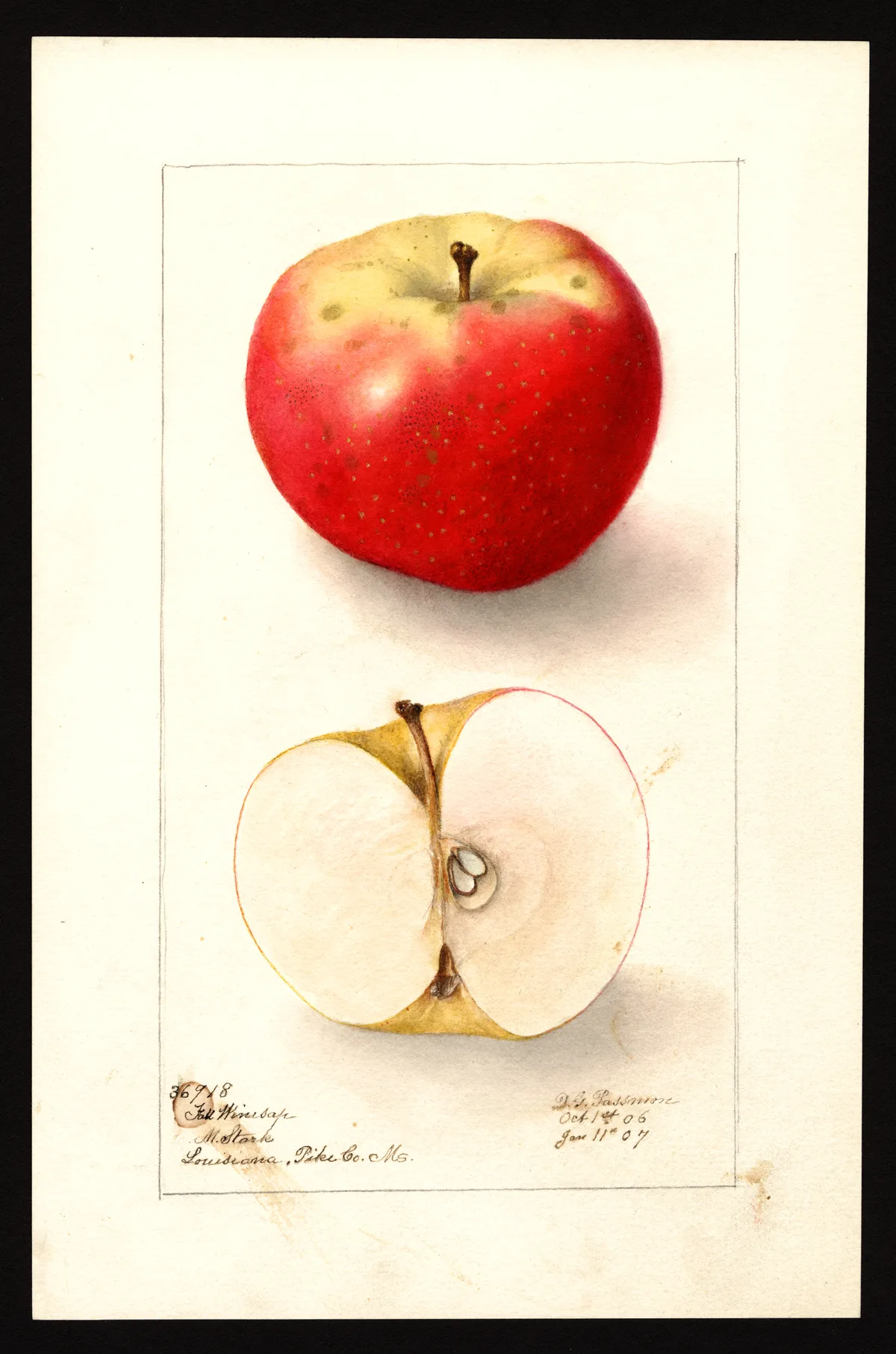
USDA Pomological Watercolor Collection
Fall Winesap
Origin / History
A Western variety, origin unknown (Downing; Budd and Hansen).
Tree
Tree a free clean grower (Downing), of strong growth (Budd and Hansen), moderately spreading, somewhat drooping as the tree acquires age. Productive and an early bearer; Budd and Hansen add "abundant" bearer.
Fruit
Size: Medium.
Form: Roundish, sometimes slightly conical (Downing); conical (Budd and Hansen).
Stem: Medium (Budd and Hansen).
Cavity: Deep, narrow, regular, acuminate, with a trace of russet in the bottom.
Calyx: Closed; segments erect, convergent. Tube funnel-shaped; stamens marginal.
Basin: Wavy, abrupt.
Skin: Yellowish green to yellow, pale yellow in the Stark Bros. catalog, with a pale or delicate blush; Downing notes considerable blush in the sun.
Dots: Distinct, numerous, yellowish, large (Budd and Hansen).
Flesh and flavor: Flesh white (Downing) or yellowish white (Budd and Hansen); fine-grained, tender, juicy, firm (Budd and Hansen). Flavor subacid; Budd and Hansen call it pleasant rich subacid. Quality good.
Core and seeds: Core closed; cells ovate, entire; seeds short, plump.
Season
October to December (Downing; Budd and Hansen). In northwestern Arkansas, from the last of July to the middle of October (Stark Bros.).
Uses
In northwestern Arkansas much valued as a cooking apple (Stark Bros.).
Subtypes / Variants
Not described in source.
Other
Not described in source.
Book Sources
Described in 2 period pomological works
Nursery Catalog Sources
Found in 9 catalogs (1894–1913) from Illinois, Missouri
- The Vineland Nurseries (Kelsey & Co. , Proprietors), St. Joseph, Missouri (Office: 13th and Atchison Sts., 2 Blocks East of the Citizens St. Car Line) — 1894
- Central Experimental Farm , Dominion Department of Agriculture, Agassiz, British Columbia (under test; Bulletin No. 3, Second Series) — 1900
- Benjamin Buckman (personal inventory) , Farmingdale , Illinois — 1901
- Phoenix Nursery Company (W. E. Rossney , President; Sidney Tuttle, Vice-President), Bloomington , Illinois — 1904 — listed as Fall Wine Sap
- Stark Bros. Nurseries & Orchards Co. , Louisiana , Missouri — 1906
- Stark Bros. Nurseries & Orchards Co. , Louisiana , Missouri — 1910
- Stark Bros. Nurseries & Orchards Co. , Louisiana , Missouri — 1911
- Stark Bros. Nurseries & Orchards Co. , Louisiana , Missouri — 1912
- Benjamin Buckman (personal inventory) , Farmingdale , Illinois — 1913
View original book sources (3)
— A.J. Downing, The Fruits and Fruit Trees of America (1900)Fall Winesap. A Western variety, the origin of which is unknown. Tree a free clean grower, moderately spreading, somewhat drooping as the tree acquires age, productive and an early bearer. Fruit medium, roundish, sometimes slightly conical, yellowish green, with considerable blush in the sun. Flesh white, fine-grained, tender, juicy, subacid. Good. October, December.
— J.L. Budd & N.E. Hansen, American Horticultural Manual, Part II: Systematic Pomology (1914)Fall Winesap. — A Western variety; origin unknown; tree an early and abundant bearer, tree of strong growth, moderately spreading, somewhat drooping with age.
Fruit medium; form conical; surface yellow with pale blush; dots distinct, numerous, yellowish, large; cavity deep, narrow, regular, acuminate, trace of russet in bottom; stem medium; basin wavy, abrupt; calyx closed; segments erect convergent. Core closed; cells ovate, entire; tube funnel-shaped; stamens marginal; seeds short, plump; flesh yellowish white, juicy, firm, fine-grained, pleasant rich subacid, good. October, December.
— Stark Bros. Nurseries & Orchards Co., Stark Bros. Year Book (1910) (1910)Pale yellow with delicate blush, of medium size. Flesh fine, tender, and juicy; flavor sub-acid—quality good. In northwestern Arkansas much valued as a cooking apple from last of July to middle of October. NCS