Ewalt
Apple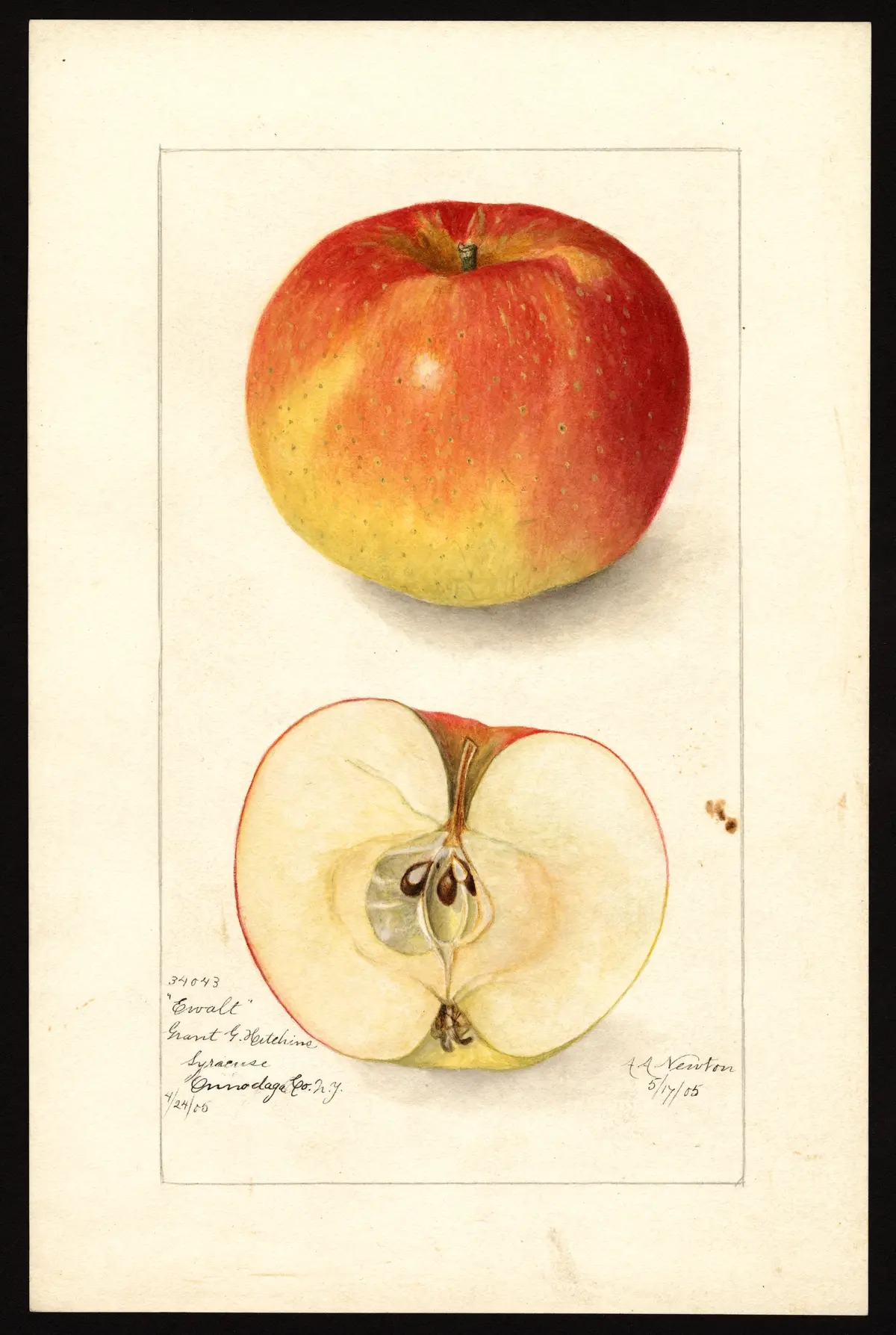
USDA Pomological Watercolor Collection
Ewalt
Origin / History
Ewalt originated in Bedford County, Pennsylvania (Downing; Beach), on the farm of John Ewalt (Elliott, after W. D. Brinckle). It was introduced by Dr. Brinckle in his ad-interim reports to the Pennsylvania Horticultural Society (Warder). Beach's earliest references are Downing, 1857, and the American Pomological Society Catalogue of 1862. Mr. Waring considers it a valuable winter apple (Warder). Beach says that although it has been known in cultivation for many years, it has not gained recognition as a commercial variety.
Tree
Tree vigorous to very vigorous, upright spreading. Warder calls it a handsome grower in the nursery, with shoots erect and dark colored. Beach describes the form as round and rather dense, and the branches as long, moderately stout, and curved. In his description the twigs are medium or above, straight, and stout, with internodes medium to long. The bark is clear dark brownish-red or tinged with olive-green, heavily pubescent, with scarf-skin rather thin or none. The lenticels are conspicuous, rather numerous, small to medium, oblong or roundish, and not raised. The buds are small to medium, flat, obtuse, free, imbedded in the bark, and pubescent.
Warder calls it an early, regular bearer. Beach says it occasionally bears good crops but commonly is a moderate or rather shy bearer. Lowther's station table reports it from one station in the Northern Division, with an asterisk indicating that the variety is also reported in more than one division.
Fruit
Size: Large; of good marketable size (Beach). Full medium in Brinckle's description (Elliott), which Thomas condenses to medium.
Form: Roundish, varying from roundish conic to roundish oblate, rather or somewhat angular, obscurely ribbed. Brinckle's description (Elliott) gives it as truncated, rendered flattened in Thomas's condensation. Beach adds that it is sometimes irregularly elliptical, with sides unequal or compressed, but usually pretty symmetrical.
Stem: Very short to short, stout or rather stout. Beach gives it as short to medium and rather slender.
Cavity: Acute to acuminate, irregular, not large, often furrowed or compressed, rather narrow to broad. Warder calls it medium in size. Downing and Beach call it deep; Elliott, after Brinckle, calls it narrow and not very deep. Beach notes the cavity is sometimes partly russeted with narrow, broken, outspreading russet rays.
Calyx: Closed (Elliott; Warder), though Beach gives it as closed or partly open. Warder calls the eye medium. Beach gives the calyx as usually large and leafy, sometimes rather small, with lobes long and acute. He describes the calyx tube as cone-shape to funnel-form and the stamens as median.
Basin: Narrow to rather narrow, abrupt, plaited or slightly plaited, not large. Downing calls it furrowed and Beach often somewhat furrowed and wrinkled. Warder calls it medium in size; Beach notes it is sometimes oblique. Depth runs from rather shallow to deep: Downing calls it deep, Beach rather shallow to moderately deep.
Skin: Smooth, tough, waxy but not glossy. Clear yellow to bright yellow, or greenish yellow in Brinckle's description (Elliott). The sunny side bears a cheek or blush of clear bright red, or shades of crimson (Downing); Lowther's table gives the color as yellow-red. Beach gives the blush as thin and brownish, sometimes deepening to bright red. Warder calls the skin not striped, while Beach notes a slight tendency to become striped. Beach adds that it is often marked with suture lines extending from the cavity toward the basin. Elliott notes many greenish russet spots, especially about the base. Handsome and attractive; Warder calls it very handsome.
Dots: Numerous, especially about the base. Warder gives them as greenish. Beach gives them as small, inconspicuous, whitish or with minute russet point, usually submerged.
Flesh and flavor: Tender, fine-grained. Downing gives the flesh as white. Beach gives it as tinged with yellow, rather firm, moderately fine, crisp, rather tender, and juicy. Flavor brisk subacid, sprightly, pleasant, aromatic; Beach calls it slightly aromatic. Warder calls it acid, becoming mild. Brinckle's description (Elliott) notes an "exceedingly fragrant odor," condensed by Thomas to "perfumed."
Quality "very good" (Elliott, after Brinckle; Warder) and "good to very good" (Downing). Beach and Lowther rate it "good."
Core and seeds: Core abaxile, medium or below; cells often unsymmetrical, closed or open; core lines clasping the funnel cylinder. Carpels variable, roundish to roundish ovate or obovate. Seeds numerous, medium to large, rather long, moderately wide, obtuse to acute (Beach).
Season
A winter apple; the recorded season runs from November into April. Downing and Beach begin it in November and carry it to March or April. Warder and Brinckle's description (Elliott) place it late, February to April or April alone. Beach gives a commercial limit of February or March.
Uses
Beach says it is not a first-class dessert apple, "being rather too acid and not high in quality, but it is good for culinary use." Lowther classes it as a market apple.
Subtypes / Variants
Not described in source.
Other
Not described in source.
Book Sources
Described in 7 period pomological works
- Beach, The Apples of New York Vol. 1 (1905)
- Warder, American Pomology: Apples (1867)
- Budd & Hansen, Systematic Pomology (1914)
- Downing, Fruits and Fruit Trees of America (1900)
- Elliott, The Western Fruit Book (1865)
- Lowther (ed.), Encyclopedia of Practical Horticulture (1914)
- Thomas, The American Fruit Culturist (1903)
Nursery Catalog Sources
Found in 5 catalogs (1900–1913) from Illinois
- Central Experimental Farm , Dominion Department of Agriculture, Agassiz, British Columbia (under test; Bulletin No. 3, Second Series) — 1900
- Benjamin Buckman (personal inventory) , Farmingdale , Illinois — 1901 — listed as Bullock Pippin
- Benjamin Buckman (personal inventory) , Farmingdale , Illinois — 1901
- Benjamin Buckman (personal inventory) , Farmingdale , Illinois — 1913 — listed as Bullock Pippin
- Benjamin Buckman (personal inventory) , Farmingdale , Illinois — 1913
View original book sources (7)
— F.R. Elliott, The Western Fruit Book (1865)Ewalt.
Origin, farm of John Ewalt. Size, full medium ; form, truncated, somewhat angular ; color, greenish yellow, with a bright red cheek, and many greenish russet spots, especially about the base ; stem, very short, rather stout, inserted in a narrow, not very deep, cavity ; calyx, closed, set in a narrow, moderately deep, slightly plaited basin ; flesh, fine texture, tender ; flavor, sprightly and pleasant, with an exceedingly fragrant odor ; quality, very good. April. (W. D. Brinckle.)
— John A. Warder, American Pomology: Apples (1867)Ewalt.
Origin Pennsylvania. Introduced by Dr. Brinckle in his ad-interim reports to the Pennsylvania Horticultural Society. Mr. Waring considers it a valuable winter apple. Tree vigorous, handsome grower in the nursery; Shoots erect, dark colored; an early, regular bearer.
Fruit large, very handsome, roundish, rather angular; Surface smooth, yellow, with clear bright red in the sun, not striped; Dots numerous about the base, greenish.
Basin medium, narrow, plaited; Eye medium, closed.
Cavity medium, acute; Stem short.
Flesh tender, fine-grained; Flavor acid, becoming mild, aromatic, sprightly; Quality very good; Season, February to April.
— A.J. Downing, The Fruits and Fruit Trees of America (1900)Ewalt.
Bullock's Pippin of some.
Origin, Bedford Co., Pa. Tree very vigorous, upright spreading. Fruit large, roundish, approaching conic, obscurely ribbed, bright yellow, shades of crimson in the sun. Stalk short, stout. Cavity deep, irregular. Basin abrupt, deep, furrowed. Flesh white, tender brisk subacid. Good to very good. November to March.
— John J. Thomas, The American Fruit Culturist (1903)Ewalt. Medium, flattened, greenish-yellow, and a red cheek; tender, pleasant, perfumed, very good. April. Pa.
— S.A. Beach, The Apples of New York, Vol. 1 (1905)EWALT.
REFERENCES. 1. Downing, 1857:141. 2. Am. Pom. Soc. Cat., 1862. 3. Warder, 1867:640. 4. Downing, 1872:166. 5. Thomas, 1885:509. 6. Pa. Hort. Assoc. Rpt., 1885:25. 7. Bailey, An. Hort., 1892:238. 8. Powell and Fulton, U. S. B. P. I. Bul., 48:40. 1903. 9. Budd-Hansen, 1903:78. 10. Beach and Clark, N. Y. Sta. Bul., 248:118. 1904.
SYNONYM. Bullocks Pippin of some (4).
Fruit of good marketable size and attractive, having a clear yellow skin usually somewhat blushed with bright red. It is not a first-class dessert apple, being rather too acid and not high in quality, but it is good for culinary use. The tree occasionally bears good crops but commonly it is a moderate or rather shy bearer.
Historical. Origin, Bedford county, Pa. (3, 4). Although it has been known in cultivation for many years it has not gained recognition as a commercial variety.
TREE.
Tree vigorous; branches long, moderately stout, curved. Form upright spreading, round, rather dense. Twigs medium or above, straight, stout; internodes medium to long. Bark clear dark brownish-red or tinged with olive-green, heavily pubescent; scarf-skin rather thin or none. Lenticels conspicuous, rather numerous, small to medium, oblong, or roundish, not raised. Buds small to medium, flat, obtuse, free, imbedded in the bark, pubescent.
FRUIT.
Fruit large. Form varies from roundish conic to roundish oblate, sometimes irregularly elliptical with sides unequal or compressed, usually pretty symmetrical. Stem short to medium, rather slender. Cavity not large, acute to acuminate, deep, rather narrow to broad, sometimes partly russeted with narrow broken outspreading russet rays, often furrowed or compressed. Calyx usually large and leafy, sometimes rather small, closed or partly open; lobes long, acute. Basin not large, sometimes oblique, rather shallow to moderately deep, rather narrow, abrupt, often somewhat furrowed and wrinkled. Skin tough, waxy, but not glossy, clear yellow usually with a thin brownish blush which sometimes deepens to bright red with a slight tendency to become striped, often marked with suture lines extending from cavity toward the basin. Dots numerous, small, inconspicuous, whitish or with minute russet point, usually submerged. Calyx tube cone-shape to funnel-form. Stamens median. Core abaxile, medium or below; cells often unsymmetrical, closed or open; core lines clasping the funnel cylinder. Carpels variable, roundish to roundish ovate or obovate. Seeds numerous, medium to large, rather long, moderately wide, obtuse to acute. Flesh tinged with yellow, rather firm, moderately fine, crisp, rather tender, juicy, brisk subacid, slightly aromatic, good. Season November to April. Commercial limit February or March (10).
— J.L. Budd & N.E. Hansen, American Horticultural Manual, Part II: Systematic Pomology (1914)Ewalt.—Origin, Bedford Co., Pennsylvania; tree very vigorous, upright, spreading, an early and regular bearer.
Fruit large, roundish, rather angular, with obscure ribs; surface smooth, bright clear yellow, shaded with crimson on sunny side, no stripes; dots greenish, numerous about the base; cavity acute, medium, irregular; stem short, stout; basin abrupt, narrow, deep, plaited; calyx closed. Flesh tender, white, fine-grained, aromatic, brisk subacid, very good. February to April.
— Granville Lowther (ed.), Encyclopedia of Practical Horticulture (1914)Ewalt: size large; form round; color yellow-red; quality good; use market; season winter; Northern Division: 1 station, with the asterisk indicating the variety is also reported in more than one division.