Golden Russet
Apple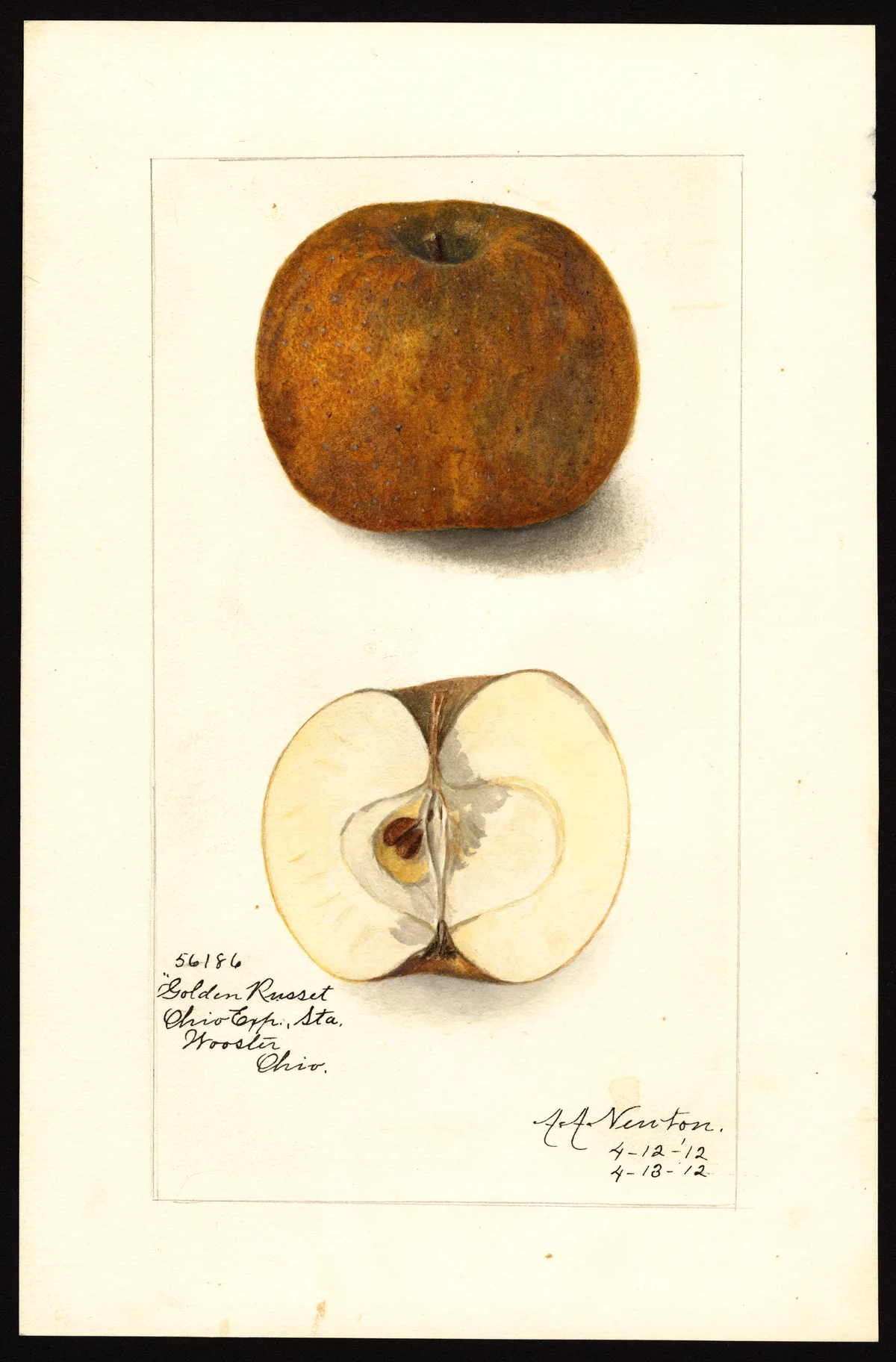
USDA Pomological Watercolor Collection
Golden Russet
Origin / History
An old English apple. Downing identifies it with the variety described by Ronalds and Lindley as Golden Russet, and follows that name as the one commonly accepted in this country. Hansen and Thomas call it English, and Elliott calls it foreign. Bunyard cites Ronalds, p. 29, and gives its origin as "probably an old English variety of some 150 years or more." Hedrick writes that Golden Russet "is at least a century old in America, but when and from where it came is not known."
Among the russets there has been much confusion of names, which Warder found "very difficult to clear up." Bunyard records confusion with the English Russet and the Roxbury Russet. Hedrick holds that "a careful reading of the descriptions will keep one straight." Golden Russet has sometimes been catalogued as English Golden Russet and confused with the English Russet, a distinct variety. Beach sets out the points of distinction in his description of English Russet. Thomas describes the English Russet as of straight upright growth and a very long keeper, and also separates Golden Russet from the American Golden Russet, or Bullock's Pippin. Golden Russet was called Golden Russet of New York, or of Western New York, in distinction from the Golden Russet of Massachusetts, or Hunt Russet, and from various other apples disseminated under the name Golden Russet (Beach). Warder describes it under the heading "Russet Golden, of Barry." Beach cites Thompson's "excellent article presented to the Michigan Horticultural Society in 1870," which compares Golden Russet with the English Russet and the Roxbury Russet.
Golden Russet came to the West from the nurseries about Rochester. Warder calls it "a very superior variety to many others that resemble it," which "may be distinguished by the palate, or by the character of the twigs." Downing calls it one of the popular apples, succeeding in nearly all sections, and especially in rich Western soils. Warder says it succeeds well in parts of Kentucky.
Among the russets grown in Central and Western New York, Golden Russet ranks second only to Roxbury in commercial importance; in other portions of the state it has been less extensively planted (Beach). Hedrick repeats the ranking for russet apples without the regional limit. Beach reports it now grown less extensively than formerly. Cold storage has extended the season of good red winter apples, so that long-keeping russets are less profitable than they were, and he calls this "undoubtedly one reason" for the decline.
Tree
Thrifty, vigorous or strong, spreading, rather irregular, forming a bushy head; Elliott and Thomas also call the growth irregular. Beach describes the tree as medium to large and moderately vigorous to vigorous. In form it is upright roundish, becoming rather spreading, and rather dense. Bunyard gives the growth as moderately vigorous and a little spreading. Branches long, moderately stout, with rather long, slender laterals which become rather drooping after bearing heavily; the young growth is more upright (Beach).
Twigs erect, slender to moderately stout, often with a large, blunt terminal bud; internodes short. Young shoots olive, olive-green, or dull reddish brown. Beach finds them lightly mottled with grayish scarf-skin. They are slightly downy and pubescent toward the tips, and speckled with numerous small white dots (Downing). Bark on the younger branches smooth, yellowish or olive. Lenticels conspicuous, becoming more so on the two-year-old wood, of a clear pale color, quite numerous, seldom large, usually below medium, roundish, sometimes raised. "It is distinguished among other russets by its peculiar, light colored, speckled shoots" (Downing, as quoted by Beach). Buds medium in size or below, deeply set, free, obtuse, pubescent. In the nursery it develops but a moderately strong root system (Beach).
An early bearer; Warder calls it "a rather early bearer." Warder calls it productive and Hedrick usually fruitful; Bunyard gives fertility as moderate. In favorable locations it is a reliable cropper, bearing regularly after it reaches maturity. It is usually classed as a biennial bearer, but in some cases is nearly annual (Beach). The fruit is borne on the ends of the branches, making it hard to pick, and hangs well to the tree till loosened by frost.
Hardy (Beach). Hansen counts it one of the hardier old varieties. A few trees are found at Vermillion, S. D., in northern Iowa, and in the southeastern corner of Minnesota, but he judges it "not sufficiently hardy for general cultivation."
Fruit
Size: Medium; not large. Downing gives medium or below, and Beach below medium to above. Hedrick, condensing Beach, prints medium to large. Bunyard gives 2⅜ by 2¼.
Form: Round to roundish, varying from a little oblate, roundish oblate, or flattened to slightly or somewhat conic. Thomas calls it usually a little oblong, sometimes slightly flattened. Warder writes that "large ones are oblate, often cylindrical, sometimes inclined." Beach adds that it is sometimes rather elliptical and sometimes obscurely angular. Regular, very regular, or nearly regular; usually smooth; uniform in shape and size.
Stem: Short to very short, not often exserted (Beach). Thomas gives half an inch to an inch, longest on oblate specimens. Slender (Elliott, Thomas) or small (Downing); Beach calls it rather stout.
Cavity: Wide to medium; medium in depth to rather deep. Regular, round, usually not furrowed; rough (Warder). Beach finds it somewhat acuminate to acute, where Hansen calls it obtuse. Often deep green with numerous paler green or grayish dots (Beach).
Calyx: Closed, or sometimes a little or partly open; Hansen gives it open. The eye is small (Warder) or usually rather large to medium (Beach). Segments long to rather long, rather acute, often a little recurved or reflexed, sometimes separated at the base (Beach). Hansen describes the segments as erect convergent. Calyx tube conical; Beach gives it rather short and wide, conical or sometimes funnel-form. Stamens median (Hansen); basal or nearly so (Beach).
Basin: Round and regular. Beach finds it often saucer-shaped and rather abrupt, sometimes oblique or irregular. It is rather shallow to moderately deep (Beach), and Warder calls it deep. Broad and rather large (Downing), or medium (Hansen). Smooth (Hansen) or even (Bunyard). Slightly corrugated (Downing), or sometimes plaited or slightly ribbed (Beach). Leather-cracked (Warder, Hansen).
Skin: Thick, moderately tender; rough (Downing). Ground greenish yellow, pale greenish yellow, or yellow. It is mostly or almost entirely covered with russet, which is thick in Warder's and Thomas's descriptions, dull in Downing's, and green or yellowish in Beach's. Thomas finds the surface sometimes wholly a thick russet, and at other times a thin, broken russet on the greenish yellow skin. Beach finds it sometimes only partly covered with patches and flecks of russet. In highly colored specimens it becomes golden russet with a bronzed cheek in the sun. Bunyard describes it as entirely covered with golden russet, with an occasional red flush. "Often decidedly attractive for a russet apple" (Beach).
Dots: Gray or grayish, minute, few, scattered; white (Warder); distinct (Hansen). Beach gives grayish or russet dots, rather inconspicuous on the smooth skin. On the russet skin they are often clear pale gray and conspicuously scattered over the base.
Flesh and flavor: Yellowish to yellow, with Downing giving whitish yellow and Warder greenish yellow. Fine-grained to rather fine-grained, firm, rather compact, crisp to moderately crisp, tender; breaking and granular (Warder). Juicy, though Bunyard calls it "a little dry." Rich, aromatic, mild to agreeably subacid. Downing adds sprightly, Hansen spicy and pleasant, and Bunyard sugary. Veitch gives "good flavour." Quality good to best, the commonest verdict being "very good" (Hansen, Beach, Lowther). Downing gives "good to very good," Warder "good to best," and Elliott nearly "best."
Core and seeds: Core medium to below, distinctly abaxile, or at least having a rather wide hollow cylinder for the axis (Beach). Warder describes it as wide and regular. Warder gives the core closed and clasping, where Hansen gives it open. Cells ovate and entire (Hansen), or often unsymmetrical and usually open (Beach). Core lines meeting or slightly clasping. Carpels broadly ovate, elongated, sometimes tufted, but slightly emarginate if at all. Seeds medium to small. Warder calls them flat, while Hansen and Beach call them plump. Hansen gives them as short. Beach describes them as rather light brown with a decided red tone, obtuse to acute, sometimes tufted.
Season
Winter; keeps through winter. The recorded season runs from December to April or later (Beach), and Hansen gives January to May. The commonest span is December to March. Warder alone narrows it to January and February. An excellent storage variety (Beach).
Uses
Dessert and kitchen; "a choice dessert fruit" (Warder). Beach finds it particularly desirable for home use during the spring months before small fruits ripen, being then excellent for dessert and culinary uses. It makes good evaporated stock and is excellent for cider and stock food. Hedrick calls it, "of all varieties, best for cider." Lowther gives its use as kitchen and market.
Beach reports that it sells well in the general market and is particularly in demand for shipment to Northwestern and Southern markets and for export. When it is grown in favorable locations and properly treated for the control of injurious insects and diseases, there is comparatively little loss from culls. The smallness of the fruit, and its bearing on the ends of the branches, make picking and packing comparatively expensive.
Subtypes / Variants
Not described in source.
Other
Lowther's table records 13 reports in the Northern Division, 7 in the Central Division, and 1 in the Southern Division, each "also reported in another division." Veitch states that it "is most usually procured as a grafted cultivar."
Beach's references run from Downing, 1845, and Thomas, 1849. They continue through Emmons (Nat. Hist. N. Y., 1851), Elliott, 1858, the American Pomological Society Catalogue of 1862, and Warder, 1867. Later entries are Thompson and Waring (Mich. Pom. Soc. Rpt., 1871), Downing (Am. Pom. Soc. Rpt., 1875, and 1876), and Barry, 1883. The list closes with Lyon (Mich. Hort. Soc. Rpt., 1890), Bailey (An. Hort., 1892), Budd-Hansen, 1903, Powell and Fulton (U. S. B. P. I. Bul. 48, 1903), and Beach and Clark (N. Y. Sta. Bul. 248, 1904).
Book Sources
Described in 10 period pomological works
- Beach, The Apples of New York Vol. 1 (1905)
- Warder, American Pomology: Apples (1867) — listed as English Golden
- Budd & Hansen, Systematic Pomology (1914) — listed as Golden Russet (English Golden Russet)
- Bunyard, A Handbook of Hardy Fruits (1920)
- Downing, Fruits and Fruit Trees of America (1900)
- Lowther (ed.), Encyclopedia of Practical Horticulture (1914)
- Hansen, A Study of Northwestern Apples (1902) — listed as Golden Russet (English Golden Russet)
- Hedrick, Cyclopedia of Hardy Fruits (1922)
- Thomas, The American Fruit Culturist (1903)
- Elliott, The Western Fruit Book (1865) — listed as English Golden Russet
USDA Nomenclature (1905)
From W.H. Ragan, Nomenclature of the Apple, USDA Bulletin No. 56
Probably identical with Golden Russet (Eng.)
Nursery Catalog Sources
Found in 35 catalogs (1845–1925) from California, England, Illinois, Massachusetts, New York, Oregon, Washington
- Winship's Nursery (Brighton Nurseries , operated by the Winship family), Brighton (Boston) , Massachusetts — 1845
- Azell Bowditch (Nursery / Fruit Catalog) , Boston , Massachusetts — 1850
- St. Helena Nursery , Howell Prairie, Marion County, OR (Marion Co., Ogn.) — 1864 — listed as English Golden Russet
- Fancher Creek Nursery , Fresno , California — 1886
- California Nursery Co. , Niles , California — 1889 — listed as English Golden Russet
- California Nursery Co. , Niles , California — 1889
- Puyallup & Yakima Nurseries , Puyallup, Washington (Lock Box 191) and North Yakima , Washington — 1892
- Sherwood Hall Nursery Co. , Timothy Hopkins (Menlo Park Nurseries), San Francisco / Menlo Park , California — 1893 — listed as English Golden Russet
- Milwaukie-Canby Nurseries , Canby, OR (and Milwaukie, OR) — 1893
- Oregon Wholesale Nurseries , Salem , Oregon — 1893
- Sherwood Hall Nursery Co. , Timothy Hopkins (Menlo Park Nurseries), San Francisco / Menlo Park , California — 1893
- Woodburn Nurseries , Woodburn, Marion Co. , Oregon — 1894
- Kelway & Son , Langport, Somerset , England — 1897
- Central Experimental Farm , Dominion Department of Agriculture, Agassiz, British Columbia (under test; Bulletin No. 3, Second Series) — 1900
- The Dalles Nurseries , The Dalles , Oregon — 1901
- Washington Nursery Co. , Toppenish , Washington — 1901
- Pacific Nursery Company (W. O. Hudson & A. D. Hudson) , Tangent , Oregon — 1903
- Russellville Nursery Co. , Russellville, OR (three miles east of Portland, one mile from Montavilla car line) — 1903
- Phoenix Nursery Company (W. E. Rossney , President; Sidney Tuttle, Vice-President), Bloomington , Illinois — 1904 — listed as English Golden Russet
- OSU Bulletin 81 — 1904
- Henderson Luelling / Traveling Nursery (historical recall) , Oregon — 1904
- Russellville Nursery Co. , Montavilla Station, Portland, OR (three miles east of Portland, one mile from Montavilla car line) — 1907
- Carlton Nursery Co. , Carlton , Oregon — 1909
- Washington Nursery Company , Toppenish , Washington — 1909
- James Veitch & Sons , Ltd., Royal Exotic Nursery, Chelsea, London (also Coombe Wood, Langley, and Feltham) , England — 1911
- Ballygreen Nurseries , Hanford , Washington — 1912
- Pacific Nursery Company , Portland , Oregon — 1912
- Vineland Nurseries Company , Clarkston , Washington — 1912
- Washington Nursery Company , Toppenish , Washington — 1912
- Samuel Fraser , Geneseo , New York — 1913
- Union Nurseries , J.B. Weaver & Sons, Union , Oregon — 1915
- Oregon Nursery Co. , Orenco , Oregon — 1920
- Benedict Nursery Co. , Portland , Oregon — 1921
- Fresno Nursery Co. , Fresno , California — 1924
- Columbia & Okanogan Nursery Co. , Wenatchee , Washington — 1925
View original book sources (11)
— F.R. Elliott, The Western Fruit Book (1865)English Golden Russet.
Golden Russet, of New York.
Foreign. Growth, irregular ; fruit, medium, roundish, russet on yellow ; stem, slender ; flesh, fine grained, crisp ; nearly "best." December to March.
— John A. Warder, American Pomology: Apples (1867)English Golden,
RUSSET GOLDEN, of Barry.
Among the russets there has been much confusion, which it is very difficult to clear up. The apple about to be described came to the West from the nurseries about Rochester; a very superior variety to many others that resemble it, and may be distinguished by the palate, or by the character of the twigs.
Tree thrifty, vigorous, spreading, productive, a rather early bearer; Shoots slender, olive, speckled.
Fruit medium, round, large ones are oblate, often cylindrical, sometimes inclined, regular; Surface greenish yellow, covered with thick russet; Dots minute, white, scattered.
Basin regular, deep, leather-cracked; Eye small, closed.
Cavity wide, regular, rough; Stem short.
Core wide, regular, closed, clasping; Seeds small, flat; Flesh greenish yellow, breaking, granular, juicy; Flavor sub-acid, rich; Quality good to best; Use, table, kitchen; Season, January, February.
A choice dessert fruit. Succeeds well in parts of Kentucky.
— A.J. Downing, The Fruits and Fruit Trees of America (1900)Golden Russet.
English Golden Russet. English Golden. Russet Golden.
This is an old English Apple described by Ronalds and Lindley as Golden Russet, and as that is its commonly accepted name in this country we have followed it. It is one of the popular Apples, succeeding in nearly all sections, and especially in rich Western soils. The tree is thrifty, vigorous, spreading, rather irregular, forming a bushy head. Young shoots slender, dull reddish brown, slightly downy, with numerous small white dots. An early bearer.
Fruit medium or below, roundish, or roundish oblate. Skin rough. Color yellow, mostly covered with dull russet, and having a bronzed cheek in the sun. Stalk short, small. Cavity medium, or rather deep. Calyx closed. Segments rather long, often a little recurved. Basin broad, rather large, slightly corrugated. Flesh whitish yellow, fine-grained, rather compact, sprightly, mild subacid. Good to very good. December to March.
— N.E. Hansen, A Study of Northwestern Apples (1902)Golden Russet (English Golden Russet)—An old English variety. Tree of strong, spreading, rather irregular growth, forming a bushy head, an early bearer. One of the hardier old varieties; a few trees are found at Vermillion, S. D., and in northern Iowa and Southeastern corner of Minnesota, but not sufficiently hardy for general cultivation.—Fruit medium, very regular, roundish, slightly conical; surface pale greenish yellow, mostly covered with russet; dots distinct, few, gray; cavity regular, obtuse; stem short; basin smooth, medium, leather-cracked; calyx open, segments erect convergent. Core open; cells ovate, entire; tube conical; stamens median; seeds plump, short; flesh firm, rich, spicy, pleasant, mild subacid, very good. January to May.
— John J. Thomas, The American Fruit Culturist (1903)Golden Russet.* (Golden Russet of Western New York.) Size medium, roundish, usually a little oblong, sometimes slightly flattened, nearly regular; surface sometimes wholly a thick russet, and at others a thin broken russet on a greenish yellow skin; stem slender, from half an inch to an inch long, being longest on oblate specimens; flesh fine-grained, firm, crisp, with a rich, aromatic flavor. Shoots speckled; tree rather irregular. Keeps through winter. This is distinct from the English Russet, of straight upright growth, and a very long keeper, and from the American Golden Russet or Bullock's Pippin. English.
— S.A. Beach, The Apples of New York, Vol. 1 (1905)GOLDEN RUSSET.
REFERENCES. 1. Downing, 1845:132. 2. Thomas, 1849:179. 3. Emmons, Nat. Hist. N. Y., 3:96. 1851. 4. Elliott, 1858:131. 5. Am. Pom. Soc. Cat., 1862. 6. Warder, 1867:624. 7. Thompson, Mich. Pom. Soc. Rpt., 1871:30-34. 8. Waring, Ib., 1871:41. 9. Downing, Am. Pom. Soc. Rpt., 1875:36. 10. Downing, 1876:196, 54 app. 11. Barry, 1883:346. 12. Lyon, Mich. Hort. Soc. Rpt., 1890:292. 13. Bailey, An. Hort., 1892:238, 240. 14. Budd-Hansen, 1903:90. 15. Powell and Fulton, U. S. B. P. I. Bul., 48:42. 1903. 16. Beach and Clark, N. Y. Sta. Bul., 248:122. 1904.
SYNONYMS. ENGLISH GOLDEN (6). English Golden (10). ENGLISH GOLDEN RUSSET (1, 2, 4, 13). English Golden Russet (10, 14). GOLDEN RUSSET OF N. Y. (3, 5, 10). Golden Russet of N. Y. (2, 4). GOLDEN RUSSET OF WESTERN N. Y. (10, 11). Russet Golden (6, 10).
Among the russets which are grown in Central and Western New York the Golden Russet ranks second only to Roxbury in commercial importance. In other portions of the state it has been less extensively planted. In recent years the season of good red winter apples has been extended by means of cold storage with the result that long keeping russet apples are less profitable than they were formerly. This is undoubtedly one reason why Golden Russet is now grown less extensively than it formerly was. It is an excellent storage variety, sells well in the general market and is particularly in demand for shipment to Northwestern and Southern markets and for export. The fruit is not large but is pretty smooth and uniform. When grown in favorable locations and properly treated for the control of injurious insects and diseases there is comparatively little loss from culls. The fruit hangs well to the tree till loosened by frost. It is borne on the ends of the branches making it hard to pick. This habit and the smallness of the fruit make the picking and packing comparatively expensive.
The fruit is particularly desirable for home use during the spring months before small fruits ripen, being then excellent for dessert and culinary uses. It makes good evaporated stock and is excellent for cider and stock food. The tree is hardy. In favorable locations it is a reliable cropper, bearing regularly after it reaches maturity. It is usually classed as a biennial bearer, but in some cases it is nearly an annual bearer.
The notable points of distinction between this variety and the English Russet are set forth in the description of English Russet.
Thompson compares these two varieties with each other and with the Roxbury Russet in an excellent article presented to the Michigan Horticultural Society in 1870 (7).
Historical. Downing calls this identical with the old English variety described by Ronalds and Lindley as Golden Russet (9). It has sometimes been catalogued under the name English Golden Russet and has been confused with the English Russet, a distinct variety. It has also been called Golden Russet of New York or of Western New York in distinction from the Golden Russet of Massachusetts, or Hunt Russet, and from the various other apples which have been disseminated under the name Golden Russet.
TREE.
Tree varies from medium to large and from moderately vigorous to vigorous; branches long, moderately stout, with rather long, slender laterals which after bearing heavily become rather drooping, but the young growth is more upright. Form upright roundish becoming rather spreading, rather dense. Twigs erect, rather slender to moderately stout, often with large, blunt terminal bud; internodes short. Bark on the younger branches smooth, yellowish or olive; on the new growth olive-green or rather dull reddish-brown lightly mottled with grayish scarf-skin; pubescent toward the tips. Lenticels conspicuous, becoming more so on the two-year-old wood, of a clear pale color, quite numerous, seldom large, usually below medium, roundish, sometimes raised. "It is distinguished among other russets by its peculiar, light colored, speckled shoots" (10). Buds medium in size or below, deeply set, free, obtuse, pubescent.
It develops but a moderately strong root system in the nursery.
FRUIT.
Fruit below medium to above. Form roundish, varying from a little oblate to somewhat conic, sometimes rather elliptical, sometimes obscurely angular, usually smooth; uniform in shape and size. Stem short to very short, rather stout, not often exserted. Cavity wide to medium, medium in depth to rather deep, somewhat acuminate to acute, usually not furrowed, often deep green with numerous paler green or grayish dots. Calyx usually rather large to medium, closed or sometimes partly open; lobes long, rather acute, often reflexed, sometimes separated at the base. Basin sometimes oblique or irregular, often saucer-shaped, round, rather abrupt, rather shallow to moderately deep, sometimes plaited or slightly ribbed.
Skin thick, moderately tender, sometimes only partly covered with patches and flecks of russet but more often almost entirely covered with green or yellowish russet, in highly colored specimens becoming golden russet with bronze cheek. Dots grayish or russet, rather inconspicuous on the smooth skin but on the russet skin often clear pale gray and conspicuously scattered over the base. Often decidedly attractive for a russet apple.
Calyx tube rather short, wide, conical or sometimes funnel-form. Stamens basal or nearly so.
Core medium to below, distinctly abaxile, or, at least, having a rather wide hollow cylinder for the axis; cells often unsymmetrical, usually open; core lines meeting or slightly clasping. Carpels broadly ovate, elongated, sometimes tufted, but slightly emarginate if at all. Seeds rather light brown with decided red tone, medium to small, plump, obtuse to acute, sometimes tufted.
Flesh yellowish, rather fine-grained, moderately crisp, tender, juicy, rich, agreeably subacid, aromatic, very good.
Season December to April or later.
— J.L. Budd & N.E. Hansen, American Horticultural Manual, Part II: Systematic Pomology (1914)Golden Russet (English Golden Russet). — An old English variety; tree of strong, spreading, rather irregular growth, forming a bushy head, an early bearer.
Fruit medium, very regular, roundish, slightly conical; surface pale greenish yellow mostly covered with russet; dots distinct, few, gray; cavity regular, obtuse; stem short; basin smooth, medium, leather-cracked; calyx open; segments erect convergent. Core open; cells ovate, entire; tube conical; stamens median; seeds plump, short; flesh firm, rich, spicy, pleasant, mild, slightly subacid, very good. January to May.
— Granville Lowther (ed.), Encyclopedia of Practical Horticulture (1914)Golden Russet. Size: medium. Form: roundish (oblate). Color: yellow with russet. Quality: very good. Use: both kitchen and market. Season: winter. Northern Division reports: 13 (also reported in another division). Central Division reports: 7 (also reported in another division). Southern Division reports: 1 (also reported in another division).
— E.A. Bunyard, A Handbook of Hardy Fruits (1920)GOLDEN RUSSET. Ronalds, p., 29. G., Vergoldeter Russet. Dessert, December to March, medium, 2⅜ by 2¼, roundish, flattened. Colour, entirely covered with golden russet, with an occasional red flush. Flesh, yellow, firm, sugary, aromatic, a little dry. Eye, closed, or a little open, in a round even basin. Stem, short, in a rather deep round cavity. Growth, moderately vigorous, a little spreading; fertility, moderate. Origin, probably an old English variety of some 150 years or more. I have never been able to obtain this apple true and the above description is borrowed from Hogg and Ronalds. There has been much confusion with this apple, the English Russet and the Roxbury Russet.
— U.P. Hedrick, Cyclopedia of Hardy Fruits (1922)GOLDEN RUSSET.
The fruits of Golden Russet are not large, but they are smooth, uniform, suffer little from pests, and are most excellent for dessert, culinary uses, evaporating, and, of all varieties, best for cider. Besides, they keep and ship very well. The trees are hardy, vigorous, and usually fruitful. Among russet apples, Golden Russet ranks second only to Roxbury. There is much confusion in names of the russet apples, but a careful reading of the descriptions will keep one straight. Golden Russet is at least a century old in America, but when and from where it came is not known.
Tree large, vigorous, upright-spreading, dense; branches long, stout, with long, slender laterals which become drooping. Fruit medium to large, round-oblate to conic, sometimes elliptical, sometimes obscurely angular, smooth, uniform in shape and size; stem short to very short, stout; cavity wide, acuminate, often deep green with numerous paler green or grayish dots; calyx large, closed or open; lobes long, acute, often reflexed, sometimes separated at the base; basin oblique, round, abrupt, shallow, sometimes plaited or ribbed; skin thick, tender, sometimes with patches and flecks of russet, more often covered with green or yellow-russet, becoming golden russet with bronze cheek; dots gray or russet, inconspicuous on the smooth skin; calyx-tube short, wide, conical; stamens basal; core medium, abaxile, or having a wide, hollow cylinder for the axis; cells often unsymmetrical, open; core-lines meeting; carpels broadly-ovate, elongated, sometimes tufted, slightly emarginate if at all; seeds light brown with a red tone, small, plump, obtuse, sometimes tufted; flesh yellow, fine-grained, crisp, tender, juicy, rich, subacid, aromatic; very good; December to April.
— James Veitch & Sons, Veitch's Fruit Trees (1911) (1911)medium size, firm flesh, good flavour, is most usually procured as a grafted cultivar.