Roxbury
Apple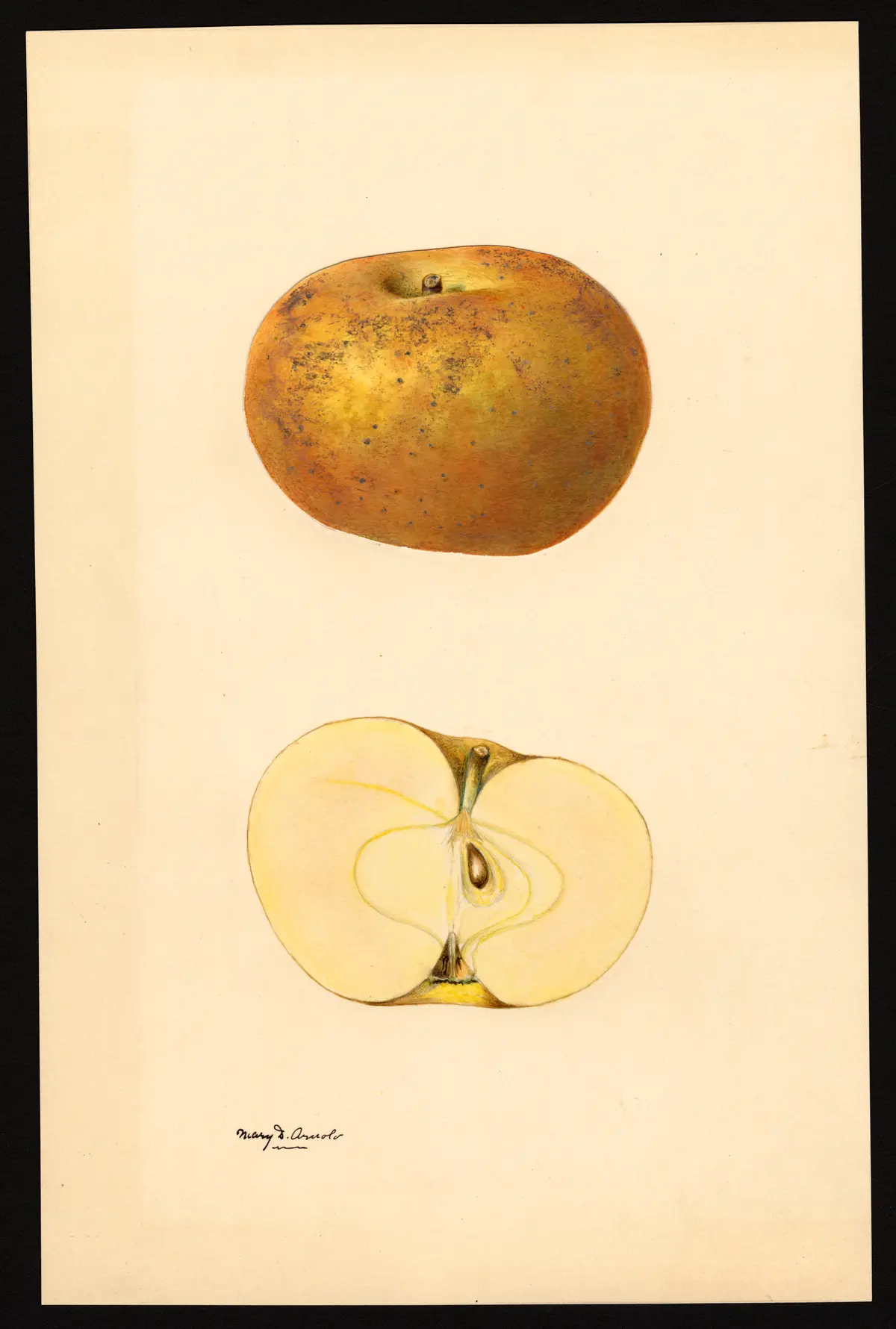
USDA Pomological Watercolor Collection
Roxbury
Origin and History
The Roxbury is generally supposed to have originated in Roxbury, Massachusetts, early in the seventeenth century. Soon after 1649 it was taken to Connecticut. About 1797 it was introduced from Connecticut into Ohio and afterwards disseminated there under the names Putnam Russet, Marietta Russet, and other regional variants.
Tree
Tree medium to large, moderately vigorous to vigorous. Form roundish spreading or flat. Twigs above medium to short, straight or nearly so, stout, often with large blunt terminal buds; internodes medium to rather long. Bark rather light, dull, reddish-brown and olive-green, streaked lightly with grayish scarf-skin, much pubescent. Lenticels not conspicuous, scattering, medium to above, roundish, oval or elongated, sometimes raised. Buds large, broad, plump, obtuse, free or nearly so, slightly pubescent.
The Roxbury has the reputation of being a biennial bearer. When grown on rich soils in favorable locations it is a pretty reliable cropper, but in many places it has proved but a moderate cropper and not very satisfactory.
Fruit
Size and Form: Fruit usually above medium to nearly large, sometimes large, variable in size and shape. Form oblate to oblate inclined to conic, often broadly and obscurely angular and sometimes remarkably elliptical; sides sometimes unequal.
Stem: Short to medium, rather thick or swollen, pubescent, often red on one side.
Cavity: Acute, rarely acuminate, rather deep, medium in width to rather wide, sometimes lipped.
Calyx: Sometimes small but usually medium to rather large, pubescent, closed or partly open; lobes variable, medium to rather large and long, sometimes short, obtuse or acute.
Basin: Variable, usually medium in width and depth, varying from narrow to rather wide, and from obtuse to abrupt, furrowed and often slightly wrinkled.
Skin: Tough or moderately tender, sometimes almost smooth, but usually largely covered with greenish to yellowish-brown russet. Highly colored specimens develop a bronze blush which rarely deepens to red. Dots russet or gray.
Calyx Tube: Rather large, moderately wide, with fleshy pistil point projecting into the base, usually conical, sometimes funnel-shaped. Stamens basal to median.
Core and Seeds: Core above medium to small, axile; cells usually symmetrical, closed, rarely partly open; core lines meeting if the calyx tube is conical but clasping if it is funnel-shaped. Carpels rather flat, elongated and narrowing toward the apex, or roundish ovate, sometimes slightly emarginate, mucronate, tufted. Seeds few, often abortive, medium or above, long, plump, acute, tufted.
Flesh and Flavor: Flesh tinged with yellow or greenish, firm, somewhat coarse, moderately tender, breaking, juicy, sprightly subacid, good to very good.
Season and Storage
December to May, or in cold storage to July.
Uses and Market Qualities
When well grown the Roxbury is of good marketable size and rather attractive for a russet. However, it varies greatly in size and appearance in different localities. Being an excellent keeper it is well liked for southern trade and also sells well in western and northwestern markets. Roxbury fruit grown in Central and Western New York keeps better than that produced in more southern localities, and for this reason is preferred by fruit buyers. This variety has consequently been planted more extensively in the New York region than in any other.
Other
The Roxbury is the most popular russet apple cultivated in New York. The recent increase in cold storage facilities has had the effect of lessening the demand for long-keeping russet apples, and neither the Roxbury nor the Golden Russet is being planted as extensively as they once were, but within recent years there has been increasing demand for them for export.
Comparison with Golden Russet: As compared with the Golden Russet, the Roxbury tree is larger, more spreading and more productive. The dots on the shoots of the Golden Russet are more conspicuous and more numerous than on the Roxbury. The fruit of Roxbury is larger, more oblate and may be characteristically elliptical; that of the Golden Russet is less variable in color and more uniform in size and shape. The Roxbury stem is thicker than that of Golden Russet, often tinged with red on one side and often swollen. The stem of the Golden Russet is usually shorter, not swollen and not tinged with red. The cavity of Roxbury is more often furrowed; that of the Golden Russet more often green and marked with greenish-gray dots. The flesh of the Golden Russet is more sprightly subacid, finer-grained and of richer flavor; that of the Roxbury is rather coarser, yellower, and more mildly subacid. The seeds of the Golden Russet are shorter than those of Roxbury and not so dark colored.
Book Sources
Described in 1 period pomological work
View original book sources (1)
— S.A. Beach, The Apples of New York, Vol. 1 (1905)ROXBURY.
REFERENCES. 1. Thacher, 1822:136. 2. Fessenden, 1828:130. 3. Kenrick, 1832:53. 4. Mag. Hort., 1:364. 1835. 5. Manning, 1838:62. 6. Mag. Hort., 7:48. 1841. 7. Downing, 1845:133. fig. 8. Floy-Lindley, 1846:411 app. 9. Horticulturist, 1:52, 341, 361. 1846-47. 10. Ib., 2:483. 1848. 11. Hovey, Mag. Hort., 14:112, 173. 1848. 12. Thomas, 1849:185, 190. fig. 13. Cole, 1849:135. fig. 14. Phoenix, Horticulturist, 4:472. 1850. 15. Emmons, Nat. Hist. N. Y., 3:96. 1851. col. pl. No. 18. 16. Am. Pom. Soc. Cat., 1852. 17. Elliott, 1854:106. 18. Hooper, 1857:73, 82. 19. Gregg, 1857:59. 20. Horticulturist, 13:144. 1858. 21. Mag. Hort., 26:6, 101. 1860. 22. Ib., 29:437. 1863. 23. Ill. Handb. der Obstk., 8:157. 1865. 24. Warder, 1867:25, 491. fig. 25. Regel, 1868:444. 26. Thompson, Mich. Pom. Soc. Rpt., 1:31. 1870. 27. Leroy, 1873:153. fig. 28. Gardiner, Me. Pom. Soc. Rpt., 1882. (cited by 35). 29. Barry, 1883:354. 30. Hogg, 1884:27. 31. Wickson, 1889:245. 32. Lyon, Mich. Hort. Soc. Rpt., 1890:296. 33. Bailey, An. Hort., 1892:248. 34. Munson, Me. Sta. Rpt., 1893:133. 35. Knowlton, Me. Pom. Soc. Rpt., 1894:126. 36. Lyon, Mich. Sta. Bul., 118:62. 1895. 37. Woolverton, Ont. Fr. Stas. An. Rpt., 3:13. 1896. fig. 38. Bunyard, Jour. Roy. Hort. Soc., 1898:356. 39. Eneroth-Smirnoff, 1901:434. 40. Budd-Hansen, 1903:169. fig. 41. Powell and Fulton, U. S. B. P. I. Bul., 48:55. 1903. 42. Beach and Clark, N. Y. Sta. Bul., 248:142. 1904.
SYNONYMS. Belpre Russet (17, 18, 27). BOSTON RUSSET (25, 27, 30). Boston Russet (9, 12, 13, 15, 17, 18, 24, 37). Marietta Russet (17, 18, 27). Putman's Russet (27, 30). PUTNAM RUSSET (23, 39). Putnam Russet (9, 10, 11, 17, 18, 24, 27, of Ohio 12, 13 and 15). ROXBURY RUSSET (4, 5, 6, 8, 9, 10, 11, 12, 13, 14, 17, 18, 19, 20, 21, 22, 24, 29, 31, 32, 33, 34). Roxbury Russet (3, 27, 30, 40, 41, 42). ROXBURY RUSSETING (1, 2, 3). Roxbury Russeting (7, 27). ROX or ROX RUSSET (colloquial). RUSSET, BOSTON OR ROXBURY (7). Russet (27). Shippen's Russet (27, 30). Sylvan Russet (17, 18, 27).
The Roxbury is the most popular russet apple cultivated in New York. When well grown it is of good marketable size, and rather attractive for a russet, but it varies greatly in size and appearance in different localities. Being an excellent keeper it is well liked for southern trade. It also sells well in western and northwestern markets. The recent increase in cold storage facilities has had the effect of lessening the demand for long-keeping russet apples, and neither the Roxbury nor the Golden Russet is being planted as extensively as they once were, but within recent years there has been increasing demand for them for export. Roxbury fruit that is grown in Central and Western New York keeps better than that produced in more southern localities, and for this reason is preferred by fruit buyers. This variety has consequently been planted more extensively in this region than in any other. It generally has the reputation of being a biennial bearer and when grown on rich soils in favorable locations it is a pretty reliable cropper, but in many places it has proved but a moderate cropper and not very satisfactory.
Historical. It is generally supposed that this variety originated in Roxbury, Massachusetts, early in the seventeenth century. Soon after 1649 it was taken to Connecticut. About 1797 it was introduced from Connecticut into Ohio and afterwards disseminated there under the name Putnam Russet, Marietta Russet, etc. (9, 11, 24).
TREE.
Tree medium to large, moderately vigorous to vigorous. Form roundish spreading or flat. Twigs above medium to short, straight or nearly so, stout, often with large blunt terminal buds; internodes medium to rather long. Bark rather light, dull, reddish-brown and olive-green, streaked lightly with grayish scarf-skin, much pubescent. Lenticels not conspicuous, scattering, medium to above, roundish, oval or elongated, sometimes raised. Buds large, broad, plump, obtuse, free or nearly so, slightly pubescent.
FRUIT.
Fruit usually above medium to nearly large, sometimes large, variable in size and shape. Form oblate to oblate inclined to conic, often broadly and obscurely angular and sometimes remarkably elliptical as shown in the accompanying half-tone illustration; sides sometimes unequal. Stem short to medium rather thick or swollen, pubescent, often red on one side. Cavity acute rarely acuminate, rather deep, medium in width to rather wide, sometimes lipped. Calyx sometimes small but usually medium to rather large, pubescent, closed or partly open; lobes variable; medium to rather large and long; sometimes short, obtuse or acute. Basin variable, usually medium in width and depth, varying from narrow to rather wide, and from obtuse to abrupt, furrowed and often slightly wrinkled.
Skin tough or moderately tender, sometimes almost smooth, but usually largely covered with greenish to yellowish-brown russet. Highly colored specimens develop a bronze blush which rarely deepens to red. Dots russet or gray.
Calyx tube rather large, moderately wide, with fleshy pistil point projecting into the base, usually conical, sometimes funnel-shape. Stamens basal to median.
Core above medium to small, axile; cells usually symmetrical, closed, rarely partly open; core lines meeting if the calyx tube is conical but clasping if it is funnel-shape. Carpels rather flat, elongated and narrowing toward the apex, or roundish ovate, sometimes slightly emarginate, mucronate, tufted. Seeds few, often abortive, medium or above, long, plump, acute, tufted.
Flesh tinged with yellow or greenish, firm, somewhat coarse, moderately tender, breaking, juicy, sprightly subacid, good to very good.
Season December to May or in cold storage to July (42).
ROXBURY COMPARED WITH GOLDEN RUSSET.
As compared with the Golden Russet the Roxbury tree is larger, more spreading and more productive. The dots on the shoots of the Golden Russet are more conspicuous and more numerous than on the Roxbury. The fruit of Roxbury is larger, more oblate and it may be characteristically elliptical as shown in the accompanying half-tone plate; that of the Golden Russet is less variable in color and more uniform in size and shape. The Roxbury stem is thicker than that of Golden Russet, often tinged with red on one side and often swollen. The stem of the Golden Russet is usually shorter, not swollen and not tinged with red. The cavity of Roxbury is more often furrowed; that of the Golden Russet more often green and marked with greenish-gray dots. The flesh of the Golden Russet is more sprightly subacid, finer-grained and of richer flavor, that of the Roxbury being rather coarser, yellower, and more mildly subacid. The seeds of the Golden Russet are shorter than those of Roxbury and not so dark colored.