Sweet Winesap
Apple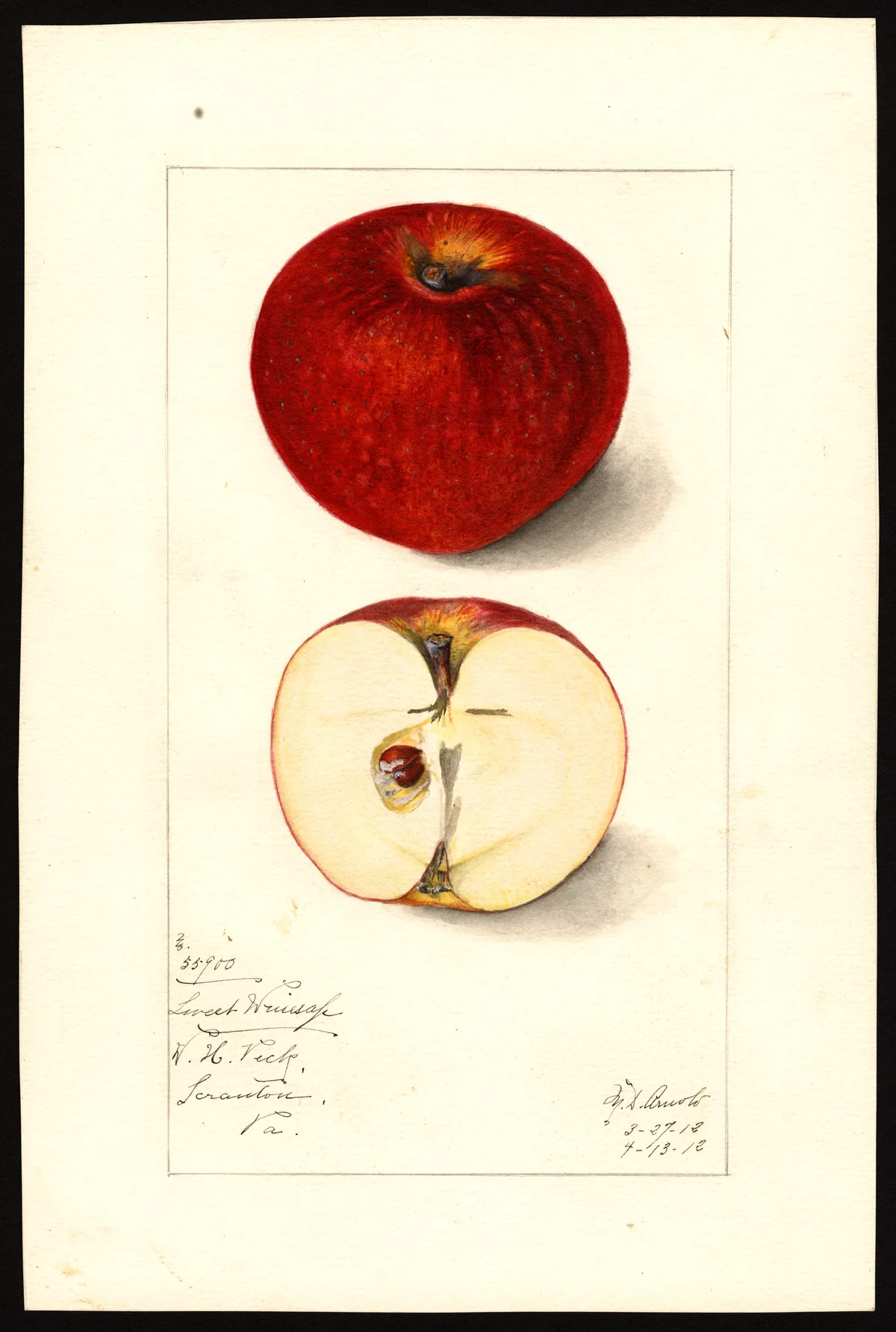
USDA Pomological Watercolor Collection
Sweet Winesap
Origin / History
Downing (1869) described Sweet Winesap as originating in Pennsylvania, a provenance later repeated by Thomas (1875), Budd & Hansen (1914), and Elliott (whose 1865 work quoted Downing). Hedrick (1922) noted that it is not actually known where the variety originated, but that it seems to have been described first in 1854 (corresponding to Elliott's 1854 reference). The variety has long been cultivated in Western New York under the names Henrick Sweet and Hendrick Sweet; in some localities, particularly in Wayne county, it is known as Rose Sweet. It is occasionally erroneously called Ladies Sweet, Lady Sweet, or Lady Sweeting — Beach notes it bears some resemblance to the true Lady Sweet, so the confusion is understandable.
In 1879 fruit of the variety commonly known in Western New York as Henrick Sweet was identified by Charles Downing for William J. Edmunds of Brockport, N. Y., as undoubtedly Sweet Winesap. In Downing's letter to Edmunds he wrote: "In looking over the apples you sent me a month or more since, I am now certain it is the Sweet Winesap which is described in Downing's second revised edition, page 378. Many years since the late Isaac Hildreth, a nurseryman at Geneva, sent me a barrel of this kind which he said went by the name of Henricks Sweet and as you say, they kept through the winter into March with very little waste. Ladies Sweet keeps still later and is one of the best of its season."
Warder listed it under the separate names of Sweet Winesap and Henrick Sweet. Thomas in 1875 followed Downing in giving Sweet Winesap as a variety from Pennsylvania and noticed Henrick Sweet as a separate variety; he was evidently not familiar with the apple under the Sweet Winesap name despite recognizing it under the Henrick Sweet name in his own section. The 1897 edition of Thomas makes Henrick Sweet a synonym of Sweet Pearmain, but Lyon doubted the correctness of this decision; Beach notes that the descriptions of Sweet Pearmain given by Downing and Elliott do not apply closely to Sweet Winesap. Per Hedrick, though widely distributed, Sweet Winesap is most commonly grown in New York and Pennsylvania.
[NOTE: Source text may be incorrect — Elliott's 1865 Western Fruit Book lists two separate entries under "Sweet Winesap." The first, "From Clark County, Ohio," describes a notably different apple (large, roundish-flattened, rough greenish-yellow skin with dark green blotches, mild sub-acid almost sweet flesh, November–December) and appears to be a distinct variety sharing the name; it is included here for completeness but should not be conflated with the Pennsylvania Sweet Winesap that is the principal subject of the other sources.]
Tree
Tree medium in size, vigorous or moderately vigorous (Beach); Hedrick describes the tree as vigorous and upright-spreading and dense, while Beach reports form upright spreading to roundish, rather dense. Downing, Budd & Hansen, and Elliott (Pennsylvania entry) describe growth as moderate and upright, productive. Beach notes some fruit growers report that the tree is satisfactorily hardy, but others find it a little lacking in hardiness and for that reason prefer to top-work it upon some vigorous, hardy stock such as Northern Spy, Roxbury, or Golden Russet. Hedrick concurs that the trees are a little lacking in vigor and hardiness, but are usually healthy, long-lived, and productive. The tree tends to form a rather dense head, particularly where thorough tillage is practiced, and for this reason the top should be made sufficiently open so that the foliage may be kept in good working condition throughout the tree. It is not an early bearer (Beach: "not an early bearer"; Hedrick: "somewhat tardy in coming in bearing"), but when it comes into bearing it is a reliable cropper. In many cases it is inclined to overbear and produce a considerable amount of undersized fruit.
Twigs medium to long, rather slender to moderately stout; internodes medium. Bark brownish tinged with dark red, mottled with inconspicuous grayish scarf-skin, scarcely pubescent. Lenticels scattering, small to medium, often elongated. Buds medium in size, broadly roundish, obtuse or sometimes acute, somewhat pubescent, generally appressed (Beach).
Fruit
Size. Variable: Downing, Budd & Hansen, and Elliott (Pennsylvania entry) call the fruit medium; Beach describes it as "good medium size, or, under favorable conditions, rather large" and notes it varies under different conditions from medium to large but is pretty uniform under fairly similar conditions; Hedrick gives medium to large, uniform in size and shape; the Encyclopedia of Practical Horticulture (1914) reports medium-sized. The variant Elliott Clark County, Ohio entry calls the fruit large.
Form. Downing, Budd & Hansen, and Elliott (Pennsylvania entry) describe the fruit as oblate, slightly approaching conic. The Encyclopedia of Practical Horticulture calls the form flat. Beach gives roundish conic, wide and flattened at the base, varying to roundish ovate or to oblate conic, regular or slightly elliptical, pretty symmetrical. Hedrick: round-conic, wide and flattened at the base, round-ovate or oblate-conic, regular or elliptical, symmetrical. Both Beach and Hedrick characterize the fruit overall as symmetrical, uniform, and well-turned. The variant Elliott Clark County entry describes the fruit as roundish flattened.
Stem / Stalk. Downing, Elliott (Pennsylvania entry), and Budd & Hansen describe the stalk as long and slender. Beach gives stem short to moderately long, moderately slender. Hedrick gives stem short, slender. The variant Elliott Clark County entry describes the stem as short.
Cavity. Downing and Elliott (Pennsylvania entry) describe the stalk as inserted in a deep cavity, surrounded with russet; Budd & Hansen call the cavity deep, russeted. Beach gives the cavity as above medium size, acuminate to acute, moderately shallow to rather deep, moderately wide to wide, symmetrical or gently furrowed, sometimes partly russeted. Hedrick: cavity acuminate, shallow, wide, symmetrical or gently furrowed, sometimes partly russeted.
Calyx. Downing, Budd & Hansen: calyx partially open. Elliott (Pennsylvania entry): calyx large, open. Beach: calyx medium or above, usually somewhat open; lobes often long and acuminate. Hedrick: calyx open; lobes long, acuminate. The variant Elliott Clark County entry calls the calyx medium.
Basin. Downing, Elliott (Pennsylvania entry), Budd & Hansen: rather deep, open basin. Beach: medium to rather large, often oblique, roundish, deep, moderately narrow to rather wide, decidedly abrupt, sometimes slightly furrowed. Hedrick: large, often oblique, round, deep, wide, abrupt, sometimes furrowed. The variant Elliott Clark County entry describes the basin as open.
Skin. Downing: red, splashed with deep crimson. Budd & Hansen: surface red, splashed with deep crimson. Elliott (Pennsylvania entry): color red, splashed with deep crimson. The Encyclopedia of Practical Horticulture (1914): striped or splashed (red). Beach: skin tough, smooth, clear pale yellow or greenish nearly overspread with bright light red, plainly marked with long narrow carmine stripes, covered with a thin bloom and often to a considerable extent with thin, light gray scarf-skin producing a slightly dull effect. Hedrick: skin tough, smooth, pale yellow overspread with bright red, plainly marked with long, narrow carmine stripes, covered with a thin bloom and often with thin, light gray scarf-skin producing a dull effect. Beach further notes the skin is tough and stands heat well before going into storage. Prevailing effect red or striped red. Dots small to medium (Beach) or small (Hedrick), scattering, whitish or russet (Beach) / white or russet (Hedrick). The variant Elliott Clark County entry describes the skin as rough, greenish yellow with blotches of dark green.
Flesh / Flavor. Downing, Elliott (Pennsylvania entry), and Budd & Hansen: flesh tender, juicy, very sweet, rich; Elliott adds "almost melting" and "peculiar flavor"; Budd & Hansen rate it good to very good. Beach: flesh nearly white, firm, rather fine, moderately crisp, tender, juicy, distinctly sweet, good to very good. Hedrick: flesh white, firm, fine, crisp, tender, juicy, sweet; good to very good. The Encyclopedia of Practical Horticulture rates the quality very good. The variant Elliott Clark County entry describes the flesh as yellowish white, tender, mild sub-acid, almost sweet — distinct from the sweet character all other sources emphasize.
Core / Seeds. Beach: calyx tube funnel-shape, with broad, yellowish limb and narrow cylinder, sometimes nearly or quite cone-shape; stamens median to marginal; core small to medium, axile or sometimes abaxile; cells usually symmetrical, closed or partly open; core lines clasping; carpels flat, roundish to broadly elliptical, emarginate; seeds medium or below, plump, obtuse. Hedrick: calyx-tube funnel-shape with broad, yellow limb and narrow cylinder; stamens median; core small, axile or sometimes abaxile; cells symmetrical, closed or partly open; core-lines clasping; carpels flat, round to broadly elliptical, emarginate; seeds small, plump, obtuse. The variant Elliott Clark County entry simply notes core and seeds small.
Season
Downing, Budd & Hansen, and Hedrick: November to March. Elliott (both Pennsylvania and Clark County entries): November, December. The Encyclopedia of Practical Horticulture: winter. Beach: as grown in Western New York it ordinarily comes into season in November and may be held in common storage till April first or in cold storage till May fifteenth. Beach notes the fruit remains sprightly and crisp till late in the season.
Uses
Excellent in quality for dessert or for baking and other culinary uses (Beach; Hedrick concurs the fruit is excellent for dessert or culinary uses). The Encyclopedia of Practical Horticulture lists its primary use as market. The tough skin and firm flesh enable the fruit to stand marketing and storage (Hedrick). Beach reports it sells well in markets where there is any considerable demand for a red winter apple of sweet flavor and is often shipped to Baltimore, Washington, and other southern markets. Beach also notes some few growers hold that two pickings should be made on account of the tendency of the fruit to drop, but others report that it hangs to the tree well enough so that but one picking is needed if the fruit is gathered before it is too far advanced in maturity.
Subtypes / Variants
Not described in source, beyond the question (see note above) of whether Elliott's 1865 "Clark County, Ohio" entry represents a distinct apple shared the same name.
Other
The Encyclopedia of Practical Horticulture (1914) reports the variety from 1 station in the Northern Division (also reported in another division) and 3 stations in the Central Division (also reported in another division), with no stations reported in the Southern Division. Hedrick observes that "under one or another of its several names, Sweet Winesap is cultivated as widely as any other sweet apple, excepting Tolman and Pound Sweet."
Book Sources
Described in 6 period pomological works
Nursery Catalog Sources
Found in 2 catalogs (1901–1913) from Illinois
- Benjamin Buckman (personal inventory) , Farmingdale , Illinois — 1901
- Benjamin Buckman (personal inventory) , Farmingdale , Illinois — 1913
View original book sources (6)
— A.J. Downing, The Fruits and Fruit Trees of America (1900)Sweet Winesap. Henrick Sweet ? Henry Sweet. Ladies Sweet, of some. Sweet Pearmain, of some. Red Sweet Winesap. From Pennsylvania. Tree of moderate, upright growth, productive. Fruit medium, oblate, slightly approaching conic. Color red, splashed with deep crimson. Stalk long and slender, inserted in a deep cavity, surrounded with russet. Calyx partially open, set in a rather deep, open basin. Flesh tender, juicy, very sweet, rich. Good to very good. November to March.
— S.A. Beach, The Apples of New York, Vol. 1 (1905)SWEET WINESAP.
REFERENCES. 1. Elliott, 1854:160—not the Sweet Winesap of Downing. 2. Warder, 1867:721, 734. 3. Downing, 1869:378. 4. Am. Pom. Soc. Cat., 1871:10. 5. Thomas, 1875:501. 6. Ib., 1875:514. 7. Lyon, Mich. Hort. Soc. Rpt., 1890:298. 8. Thomas, 1897:270. 9. Budd-Hansen, 1903:186. 10. Beach and Clark, N. Y. Sta. Bul., 248:124. 1904. 11. Ragan, U. S. B. P. I. Bul., 56:141. 1905. 12. Ib., 56:170. 1905. 13. Ib., 56:304, 305. 1905.
SYNONYMS. Bailey Sweet (10) incorrectly. HENDRICK (10). Hendrick Sweet (10). HENRICK (11). HENRICK SWEET (2, 5). Henrick Sweet (7, 8, 11, 13, ?3). Henry Sweet (3, 13). Ladies' Sweet of some (3, 12, 13), but erroneously. Lady Sweet of some, but erroneously. Lady Sweeting of some, but erroneously. Red Sweet Winesap (3, 13). Rose Sweet. SWEET PEARMAIN (8). Sweet Pearmain of some (3, 13). SWEET WINE SAP (6).
An attractive red winter apple, symmetrical, uniform, of good medium size, or, under favorable conditions, rather large. It is excellent in quality for dessert or for baking or other culinary uses. Some fruit growers report that the tree is satisfactorily hardy, but others find that it is a little lacking in hardiness and for that reason prefer to top-work it upon some vigorous, hardy stock such as Northern Spy, Roxbury or Golden Russet. It is usually healthy and moderately long-lived. It tends to form a rather dense head, particularly where thorough tillage is practiced, and for this reason the top should be made sufficiently open so that the foliage may be kept in good working condition throughout the tree. The tree is not an early bearer, but when it comes into bearing it is a reliable cropper. In many cases it is inclined to overbear and produce a considerable amount of undersized fruit. Some few hold that two pickings should be made on account of the tendency of the fruit to drop, but others report that it hangs to the tree well enough so that but one picking is needed if the fruit is gathered before it is too far advanced in maturity. The fruit has a tough skin, stands heat well before going into storage and remains sprightly and crisp till late in the season. As grown in Western New York it ordinarily comes into season in November and may be held in common storage till April first or in cold storage till May fifteenth (10). It sells well in markets where there is any considerable demand for a red winter apple of sweet flavor. It is often shipped to Baltimore, Washington and other southern markets.
Historical. Downing described Sweet Winesap in 1869 as a variety from Pennsylvania (3), with Henrick Sweet as a synonym. In 1879 fruit of the variety commonly known in Western New York as Henrick Sweet was identified by Charles Downing for William J. Edmunds, of Brockport, N. Y., as undoubtedly Sweet Winesap. Mr. Edmunds has very kindly supplied us with some of his Sweet Winesap fruit which certainly is identical with the apple grown at Geneva and in other parts of the state as Henrick Sweet or Hendrick Sweet. He has also presented us with Downing's letter, the text of which is here given in full. " In looking over the apples you sent me a month or more since, I am now certain it is the Sweet Winesap which is described in Downing's second revised edition, page 378. Many years since the late Isaac Hildreth, a nurseryman at Geneva, sent me a barrel of this kind which he said went by the name of Henricks Sweet and as you say, they kept through the winter into March with very little waste. Ladies Sweet keeps still later and is one of the best of its season."
Sweet Winesap has long been cultivated in Western New York under the names Henrick Sweet and Hendrick Sweet. In some localities, particularly in Wayne county, it is known as Rose Sweet. Occasionally it is erroneously called Ladies Sweet, Lady Sweet or Lady Sweeting. Since it bears some resemblance to the true Lady Sweet it is not strange that it is sometimes thus confused with that variety. Warder listed it under the separate names of Sweet Winesap and Henrick Sweet. Thomas in 1875 followed Downing in giving Sweet Winesap as a variety from Pennsylvania and notices Henrick Sweet as a separate variety. Evidently he was not familiar with this variety under the name Sweet Winesap, but he must have recognized that it was identical with the apple commonly known in his own section as Henrick Sweet. The 1897 edition of Thomas (8), makes Henrick Sweet a synonym of Sweet Pearmain, but Lyon doubted the correctness of this decision (11).
We have not seen Sweet Pearmain but the descriptions of that variety given by Downing (3) and Elliott (1) do not apply closely to Sweet Winesap.
TREE.
Tree medium in size, vigorous or moderately vigorous. Form upright spreading to roundish, rather dense. Twigs medium to long, rather slender to moderately stout; internodes medium. Bark brownish tinged with dark red, mottled with inconspicuous grayish scarf-skin, scarcely pubescent. Lenticels scattering, small to medium, often elongated. Buds medium in size, broadly roundish, obtuse or sometimes acute, somewhat pubescent, generally appressed.
FRUIT.
Fruit varies under different conditions from medium to large but under fairly similar conditions is pretty uniform in size and shape. Form roundish conic, wide and flattened at the base, varying to roundish ovate or to oblate conic, regular or slightly elliptical, pretty symmetrical. Stem short to moderately long, moderately slender. Cavity above medium size, acuminate to acute, moderately shallow to rather deep, moderately wide to wide, symmetrical or gently furrowed, sometimes partly russeted. Calyx medium or above, usually somewhat open; lobes often long and acuminate. Basin medium to rather large, often oblique, roundish, deep, moderately narrow to rather wide, decidedly abrupt, sometimes slightly furrowed. Skin tough, smooth, clear pale yellow or greenish nearly overspread with bright light red, plainly marked with long narrow carmine stripes, covered with a thin bloom and often to a considerable extent with thin, light gray scarf-skin producing a slightly dull effect. Dots small to medium, scattering, whitish or russet. Prevailing effect red or striped red. Calyx tube funnel-shape, with broad, yellowish limb and narrow cylinder, sometimes nearly or quite cone-shape. Stamens median to marginal. Core small to medium, axile or sometimes abaxile; cells usually symmetrical, closed or partly open; core lines clasping. Carpels flat, roundish to broadly elliptical, emarginate. Seeds medium or below, plump, obtuse. Flesh nearly white, firm, rather fine, moderately crisp, tender, juicy, distinctly sweet, good to very good.
— Granville Lowther (ed.), Encyclopedia of Practical Horticulture (1914)Sweet Winesap is a medium-sized apple of flat form, with striped or splashed (red) skin color. Quality is very good. Primary use is market. Season is winter. It is reported by 1 station in the Northern Division (also reported in another division) and 3 stations in the Central Division (also reported in another division). No stations are reported in the Southern Division.
— F.R. Elliott, The Western Fruit Book (1865)Sweet Winesap.
From Clark County, Ohio. Fruit, large, roundish flattened, rough skin, greenish yellow, with blotches of dark green : calyx, medium ; basin, open ; stem, short ; core and seeds, small : flesh, yellowish white, tender, mild sub-acid, almost sweet. November, December.
Sweet Winesap.
From Pennsylvania. Tree of moderate, upright growth, productive. Fruit, medium, oblate, slightly approaching conic ; color, red, splashed with deep crimson : stalk, long and slender, inserted in a deep cavity, surrounded with russet ; calyx, large, open, set in a rather deep, open basin ; flesh, tender, juicy, almost melting, with a very sweet, rich, peculiar flavor. November, December. (Downing.)
— J.L. Budd & N.E. Hansen, American Horticultural Manual, Part II: Systematic Pomology (1914)Sweet Winesap. — Origin, Pennsylvania; tree of moderate, upright growth, productive.
Fruit medium, oblate, slightly approaching conic; surface red, splashed with deep crimson; cavity deep, russeted; stem long, slender; basin rather deep, open; calyx partially open. Flesh tender, juicy, very sweet, rich, good to very good. November to March.
— U.P. Hedrick, Cyclopedia of Hardy Fruits (1922)SWEET WINESAP. Fig. 54. Hendrick. Hendrick Sweet. Sweet Pearmain. Under one or another of its several names, Sweet Winesap is cultivated as widely as any other sweet apple, excepting Tolman and Pound Sweet. The fruits are a handsome red, large, well-turned, symmetrical, and uniform; excellent for dessert or culinary uses; and sufficiently firm of flesh and tough of skin to stand marketing and storage. The trees are a little lacking in vigor and hardiness, but are usually healthy, long-lived, and productive, though they are somewhat tardy in coming in bearing. It is not known where the variety originated, but it seems to have been described first in 1854. Though widely distributed, Sweet Winesap is most commonly grown in New York and Pennsylvania. Tree medium in size, vigorous, upright-spreading, dense. Fruit medium to large, uniform in size and shape, round-conic, wide and flattened at the base, round-ovate or oblate-conic, regular or elliptical, symmetrical; stem short, slender; cavity acuminate, shallow, wide, symmetrical or gently furrowed, sometimes partly russeted; calyx open; lobes long, acuminate; basin large, often oblique, round, deep, wide, abrupt, sometimes furrowed; skin tough, smooth, pale yellow overspread with bright red, plainly marked with long, narrow carmine stripes, covered with a thin bloom and often with thin, light gray scarf-skin producing a dull effect; dots small, scattering, white or russet; prevailing effect red or striped-red; calyx-tube funnel-shape with broad, yellow limb and narrow cylinder; stamens median; core small, axile or sometimes abaxile; cells symmetrical, closed or partly open; core-lines clasping; carpels flat, round to broadly elliptical, emarginate; seeds small, plump, obtuse; flesh white, firm, fine, crisp, tender, juicy, sweet; good to very good; November to March.