Northern Spy
Apple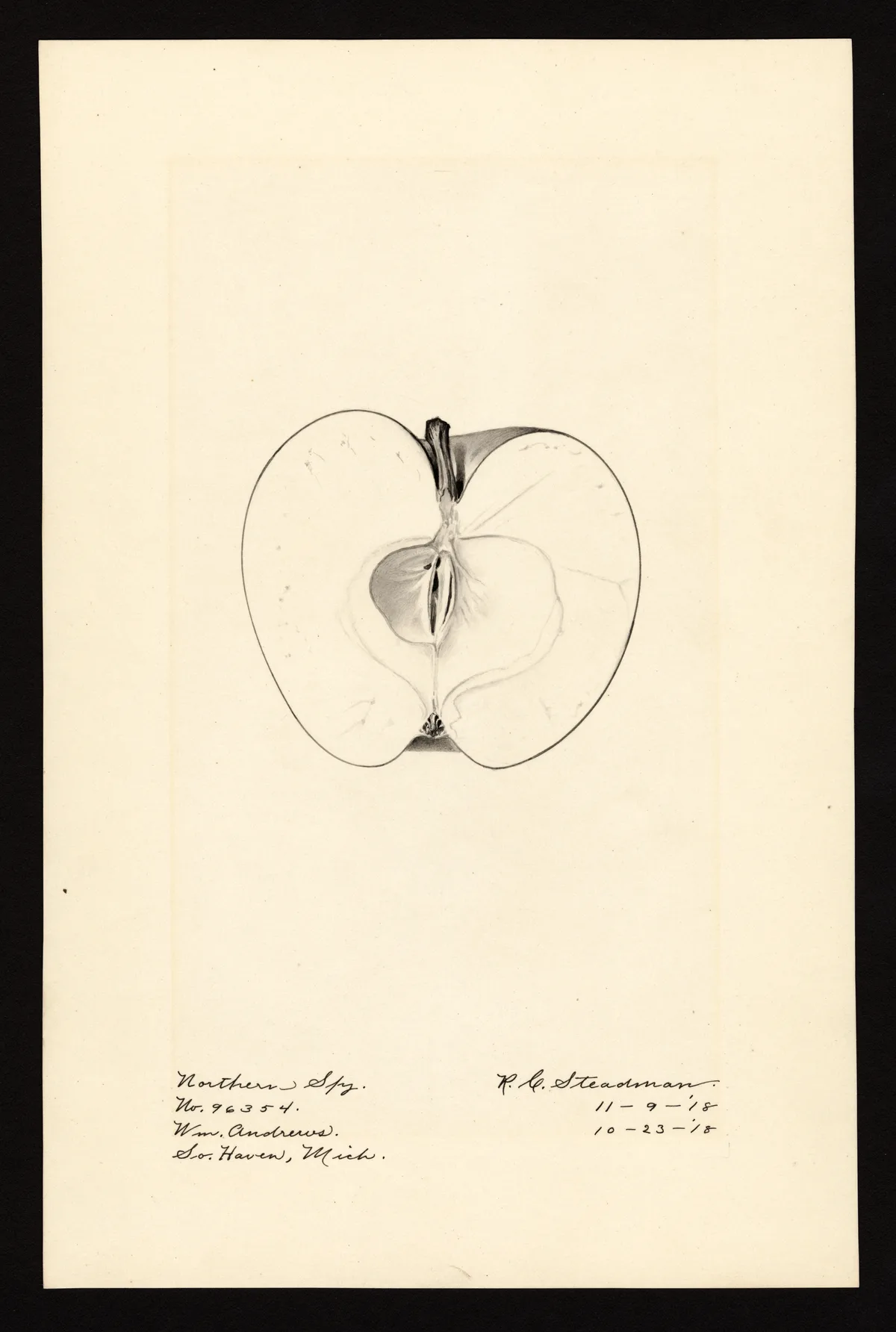
USDA Pomological Watercolor Collection
Northern Spy
Origin / History
Raised at East Bloomfield, N. Y., near Rochester, from seed brought from Connecticut; Beach names Salisbury, Connecticut. Heman Chapin planted the seedling orchard about 1800. The same orchard also produced the Early Joe and the Melon. Hovey, writing in 1852, puts the raising "nearly fifty years ago."
The original tree died before bearing. Roswell Humphrey took up and planted sprouts or suckers from it and from these first raised the fruit. In 1847 nine of the trees set out by Humphrey were still living (Beach). Bunyard alone places the origin at the orchard of Mr. R. Humphrey, East Bloomfield, "soon after 1840." Lowther spells the planter's name "Herman Chapin."
For many years Northern Spy was confined to the locality of its origin. About 1840 it began to attract the attention of growers elsewhere. Hovey gives 1840 or 1841, when fine specimens seen in Rochester as late as May proved on inquiry to be "an entirely new and remarkable seedling variety." He refers to a full account of its history and origin in the Magazine of Horticulture for 1847, vol. xiii, pp. 72, 104. In 1852 the American Pomological Society listed it both as a new variety of promise and as a variety worthy of general cultivation. Beach records that it was afterward planted extensively in New York and in other parts of the more northern apple-growing regions. Hedrick says its culture spread westward to the Pacific. Fruit growers and dealers commonly call it simply Spy (Beach).
Hovey set Northern Spy against the Baldwin, which "has so long been the favorite, and justly held its place at the head" among late-keeping winter apples. Of Northern Spy he wrote: "in our estimation, it is surpassed by no other fruit." If its productiveness proved equal to the Baldwin's, "it will dispute the palm with that esteemed and popular variety." Elliott held that its quality "secures it a place among first class fruit." Downing called it "one of the most delicious, fragrant, and sprightly of all late dessert apples," and Thomas "a fruit of the highest quality."
Beach ranks it third in commercial importance among New York apples, after Baldwin and Rhode Island Greening. When well grown he finds it superior to both in flavor and quality, and among "the very best winter apples of New York." He nonetheless judges it less well adapted than either for general cultivation, being more or less variable in season and quality and in some sections an unreliable cropper. In some parts of New York it had become the leading variety in commercial orchards. It was also grown quite extensively in many other localities and was generally well known throughout the state.
Lowther calls it "perhaps the very best apple for Michigan" and "a first-class apple" where best adapted. Hedrick counts it "one of the leading American apples." He grounds this on its "delectable quality, great beauty in color and form, and the fair size of the fruit, with hardiness, healthfulness, reliability in bearing, vigor and productiveness in the tree." He adds that it was long considered one of the best apples in New York and New England.
Zielinski, writing for Oregon, ranks it "distinctly superior in flavor and quality" and among the best early winter varieties. It was grown commercially there only to a limited extent. In Oregon it and its red sports "are not often included in new apple plantings." Way, writing of New York in 1979, says growers continue to plant it despite its "extreme nonprecocity," and that it is the most extensively grown variety in nearby Ontario. The Central Experimental Farm at Agassiz, British Columbia, planted it in spring 1890.
Tree
Large to of largest size (Hedrick), very vigorous, thrifty, upright, free-growing, of rapid growth, long-lived. Head close, compact, dense, becoming roundish and handsome when old, spreading when older (Warder). Hovey calls the tree "very regular," as in his vignette of a tree three years grafted, and Hedrick calls it nearly perfect in form. Branches long, moderately stout, curved. Laterals willowy and slender, somewhat inclined to droop (Beach).
Young shoots dark, reddish, dark reddish brown to dark reddish chestnut, spotted. Twigs long to medium, erect, straight or somewhat crooked, slender to stout; internodes long to rather short. Hovey calls the wood rather slender and short-jointed; Elliott and Thomas call the shoots stout, and Thomas erect. Bark dull, dark brownish-red mingled with olive-green, lightly streaked with thick scarf-skin, heavily pubescent (Beach). Lenticels numerous, conspicuous, small, roundish or oblong, slightly raised; Hovey calls them "very prominent, round, grayish specks" thickly covering the wood. Buds very small to medium, short, broad, obtuse, appressed, slightly pubescent, deeply set in the bark. Hovey calls them flattened and Beach plump. Flower-buds oval (Hovey).
Leaves ovate-oblong to oval, rich glossy green to dark, healthy (Warder). Hovey calls them medium-sized; Warder calls them large. Hovey describes the leaf as tapering regularly to the point, with one side of the base longer than the other. The margins are wavy, with very irregular, rather sharp, moderately deep serratures, and the petioles rather short and slender. Bunyard calls the leaf nearly flat and undulating. Flowers medium-sized, tinged with pink (Hovey). Bloom remarkably late, so the blossoms often escape late spring frosts that injure earlier varieties.
Tardy in coming into bearing, coming into bearing only after several years of care, and productive when old. The young trees increase in productiveness as they advance in maturity (Beach). Under favorable conditions profitable crops have come within seven years of planting (Beach). Commonly they come only at twelve or fifteen years (Zielinski), or not until the trees are at least twenty years of age (Elliott), and as much as fourteen years may pass before the first bushel (Way). Way says dwarfing rootstocks, limb spreading, and minimal pruning encourage earlier bearing.
Several authors find the crops moderate. Downing gives moderate crops, Bunyard calls it only moderately fertile, and at Agassiz it was a fair bearer when well grown. Hedrick credits the tree with reliability in bearing and productiveness. In favorable locations under good care it becomes a reliable cropper, with moderate to heavy crops biennially or in some cases almost annually (Beach). Way calls the bearing biennial. Hovey alone says it "bears regularly every year." He reports that its productiveness was disputed. Some alleged that only part of the crop is large, fair, and fit for market; others held that in good soils and situations it gives as good an average crop as other varieties.
The tree often sets many small apples that are seedless or nearly so, which Beach takes to indicate improper fertilization of the blossoms. He thought it remained to be shown whether a late-blooming variety with abundant fertile pollen planted nearby would remedy this.
Very hardy and healthy, with a strong root system in nursery and orchard (Beach). Beach says these traits and its upright, free-growing habit make it much in favor as a stock on which to top-work less vigorous, less hardy, or less healthy varieties. Hedrick grounds the same favor on its long life, nearly perfect form, and rapid growth to maturity from the nursery. Foliage and fruit are noticeably susceptible to apple scab. Lowther calls the tree resistant to woolly aphis. Way names bitter pit as a problem, together with limb-rub blemishes and bruise marks from handling.
The top tends to become dense and must be pruned regularly and thoroughly to admit light and air. Otherwise much of the fruit, especially on older trees, is poorly matured and poorly colored. Downing says it is then "wanting in flavor, and apt to be imperfect and knotty." Hovey thought careful and judicious pruning would "undoubtedly produce both large and perfect fruit." Elliott advises severe thinning out of the tops. Beach directs removing crossing laterals and limbs while leaving the smaller twigs and spurs, on which most of the fruit is borne.
E. W. Lamont of Cobleskill, N. Y., quoted by Beach, warns that the wood is very straight-grained and the tree liable to split under heavy loads. The three or four limbs chosen to form the head should therefore be spaced along the trunk some distance apart, never opposite or nearly opposite. Standard trees should stand forty to fifty feet apart. Zielinski adds that the long twigs let the fruit whip and bruise, and bruised fruit tends to rot on the tree.
Requires rich soil and high cultivation, and must be kept thrifty by good cultivation to afford fine fruit (Thomas). Hedrick calls it "most capricious as to soils." The preferred soil is warm, fertile, and well drained. Beach's growers favor gravelly loam or clay loam with well-drained subsoil, a few districts preferring rather heavy clay loam. Hedrick gives gravelly or sandy loam in a cool and somewhat moist climate. In the territory best adapted to it the tree grows satisfactorily on different slopes and soils. Grown in sod the trees may be less productive, but the fruit colors and keeps better than under frequent tillage (Beach). Overfertilized or overwatered trees give fruit poor in color, excessively large, poor in quality, and subject to cracking and bitter pit (Zielinski). In some seasons and some areas many fruits are poorly colored (Zielinski).
In New York it succeeds better in the cooler interior than on the warm slopes south of the Fishkill mountains and on the coastal plain. It does well on the hills and well-drained slopes from Chautauqua lake eastward to the Catskills, along the Champlain valley, and in the uplands east of the Hudson as far south as the Fishkill mountains (Beach). Thomas finds it succeeds throughout the North and Northwest but is less valuable farther South. Lowther finds it peculiarly adapted to the soils of Michigan but not doing so well in the Pacific Northwest. In Oregon it succeeds better in the cooler areas, but experience there showed it "not well adapted to further planting" (Zielinski). Bunyard says it does well in England only in very favorable years.
Fruit
Size: Medium to very large, most authors calling it large. Beach gives usually large or very large, except when seedless; Elliott gives medium to large; Bunyard alone calls it medium, 2⅜ by 2¼. Hovey gives about two and a half inches deep and three and a half broad, many specimens measuring twelve inches in circumference. Fairly uniform (Zielinski).
Form: Roundish conical, often flattened, especially at the base. Hovey describes it as flat and broad at the base, tapering much toward the small crown. Downing calls it roundish oblate conical and Warder flattened-conical. Sometimes inclined to oblong (Beach). Nearly symmetrical, sometimes regular but often noticeably ribbed or angular, the ribbing slight or obscure in some accounts; Bunyard calls it almost regular.
Stem: Short to very long, slender to moderately thick, deep set. Hovey gives short, about half an inch, rather slender, very deeply inserted. Downing gives three-fourths of an inch, rather slender. Elliott says it projects about even with the surface. Beach gives medium to long and moderately thick, against the slender stem of the other authors, and Bunyard alone calls it very long.
Cavity: Large, acute, very wide, open, and deep. Often broadly furrowed (Beach); regular or wavy (Warder). Russeted: Downing says sometimes, and Beach usually, with greenish-russet radiating upward to the brim. Bunyard calls it faintly russet-veined and Warder brown. Hovey notes the skin often has a blotch of russet around the stem.
Calyx: Eye small to very small, closed, sometimes partly open (Beach). Lobes short, broad, obtuse (Beach); segments flat, convergent, very small (Budd-Hansen). Calyx tube sometimes large, long, and cone-shaped, but more often narrow and somewhat funnel-form with very narrow cylinder (Beach). Beach gives the stamens as basal or nearly so; Budd-Hansen gives them as median.
Basin: Small to medium, narrow to medium in width, abrupt, regular or folded, somewhat ribbed or furrowed. Elliott calls it open and regular apart from the furrows produced by the ribs. Hovey gives a medium-sized, abruptly depressed hollow with the eye rather deeply sunk; Thomas calls the calyx deep set, and Beach the basin moderately deep. Elliott calls it "not deep, but rather abrupt" and Bunyard shallow.
Skin: Thin, tender, smooth, and fair, glossy in highly colored specimens. Ground color on the shaded side yellow, pale or clear pale yellow, light yellow, or greenish yellow; Veitch's catalog describes the fruit as green with a crimson cheek. The ground is mostly or nearly covered with red in two shades, light and dark. The red is striped, mottled, and splashed, with stripes extending nearly to the eye (Hovey).
The red itself is recorded as bright glossy red with distinct stripes of rich purplish crimson (Hovey, who also writes of "a rich, deep crimson skin, with purplish stripes"), light red striped and slashed with carmine (Elliott), scarlet or crimson (Warder), light and dark purplish red (Downing), and bright pinkish-red mottled and splashed with carmine (Beach). Bunyard alone describes it as almost covered with faint red stripes and flush.
Prevailing effect bright red or striped red, handsomely striped. Rarely the yellow or green predominates, and such fruit is low in quality (Beach). Overspread with a thin, delicate, white bloom, fine when first gathered (Elliott); Hovey compares it to the soft bloom of Red Astrachan. A handsome and beautiful apple.
Dots: Few, scattering, inconspicuous, minute to medium, yellow, pale, whitish, gray, or russet.
Flesh and flavor: Yellowish white to white; Beach gives yellowish and Bunyard alone greenish-yellow. Fine to moderately fine-grained (Beach), crisp, very tender, very juicy. Beach adds rather firm, while Bunyard calls it loose. Warder calls it breaking and granular, and while he considers the quality "best," he finds it "rather coarse in texture."
Juice plentiful and brisk. Flavor sprightly, aromatic, rich, fragrant, subacid, mild or slightly subacid in some accounts, highly flavored (Zielinski). Hovey describes "a rich sub-acid, possessing a peculiarly delicious aromatic flavor." Downing gives "a peculiarly fresh and delicious flavor." Warder calls it "acid, becoming sub-acid, aromatic, rich, with the spiciness of a Spitzenberg." Budd-Hansen calls it spicy, and Thomas "fine."
Quality very good to best. Bunyard rates it "of good flavour," and Agassiz "a good flavour, quality very good." Poorly colored fruit is not good in flavor (Beach) and low in quality (Zielinski); when poorly grown the flavor deteriorates (Hedrick).
Core and seeds: Core large, sometimes medium, open. Hovey calls it medium and "rather open." Abaxile (Beach); irregular (Warder). Cells pretty symmetrical, open or nearly closed, often not uniformly developed (Beach); ovate, entire (Budd-Hansen). Core lines clasping the funnel cylinder. Carpels much concave, broadly roundish, emarginate, slightly tufted (Beach).
Seeds small to medium, plump, numerous or abundant in most accounts. Beach finds them often abortive and few, but sometimes numerous. Elliott and Warder describe them as pointed, many of them triangular ovate (Elliott), and Warder as pale. Beach gives them as wide, obtuse, dark, and somewhat tufted; Budd-Hansen gives them as short.
Season
The recorded season runs from October to June. Most authors give a winter season beginning in November, December, or January and closing between February and May. Hovey and Downing carry it to June. Hovey says it keeps "perfectly sound" and retains "all its freshness," superior to Baldwin in keeping, though its flesh is remarkably tender and juicy. Thomas says it keeps through winter and late into spring and preserves its flavor remarkably fresh. Warder says it lasts longer in the North, and Elliott expected it to become an early-winter variety in the South. At Agassiz it was in season December and January. Veitch's catalog gives October to May and calls it a good late keeper. Way gives the storage life as long.
Beach says it is ready for use in November and December and keeps its crispness and high flavor remarkably well to the close of its season. Keeping varies with season and location. In ordinary cellar storage the season sometimes closes in February and more often extends to March or April; with very careful temperature regulation it may sometimes reach May. In some localities it needs two to three weeks longer than Rhode Island Greening to ripen properly. It stands heat fairly well but should go into storage as soon as possible after picking. If well colored, picked, packed, and handled with great care, and stored soon after picking, it may be carried as long as most winter varieties.
The thin skin and juicy, tender flesh make careful handling absolutely necessary, or shrinkage in storage is heavy. The fruit is particularly susceptible to blue mold (Penicillium glaucum Link) in storage, especially when bruised or delayed in reaching storage. Poorly colored fruit keeps less well than well-ripened, highly colored fruit. Hedrick says the fruit stands usage in shipping, storing, and marketing very well.
Uses
Dessert and kitchen, excellent for both. Too juicy and tender for evaporating (Beach). Way calls it one of the best processing sorts, with premium prices paid for frozen slices, and of excellent eating quality.
A market apple of well-established reputation, selling at high prices. Downing says it "always commands the highest market price." Beach finds it suited to local, general, or fancy trade, often selling above average prices for its size, beauty, flavor, and quality. Hedrick gives a well-established reputation in all American fruit markets. Thomas calls it profitable for market under proper cultivation and with care in picking, assorting, and packing.
Subtypes / Variants
Red sports have a distinct, medium-reddish blush. The color lacks the brightness and liveliness of the streaked red of the parent type, and quality often seems below that of the ordinary Northern Spy (Zielinski). A number were under test at the Experiment Station, none yet superior to the parent. Way says the red sports are subject to storage breakdown and are less popular with growers than the original striped, partially red Northern Spy.
Other
Not described in source.
Book Sources
Described in 12 period pomological works
- Beach, The Apples of New York Vol. 1 (1905)
- Warder, American Pomology: Apples (1867)
- Budd & Hansen, Systematic Pomology (1914)
- Bunyard, A Handbook of Hardy Fruits (1920)
- Downing, Fruits and Fruit Trees of America (1900)
- Hedrick, Cyclopedia of Hardy Fruits (1922)
- Zielinski, Apple Varieties for Oregon (1964)
- Elliott, The Western Fruit Book (1865)
- Lowther (ed.), Encyclopedia of Practical Horticulture (1914)
- Thomas, The American Fruit Culturist (1903)
- Way, Apple Varieties Grown in New York State (1979)
- Hovey, The Fruits of America (1852) — listed as THE NORTHERN SPY APPLE
Nursery Catalog Sources
Found in 83 catalogs (1845–1955) from Alabama, California, England, Illinois, Maryland, Massachusetts, Missouri, New Jersey, New York, Oregon, Pennsylvania, Virginia, Washington
- Winship's Nursery (Brighton Nurseries , operated by the Winship family), Brighton (Boston) , Massachusetts — 1845
- Azell Bowditch (Nursery / Fruit Catalog) , Boston , Massachusetts — 1850
- Joseph Breck & Co. , Boston , Massachusetts — 1855
- St. Helena Nursery , Howell Prairie, Marion County, OR (Marion Co., Ogn.) — 1864
- Hutchison Nursery , James Hutchison, Oakland , California — 1881
- Felix Gillet , Barren Hill Nursery, Nevada City , California — 1884
- Huntsville Wholesale Nurseries (Jessie S. Moss , Proprietor; W.F. Heikes, Manager), Huntsville , Alabama — 1886
- Felix Gillet , Barren Hill Nursery, Nevada City , California — 1888
- California Nursery Co. , Niles , California — 1889
- Felix Gillet , Barren Hill Nursery, Nevada City , California — 1889
- Palouse Nursery and Pleasant Dale Fruit Farm , Colfax, Washington Territory (situated two miles northeast of Colfax) - undated (single-page broadside flyer; "Washington Territory" suggests pre — 1889
- Felix Gillet , Barren Hill Nursery, Nevada City , California — 1890
- William H. Moon Co. , Morrisville, Bucks County , Pennsylvania — 1890
- Felix Gillet , Barren Hill Nursery, Nevada City , California — 1891
- Puyallup & Yakima Nurseries , Puyallup, Washington (Lock Box 191) and North Yakima , Washington — 1892
- Oregon Wholesale Nurseries , Salem , Oregon — 1893
- Rogers Nursery Co. , Moorestown , New Jersey — 1893
- Sherwood Hall Nursery Co. , Timothy Hopkins (Menlo Park Nurseries), San Francisco / Menlo Park , California — 1893
- Green's Nursery Co. (Charles A. Green) , Rochester , New York — 1894
- Multnomah Nurseries , Russellville , Oregon — 1894
- The Vineland Nurseries (Kelsey & Co. , Proprietors), St. Joseph, Missouri (Office: 13th and Atchison Sts., 2 Blocks East of the Citizens St. Car Line) — 1894
- Woodburn Nurseries , Woodburn, Marion Co. , Oregon — 1894
- Felix Gillet , Barren Hill Nursery, Nevada City , California — 1895
- The Lovett Company , Little Silver , New Jersey — 1896
- Felix Gillet , Barren Hill Nursery, Nevada City , California — 1897
- Kelway & Son , Langport, Somerset , England — 1897
- The Salem Nursery (John A. Francis , Proprietor), Salem , Virginia — 1897
- Arthur J. Collins & Sons , Moorestown , New Jersey — 1898
- Reading Nursery , Jacob W. Manning, Proprietor, Reading , Massachusetts — 1898
- Stark Bros. Nurseries & Orchards Co. , Louisiana , Missouri — 1898
- Brown Brothers Co. , Continental Nurseries, Rochester, NY (also operated from Toronto, Canada) — 1899
- Alabama Nursery Co. , Huntsville , Alabama — 1900
- Central Experimental Farm , Dominion Department of Agriculture, Agassiz, British Columbia (under test; Bulletin No. 3, Second Series) — 1900
- The Dalles Nurseries , The Dalles , Oregon — 1901
- Washington Nursery Co. , Toppenish , Washington — 1901
- Brown Brothers Co. , Continental Nurseries, Rochester, NY (also operated from Toronto, Canada) — 1901
- Mountain Grove Nurseries (Tippin & Moore , Proprietors; Geo. T. Tippin, J. W. Tippin, J. C. Moore), Mountain Grove , Missouri — 1901
- S.L. Watkins , Grizzly Flats, El Dorado County , California — 1901
- Benjamin Buckman (personal inventory) , Farmingdale , Illinois — 1901
- Forestville Nurseries , T.J. True, Forestville , California — 1902
- Pacific Nursery Company (W. O. Hudson & A. D. Hudson) , Tangent , Oregon — 1903
- Russellville Nursery Co. , Russellville, OR (three miles east of Portland, one mile from Montavilla car line) — 1903
- OSU Bulletin 81 — 1904
- Henderson Luelling / Traveling Nursery (historical recall) , Oregon — 1904
- Stark Bros. Nurseries & Orchards Co. , Louisiana , Missouri — 1906
- J.B. Pilkington , Portland , Oregon — 1907
- Russellville Nursery Co. , Montavilla Station, Portland, OR (three miles east of Portland, one mile from Montavilla car line) — 1907
- Carlton Nursery Co. , Carlton , Oregon — 1909
- Wm. J. Corse (successor to Robert Sinclair / Sinclair Nurseries) , Baltimore , Maryland — 1909
- Washington Nursery Company , Toppenish , Washington — 1909
- C.F. Lansing , Salem , Oregon — 1910
- Island Nurseries & Fruit Farm , Vashon (Vashon Island) , Washington — 1910
- Stark Bros. Nurseries & Orchards Co. , Louisiana , Missouri — 1910
- Island Nurseries & Fruit Farm , Vashon (Vashon Island) , Washington — 1911
- Stark Bros. Nurseries & Orchards Co. , Louisiana , Missouri — 1911
- James Veitch & Sons , Ltd., Royal Exotic Nursery, Chelsea, London (also Coombe Wood, Langley, and Feltham) , England — 1911
- Ballygreen Nurseries , Hanford , Washington — 1912
- Pacific Nursery Company , Portland , Oregon — 1912
- Stark Bros. Nurseries & Orchards Co. , Louisiana , Missouri — 1912
- Vineland Nurseries Company , Clarkston , Washington — 1912
- Washington Nursery Company , Toppenish , Washington — 1912
- J. B. Pilkington , Nurseryman, Portland, OR (nurseries near Newberg, forty miles from Portland) — 1913
- Samuel Fraser , Geneseo , New York — 1913
- Van Holderbeke Nursery Co. , Incorporated, Spokane, Washington (nurseries at Otis Orchards WA, Pasadena WA, Kennewick WA) — 1913
- Island Nurseries & Fruit Farm , Vashon (Vashon Island) , Washington — 1914
- Island Nurseries & Fruit Farm , Vashon (Vashon Island) , Washington — 1915
- Ornamental & Fruit Nursery Company , Wapato, County of Yakima , Washington — 1915
- Union Nurseries , J.B. Weaver & Sons, Union , Oregon — 1915
- Island Nurseries & Fruit Farm , Vashon (Vashon Island) , Washington — 1916
- Island Nurseries & Fruit Farm , Vashon (Vashon Island) , Washington — 1917
- Fancher Creek Nurseries , George C. Roeding, Fresno , California — 1918
- Stark Bros. Nurseries & Orchards Co. , Louisiana , Missouri — 1918
- Oregon Nursery Co. , Orenco , Oregon — 1920
- Christopher Nurseries / John Stewart & Sons , Christopher , Washington — 1920
- Benedict Nursery Co. , Portland , Oregon — 1921
- Island Nurseries & Fruit Farm , Vashon , Washington — 1921
- Fresno Nursery Co. , Fresno , California — 1924
- Columbia & Okanogan Nursery Co. , Wenatchee , Washington — 1925
- Hudson's Wholesale Nurseries , Tangent , Oregon — 1926
- Stark Bro's Nurseries , Louisiana , Missouri — 1932
- Carlton Nursery Co. , Forest Grove , Oregon — 1955
- Rich & Sons Nursery , Hillsboro , Oregon
- North-Western Nurseries , Walla Walla , Washington
View original book sources (14)
— C.M. Hovey, The Fruits of America (1852)THE NORTHERN SPY APPLE.
Northern Spy. Magazine of Horticulture, vol. x. p. 375.
For many years, there have been no very remarkable additions to our varieties of late-keeping winter apples. The Baldwin, which has so long been the favorite, and justly held its place at the head, seems to have been one of those productions which combine all that nature is capable of bestowing on the apple, and to excel it, or even equal it, is sufficient to give a new variety the very highest merit. Of this character is the Northern Spy: in our estimation, it is surpassed by no other fruit; and, if its qualities for productiveness should prove equal to the Baldwin, it will dispute the palm with that esteemed and popular variety. It is one of the most beautiful apples; having a rich, deep crimson skin, with purplish stripes, and covered with a soft bloom, like the Red Astrachan. In its keeping qualities, it is superior to the Baldwin; and although its flesh is remarkably tender and juicy, it keeps perfectly sound, and retains all its freshness, till June.
The Northern Spy was raised in the town of East Bloomfield, N. Y., nearly fifty years ago, from seeds carried from Connecticut. The original tree was set out in the orchard of Heman Chapin, of that town, and suckers were taken from it by Roswell Humphrey, who first raised the fruit, the parent tree having died. For a long period, the variety was wholly confined to the locality where it was raised, and it was not until 1840 or '41, that it first attracted the attention of cultivators: at that time, some very fine specimens of apples were seen in Rochester, as late as May, and, on inquiry, they proved to be the Northern Spy, an entirely new and remarkable seedling variety. A full account of its history and origin will be found in the Magazine of Horticulture for 1847, vol. xiii. pp. 72, 104.
Much has been said of the productiveness of the Spy, some alleging that only a portion of the fruit is large and fair, and suitable for market, while others state that, in good soils and situations, it produces as good an average crop as other varieties. It bears regularly every year, and many of the specimens measure twelve inches in circumference. The tree is of upright and rather compact growth, and probably needs a careful and judicious pruning. If this is attended to, they will undoubtedly produce both large and perfect fruit.
NORTHERN SPY APPLE.
Tree. — Very vigorous, upright, and very regular, as represented in our vignette, which is from a tree three years grafted; when old, forming a handsome head.
Wood. — Dark reddish chestnut, rather slender, short-jointed, and thickly covered with very prominent, round, grayish specks; buds very small, short, and flattened: Flower-buds oval.
Leaves. — Medium size, ovate-oblong, rich glossy green, tapering regularly to the point, with one side of the base longer than the other; margins wavy, with very irregular, rather sharp, and moderately deep serratures; petioles rather short and slender.
Flowers. — Medium size, tinged with pink.
Fruit. — Large, about two and a half inches deep, and three and a half broad: Form, roundish-conical, flat and broad at the base, tapering much towards the crown, which is small: Skin, fair, smooth, yellow on the shady side, but nearly covered with bright glossy red and distinct stripes of rich purplish crimson, extending nearly to the eye; often having a blotch of russet around the stem, marked with scattered yellow specks, and partially covered with a thin white bloom: Stem, short, about half an inch in length, rather slender, and very deeply inserted in a large, very wide, open, cavity: Eye, small, and rather deeply sunk in a medium sized, somewhat ribbed, and abruptly depressed hollow: Flesh, yellowish white, fine, crisp, and very tender: Juice, plentiful and brisk, of a rich sub-acid, possessing a peculiarly delicious aromatic flavor: Core, medium size, and rather open.
Ripe in January, and keeps perfectly sound till June.
— F.R. Elliott, The Western Fruit Book (1865)Northern Spy.
American. Native of East Bloomfield, N. Y. While the quality of this variety secures it a place among first class fruit, it cannot be considered a profitable variety until the trees have acquired at least twenty years of age, as it is tardy in coming into bearing. It is of thrifty, vigorous growth, requiring a rich soil, high state of cultivation, and as an orchard tree, severe thinning out of the tops, as it inclines to make an upright, close head; young shoots, stout, dark, spotted; blooms late, often escaping late frosts in Spring.
Fruit, medium to large; form, roundish conical, sometimes ribbed; skin, thin and tender; color, light yellow, mostly overspread with light red, striped and slashed with streaks of carmine red, and, when first gathered, covered with a fine bloom; stem, slender, projecting about even with the surface; cavity, open, wide, deep; calyx, small, closed; basin, open, regular, other than the furrows produced by ribs of the fruit—not deep, but rather abrupt; flesh, yellowish white, very tender, crisp, juicy, sprightly; core, large, capsules open; seeds, abundant, many of them triangular ovate pointed. January to April. South, it will probably become an early Winter variety.
— John A. Warder, American Pomology: Apples (1867)Northern Spy.
Origin near Rochester, New York. Tree very vigorous, large, upright, spreading, when older; shoots reddish, leaves healthy, large, dark. Tree productive when old, but not an early bearer; needs trimming to admit light and air to the fruit.
Fruit large, flattened-conical, angular; Surface smooth, yellow, mixed, and splashed, scarlet, or crimson; Dots scattered, small.
Basin abrupt, regular, or folded; Eye small, closed.
Cavity wide, regular or wavy, brown; Stem medium to short.
Core large, irregular, open; Seeds numerous, small, pointed, pale; Flesh yellowish-white, breaking, granular, juicy; Flavor acid, becoming sub-acid, aromatic, rich, with the spiciness of a Spitzenberg; Quality considered best, but rather coarse in texture; Use, table, kitchen and market; Season, December until May, and in the North longer.
— A.J. Downing, The Fruits and Fruit Trees of America (1900)Northern Spy. Northern Spy.
This beautiful American fruit is one of the most delicious, fragrant, and sprightly of all late dessert apples. It ripens in January, keeps till June, and always commands the highest market price. The tree is of rapid, upright growth, and bears moderate crops. It originated on the farm of Heman Chapin, of East Bloomfield, near Rochester, N. Y. The trees require high culture, and open heads to let in the sun, otherwise the fruit is wanting in flavor, and apt to be imperfect and knotty. Young shoots dark reddish brown. The tree blooms late, often escaping vernal frosts.
Fruit large, roundish oblate conical. Skin thin, smooth, in the shade greenish or pale yellow, in the sun covered with light and dark stripes of purplish red, marked with a few pale dots, and a thin white bloom. Stalk three-fourths of an inch long, rather slender, planted in a very wide, deep cavity, sometimes marked with russet. Calyx small, closed. Basin narrow, abrupt, furrowed. Flesh white, fine-grained, tender, slightly subacid, with a peculiarly fresh and delicious flavor. Core large and open. Very good to best. December to June.
— John J. Thomas, The American Fruit Culturist (1903)Northern Spy.* Large, roundish-conical, often flattened, slightly ribbed; handsomely striped with red; stalk and calyx deep set; flavor rich, aromatic, mild sub-acid, fine. Keeps through winter and late into spring; preserves its flavor remarkably fresh. Shoots dark, spotted, erect, stout. A tardy bearer. To afford fine fruit, the tree must be kept thrifty by good cultivation. A native of East Bloomfield, N. Y. A fruit of the highest quality, and profitable for market under proper cultivation, and with care in picking, assorting, and packing. Succeeds throughout the North and Northwest, but less valuable farther South. Fig. 439.
— S.A. Beach, The Apples of New York, Vol. 1 (1905)NORTHERN SPY.
REFERENCES. 1. Mag. Hort., 10:275. 1844. 2. Albany Cultivator, 2:41, 56. 1845. 3. Genesee Farmer, 1845. (cited by 6). 4. Downing, 1845:120. 5. Horticulturist, 1:30, 144. 1846. 6. Ib., 1:386, 482. 1847. 7. Hovey and Watts, Mag. Hort., 13:72, 104, 538. 1847. fig. 8. Hovey, Mag. Hort., 14:530. 1848. 9. Thomas, 1849:169, 174. fig. 10. Cole, 1849:134. fig. 11. Allen, Horticulturist, 6:351. 1851. 12. Emmons, Nat. Hist. N. Y., 3:70. 1851. col. pl. No. 23. 13. Hovey, 1:19. 1851. col. pl. and fig. 14. Am. Pom. Soc. Cat., 1852. 15. Mag. Hort., 19:68. 1853. 16. Elliott, 1854:94. fig. 17. Smith, Horticulturist, 11:242. 1856. 18. Hooper, 1857:66. 19. Hoffy, N. A. Pom., 1860. col. pl. 20. Hovey, Mag. Hort., 29:459. 1863. 21. Warder, 1867:541. fig. 22. Downing, 1869:289. fig. 23. Fitz, 1872:166. 24. Leroy, 1873:501. fig. 25. Barry, 1883:351. 26. Hogg, 1884:161. 27. Wickson, 1889:248. 28. Lyon, Mich. Hort. Soc. Rpt., 1890:294. 29. Bailey, An. Hort., 1892:245. 30. Taylor, Am. Pom. Soc. Rpt., 1895:192. 31. Woolverton, Ont. Fr. Stas. An. Rpt., 3:15. 1896. figs. 32. Bruner, N. C. Sta. Bul., 182:21. 1903. figs. 33. Budd-Hansen, 1903:137. fig. 34. Powell and Fulton, U. S. B. P. I. Bul., 48:51. 1903. 35. Beach and Clark, N. Y. Sta. Bul., 248:134. 1904.
SYNONYMS. Northern Spy (31). Spy (31). Spy (1, 19).
Northern Spy is often known among fruit growers and fruit buyers by the simple name of Spy. It ranks third in commercial importance among New York apples, being surpassed in this respect by Baldwin and Rhode Island Greening. When it is well grown it is superior to either of these in flavor and quality and easily ranks among the very best winter apples of New York. The fruit is large and attractive, being of a bright red color, overspread with a delicate bloom. The flesh is very juicy, crisp, tender and most excellent for either dessert or culinary uses. It is not a good variety for evaporating because it is too juicy and tender. It is well adapted for either local, general or fancy trade. It has a well-established reputation in market, and because of its size, beauty, fine flavor and high quality it often sells at more than average prices. It is ready for use in November and December, and retains its crispness and high flavor remarkably well until the close of the season (35). Its thin skin and juicy, tender flesh render careful handling absolutely necessary, otherwise there is much shrinkage in storage (35). It is particularly susceptible to attack from blue mold (Penicillium glaucum Link) in storage, especially if bruised or delayed in reaching storage. If well colored, picked, packed and handled with great care and stored soon after picking, it may be carried in storage as long as most winter varieties (34). Its keeping quality varies considerably in different seasons and in different locations. In ordinary cellar storage its season sometimes closes in February, but more often extends to March or April, and if the temperature is very carefully regulated it may sometimes be held till May. It stands heat fairly well, but after being picked it should go into storage as soon as possible. Poorly colored fruit of this variety is not good in flavor and does not keep as well as well-ripened and highly colored fruit. In some localities it appears to require from two to three weeks longer than Rhode Island Greening to ripen properly.
Both the foliage and fruit of Northern Spy are noticeably susceptible to injury by the scab and thorough treatment is required to prevent loss from this disease. It comes into bloom remarkably late. On this account its blossoms sometimes escape destruction by late frosts when earlier-blooming varieties are much injured. Often it produces many small apples which are seedless or nearly so. This indicates an improper fertilization of the blossoms. It remains to be demonstrated whether or not this fault may be remedied by planting near the Northern Spy some other late-blooming variety bearing an abundance of fertile pollen.
Northern Spy is not as well adapted for general cultivation as is either Baldwin or Rhode Island Greening because it is more or less variable in season and quality, and in some sections is an unreliable cropper. Usually it is rather slow in coming into bearing, although under favorable conditions it has been known to yield profitable crops within seven years from the time of planting. The young trees increase in productiveness as they advance in maturity. In favorable locations, under good care, they usually become reliable croppers yielding from moderate to heavy crops biennially, or in some cases almost annually. This variety succeeds better in the cooler regions of the interior of the state than it does on the warm slopes south of the Fishkill mountains and on the coastal plain. It generally does well on the hills and well-drained slopes in the more elevated regions from Chautauqua lake eastward to the Catskills, along the Champlain valley and in the uplands east of the Hudson as far south as the Fishkill mountains. In some portions of the regions just named it has become the leading variety in commercial orchards, but its cultivation is by no means confined to these regions, for it is grown quite extensively in many other localities and is generally well known throughout the state. Experienced fruit growers frequently express a preference for warm, fertile soil, either gravelly loam or clay loam, with well-drained subsoil, upon which to plant Northern Spy, although in some few districts there is a decided preference for rather heavy clay loam. In the territory best adapted to its cultivation it is grown satisfactorily upon different slopes and different soils. When grown in sod the trees may be less productive, but the fruit doubtless colors better and keeps better than when the orchard is given frequent and thorough tillage during the growing season.
The tree is very hardy and healthy, develops a strong root system both in the nursery and in the orchard, and has an upright, free-growing habit. For these reasons it is much in favor as a stock upon which to top-work varieties that are less vigorous, less hardy or less healthy. The top tends to become dense and must be pruned regularly and thoroughly to keep it sufficiently open to admit light and air to the foliage in all parts of the tree; otherwise, especially on the older trees, much of the fruit is apt to be poorly matured and poorly colored. Pruning for this purpose should be done by removing the laterals and limbs that cross, being careful to leave the smaller twigs and spurs, as these are the ones upon which the most of the fruit is borne.
The head of the young orchard tree should be formed with great care. In the words of one of our correspondents,¹ the wood of this variety is very straight-grained and the tree is liable to split when heavily loaded. To guard against this, when the head of the small tree is formed no two limbs should be left opposite or nearly opposite each other, but the three or four branches which are selected for forming the head of the tree should be distributed along the main stem at some little distance apart. This distributes the load upon the trunk and gives more spring to the body of the tree, thus tending to prevent its splitting with heavy loads. Standard orchard trees of Northern Spy should stand forty to fifty feet apart in order to prevent their becoming too much crowded when fully matured.
¹E. W. Lamont, Cobleskill, N. Y.
Historical. Originated in a seedling orchard at East Bloomfield, N. Y., which is famous for the production of this variety, the Early Joe and the Melon. This orchard was planted by Heman Chapin with seedling trees grown from seeds brought from Salisbury, Connecticut, about the year 1800 (3, 4, 5, 6, 7, 18). Sprouts from the original tree were taken up and planted by Roswell Humphrey and by him the first fruit of the Northern Spy was raised as the original tree died before bearing. In 1847 nine of the trees set out by Humphrey were still living (6). The variety was confined to the vicinity of its origin for many years and it was not till about 1840 that it began to attract the attention of fruit growers in other localities (6, 12). Its great value then came to be more widely recognized and in 1852 the American Pomological Society not only listed it as a new variety of promise but also as a variety worthy of general cultivation. Since that time it has become extensively planted not only in New York but in various other portions of the more northern apple-growing regions.
TREE.
Tree large, vigorous; branches long, moderately stout, curved. Form upright, dense, becoming roundish with willowy, slender laterals somewhat inclined to droop. Twigs long to medium in length, erect, straight or somewhat crooked, slender to moderately stout; internodes long to rather short. Bark dull, dark brownish-red mingled with olive-green lightly streaked with thick scarf-skin; heavily pubescent. Lenticels numerous, conspicuous, small, roundish or oblong, slightly raised. Buds deeply set in bark, medium to small, broad, plump, obtuse, appressed, slightly pubescent.
FRUIT.
Fruit except when it is seedless is usually large or very large. Form roundish conical, sometimes inclined to oblong, often noticeably flattened at the base, nearly symmetrical, sometimes regular but often noticeably ribbed. Stem medium to long, moderately thick. Cavity large, acute, very wide and deep, often broadly furrowed, usually with greenish-russet radiating upwards to the brim. Calyx usually small, closed, sometimes partly open; lobes short, broad, obtuse. Basin small to medium, narrow to medium in width, moderately deep, abrupt, usually somewhat furrowed.
Skin thin, tender and smooth. In highly colored specimens it is glossy and the clear pale yellow ground color is nearly concealed with bright pinkish-red mottled and splashed with carmine and overspread with a thin delicate bloom. Dots medium to small, not conspicuous, scattering, whitish, gray or russet. Prevailing effect bright red or striped red. Rarely the yellow or green color predominates. In such cases the quality of the fruit is low.
Calyx tube sometimes large, long, cone-shape but more often narrow and somewhat funnel-form with very narrow cylinder. Stamens basal or nearly so.
Core usually large, sometimes medium, abaxile; cells pretty symmetrical, open or nearly closed, often not uniformly developed; core lines clasping the funnel cylinder. Carpels much concave, broadly roundish, emarginate, slightly tufted. Seeds small to medium, wide, often abortive and few but sometimes numerous, plump, obtuse, dark, somewhat tufted.
Flesh yellowish, rather firm, moderately fine-grained, very tender, crisp, very juicy, sprightly, aromatic, subacid, very good to best.
[Additional entry in this volume: "SPY", pp. 536–536]
SPY.
Fruit growers and fruit dealers commonly mention the Northern Spy by the simple name of Spy. For a description of this variety the reader is referred to Northern Spy.
— J.L. Budd & N.E. Hansen, American Horticultural Manual, Part II: Systematic Pomology (1914)Northern Spy. — Originated about 1800 in East Bloomfield, near Rochester, New York; tree blooms late and is of rapid upright growth, spreading with age, not an early bearer but productive when old, needs high culture and pruning to admit the sun and air to the fruit.
Northern Spy.
Fruit large; form roundish, oblate, conical, obscurely angular; surface smooth, greenish yellow, thinly covered with light and dark purplish red overlaid with a thin whitish bloom; dots, obscure, few, yellow, minute; cavity very wide, deep, sometimes with radiating russet; stem medium; rather slender; basin narrow, abrupt, furrowed; calyx small, closed; segments flat convergent, very small. Core large, open; cells ovate, entire; tube funnel-shaped; stamens median; seeds numerous, short, plump; flesh white, fine-grained; juicy, tender, delicious, spicy, subacid, very good to best. December to June.
— Granville Lowther (ed.), Encyclopedia of Practical Horticulture (1914)Northern Spy
The Northern Spy is perhaps the very best apple for Michigan, being peculiarly adapted to the soils of that region. In New York it ranks third, being superseded by the Baldwin and Rhode Island Greening. When it is grown where it is best adapted it is a first-class apple. In the Pacific Northwest it does not do so well as in some other sections of the country. The fruit is large, red, tender, juicy, crisp and good for dessert or for culinary purposes. It has a well established reputation, and because of its high quality often sells for good prices. Its season is November and December. It is susceptible to the attack of blue mold, if kept in storage, and is easily bruised in handling.
Tree very hardy and healthy, growing to a large size, with large vigorous branches, long and stout, curved. Form upright, roundish, slender laterals, somewhat inclined to droop. Bark dark brownish red mingled with olive green lightly streaked with thick scarf skin, heavily pubescent.
Historical. The Northern Spy originated in a seedling orchard at East Bloomfield, New York. The trees were planted by Herman Chapin about 1800, but attracted very little attention until about 1840, when it began to be more widely recognized as a valuable variety, and to be more extensively cultivated.
There are the following peculiarities of the tree that should be considered in selecting commercial varieties. First, it is more than ordinarily susceptible to "apple scab fungus." Second, it comes into bloom remarkably late, and this fact often prevents it from being injured by spring frosts, when earlier blooming varieties are killed. Third, it often produces many small apples which are seedless, the result of improper fertilization of the blossoms. The tree is resistant to woolly aphis.
— E.A. Bunyard, A Handbook of Hardy Fruits (1920)NORTHERN SPY. Fl. and Pom., 1862, 8. G., Spaeher des Nordens. (Spy.) Dessert, till March, medium, 2⅜ by 2¼, round conical, almost regular. Colour, greenish-yellow, almost covered with faint red stripes and flush. Flesh, loose, juicy, greenish-yellow, of good flavour. Eye, very small, closed in a shallow ribbed basin. Stem, very long, slender in a very wide and deep cavity, faintly russet veined. Growth, upright, compact; only moderately fertile. Leaf, oval, nearly flat, undulating. Origin, at the orchard of Mr. R. Humphrey, East Bloomfield, New York, soon after 1840. This apple only does well in England in very favourable years.
— U.P. Hedrick, Cyclopedia of Hardy Fruits (1922)NORTHERN SPY. Fig. 37. Spy. Delectable quality, great beauty in color and form, and the fair size of the fruit, with hardiness, healthfulness, reliability in bearing, vigor and productiveness in the tree, make the Northern Spy one of the leading American apples. The fruits play an important part in commerce, having a well established reputation in all American fruit markets; they stand usage in shipping, storing, and marketing very well, after which they sell at highest prices. The trees bloom remarkably late and thereby often escape spring frosts; they are long-lived, nearly perfect in form; and grow to maturity with rapidity from the nursery. The last three characters make them favorites upon which to graft less vigorous sorts. Northern Spy is not without faults, however. Those of the fruit are: the skin is thin and tender, making careful handling necessary; and when poorly grown, the flavor deteriorates. Other faults are: the trees are most capricious as to soils; come in bearing only after several years of care; and are an inviting prey to apple-scab, both fruit and foliage suffering. The Northern Spy tree is of largest size and must be given plenty of room in the orchard; it prefers a warm, fertile, well-drained, gravelly or sandy loam in a cool and somewhat moist climate. This excellent apple was grown from seeds planted by Heman Chapin about 1800 in East Bloomfield, New York. Long considered one of the best apples in New York and New England, its culture has spread westward to the Pacific. Tree large, vigorous, upright, dense, becoming round-topped, with willowy, slender, drooping laterals; branches long, stout, curved. Fruit large, round-conical, sometimes oblong, flattened at the base, symmetrical, ribbed; stem thick; cavity large, acute, very wide and deep, broadly furrowed, usually with greenish-russet radiating upwards to the brim; calyx small, closed; lobes short, broad, obtuse; basin small, narrow, deep, abrupt, furrowed; skin thin, tender, smooth, glossy, the pale yellow ground-color nearly concealed with bright red, mottled and splashed with carmine and overspread with thin bloom; dots small, scattering, white, gray or russet; prevailing effect striped-red; calyx-tube large, long, narrow funnel-form with very narrow cylinder; stamens basal; core large, abaxile; cells symmetrical, open, often not uniformly developed; core-lines clasping the funnel cylinder; carpels concave, broadly round, emarginate, tufted; seeds small, wide, plump, obtuse, dark, tufted; flesh yellow, firm, fine-grained, tender, crisp, juicy, sprightly, aromatic, subacid; very good to best; November to April.
— Quentin B. Zielinski, Apple Varieties for Oregon (1964)Northern Spy
The Spy apple has been grown commercially to a limited extent in Oregon. It is distinctly superior in flavor and quality, and ranks among the best early winter varieties. It originated as a seedling in New York about 1800.
Characteristics
Trees are hardy, healthy, long lived, and vigorous, with long, moderately stout branches. Fruit is usually large or very large, fairly uniform, round to conical in shape, and often noticeably flattened at the base. The skin is thin, tender, and smooth. In areas where a fine finish is obtained, Spy develops a smooth skin with pale yellow ground color that is nearly covered with a bright pinkish-red color. Color is both a mottled and splashed carmine red covered with a thin delicate bloom. The prevailing effect is bright red or striped red. Flesh is yellowish, rather firm, fine grained, very tender, crisp, juicy, sprightly, aromatic, subacid, and highly flavored. For general quality the fruit is rated very good to best.
Limitations
This variety has its faults. Trees often do not bear profitable crops until they are 12 or 15 years old. Fruit quality is variable. Poorly colored fruits are low in quality. In some seasons and in some areas many fruits are poorly colored. Long twigs allow the fruit to whip and become bruised, and such bruised fruit tends to rot on the tree. Skin is tender and fruits must be handled carefully. Both the fruit and foliage are noticeably susceptible to scab injury.
Experience in Oregon has shown that Spy is not well adapted to further planting. It is variable in season and quality, and in some areas it is an unreliable cropper. The variety succeeds better in the cooler growing areas of the state. The top tends to become dense and must be pruned regularly and thoroughly. If the trees are overfertilized or given too much water, fruits will likely be poor in color, excessively large in size, poor in quality, and subject to cracking and bitter pit.
Red sports
Red sports of Spy have not, as yet, proved equal in all respects to the standard Spy. While they have a distinct, medium-reddish blush, the color lacks the brightness and liveliness of the streaked red of the parent type. Quality, too, often seems to be below that of the ordinary Spy. A number of red sports of Spy are under test at the Experiment Station but none appear, as yet, to be superior to the parent variety. Recent surveys indicate that this variety and its red sports are not often included in new apple plantings in Oregon.
— Roger D. Way, Apple Varieties Grown in New York State (1979)
- Northern Spy trees are very slow to come into bearing. Sometimes 14 years elapse before they bear their first bushel. Dwarfing rootstocks, limb spreading, and minimal pruning will encourge earlier bearing. The trees tend to be biennial after they come into bearing. Despite this extreme nonprecocity, growers continue to plant Spy because it is one of the best processing sorts. Premium prices are paid for frozen slices of Spy. Spy also has excellent eating quality. Bitter pit is a problem, as well as limb-rub blemishes and bruise marks caused by handling. The storage life of Spy is long. Red sports are subject to storage breakdown and are less popular with growers than the original striped, partially red Northern Spy. The trees are late blooming. Spy is the most extensively grown variety in nearby Ontario.
— Central Experimental Farm, Central Experimental Farm, Agassiz BC — Catalogue of Fruit Trees under Test (Bulletin No. 3, 1900) (1900)Planted Spring 1890. Tree a vigorous grower and a fair bearer when well grown. Fruit large, roundish, conical. Skin greenish yellow, with splashes of red in two shades. Flesh white, fine, tender, juicy, mildly sub-acid, with a good flavour, quality very good. Season December and January.
— James Veitch & Sons, Veitch's Fruit Trees (1911) (1911)large and handsome, green with a crimson cheek, tender flesh, juicy and aromatic flavour. A good late keeper. Oct. to May