St. Lawrence
Apple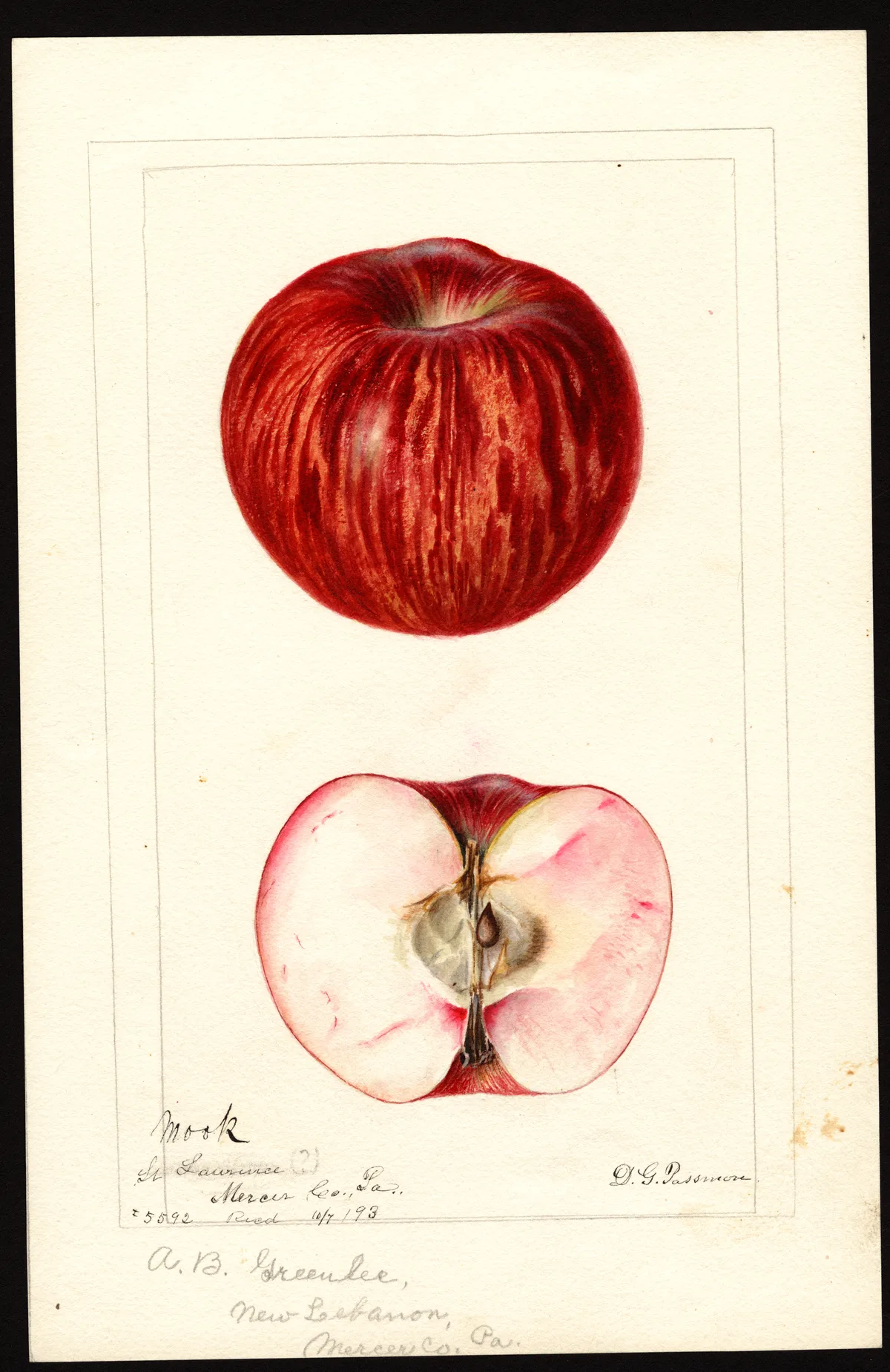
USDA Pomological Watercolor Collection
St. Lawrence
Origin / History
The origin of St. Lawrence is not definitely known. Several sources credit it to America (Downing; Hansen; Budd-Hansen; Beach), while Elliott (1865) and Thomas (1903) call it Canadian, with Thomas giving the additional name "Corse's St. Lawrence." Hedrick (1922) considered it probably a seedling of Fameuse grown in lower Canada early in the nineteenth century.
Beach traces a detailed bibliographic history: as early as 1835 St. Lawrence was recommended as one of the American varieties worthy of cultivation in England. In 1848 Thomas described it as a newly introduced variety cultivated in the vicinity of Rochester and originally from Lower Canada. It was entered in the catalogue of the American Pomological Society in 1862, and was frequently listed by nurserymen but, by Beach's time, seldom planted in New York state.
Tree
Tree of medium size, vigorous to moderately vigorous, upright to upright-spreading, hardy, generally pretty healthy, moderately long-lived, productive, and a reliable cropper yielding good to rather heavy crops biennially (Beach; Hansen; Budd-Hansen; Downing; Hedrick; Central Experimental Farm). Young shoots/twigs smooth, reddish brown to rather dark reddish-brown (Downing; Beach).
Beach notes it is not a very good grower in the nursery, and that some growers hold it desirable to topwork it upon some more vigorous stock such as Northern Spy. Hansen and Budd-Hansen both note that, although valuable, the variety "ripens when there is an abundance of other fruit." In the Niagara district it is considerably affected by scab and by codling moth (Woolverton, cited by Beach).
Fruit
Size. Large, or large to medium (Beach); Lowther also rates it large.
Form. Oblate, tapering toward the eye (Downing; Central Experimental Farm), somewhat conical and slightly angular (Hansen; Budd-Hansen), oblate inclined to conic varying to roundish oblate, faintly ribbed (Beach), oblate-conic or round-oblate, faintly ribbed (Hedrick), roundish flattened (Elliott), or roundish, slightly oblate and sometimes a little conical, obtuse (Thomas). Lowther gives form code "ja." Hedrick characterizes the fruit as of the Fameuse type, greatly resembling Fameuse but seldom equaling it except in size, being usually much larger.
Stem / stalk. Short (Elliott), short and rather slender (Thomas; Hedrick), short to medium in length and moderately slender (Beach), or of medium length (Downing; Hansen; Budd-Hansen).
Cavity. Open and deep (Elliott); large (Downing); wide, deep, regular, with faint trace of russet (Hansen; Budd-Hansen); wide (Thomas); large, acute, deep, regular, greenish-russeted (Beach; Hedrick).
Calyx. Closed (Elliott; Downing — "firmly closed"; Hansen; Budd-Hansen; Beach — "small, closed"; Hedrick — "small, closed"). Hansen and Budd-Hansen add: segments long, erect convergent.
Basin. Slightly furrowed (Elliott); small and deep (Downing); deep, narrow, abrupt, smooth or slightly wrinkled (Hansen; Budd-Hansen); round, deep, with a very obtuse rim (Thomas); rather small, narrow, moderately deep, abrupt, wrinkled (Beach); small, narrow, deep, abrupt, wrinkled (Hedrick).
Skin / color. Pale yellow, striped and splashed with red and deep crimson (Elliott); yellowish, striped and splashed with carmine (Downing; Central Experimental Farm); surface smooth, yellowish green, mostly covered with sharply defined carmine splashes and stripes — the sharp contrast between the red and green being a marked characteristic (Hansen; Budd-Hansen); whole surface broadly and very distinctly striped with very dark red, on light greenish yellow ground (Thomas); pale yellow washed and marbled with bright red, striped and splashed with bright dark carmine and overspread with thin white bloom (Beach); pale yellow washed and marbled with red, striped and splashed with dark carmine and overspread with thin bloom (Hedrick); skin color yellow-red (Lowther).
Dots. Gray, minute, obscure (Hansen; Budd-Hansen); numerous, rather obscure, fine, russet (Beach); numerous, obscure, fine, russet (Hedrick).
Calyx tube. Narrow, cone-shape to funnel-form (Beach); narrow, cone-shape (Hedrick); conical (Hansen; Budd-Hansen).
Stamens. Median (Hansen; Budd-Hansen; Beach; Hedrick).
Core / seeds. Core large; seeds small (Elliott). Core partially open, clasping; cells obovate, widely slit (Hansen; Budd-Hansen). Core medium size, somewhat abaxile; cells partly open; core lines clasping; carpels obovate to elliptical, emarginate (Beach). Core medium in size, abaxile; cells partly open; core-lines clasping; carpels obovate, emarginate (Hedrick).
Flesh and flavor. White, fine-grained, tender, juicy, sharp, sub-acid; "very good" (Elliott). White, lightly stained, crisp, juicy, tender, and vinous; good to very good (Downing). White, often slightly stained with pink, crisp, tender, juicy, vinous subacid, good to very good (Hansen; Budd-Hansen). Flavor rather acid, moderately rich, agreeable (Thomas). White, sometimes slightly stained with red, tender, fine-grained, crisp, juicy, mild subacid, good to very good for dessert; rather mild for culinary uses (Beach). White, stained with red, tender, fine-grained, crisp, juicy, mild subacid; good to very good (Hedrick). White, juicy, crisp, tender and vinous, quality very good (Central Experimental Farm). Lowther: quality very good.
Season
September to October (Elliott; Downing; Hansen; Budd-Hansen; Beach; Hedrick). September (Central Experimental Farm). Ripening about mid-autumn (Thomas); autumn (Lowther).
Beach notes the crop ripens somewhat unevenly and should have more than one picking in order to secure the fruit in prime condition and prevent great loss from dropping. The fruit may not remain on the tree till it is well colored, and unless it is well colored it fades in the barrel so much as to render it almost valueless for market. The variety does not stand heat well before going into storage and goes down quickly; it varies greatly in keeping qualities in different seasons but usually October is its commercial limit in ordinary storage; in cold storage it may be held until December.
Uses
When well grown, St. Lawrence is a large, handsome apple; it is better for dessert than for culinary use but does not excel standard varieties of its season for either purpose (Beach). Thomas calls it "a very handsome, hardy, and productive apple, of good flavor." Lowther lists the primary use as market.
Beach notes that, although many fruit growers regard it as a fairly profitable commercial apple, it cannot be recommended for general cultivation. Waugh (cited by Beach) remarks that in Grand Isle county, Vermont, "It is rather common but not highly prized. It precedes Fameuse in season and is of the same general character." Woolverton (cited by Beach) states that it is not planted in the commercial orchards of Ontario bordering Lakes Ontario, Erie or Huron, but is valued in orchards along the St. Lawrence river and parts of the Province between latitudes 45 and 46. Hedrick observes that it thrives in New England and parts of Canada and is especially prized along the St. Lawrence River. Beach also notes that while it does very well in some portions of Western New York, it generally reaches a higher degree of perfection in favorable locations in the St. Lawrence valley and in the Lake Champlain region than in other portions of the state.
Lowther reports 12 stations in the Northern Division and 5 stations in the Central Division (both with cross-division reporting indicated), with no stations reported in the Southern Division.
Subtypes / Variants
Not described in source.
Other
Central Experimental Farm (Agassiz, BC) notes the variety was planted at that station in the spring of 1890.
Book Sources
Described in 8 period pomological works
- Beach, The Apples of New York Vol. 2 (1905)
- Hedrick, Cyclopedia of Hardy Fruits (1922)
- Budd & Hansen, Systematic Pomology (1914) — listed as Saint Lawrence
- Downing, Fruits and Fruit Trees of America (1900)
- Elliott, The Western Fruit Book (1865)
- Lowther (ed.), Encyclopedia of Practical Horticulture (1914)
- Hansen, A Study of Northwestern Apples (1902)
- Thomas, The American Fruit Culturist (1903)
Nursery Catalog Sources
Found in 16 catalogs (1889–1920) from Illinois, Maryland, Massachusetts, New Jersey, Oregon, Pennsylvania, Washington
- Palouse Nursery and Pleasant Dale Fruit Farm , Colfax, Washington Territory (situated two miles northeast of Colfax) - undated (single-page broadside flyer; "Washington Territory" suggests pre — 1889
- William H. Moon Co. , Morrisville, Bucks County , Pennsylvania — 1890
- Rogers Nursery Co. , Moorestown , New Jersey — 1893
- Reading Nursery , Jacob W. Manning, Proprietor, Reading , Massachusetts — 1898
- Brown Brothers Co. , Continental Nurseries, Rochester, NY (also operated from Toronto, Canada) — 1899
- Central Experimental Farm , Dominion Department of Agriculture, Agassiz, British Columbia (under test; Bulletin No. 3, Second Series) — 1900
- Washington Nursery Co. , Toppenish , Washington — 1901
- Brown Brothers Co. , Continental Nurseries, Rochester, NY (also operated from Toronto, Canada) — 1901
- Benjamin Buckman (personal inventory) , Farmingdale , Illinois — 1901
- Phoenix Nursery Company (W. E. Rossney , President; Sidney Tuttle, Vice-President), Bloomington , Illinois — 1904
- Wm. J. Corse (successor to Robert Sinclair / Sinclair Nurseries) , Baltimore , Maryland — 1909
- Washington Nursery Company , Toppenish , Washington — 1909
- Pacific Nursery Company , Portland , Oregon — 1912
- Washington Nursery Company , Toppenish , Washington — 1912
- Benjamin Buckman (personal inventory) , Farmingdale , Illinois — 1913
- Oregon Nursery Co. , Orenco , Oregon — 1920
View original book sources (9)
— F.R. Elliott, The Western Fruit Book (1865)St. Lawrence.
Montreal.
From Canada. Fruit, large, roundish flattened, pale yellow, striped and splashed with red and deep crimson; stem, short; cavity, open, deep; calyx, closed; basin, slightly furrowed; core, large; seeds, small; flesh, white, fine-grained, tender, juicy, sharp, sub-acid; "very good." September to October.
— A.J. Downing, The Fruits and Fruit Trees of America (1900)St. Lawrence.
Origin uncertain. Tree vigorous, upright, productive. Young shoots smooth, reddish brown.
Fruit large, oblate, tapering towards the eye, yellowish, striped and splashed with carmine. Stalk of medium length, inserted in a large cavity. Calyx firmly closed. Basin small and deep. Flesh white, lightly stained, crisp, juicy, tender, and vinous. Good to very good. September, October.
— N.E. Hansen, A Study of Northwestern Apples (1902)St. Lawrence—Of American origin; tree vigorous, upright, productive, valuable, but ripens when there is an abundance of fruit—Fruit large, oblate, somewhat conical, slightly angular; surface smooth, yellowish green, mostly covered with sharply defined carmine splashes and stripes, the sharp contrast between the red and green is a marked characteristic; dots gray, minute, obscure; cavity wide, deep, regular, with faint trace of russet; stem medium; basin deep, narrow, abrupt, smooth or slightly wrinkled; calyx closed, segments long, erect convergent. Core partially open, clasping; cells obovate, widely slit; tube conical; stamens median; flesh white, often slightly stained with pink, crisp, tender, juicy, vinous subacid, good to very good. September to October.
— John J. Thomas, The American Fruit Culturist (1903)St. Lawrence. (Corse's St. Lawrence.) Large, roundish, slightly oblate, and sometimes a little conical, obtuse; whole surface broadly and very distinctly striped with very dark red, on light greenish yellow ground; stem rather short and slender, cavity wide; basin round, deep, with a very obtuse rim; flavor rather acid, moderately rich, agreeable. A very handsome, hardy, and productive apple, of good flavor, ripening about mid-autumn. Canadian.
[Additional entry in this volume: "Corse's St. Lawrence", pp. 721–721]
Corse's St. Lawrence. See St. Lawrence.
— S.A. Beach, The Apples of New York, Vol. 2 (1905)ST. LAWRENCE.
REFERENCES. 1. London Hort. Soc. Cat., 1831:No. 1187. 2. Kenrick, 1832:28. 3. Mag. Hort., 1:149. 1835. 4. Hovey, Ib., 13:539. 1847. fig. 5. Mag. Hort., 14:531, 539. 1848. 6. Thomas, Cultivator, 5:246. 1848. 7. Cole, 1849:104. 8. Thomas, 1849:152. 9. Barry, 1851:286. 10. Waring, 1851:30. 11. Elliott, 1854:158. 12. Downing, 1857:193. 13. Hooper, 1857:90. 14. Gregg, 1857:47. 15. Am. Pom. Soc. Cat., 1862. 16. Warder, 1867:731. 17. Downing, 1872:10 index, app. 18. Leroy, 1873:799. fig. 19. Montreal Hort. Soc. Rpt., 1876:11. 20. Ib., 15:19, 27. 1890. 21. Lyon, Mich. Hort. Soc. Rpt., 1890:298. 22. Taylor, Me. Pom. Soc. Rpt., 1892:57. 23. Bailey, An. Hort., 1892:249. 24. Woolverton, Ont. Fr. Stas. An. Rpt., 6:9. 1899. figs. 25. Waugh, Vt. Sta. An. Rpt., 14:307. 1901. 26. Hansen, S. D. Sta. Bui, 76:96. 1902. 27. Farrand, Mich. Sta. Bui., 205:46. 1903. 28. Budd-Hansen, 1903:171. fig. 29. Can. Hort., 27:51. 1904. fig. 30. Beach and Clark, N. Y. Sta. Bui, 248:143. 1904. 31. Scriver, Can. Hort., 28:277. 1905.
SYNONYMS. Corse's St. Lawrence (8). Montreal (4, 11, 18). SAINTLAURENT (18). ST. LAWRENCE (1, 2, 3, 4, 5, 6, 7, 8, 9, 10, 11, 12, 13, 14, 15, 16, 17, 19, 20, 21, 22, 23, 24, 25, 26, 27, 28, 29, 30, 31). Saint-Lawrence (18). York and Lancaster (17).
When well grown, St. Lawrence is a large, handsome apple. It is better for dessert than for culinary use but does not excel standard varieties of its season for either purpose. While it does very well in some portions of Western New York, generally speaking, it reaches a higher degree of perfection in favorable locations in the St. Lawrence valley and in the Lake Champlain region than in other portions of the state. The crop ripens somewhat unevenly and should have more than one picking in order to secure the fruit in prime condition and prevent great loss from dropping. It does not stand heat well before going into storage and goes down quickly. The fruit may not remain on the tree till it is well colored, and unless it is well colored it fades in the barrel so much as to render it almost valueless for market. It varies greatly in keeping qualities in different seasons but usually October is its commercial limit in ordinary storage. In cold storage it may be held until December (30).
The tree is a moderately strong grower, hardy, generally pretty healthy, moderately long-lived and a reliable cropper yielding good to rather heavy crops biennially. It is not a very good grower in the nursery. Some growers hold that it is desirable to topwork it upon some more vigorous stock as Northern Spy. Although many fruit growers regard it as a fairly profitable commercial apple it cannot be recommended for general cultivation.
Waugh remarks, that in Grand Isle county, Vermont, "It is rather common but not highly prized. It precedes Fameuse in season and is of the same general character" (25).
Woolverton (29) states that it is not planted in the commercial orchards of Ontario bordering Lakes Ontario, Erie or Huron, but it is valued in orchards along the St. Lawrence river and parts of the Province between the latitudes 45 and 46. In the Niagara district it is considerably affected by scab and by codling moth.
Historical. As early as 1835 St. Lawrence was recommended as one of the American varieties which was worthy of cultivation in England (3). Its origin does not appear to be definitely known but some credit it to this country (12, 17, 26, 28, 29). In 1848 Thomas (6) described it as a newly introduced variety cultivated in the vicinity of Rochester and originally from Lower Canada. In 1862 it was entered in the catalogue of the American Pomological Society (15). It is frequently listed by nurserymen (23) but is now seldom planted in New York state.
TREE.
Tree medium size, moderately vigorous. Form upright spreading. Twigs smooth, rather dark reddish-brown.
FRUIT.
Fruit large to medium. Form oblate inclined to conic varying to roundish oblate, faintly ribbed. Stem short to medium in length, moderately slender. Cavity large, acute, deep, regular, greenish-russeted. Calyx small, closed. Basin rather small, narrow, moderately deep, abrupt, wrinkled. Skin pale yellow washed and marbled with bright red striped and splashed with bright dark carmine and overspread with thin white bloom. Dots numerous, rather obscure, fine, russet. Calyx tube narrow, cone-shape to funnel-form. Stamens median. Core medium size, somewhat abaxile; cells partly open; core lines clasping. Carpels obovate to elliptical, emarginate. Flesh white, sometimes slightly stained with red, tender, fine-grained, crisp, juicy, mild subacid, good to very good for dessert; rather mild for culinary uses. Season September and October.
— J.L. Budd & N.E. Hansen, American Horticultural Manual, Part II: Systematic Pomology (1914)Saint Lawrence. — Of American origin; tree vigorous, upright, productive; valuable, but ripens when there is an abundance of other fruit.
Saint Lawrence.
Fruit large, oblate, somewhat conical, slightly angular; surface smooth, yellowish green, mostly covered with sharply defined carmine splashes and stripes, the sharp contrast between the red and green is a marked characteristic; dots gray, minute, obscure; cavity wide, deep, regular, with faint trace of russet; stem medium; basin deep, narrow, abrupt, smooth or slightly wrinkled; calyx closed; segments long, erect convergent. Core partially open, clasping; cells obovate, widely slit; tube conical; stamens median; flesh white, often slightly stained with pink, crisp, tender, juicy, vinous subacid, good to very good. September to October.
— Granville Lowther (ed.), Encyclopedia of Practical Horticulture (1914)Saint Lawrence is a large apple with skin color yellow-red. Quality is very good. Primary use is market. Season is autumn. Reported by 12 stations in the Northern Division (cross-division reporting indicated) and 5 stations in the Central Division (cross-division reporting indicated); no stations reported in the Southern Division. Form code: 'ja'.
— U.P. Hedrick, Cyclopedia of Hardy Fruits (1922)ST. LAWRENCE. Montreal. St. Lawrence is an apple of the Fameuse type; the fruits greatly resemble those of Fameuse, but seldom equal them except in size, being usually much larger. It thrives in New England and parts of Canada and is especially prized along the St. Lawrence River. Its origin is not known, but it is probably a seedling of Fameuse grown in lower Canada early in the nineteenth century.
Tree of medium size, vigorous, upright-spreading. Fruit large, oblate-conic or round-oblate, faintly ribbed; stem short, slender; cavity large, acute, deep, regular, greenish-russeted; calyx small, closed; basin small, narrow, deep, abrupt, wrinkled; skin pale yellow washed and marbled with red, striped and splashed with dark carmine and overspread with thin bloom; dots numerous, obscure, fine, russet; calyx-tube narrow, cone-shape; stamens median; core medium in size, abaxile; cells partly open; core-lines clasping; carpels obovate, emarginate; flesh white, stained with red, tender, fine-grained, crisp, juicy, mild subacid; good to very good; September and October.
— Central Experimental Farm, Central Experimental Farm, Agassiz BC — Catalogue of Fruit Trees under Test (Bulletin No. 3, 1900) (1900)Planted Spring 1890. Tree a vigorous grower, and regular bearer. Fruit large, oblate tapering to the eye. Skin yellowish, striped and splashed with carmine. Flesh white, juicy, crisp, tender and vinous, quality very good. Season September.