Scott
Apple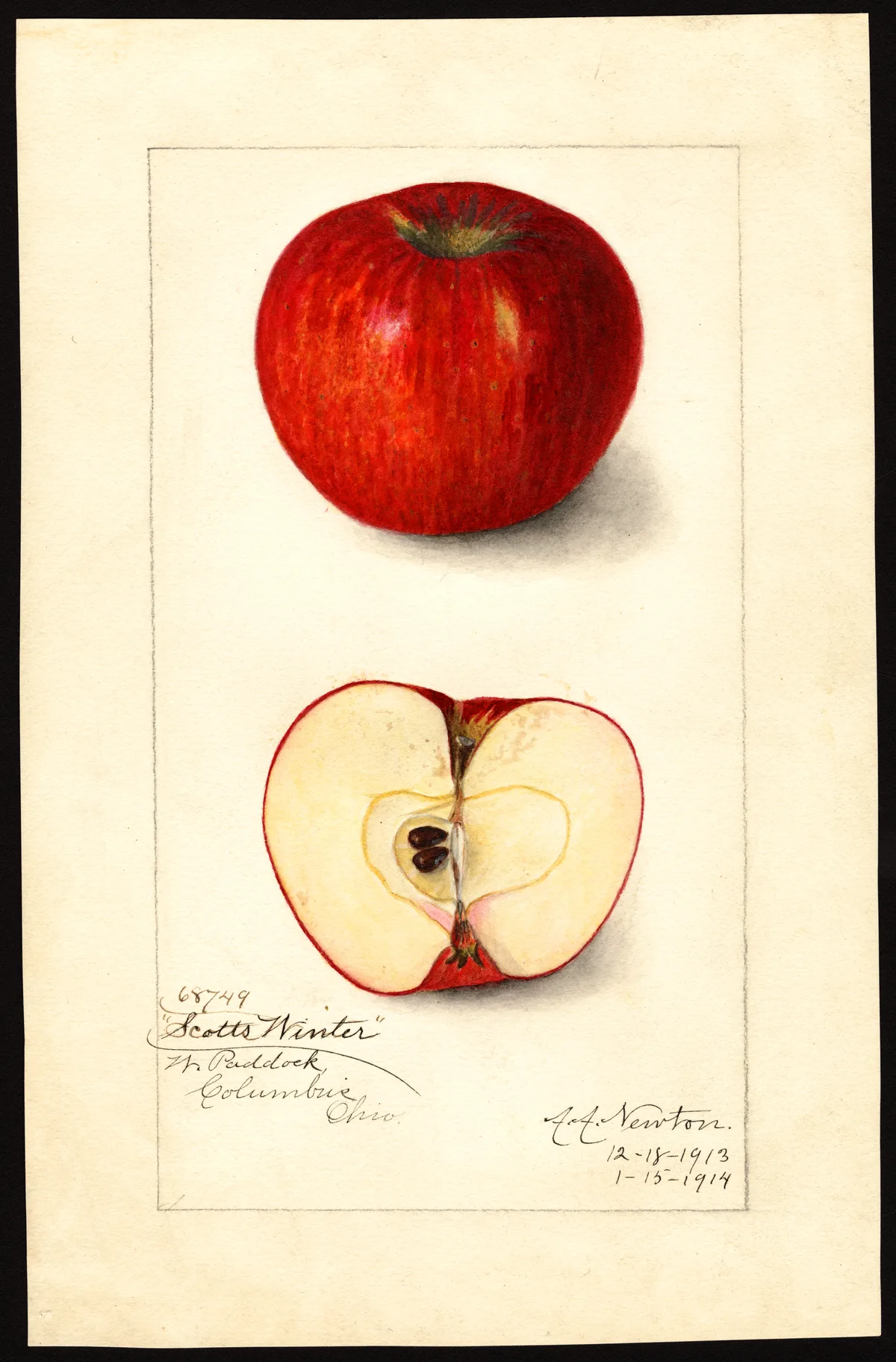
USDA Pomological Watercolor Collection
Scott
Origin / History
Scott originated about 1864 on the Scott Farm at Newport, Vermont (Beach; Hedrick). It was brought to notice by Dr. T. H. Hoskins of that place (Beach). Hansen likewise gives the origin as Vermont and credits the introduction to Dr. Hoskins. The earliest report Beach cites is that of the Montreal Horticultural Society for 1877. Through the 1880s and 1890s the variety appeared in American and Canadian horticultural reports chiefly under the name "Scott Winter." Trees were planted for trial at the Central Experimental Farm, Agassiz, British Columbia, in the spring of 1890.
Hansen called it "promising at the North." Thomas judged it "a good substitute at the North for Roxbury Russet." Beach found it valuable for regions where the climate is too severe to permit varieties of the grade of hardiness of Northern Spy and Rhode Island Greening to be grown profitably. Writing in 1905, he said it was not generally known among New York fruit growers. It had been sparingly disseminated in various portions of that state but not planted extensively in any locality. In some New York localities it was grown with profit for local market, and in portions of New England and Canada it was classed among the commercial varieties.
Hedrick wrote in 1922 that Scott "at one time played an important part as a commercial apple in New England, but seems now to be passing from cultivation." By his account it came into prominence because of the hardiness, healthfulness, and reliability of the trees and the long-keeping qualities of the apples. It was being superseded by better kinds, because the apples are small, uneven in shape and size, susceptible to scab, and of coarse flesh and austere flavor. By then it was grown with profit only in a few parts of New England and Canada.
Tree
Tree medium to rather large, vigorous, a strong grower. Form upright, becoming roundish or spreading, rather dense. Twigs medium to long, stout to somewhat slender; internodes medium to long. Bark dull reddish-brown mingled with olive-green, irregularly streaked with scarf-skin, pubescent. Lenticels scattering, small to medium, roundish, slightly raised. Buds medium or below medium in size, broad, plump, obtuse to somewhat acute, free or nearly so, slightly pubescent (Beach).
Very hardy and healthy. An early, constant, and reliable bearer, yielding moderate to rather heavy crops biennially or in some cases annually (Beach); Hansen calls it an annual and good bearer. The fruit hangs well to the tree.
The fruit is liable to injury by scab unless proper preventive treatment is given. Beach, citing Craig, warns that the tree should not be grown in sod. The fruit is naturally small and becomes unprofitably so unless the orchard is heavily manured and given thorough tillage.
Fruit
Size: Small to medium. Most authors place it below medium or sometimes medium; Thomas and Lowther call it medium, and Hedrick calls the apples small. The fruit is apt to be uneven in size (Beach).
Form: Roundish conic to roundish oblate or oblate, conical or tapering to the eye, often irregularly elliptical, broadly but obscurely ribbed or somewhat angular. Thomas calls it round. Beach calls it of "pretty good form," while Hedrick calls it uneven in shape.
Stem: Short to very short.
Cavity: Deep, above medium to rather small, narrow to rather wide, sometimes gently furrowed. Usually russeted, often with outspreading russet rays or stellate russet. Beach calls the cavity acuminate; Hansen calls it regular and obtuse.
Calyx: Small, closed or nearly so. Lobes medium in length, converging, rather narrow, acute; Beach describes them as usually reflexed, Hansen as erect convergent. Calyx tube conical; Beach finds it rather long, cone-shaped or approaching funnel-form, sometimes extending into the core. Stamens median to marginal.
Basin: Narrow to rather narrow, abrupt to very abrupt, usually deep, below medium to rather small. Slightly furrowed, or slightly wrinkled or wavy, often pubescent.
Skin: Smooth, rather thin, moderately tough (Beach). Ground green, greenish, or pale yellow to rich yellow. It is mostly or almost covered with bright deep red, mottled, striped, and splashed with darker red ("two shades of red," Agassiz station). Highly colored specimens have a very dark, almost purplish-red cheek (Beach). Hansen describes the surface as heavily washed with red, with indistinct dark stripes and splashes and some open russet net-veining, "giving the fruit a peculiar marbled, dark orange red color." General appearance good red or striped red; color attractive.
Dots: Scattering, obscure, pale yellow or russet (Beach).
Flesh and flavor: Flesh crisp, firm, juicy to very juicy, tender. Color slightly tinged with yellow and sometimes stained with red (Beach), yellow (Hansen), or white (Agassiz station). Hansen calls the flesh fine grained; Beach calls it "a little coarse," and Hedrick calls it coarse.
Flavor acid to briskly subacid, sprightly, pleasant, aromatic, eventually becoming rather mild subacid (Beach). Thomas calls it "rather acid," and Hedrick calls the flavor austere.
Quality "good" by most accounts. The Agassiz station rates it "good to very good," while Beach adds that it is "not of high quality."
Core and seeds: Core rather small to moderately large, axile or somewhat abaxile with hollow central cylinder (Beach). Hansen calls the core closed; Beach finds the cells closed or partly open. Cells pretty uniformly developed and symmetrical (Beach), round (Hansen). Core lines meeting or somewhat clasping.
Carpels broadly roundish, varying from nearly elliptical to nearly cordate, slightly emarginate, mucronate, smooth or nearly so (Beach). Seeds numerous, eight to ten (Hansen), above medium to rather small, short, rather narrow to moderately wide, acute to acuminate, plump, dark, sometimes a little tufted.
Season
Winter to late winter, recorded from December into May; a long keeper. The Agassiz station records January to February. Beach, citing Beach and Clark, gives December to May in ordinary storage, with March as its commercial limit.
Uses
Chiefly culinary. Beach finds it especially suitable for culinary purposes in the spring, because it retains a good degree of acidity later than most varieties of its season. Toward the close of the season its acidity is somewhat subdued, and it then becomes an acceptable dessert fruit.
Lowther gives market as its primary use. Beach notes that uneven size and scab injury often cause considerable loss in undersized or otherwise unmarketable fruit.
Subtypes / Variants
Not described in source.
Other
Not described in source.
Book Sources
Described in 6 period pomological works
- Beach, The Apples of New York Vol. 1 (1905)
- Thomas, The American Fruit Culturist (1903) — listed as Scott's Winter
- Budd & Hansen, Systematic Pomology (1914) — listed as Scott Winter
- Lowther (ed.), Encyclopedia of Practical Horticulture (1914) — listed as Scott's Winter
- Hansen, A Study of Northwestern Apples (1902) — listed as Scott's Winter
- Hedrick, Cyclopedia of Hardy Fruits (1922) — listed as Scott's Winter
Nursery Catalog Sources
Found in 9 catalogs (1891–1912) from Illinois, Missouri, Oregon, Washington
- Missouri Nursery Co. , Louisiana , Missouri — 1891 — listed as Scott's Winter
- J.V. Cotta (Cotta Nursery) , Carroll County , Illinois — 1898 — listed as Scott's Winter
- Central Experimental Farm , Dominion Department of Agriculture, Agassiz, British Columbia (under test; Bulletin No. 3, Second Series) — 1900 — listed as Scott's Winter
- Washington Nursery Co. , Toppenish , Washington — 1901 — listed as Scott's Winter
- Benjamin Buckman (personal inventory) , Farmingdale , Illinois — 1901 — listed as Scott's Winter
- Washington Nursery Company , Toppenish , Washington — 1909 — listed as Scott's Winter
- Pacific Nursery Company , Portland , Oregon — 1912 — listed as Scott's Winter
- Vineland Nurseries Company , Clarkston , Washington — 1912 — listed as Scott's Winter
- Washington Nursery Company , Toppenish , Washington — 1912 — listed as Scott's Winter
View original book sources (7)
— N.E. Hansen, A Study of Northwestern Apples (1902)Scott Winter—Origin, Vermont; introduced by Dr. T. H. Hoskins. Tree a strong, upright grower; an annual and good bearer. Promising at the north—Fruit medium or below, roundish oblate, conical, somewhat angular; surface a rich yellow, heavily washed with red, with indistinct dark stripes and splashes and some open russet net-veining, giving the fruit a peculiar marbled, dark orange red color; cavity regular, deep, obtuse, with stellate russet; stem short; basin narrow, very abrupt, slightly wrinkled or wavy; calyx closed, segments erect convergent. Core closed, clasping; cells round; tube conical; stamens median; seeds eight to ten, short, plump; flesh yellow, fine grained, juicy, crisp, pleasant sprightly acid, good; use chiefly culinary. Late winter.
— John J. Thomas, The American Fruit Culturist (1903)Scott's Winter. Medium, round, deep red, rather acid, good. Is very hardy and a long keeper, and a good substitute at the North for Roxbury Russet.
— S.A. Beach, The Apples of New York, Vol. 1 (1905)SCOTT.
REFERENCES. 1. Montreal Hort. Soc. Rpt., 1877. (cited by 24). 2. Budd, Ia. Hort. Soc. Rpt., 1880:524. 3. Thomas, 1885:523. 4. Van Deman, U. S. Pom. Rpt., 1886:271. fig. 5. Montreal Hort. Soc. Rpt., 1886-87:9, 94. 6. Rural N. Y., 47:249, 646. 1888. 7. Can. Hort., 13:174, 187, 216. 1890. 8. Bailey, An. Hort., 1892:249. 9. Can. Hort., 15:159. 1892. col. pl. 10. Ib., 16:204. 1893. 11. Heiges, U. S. Pom. Rpt., 1894:22. 12. Craig, Can. Dept. Agr. Rpt., 1894:125. 13. Ont. Fr. Gr. Assn. An. Rpt., 26:16, 75. 1894. 14. Card, and For., 8:200. 1895. 15. Craig, Can. Dept. Agr. Rpt., 1895:93. figs. 16. Budd, Ia. Sta. Bul., 31:333. 1895. 17. Waugh, Vt. Sta. Bul., 61:32. 1897. 18. Am. Pom. Soc. Cat., 1897:14. 19. Waugh, Vt. Sta. An. Rpt., 14:308. 1901. 20. Hansen, S. D. Sta. Bul., 76:98. 1902. fig. 21. Budd-Hansen, 1903:173. fig. 22. Powell and Fulton, U. S. B. P. I. Bul., 48:55, 1903. 23. Beach and Clark, N. Y. Sta. Bul., 248:144. 1904. 24. Ragan, U. S. B. P. I. Bul., 56:277. 1905.
SYNONYMS. Scott's Red Winter (8, 22). SCOTT WINTER (2, 3, 4, 5, 6, 7, 8, 9, 10, 11, 12, 13, 14, 15, 16, 17, 18, 20, 21, 22, 24). Scott's Winter (11, 19, 23, 24). Wilcox's Winter (24).
Fruit medium to rather small, of pretty good form and attractive color. It is especially suitable for culinary purposes in the spring because it retains a good degree of acidity later than most varieties of its season. Toward the close of its season its acidity is somewhat subdued and it then becomes an acceptable dessert fruit although it is not of high quality. The tree is very hardy, healthy, comes into bearing young and is a reliable cropper, yielding moderate to rather heavy crops biennially or in some cases annually. The fruit hangs well to the tree but it is apt to be uneven in size and unless proper preventive treatment is given is liable to be injured by scab so that, on the whole, there is often considerable loss in undersized or otherwise unmarketable fruit. In ordinary storage it is in season from December to May with March as its commercial limit (23). Scott is valuable for regions where the climate is too severe to permit varieties of the grade of hardiness of Northern Spy and Rhode Island Greening to be grown profitably. It should not be grown in sod because the fruit is naturally small and becomes unprofitably so unless the orchard is heavily manured and given thorough tillage (12, 15). In some localities in this state it is grown with profit for local market, and in portions of New England and Canada it is classed among the commercial varieties.
Historical. Originated about 1864 on the Scott Farm at Newport, Vermont, and brought to notice by Dr. T. H. Hoskins of that place. It is not generally known among New York fruit growers. It has been sparingly disseminated in various portions of this state but has not been planted extensively in any locality.
TREE.
Tree medium to rather large, vigorous. Form upright, becoming roundish or spreading, rather dense. Twigs medium to long, stout to somewhat slender; internodes medium to long. Bark dull reddish-brown mingled with olive-green, irregularly streaked with scarf-skin; pubescent. Lenticels scattering, small to medium, roundish, slightly raised. Buds medium or below medium in size, broad, plump, obtuse to somewhat acute, free or nearly so, slightly pubescent.
FRUIT.
Fruit below medium or sometimes medium. Form roundish conic to roundish oblate, often irregularly elliptical, broadly but obscurely ribbed. Stem short to very short. Cavity above medium to rather small, acuminate, deep, narrow to rather wide, sometimes gently furrowed, usually russeted and often with outspreading russet rays. Calyx small, closed or nearly so; lobes medium in length, converging and usually reflexed, rather narrow, acute. Basin below medium to rather small, abrupt, usually deep and rather narrow, slightly furrowed, often pubescent. Skin smooth, rather thin, moderately tough, pale yellow or greenish mostly covered with a bright deep red mottled and striped with darker red. Highly colored specimens have a very dark and almost purplish-red cheek. Dots scattering, obscure, pale yellow or russet. General appearance good red or striped red. Calyx tube rather long, cone-shape or approaching funnel-form, sometimes extending into the core. Stamens median to marginal. Core rather small to moderately large; axile or somewhat abaxile with hollow central cylinder; cells pretty uniformly developed, symmetrical, closed or partly open; core lines meeting or somewhat clasping. Carpels broadly roundish, varying from nearly elliptical to nearly cordate, slightly emarginate, mucronate, smooth or nearly so. Seeds numerous, above medium to rather small, rather narrow to moderately wide, acute to acuminate, plump, dark, sometimes a little tufted. Flesh slightly tinged with yellow, sometimes stained with red, firm, crisp, a little coarse, tender, very juicy, briskly subacid, eventually becoming rather mild subacid, aromatic, good.
— J.L. Budd & N.E. Hansen, American Horticultural Manual, Part II: Systematic Pomology (1914)Scott Winter.—Origin, Vermont; introduced by Dr. T. H. Hoskins. Tree a strong, upright grower; an annual and good bearer. Promising at the North.
Fruit medium or below, roundish oblate, conical, somewhat angular; surface a rich yellow, heavily washed with red, with indistinct dark stripes and splashes and some open russet net-veining, giving the fruit a peculiar marbled, dark orange-red color; cavity regular, deep, obtuse with stellate russet; stem short; basin narrow very abrupt, slightly wrinkled or wavy; calyx closed; segments erect convergent. Core closed, clasping; cells round; tube conical; stamens median; seeds eight to ten, short, plump; flesh yellow, fine-grained, juicy, crisp, pleasant, sprightly acid, good; use chiefly culinary. Late winter.
— Granville Lowther (ed.), Encyclopedia of Practical Horticulture (1914)Scott Winter is a medium-sized apple of roundish conical form. The skin is striped or splashed (red). Quality is good. Primary use is market. Season is winter.
— U.P. Hedrick, Cyclopedia of Hardy Fruits (1922)SCOTT WINTER. Scott's Red Winter. Scott. This variety at one time played an important part as a commercial apple in New England, but seems now to be passing from cultivation. It came into prominence because of the hardiness, healthfulness, and reliability of the trees, and the long-keeping qualities of the apples. It is being superseded by better kinds, because the apples are small, uneven in shape and size, susceptible to scab, and with coarse flesh and austere flavor. The apple is now grown with profit only in a few parts of New England and Canada. It originated on the Scott farm, Newport, Vermont, about 1864.
— Central Experimental Farm, Central Experimental Farm, Agassiz BC — Catalogue of Fruit Trees under Test (Bulletin No. 3, 1900) (1900)Planted Spring 1890. Tree a vigorous grower, and an early and constant bearer. Fruit below medium size, oblate, tapering to the eye. Skin green, almost covered with two shades of red. Flesh white, crisp, juicy, sprightly, pleasantly acid, quality good to very good. Season January to February.