Rhode Island Greening
Apple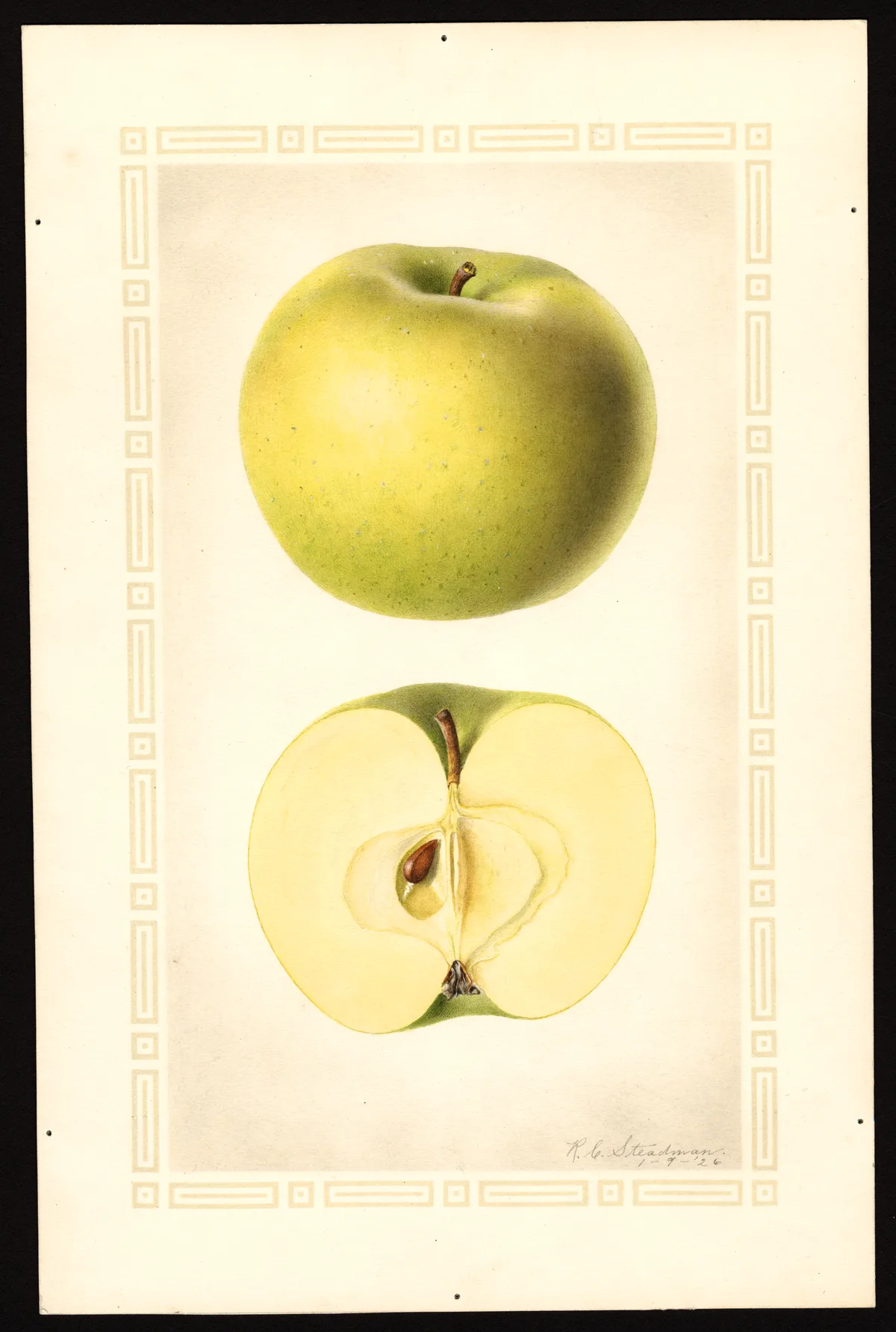
USDA Pomological Watercolor Collection
Rhode Island Greening
Origin/History
The locality of origin is not known with certainty, but there is little reason to doubt that Rhode Island Greening originated in the State of Rhode Island, and probably in the vicinity of Newport near the place now known as Green's End, "where, in olden times, there was a tavern kept by Mr. Green, who raised apple trees from seed. Among the trees thus produced was one which bore a large green apple. The scions of this tree were in such demand by the people who stopped there as guests, that the tree died from excessive cutting and exhaustion. The fruit which resulted from grafting with these scions was known by different names in Rhode Island as the 'apple from Green's Inn,' while in adjoining States it was called the 'Green's Inn apple from Rhode Island.'" In the town of Foster, upon the farm of Thomas R. Drowne at Mt. Hygeia, stood an old Rhode Island Greening tree supposed to be nearly 200 years old (as of 1905/1914), which had borne uninterruptedly until within a few years of that date. On the farm of Frederick W. Winslow, a few rods southwest of the lime kiln on the northern verge of Fruit Hill, stood a tree locally known as the "Daughter Tree" — a limb of the mother tree which was broken off in the September gale of 1815, thrust into rich moist soil, took root, and became an independent tree. The mother tree was planted in 1748 and was, therefore, 141 years old when it was cut down in 1889. Authentic records of trees of this variety planted about 150 years ago in the soil of North Providence, on the farm of the late Lemuel Angell, were still in possession of that family. The variety was introduced into the old Plymouth colony from Newport in 1765, and from there was carried into Ohio by General Putnam in 1796 or 1797, and from thence distributed over that section of country (Hovey gives 1796 or 97; Beach's quoted source gives 1796). Coxe, in 1817, is the first author who fully describes it, and says nothing of the origin; in New Jersey it was in his time, and still was in some localities later, called the Jersey Greening, but from its name Hovey presumes it originated in Rhode Island. While there is no record of its earliest introduction into New York, it is well known that Rhode Island Greening was pretty widely disseminated in the older settled regions of New York during the eighteenth century, and is often found in the very oldest orchards as well as in recently planted ones. Bunyard (1920) gives its origin as American, probably over 150 years old. Its cultivation dates back nearly 200 years (Hedrick, 1922). The variety is one of the main orchard fruits of America, along with Roxbury Russet and Baldwin (Hovey). It is more generally planted than any other variety in New York except Baldwin (Beach), and ranks among the first half-dozen commercial varieties of the country (Hedrick). Coxe (1817), in a separate entry under the name "Large Greening" (No. 132), notes: "This apple I received as the Rhode-Island Greening, which is a superior apple: it is cultivated in Bucks county, Pennsylvania; is a large and uncommonly flat apple; the skin a smooth, lively green; the flesh is white, juicy, and tender, but not highly flavoured—it is an early winter fruit; the tree handsomely formed, and very tall" — Coxe thus distinguishes the Bucks county "Large Greening" from the true Rhode Island Greening despite the original name supplied to him.
Tree
Tree large, or above medium, eventually becoming large though not an exceptionally rapid grower (Beach); very vigorous (Coxe, Hovey, Warder, Downing, Budd-Hansen, Lowther, Hedrick), of strong, spreading growth (Budd-Hansen); hardy, strong, vigorous, usually pretty healthy (Beach, Lowther); long-lived (Beach, Hedrick). Form wide-spreading, somewhat drooping, rather dense (Beach, Lowther, Hedrick); Hovey describes it as not much inclined to run up, but assuming a rather low and branching habit, forming a broad, flattened head — and consequently does not make so tall and round a head as the Baldwin; its branches spread out more, and, as the tree acquires age, they become somewhat pendent and nearly touch the ground. Warder describes it as crooked, spreading, productive. Coxe describes the tree as very large, the limbs strong and spreading, the growth very luxuriant. Bunyard describes growth as sturdy and compact; regularly fertile. Annual growth moderate (Hovey). The tree has a tendency to form a rather dense head particularly when the soil is kept fertile and well tilled and the foliage is thoroughly protected from the attacks of insects and fungi; in pruning, special care should be taken to keep the head sufficiently open so that the light may reach the foliage in all parts of the tree — orchardists sometimes mistake this by cutting out large branches from the center, exposing the remaining limbs to sunscald; a better way is to thin the top every year by removing as many of the smaller branches as may be necessary to make it uniformly open. In training the young tree it is well to form the head rather high, because as it matures the branches become long, wide-spreading and more or less drooping; where the tree is headed low the lower branches eventually are so much in the way that it is necessary to remove them, and when loaded with fruit these bend so close to the ground as to interfere with the free circulation of the air beneath the tree, favoring apple scab and other fungous diseases (Beach).
Twigs medium to long, often somewhat crooked, rather stocky; internodes usually short (Beach, Lowther). Thomas notes young trees crooked or oblique, shoots rather spreading. Wood (Hovey): light reddish chestnut, dotted with a few round white specks, downy at the ends, moderately stout, and short-jointed; old wood, grayish chestnut. Warder: shoots stout, dark, with dark foliage. Downing: young shoots reddish brown. Bark olive-green with reddish-brown tinge, thinly covered with lines of gray scarf-skin, pubescent (Beach, Lowther). Lenticels scattering but rather conspicuous, medium in size to rather large, usually roundish, raised (Beach).
Buds (Hovey): small, short, broad, much flattened, very erect, and slightly woolly; flower-buds medium size, woolly. Beach: buds medium to large, broad, plump, obtuse, appressed, pubescent.
Leaves rather large, broad; foliage rather dense (Beach, Lowther, Hedrick). Hovey: medium size, long ovate, narrowing next to the stem, sharply pointed, bright green above, paler and slightly downy beneath, deeply and sharply serrated; petioles medium length, about one inch long, stout, downy. Thomas: leaves sharp serrate. Bunyard: leaf long oval, very dark green, upfolded, very sharply curved serrate.
Flowers (Hovey): large; petals obovate, wavy, cupped, and slightly tinged with blush.
Bearing habits: a regular bearer, producing moderately every year (Hovey); generally a reliable cropper and productive (Beach); generally productive and an annual bearer (Lowther); an abundant bearer (Budd-Hansen). However, Beach also notes that the tree does not come into bearing very young and in many cases is classed as a biennial cropper, but in favorable locations with good care it becomes almost an annual bearer yielding moderate to heavy crops. Thomas notes very productive, single trees sometimes yielding forty bushels of fair fruit in favorable years and orchards 500 bushels per acre. The fruit hangs well to the tree until it begins to ripen, but then is apt to drop to a considerable extent, especially in high winds (Beach). Hedrick notes that the trees load themselves with fruit and are long-lived, but fail in not always holding their load well, in susceptibility to apple-scab, and in tenderness to cold.
Climate and soil: Hovey says it seems suited to all soils and localities, and flourishes throughout the Middle and Western States; in the rich soils of the Ohio valley the most beautiful specimens are produced, but though so large and fair, they hardly equal in quality the produce of more sterile soil and varied climate. Elliott notes it is a gross feeder, and needs soil well drained, rich in lime and phosphates; on usual soils where the variety is defective, liberal dressing with wood ashes will answer; on sandy soils, well manured, the texture is closer than on clay. Warder: in sandstone soils, even in Southern Indiana and Illinois, it does better than on limestone clays; the fruit attains an enormous size, but matures too early for a winter apple. Downing: succeeds well in almost all of the northern sections of the States, and on a great variety of soils. Thomas: fine in New England and New York; tender far West. Beach: succeeds particularly well in Central and Western New York and in the middle portion of the Hudson valley; when grown farther south it is less desirable for commercial purposes because it ripens earlier and is not so good a keeper; in the North it is a little less hardy than Baldwin; in regions best adapted to its cultivation it thrives on different slopes and on a variety of soils, but generally appears to do particularly well on fertile gravelly or sandy loam with well-drained clay subsoil. Lowther: does not do the best in the Pacific Northwest and the Rocky Mountain states, but is at home in New England, New York and Pennsylvania; in the northeastern and north central states it is probably unsurpassed as an apple for dessert and culinary purposes. Hedrick: more fastidious to climate than to soil, refusing to flourish either in extreme northern or in southern apple regions; prefers the fertile intervale lands of New York or Michigan, whether sandy loam or clayey loam, requiring always good drainage. Stark Bros: "Valuable in the East, valuable in all sections where it does well." Elliott: "It is unreliable, South; drops too early." Warder: in some portions of the West it has failed to give satisfaction, being slow to come into bearing, becoming an autumn instead of a winter fruit, and falling badly from the trees before picking time. Downing: in Southern Ohio, Indiana, and farther south it drops too early.
Disease/pest susceptibility: owing partly to the tenderness of its skin, it is more inclined to be wormy than some other varieties — the only fault Hovey considers it possesses, if it can be considered one. Beach: somewhat more subject than Baldwin to apple scab; unless thorough preventive treatment is given, this trouble is apt to cause very serious loss both by direct injury to the fruit and by opening the way to the attacks of other fungi, notably the pink-rot fungus. In some locations the limbs are rather susceptible to canker (Beach). Thomas: susceptible to scab. Hedrick: faults of the fruits are that they bruise rather easily, are often disfigured by apple-scab, and scald badly in cold storage.
Fruit
Size
Large to very large (Coxe, Warder, Elliott, Beach, Budd-Hansen, Lowther, Hedrick); above medium to large or very large, quite uniform in shape and size (Beach, Lowther). Hovey gives about three and a half inches broad and two and three-quarters deep. Bunyard gives medium to large, 3 by 2¼. When well grown, Rhode Island Greening produces a large percentage of high-grade fruit that is smooth, uniform and pretty large with little loss from undersized or other low-grade apples (Beach). The fruit attains an enormous size in some locations (Warder, in sandstone soils of Southern Indiana and Illinois). The apples are substantially large, never coarse, in general symmetrically rotund, and very uniform in size and shape (Hedrick).
Form
Round (Coxe), roundish, a little flattened, pretty regular (Downing), roundish flattened, sometimes a little angular at the base end (Elliott), roundish oblate, slightly flattened at the base, and indistinctly ribbed (Hovey), large, roundish oblate (Thomas, Lowther "R. I. Greening" entry), varying in shape from globular or round to flat — which is the prevailing and characteristic form (Warder), roundish to roundish oblate or sometimes slightly inclined to conic, regular or a little inclined to elliptical, sometimes obscurely ribbed, symmetrical or sides slightly unequal (Beach, Lowther, Hedrick), roundish to roundish oblate, often obscurely ribbed (Budd-Hansen), round, slightly conical (Bunyard). The ends are somewhat flattened, and the stem and crown sunk below the level of the fruit (Coxe).
Stem
Medium in length and thickness, partly green, pubescent (Beach); medium in length, green, pubescent (Hedrick); medium (Elliott); medium length, about three-quarters of an inch long, moderately stout, curved (Hovey); three-fourths of an inch long, curved, thickest at the bottom (Downing); three-fourths of an inch long (Thomas); medium to long, curved, often reddish (Warder); medium to long (Budd-Hansen); rather long, in a narrow cavity (Bunyard).
Cavity
Cavity open (Elliott); wide, regular (Warder); wide, regular, deep, obtuse (Budd-Hansen); medium in size, acute, medium in depth and width, symmetrical or rarely lipped, usually smooth, sometimes russeted and with narrow, outspreading russet rays (Beach); acute, medium in depth and width, symmetrical or rarely lipped, smooth, sometimes russeted and with narrow, outspreading russet rays (Hedrick); moderately deep (Hovey, "inserted in a moderately deep cavity"); narrow (Bunyard).
Calyx
Eye small, closed, and slightly depressed (Hovey); small, woolly, closed, in a slightly sunk scarcely plaited basin (Downing); calyx small, woolly, closed; segments long, pointed, divergent (Budd-Hansen); small, woolly (Elliott); rather small, woolly (Elliott — basin "medium depth, slightly furrowed"); eye small to medium, closed (Warder); below medium to rather large, usually closed, sometimes partly open, pubescent; lobes moderately long, acute (Beach); large, closed, sometimes partly open, pubescent; lobes long, acute (Hedrick); eye closed, in a medium basin (Bunyard). Hovey describes the segments of the calyx as woolly.
Basin
Slightly depressed in a somewhat furrowed basin (Hovey); medium depth, slightly furrowed (Elliott); rather small, often slightly russeted (Thomas); regular, small and russeted to a greater or less extent, sometimes extending half way down the sides of the fruit (Warder); very shallow, small, nearly smooth, often slightly russeted (Budd-Hansen); small to medium, shallow and obtuse to moderately deep and abrupt, regular or slightly furrowed (Beach); small, shallow, obtuse, regular or furrowed (Hedrick); slightly sunk, scarcely plaited (Downing); medium (Bunyard).
Skin
Yellowish green skin, spotted with red like a Newton pippin (Coxe). Coxe's separate "Large Greening" entry describes "a smooth, lively green" skin. Fair, smooth, with an oily touch, of a clear deep green, becoming of a mellow yellow when ripe, with a faint tinge of blush on the sunny side (Hovey). Color green, yellowish green when ripe, with a dull blush, on sun-grown specimens, near the stem (Elliott). Always fair, green, becoming greenish yellow, a dull brown blush to the sun (Thomas). Surface smooth in the North, somewhat rough and often quite russeted in the South, a dull green, becoming yellow at maturity (Warder). Dark green, becoming greenish yellow when ripe, when it sometimes shows a dull blush near the stalk (Downing). Surface dark dull green, becoming greenish yellow when ripe, sometimes with faint dull blush, at the south somewhat rough and often russeted (Budd-Hansen). Skin moderately thick, tough, smooth, waxy, grass-green varying to rather yellow, sometimes with brownish-red blush which rarely deepens to a distinct bright red (Beach, citing Rural N.Y.). Skin thick, tough, smooth, waxy, green or yellow, sometimes with brownish-red blush which rarely deepens to red (Hedrick). Pea green fading to pale yellow (Bunyard). Yellow-green color (Stark Bros). The apple, as the name indicates, is green in color, commonly deep grass-green in autumn, and later, as it ripens, develops more or less of a yellow color; it often has a dull blush and occasionally develops a rather bright red cheek but is never striped (Beach, Lowther). The markets of the East prefer the green-colored fruit, probably because this color is regarded as an indication that the apples are not over-ripe; in some western markets the more attractive yellow and blushed fruit sells well. Some fruit growers follow the practice of picking the fruit while it is still quite green in order to hold its green color; such fruit does not have as good flavor and quality as that which is allowed to become properly ripened on the tree, and probably it is more liable to scald (Beach). In color, the apples are a mellow shade of yellow with a dull blush or occasionally a pale red cheek not showy but pleasing (Hedrick). Lowther also describes skin as moderately thick, tough, smooth, waxy, grass-green varying to rather yellow. Central Experimental Farm catalog: skin greenish yellow, sometimes with a dull blush.
Dots
Dots grey, irregular, numerous (Warder). Dots many, gray, irregular (Budd-Hansen). Dots greenish-white or russet, especially numerous toward the basin and often submerged; prevailing effect green or yellowish (Beach, Hedrick).
Calyx tube / Stamens
Calyx tube rather wide, usually cone-shape with fleshy pistil point projecting into the base but occasionally funnel-form; stamens median to basal (Beach); calyx-tube wide, cone-shape with fleshy pistil point projecting into the base; stamens median (Hedrick); tube funnel-shaped; stamens median or basal (Budd-Hansen).
Flesh and Flavor
Flesh rich, juicy, tender, and very yellow (Coxe — though Coxe's separate Large Greening entry describes the flesh as white, juicy, and tender, but not highly flavoured). Flesh yellow, fine, crisp and tender; juice very abundant, of a brisk, refreshing acid, very high flavored and rich (Hovey). Yellowish, fine-grained, tender, slightly aromatic, lively acid juice (Elliott). Flesh yellow — a rich yellow if much exposed to the sun, and whitish yellow or greenish white if much shaded — tender, juicy, with a rich rather acid flavor (Thomas). Very yellow, breaking, tender, juicy, with a rich, acid flavor (Warder). Yellow, fine-grained, tender, crisp, with an abundance of rich, slightly aromatic, lively, acid juice (Downing). Yellow, fine-grained, tender, very juicy, rich, slightly aromatic, rather acid (Budd-Hansen). Yellowish, firm, moderately fine-grained, crisp, tender, juicy, rich, sprightly subacid, peculiarly flavored (Beach). Yellow, firm, fine-grained, crisp, tender, juicy, rich, sprightly subacid (Hedrick). Crisp, very juicy, pale yellow, spicy flavour (Bunyard). The flesh is tender, very juicy, and has the mellow, yellow tint of the skin; the flavor is rich but does not cloy, pleasantly acidulous, always refreshing, and as the apples ripen they develop a delightful aroma (Hedrick). Tender crisp juicy and good (Stark Bros). Yellowish, fine grained, tender, crisp, juicy, with a pleasant flavour, quality good (Central Experimental Farm).
Hovey on flavor: "To some tastes it is rather acid; but the tenderness of its very juicy flesh, the sprightliness of its abundant juice, and the delicacy of its rich and fine flavor, is not excelled by any of the numerous varieties that we at present possess. In addition to these merits, it ripens up of a fine mellow shade of yellow, and its entire flesh, when well matured, is of the same rich tint."
Quality: very good (Beach, Hedrick, Budd-Hansen, Downing); good (Central Experimental Farm); almost first rate (Warder); very good for dessert in March and April when well ripened (Bunyard). Beach considers it almost the peer of Esopus Spitsenburg as a cooking apple, and decidedly superior to Baldwin for all culinary purposes; also very good in quality for dessert use.
Core and Seeds
Core medium size; seeds medium size (Hovey). Core small; seeds ovate pointed (Elliott). Core roundish-oval, regular, closed, clasping the eye; seeds numerous, angular, dark (Warder). Core open; cells abaxile, ovate, widely slit, with much white exudate (Budd-Hansen); seeds few, angular, pointed, not plump (Budd-Hansen). Core medium or below, somewhat abaxile to axile or nearly so; cells pretty uniform, symmetrical, closed or partly open; core lines meeting if the calyx tube is cone-shape, otherwise clasping. Carpels rather thin, flat, emarginate, roundish to roundish cordate, sometimes tufted. Seeds few; often some are abortive. The plump ones are large, moderately narrow, long, acute to acuminate and sometimes tufted (Beach). Core small, abaxile; cells uniform, symmetrical, closed or partly open; core-lines meeting; carpels thin, flat, emarginate, round to round-cordate, sometimes tufted; seeds few, often abortive, large, narrow, long, acute, sometimes tufted (Hedrick).
Season
As a table fruit, in October, November and December, highly esteemed (Coxe — who notes the Large Greening as "an early winter fruit"). Ripe in December, and often keeps till March (Hovey). December to February (Elliott). Season October to December — in the North, keeping until March (Warder). November to February (Downing, Budd-Hansen). Winter season (Lowther R.I. Greening entry). November to March (Hedrick). Till April (Bunyard); good for dessert in March and April when well ripened. Season early Winter (Central Experimental Farm). In ordinary storage it is in season from October to March or April, and its common commercial limit is January or early February; it may be held commercially in cold storage till March or April. It ripens rapidly during periods of warm weather in autumn and does not stand heat well before going into storage as this induces scald. If put in cold storage in good condition the fruit keeps well and goes down gradually; but if affected by scald or disease it goes down quickly. In going down, it scalds badly in storage, loses in quality, turns yellow, becomes mealy, and large specimens are liable to burst (Beach, citing Beach and Clark). It is a good variety to grow with Baldwin in commercial orchards because, being a little earlier in season, it can be picked and marketed before it is necessary to pick Baldwin (Beach). It is very important that fruit of this variety which is intended for cold storage should be hurried into storage as soon as it is picked — more so than with the average variety (Beach).
Uses
As a cooking apple, the Greening is unsurpassed; and as a dessert fruit of its season, has few equals (Hovey, repeated by Beach). The best cooking apple as yet known (Elliott). A superior cooking apple, and very fine for the dessert when fully ripe (Warder). Generally regarded as one of the very best cooking apples grown, being almost the peer of Esopus Spitsenburg and decidedly superior to Baldwin for all culinary purposes; also very good in quality for dessert use (Beach). Probably unsurpassed as an apple for dessert and culinary purposes in the northeastern and north central states (Lowther). The fruit ranks high among dessert apples, and for culinary purposes is unsurpassed (Hedrick). Both kitchen and market use (Lowther R.I. Greening entry). Dessert or culinary, till April (Bunyard). A useful late fruit of the Newtown Pippin style (Bunyard). The fruit has a recognized standing both in domestic and foreign markets and sells readily at good prices (Beach, Lowther).
Subtypes/Variants
Coxe (1817) describes a related but distinguished apple under "Large Greening" (No. 132), which he received as the Rhode-Island Greening but identifies as a different fruit cultivated in Bucks county, Pennsylvania — large and uncommonly flat, with smooth, lively green skin; white, juicy, tender flesh, but not highly flavoured; an early winter fruit; the tree handsomely formed, and very tall.
Beach notes that the name "Greening" has also been used to some extent as a class name for certain types of green or yellowish-green winter apples, and enters into the names of several well recognized pomological varieties — prominent among which are Bottle Greening, Northwestern Greening, and Patten or Patten Greening. The apple commonly known by the simple name "Greening" among New York fruit growers and fruit dealers is the Rhode Island Greening.
Other
In accordance with the usage of the American Pomological Society, the word "Greening" in the name of this variety was put in italics as the first step toward shortening the name to Rhode Island (Beach). Fruit growers and fruit dealers know the variety very well by the name Rhode Island Greening but commonly call it by the simple name "Greening" (Beach).
Reporting station distribution (Lowther's "R. I. Greening" entry): Northern Division: 20 reporting stations (also reported in another division). Central Division: 12 reporting stations (also reported in another division). Southern Division: not reported.
Central Experimental Farm, Agassiz BC (1900): planted Spring 1890; tree a vigorous but spreading grower.
Book Sources
Described in 11 period pomological works
- Beach, The Apples of New York Vol. 1 (1905)
- Budd & Hansen, Systematic Pomology (1914)
- Warder, American Pomology: Apples (1867)
- Downing, Fruits and Fruit Trees of America (1900)
- Elliott, The Western Fruit Book (1865)
- Hedrick, Cyclopedia of Hardy Fruits (1922)
- Coxe, A View of the Cultivation of Fruit Trees (1817) — listed as Jersey, Or Rhode-Island Greening
- Bunyard, A Handbook of Hardy Fruits (1920)
- Lowther (ed.), Encyclopedia of Practical Horticulture (1914)
- Thomas, The American Fruit Culturist (1903)
- Hovey, The Fruits of America (1852) — listed as THE RHODE-ISLAND GREENING APPLE
Nursery Catalog Sources
Found in 78 catalogs (1845–1936) from Alabama, California, Illinois, Maryland, Massachusetts, Missouri, New Jersey, New York, Oregon, Pennsylvania, Washington
- Winship's Nursery (Brighton Nurseries , operated by the Winship family), Brighton (Boston) , Massachusetts — 1845
- Hovey & Co. , Cambridge , Massachusetts — 1849
- Azell Bowditch (Nursery / Fruit Catalog) , Boston , Massachusetts — 1850
- Joseph Breck & Co. , Boston , Massachusetts — 1855
- St. Helena Nursery , Howell's Prairie, Marion County , Oregon — 1864
- Hutchison Nursery , James Hutchison, Oakland , California — 1881
- Felix Gillet , Barren Hill Nursery, Nevada City , California — 1884
- Fancher Creek Nursery , Fresno , California — 1886
- W.R. Strong & Co. , Capital and Orange Hill Nurseries (Robert Williamson, prop.), Sacramento , California — 1886
- Felix Gillet , Barren Hill Nursery, Nevada City , California — 1888
- California Nursery Co. , Niles , California — 1889
- Felix Gillet , Barren Hill Nursery, Nevada City , California — 1889
- Felix Gillet , Barren Hill Nursery, Nevada City , California — 1890
- William H. Moon Co. , Morrisville, Bucks County , Pennsylvania — 1890
- Felix Gillet , Barren Hill Nursery, Nevada City , California — 1891
- Puyallup & Yakima Nurseries , Puyallup, Washington (Lock Box 191) and North Yakima , Washington — 1892
- Milwaukie-Canby Nurseries , Canby, OR (and Milwaukie, OR) — 1893
- Oregon Wholesale Nurseries , Salem , Oregon — 1893
- Rogers Nursery Co. , Moorestown , New Jersey — 1893
- Sherwood Hall Nursery Co. , Timothy Hopkins (Menlo Park Nurseries), San Francisco / Menlo Park , California — 1893
- Green's Nursery Co. (Charles A. Green) , Rochester , New York — 1894
- Multnomah Nurseries , Russellville , Oregon — 1894
- The Vineland Nurseries (Kelsey & Co. , Proprietors), St. Joseph, Missouri (Office: 13th and Atchison Sts., 2 Blocks East of the Citizens St. Car Line) — 1894
- Woodburn Nurseries , Woodburn, Marion Co. , Oregon — 1894
- Felix Gillet , Barren Hill Nursery, Nevada City , California — 1895
- Stark Bros. Nurseries & Orchards Co. , Louisiana , Missouri — 1896
- The Lovett Company , Little Silver , New Jersey — 1896
- Felix Gillet , Barren Hill Nursery, Nevada City , California — 1897
- Arthur J. Collins & Sons , Moorestown , New Jersey — 1898
- Reading Nursery , Jacob W. Manning, Proprietor, Reading , Massachusetts — 1898
- Stark Bros. Nurseries & Orchards Co. , Louisiana , Missouri — 1898
- Brown Brothers Co. , Continental Nurseries, Rochester, NY (also operated from Toronto, Canada) — 1899
- Alabama Nursery Co. , Huntsville , Alabama — 1900
- Central Experimental Farm , Dominion Department of Agriculture, Agassiz, British Columbia (under test; Bulletin No. 3, Second Series) — 1900
- The Dalles Nurseries , The Dalles , Oregon — 1901
- Washington Nursery Co. , Toppenish , Washington — 1901
- Brown Brothers Co. , Continental Nurseries, Rochester, NY (also operated from Toronto, Canada) — 1901
- S.L. Watkins , Grizzly Flats, El Dorado County , California — 1901
- Forestville Nurseries , T.J. True, Forestville , California — 1902
- Pacific Nursery Company (W. O. Hudson & A. D. Hudson) , Tangent , Oregon — 1903
- Russellville Nursery Co. , Russellville, OR (three miles east of Portland, one mile from Montavilla car line) — 1903
- OSU Bulletin 81 — 1904
- Phoenix Nursery Company (W. E. Rossney , President; Sidney Tuttle, Vice-President), Bloomington , Illinois — 1904
- Stark Bros. Nurseries & Orchards Co. , Louisiana , Missouri — 1906
- J.B. Pilkington , Portland , Oregon — 1907
- Russellville Nursery Co. , Montavilla Station, Portland, OR (three miles east of Portland, one mile from Montavilla car line) — 1907
- Carlton Nursery Co. , Carlton , Oregon — 1909
- Milton Nursery Co. (A. Miller & Sons , Proprietors), Milton , Oregon — 1909
- Wm. J. Corse (successor to Robert Sinclair / Sinclair Nurseries) , Baltimore , Maryland — 1909
- Washington Nursery Company , Toppenish , Washington — 1909
- C.F. Lansing , Salem , Oregon — 1910
- Island Nurseries & Fruit Farm , Vashon (Vashon Island) , Washington — 1910
- Stark Bros. Nurseries & Orchards Co. , Louisiana , Missouri — 1910
- Island Nurseries & Fruit Farm , Vashon (Vashon Island) , Washington — 1911
- Stark Bros. Nurseries & Orchards Co. , Louisiana , Missouri — 1911
- Ballygreen Nurseries , Hanford , Washington — 1912
- Pacific Nursery Company , Portland , Oregon — 1912
- Stark Bros. Nurseries & Orchards Co. , Louisiana , Missouri — 1912
- Vineland Nurseries Company , Clarkston , Washington — 1912
- Washington Nursery Company , Toppenish , Washington — 1912
- Samuel Fraser , Geneseo , New York — 1913
- Van Holderbeke Nursery Co. , Incorporated, Spokane, Washington (nurseries at Otis Orchards WA, Pasadena WA, Kennewick WA) — 1913
- Island Nurseries & Fruit Farm , Vashon (Vashon Island) , Washington — 1914
- Island Nurseries & Fruit Farm , Vashon (Vashon Island) , Washington — 1915
- Union Nurseries , J.B. Weaver & Sons, Union , Oregon — 1915
- Island Nurseries & Fruit Farm , Vashon (Vashon Island) , Washington — 1916
- Manalapan Nurseries , Englishtown , New Jersey — 1916
- Island Nurseries & Fruit Farm , Vashon (Vashon Island) , Washington — 1917
- Fancher Creek Nurseries , George C. Roeding, Fresno , California — 1918
- Oregon Nursery Co. , Orenco , Oregon — 1920
- Christopher Nurseries / John Stewart & Sons , Christopher , Washington — 1920
- Benedict Nursery Co. , Portland , Oregon — 1921
- Island Nurseries & Fruit Farm , Vashon , Washington — 1921
- Fresno Nursery Co. , Fresno , California — 1924
- Columbia & Okanogan Nursery Co. , Wenatchee , Washington — 1925
- Stark Bro's Nurseries , Louisiana , Missouri — 1932
- Hudson's Wholesale Nurseries , Tangent , Oregon — 1936
- North-Western Nurseries , Walla Walla , Washington
View original book sources (13)
— William Coxe, A View of the Cultivation of Fruit Trees (1817)NO. 48. JERSEY, OR RHODE-ISLAND GREENING.
Sometimes called the Burlington Greening; is a very large fair apple, of a round shape with a yellowish green skin, spotted with red like a Newton pippin; the ends are somewhat flattened, and the stem and crown sunk below the level of the fruit: the flesh is rich, juicy, tender, and very yellow—as a table fruit, in October, November and December, it is highly esteemed—the tree is very large, the limbs strong and spreading, the growth very luxuriant.
[Additional entry in this volume: "Large Greening", pp. 260–261]
NO. 132. LARGE GREENING.
This apple I received as the Rhode-Island Greening, which is a superior apple: it is cultivated in Bucks county, Pennsylvania; is a large and uncommonly flat apple; the skin a smooth, lively green; the flesh is white, juicy, and tender, but not highly flavoured—it is an early winter fruit; the tree handsomely formed, and very tall.
— C.M. Hovey, The Fruits of America (1852)THE RHODE-ISLAND GREENING APPLE.
Rhode-Island Greening. Coxe's View of Fruits, &c. Jersey Greening, } Burlington Greening, } According to Coxe. Hampshire Greening, according to American Fruit Growers' Guide.
There are few apples better known than the Rhode-Island Greening, and few, if any, that surpass it, all its qualities considered. It is extensively cultivated, and, with the exception of the Roxbury Russet and Baldwin, is more generally planted than any other variety. Indeed, these three apples are the main orchard fruits of this country, and are not likely soon to be displaced by kinds of more recent introduction. As a cooking apple, the Greening is unsurpassed; and as a dessert fruit of its season, has few equals. To some tastes it is rather acid; but the tenderness of its very juicy flesh, the sprightliness of its abundant juice, and the delicacy of its rich and fine flavor, is not excelled by any of the numerous varieties that we at present possess. In addition to these merits, it ripens up of a fine mellow shade of yellow, and its entire flesh, when well matured, is of the same rich tint.
Of the origin of this old apple we have no certain information. Coxe, who is the first author who fully describes it, says nothing on this point. In New Jersey it was in his town, and still is in some localities, called the Jersey Greening; but from its name we presume it originated in Rhode-Island. It seems suited to all soils and localities, and flourishes throughout the Middle and Western States. It was one of the apples carried to Ohio, by Gen. Putnam, in 1796 or 97, and from thence distributed over that section of country. In the rich soils of the Ohio valley the most beautiful specimens are produced; but though so large and fair, they hardly equal in quality the produce of our more sterile soil and varied climate. It is a variety that cannot be too extensively cultivated.
The tree is a vigorous grower, not much inclined to run up, but assuming a rather low and branching habit, and consequently does not make so tall and round a head as the Baldwin; its branches spread out more, and, as the tree acquires age, they become somewhat pendent and nearly touch the ground: it is a regular bearer, producing moderately every year. Owing partly to the tenderness of its skin, it is more inclined to be wormy than some other varieties, which is the only fault, if this can be considered one, which the Greening possesses.
Tree.—Vigorous, with a branching and rather spreading habit, forming a broad, flattened head; annual growth, moderate.
Wood.—Light reddish chestnut, dotted with a few round white specks, downy at the ends, moderately stout, and short-jointed; old wood, grayish chestnut; buds, small, short, broad, much flattened, very erect, and slightly woolly: Flower-buds, medium size, woolly.
Leaves.—Medium size, long ovate, narrowing next to the stem, sharply pointed, bright green above, paler and slightly downy beneath, deeply and sharply serrated; petioles, medium length, about one inch long, stout, downy.
Flowers.—Large; petals obovate, wavy, cupped, and slightly tinged with blush.
Fruit.—Large, about three and a half inches broad, and two and three quarters deep: Form, roundish oblate, slightly flattened at the base, and indistinctly ribbed: Skin, fair, smooth, with an oily touch, of a clear deep green, becoming of a mellow yellow when ripe, with a faint tinge of blush on the sunny side: Stem, medium length, about three quarters of an inch long, moderately stout, curved, and inserted in a moderately deep cavity: Eye, small, closed, and slightly depressed in a somewhat furrowed basin; segments of the calyx, woolly: Flesh, yellow, fine, crisp and tender: Juice, very abundant, of a brisk, refreshing acid, very high flavored and rich: Core, medium size: Seeds, medium size.
Ripe in December, and often keeps till March.
— F.R. Elliott, The Western Fruit Book (1865)Rhode Island Greening.
Burlington Greening, | Jersey Greening? Coxe, | Hampshire Greening.
This variety has been condemned in many sections, because of not producing as fine fruit on the same trees without care, as when the trees were young. Testimony has shown that it is a gross feeder, and needs soil well drained, rich in lime and phosphates : on usual soils, where the variety is defective, liberal dressing with wood ashes will answer. On sandy soils, well manured, the texture is closer than on clay. It is unreliable, South ; drops too early.
Fruit, large ; form, roundish flattened, sometimes a little angular at the base end ; color, green, yellowish green when ripe, with a dull blush, on sun-grown specimens, near the stem ; stem, medium ; cavity, open ; calyx, rather small, woolly ; basin, medium depth, slightly furrowed ; flesh, yellowish, fine-grained, tender, slightly aromatic, lively acid juice; core, small ; seeds, ovate pointed. December to February. The best cooking apple as yet known.
— John A. Warder, American Pomology: Apples (1867)Rhode Island Greening.
From its name this apple would appear, like the Peck's Pleasant, to have come from the sea-girt State. It is a universal favorite, and is found to succeed well in a great many situations; but there are some portions of the West where it has failed to give satisfaction, being slow to come into bearing, becoming an autumn instead of a winter fruit, and falling badly from the trees before picking time. In sandstone soils, however, even in Southern Indiana and Illinois, it does better than on the limestone clays; the fruit attains an enormous size, but matures too early for a winter apple.
Tree very vigorous, crooked, spreading, productive; Shoots stout, dark, with dark foliage.
Fruit large to very large, varying in shape from globular or round to flat, which is the prevailing and characteristic form. Surface smooth in the North, somewhat rough and often quite russeted in the South, a dull green, becoming yellow at maturity; Dots grey, irregular, numerous.
Fig. 79.— RHODE ISLAND GREENING.
Basin regular, small and russeted to a greater or less extent, sometimes extending half way down the sides of the fruit; Eye small to medium, closed.
Cavity wide, regular; Stem medium to long, curved, often reddish.
Core roundish-oval, regular, closed, clasping the eye; Seeds numerous, angular, dark; Flesh very yellow, breaking, tender, juicy, with a rich, acid flavor, making it a superior cooking apple, and very fine for the dessert when fully ripe; Quality almost first rate; Season October to December — in the North, keeping until March.
— A.J. Downing, The Fruits and Fruit Trees of America (1900)Rhode Island Greening.
Burlington Greening. Russine. Bell Dubois, Jersey Greening. Grunting von Rhode Island.
The Rhode Island Greening is such a universal favorite, and is so generally known, that it seems almost superfluous to give a description of it. It succeeds well in almost all of the northern sections of the States, and on a great variety of soils, and where it does succeed is one of the most esteemed and profitable among early winter fruits. In Southern Ohio, Indiana, and farther south it drops too early. Tree a very vigorous, strong, spreading grower. Young shoots reddish brown. Very productive.
Rhode Island Greening.
Fruit large, roundish, a little flattened, pretty regular, but often obscurely ribbed, dark green, becoming greenish yellow when ripe, when it sometimes shows a dull blush near the stalk. Calyx small, woolly, closed, in a slightly sunk scarcely plaited basin. Stalk three-fourths of an inch long, curved, thickest at the bottom. Flesh yellow, fine-grained, tender, crisp, with an abundance of rich, slightly aromatic, Lively, acid juice. Very good. November to February.
— John J. Thomas, The American Fruit Culturist (1903)Rhode Island Greening.* (Greening.) Large, roundish oblate; green, becoming greenish yellow, always fair, a dull brown blush to the sun; stalk three-fourths of an inch long; basin rather small, often slightly russeted; flesh yellow—a rich yellow if much exposed to the sun, and whitish yellow or greenish white if much shaded—tender, juicy, with a rich rather acid flavor. Growth strong, young trees crooked or oblique, shoots rather spreading, leaves sharp serrate; very productive, single trees sometimes yielding forty bushels of fair fruit in favorable years and orchards 500 bushels per acre. Fine in New England and New York. Fig. 475. Tender far West. Susceptible to scab. Rhode Island.
— S.A. Beach, The Apples of New York, Vol. 1 (1905)RHODE ISLAND GREENING.
REFERENCES.
- Coxe, 1817:129. fig. 2. Thacher, 1822:134. 3. Duel, N. Y. Bd. Agr. Mem., 1826:476. 4. Fessenden, 1828:131. 5. Cat. Hort. Soc. London, 1831:32. 6. Kenrick, 1832:52. 7. Floy-Lindley, 1833:37. 8. Ib., 1833:86. 9. Mag. Hort., 1:326, 364. 1835. 10. Manning, 1838:56. 11. Ib., Mag. Hort., 7:51. 1841. 12. Downing, 1845:128. fig. 13. Horticulturist, 1:257. 1846. 14. Ib., 1:361, 407, 431. 1847. 15. Ib., 2:545. 1848. 16. Ib., 3:292. 1848. 17. Thomas, 1849:184. 18. Cole, 1849:123. fig. 19. Elliott, Horticulturist, 3:420. 1849. 20. Phoenix, Ib., 4:472. 1850. 21. Emmons, Nat. Hist. N. Y., 3:90. 1851. col. pl. No. 22. 22. Hovey, 2:79. 1851. 23. Am. Pom. Soc. Cat., 1852. 24. Elliott, 1854:104. fig. 25. Bivort, An. de Pom. Belge, 1855:60. 26. Gregg, 1857:58. 27. Hooper, 1857:79. 28. Horticulturist, 13:144. 1858. 29. Ill. Handb. Obst., 1:265. 1858. 30. Warder, 1867:414. fig. 31. Regel, 1868:453. 32. Mas, Le Verger, 1868:ii. 33. Leroy, 1873:853. fig. 34. Lauche, 1: col. pl. No. 62. 1882. 35. Barry, 1883:353. 36. Hogg, 1884:194. 37. Rural N. Y., 43:681. 1884. 38. Wickson, 1889:246. 39. Lyon, Mich. Hort. Soc. Rpt., 1890:296. 40. Bailey, An. Hort., 1892:248. 41. Bredsted, 1893:171. 42. U. S. Pom. Bul., 7:354. 1898. 43. Adams, Amer. Gard., 22:599. 1901. 44. Eneroth-Smirnoff, 1901:425. 45. Budd-Hansen, 1903:163. fig. 46. U. S. Dept. Agr. Yr. Bk., 1903:233. col. pl. No. 26. 47. Powell and Fulton, U. S. B. P. I. Bul., 48:54. 1903. 48. Beach and Clark, N. Y. Sta. Bul., 248:141. 1904.
SYNONYMS.
Burlington Greening (1, 6, 12, 24, 33, 36). Greening (17 and common colloquial usage). GREEN NEWTOWN PIPPIN (7) erroneously, corrected by Floy. Green Newtown Pippin (36, erroneously 33). HAMPSHIRE GREENING (33). Hampshire Greening (24). JERSEY GREENING (1, 6, 24, 33, 36). Jersey Greening (6, 24, 33, 36, ? 2 and 12). RHODE ISLAND (47). RHODE ISLAND GREENING (1, 2, 3, 4, 5, 6, 8, 9, 10, 11, 12, 13, 14, 15, 16, 18, 19, 20, 21, 22, 23, 24, 25, 26, 27, 28, 30, 31, 32, 33, 35, 36, 37, 38, 39, 40, 41, 44, 46, 48). Rhode Island Greening (47). Verte de l'Ile de Rhodes (33). VERTE DE RHODE ISLAND (33).
Rhode Island Greening is grown more extensively in New York than any other apple except the Baldwin and in a few sections of the state it surpasses even Baldwin. Its range of distribution on this continent is nearly coextensive with that of Baldwin. In accordance with the usage of the American Pomological Society (23) the word Greening in the name of this variety is put in italics as the first step toward shortening the name to Rhode Island. Fruit growers and fruit dealers know the variety very well by the name Rhode Island Greening but commonly call it by the simple name Greening. Among these classes of people it will doubtless continue to be known by the name Greening or Rhode Island Greening as long as it remains in cultivation.
The apple, as the name indicates, is green in color. It is commonly deep grass-green in autumn, and later, as it ripens, develops more or less of a yellow color. It often has a dull blush and occasionally develops a rather bright red cheek but is never striped. Generally it is a reliable cropper and productive. The fruit has a recognized standing both in domestic and foreign markets and sells readily at good prices. It is generally regarded as one of the very best cooking apples grown being almost the peer of Esopus Spitsenburg and decidedly superior to Baldwin for all culinary purposes. It is also very good in quality for dessert use. Hovey well remarks (22): "As a cooking apple, the Greening is unsurpassed; and as a dessert fruit of its season, has few equals. To some tastes it is rather acid; but the tenderness of its very juicy flesh, the sprightliness of its abundant juice, and the delicacy of its rich and fine flavor is not excelled by any of the numerous varieties that we at present possess. In addition to these merits, it ripens up of a fine mellow shade of yellow, and its entire flesh, when well matured, is of the same rich tint."
It is a favorite variety in nearly all of the apple-growing sections of the state but it succeeds particularly well in Central and Western New York and in the middle portion of the Hudson valley. When grown farther south it is less desirable for commercial purposes because it ripens earlier and is not so good a keeper. In the North it is a little less hardy than Baldwin. It is a good variety to grow with the Baldwin in commercial orchards because, being a little earlier in season, it can be picked and marketed before it is necessary to pick Baldwin. Moreover it bears good crops some years when there is but a light crop of Baldwins or perhaps none at all. In regions best adapted to its cultivation it thrives on different slopes and on a variety of soils, but generally, it appears to do particularly well on fertile gravelly or sandy loam with well-drained clay subsoil.
The tree is long-lived and eventually becomes large although it is not an exceptionally rapid grower. It is hardy, strong, vigorous, and usually pretty healthy but unless thorough preventive treatment is given, both the foliage and the fruit are often injured by the apple-scab fungus. In some locations the limbs are rather susceptible to the disease known as canker.¹
The tree does not come into bearing very young and in many cases it is classed as a biennial cropper, but in favorable locations with good care it becomes almost an annual bearer yielding moderate to heavy crops. The fruit hangs well to the tree until it begins to ripen, but then is apt to drop to a considerable extent especially in high winds.
The tree has a tendency to form a rather dense head particularly when the soil is kept fertile and well tilled and the foliage is thoroughly protected from the attacks of insects and fungi. In pruning, special care should be taken to keep the head sufficiently open so that the light may reach the foliage in all parts of the tree. Sometimes the orchardist makes the mistake of cutting out large branches from the center of the tree thereby exposing the remaining limbs to injury by sunscald. A better way is to thin the top every year by removing as many of the smaller branches as may be necessary to make it uniformly open.
In training the young tree it is well to form the head rather high because as it matures the branches become long, wide-spreading and more or less drooping, and where the tree is headed low the lower branches eventually are so much in the way that it is necessary to remove them. Moreover when loaded with fruit these bend so close to the ground as to interfere with the free circulation of the air beneath the tree, and thus conditions are produced which favor the development of the apple scab and other fungous diseases.
When well grown, Rhode Island Greening produces a large percentage of high-grade fruit that is smooth, uniform and pretty large with little loss from undersized or other low-grade apples. It appears to be somewhat more subject than Baldwin to the attacks of apple scab and unless thorough preventive treatment is given this trouble is apt to cause very serious loss both by direct injury to the fruit and by opening the way to the attacks of other fungi, notably the pink-rot fungus.²
In ordinary storage it is in season from October to March or April and its common commercial limit is January or early February. It may be held commercially in cold storage till March or April (48). It ripens rapidly during periods of warm weather in autumn and does not stand heat well before going into storage as this induces scald. If put in cold storage in good condition the fruit keeps well and goes down gradually but if affected by scald or disease it goes down quickly. In going down, it scalds badly in storage, loses in quality, turns yellow, becomes mealy and large specimens are liable to burst (48).
The markets of the East prefer the green-colored fruit probably because this color is regarded as an indication that the apples are not over-ripe. In some western markets however the more attractive yellow and blushed fruit sells well. Some fruit growers follow the practice of picking the fruit while it is still quite green in order to hold its green color. Such fruit does not have as good flavor and quality as that which is allowed to become properly ripened on the tree and probably it is more liable to scald but storage men differ in their opinions on this point. It is very important that fruit of this variety which is intended for cold storage should be hurried into storage as soon as it is picked. This practice is more essential with Rhode Island Greening than with the average variety (48).
Historical. The locality of the origin of Rhode Island Greening is not known with certainty but there is little reason to doubt that it originated in the State of Rhode Island and probably in the vicinity of Newport near the place now known as Green's End (43), "where, in olden times, there was a tavern kept by Mr. Green, who raised apple trees from seed. Among the trees thus produced was one which bore a large green apple. The scions of this tree were in such demand by the people who stopped there as guests, that the tree died from excessive cutting and exhaustion. The fruit which resulted from grafting with these scions was known by different names in Rhode Island as the 'apple from Green's Inn,' while in adjoining States it was called the 'Green's Inn apple from Rhode Island.' * * * In the town of Foster, upon the farm of Thomas R. Drowne, at Mt. Hygeia, stands an old Rhode Island Greening tree, which is supposed to be nearly 200 years old. * * * This tree, to the knowledge of members of the family now living, has borne uninterruptedly until within a few years.³ * * * On the farm of Frederick W. Winslow, a few rods southwest of the lime kiln on the northern verge of Fruit Hill, stands a Rhode Island Greening tree, which is locally known as the 'Daughter Tree.' This tree is a limb of the mother tree, which was broken off in the September gale of 1815, and which upon being thrust into the rich moist soil, took root and became an independent tree. The mother tree was planted * * * in 1748. It was, therefore, 141 years old when it was cut down in 1889. * * * Authentic records of trees of this variety that were planted about 150 years ago in the soil of North Providence, on the farm of the late Lemuel Angell, are still in possession of that family. It was introduced into the old Plymouth colony from Newport in 1765; from there (?) it was carried into Ohio in 1796 by General Putnam."
While we have no record of its earliest introduction into this state it is well known that Rhode Island Greening was pretty widely disseminated in the older settled regions of New York during the eighteenth century. It is often found in the very oldest orchards now in existence in New York and it also ranks as one of the most important varieties in recently planted orchards.
TREE.
Tree large or above medium, strong, vigorous. Form wide-spreading, somewhat drooping, rather dense. Twigs medium to long, often somewhat crooked, rather stocky; internodes usually short. Bark olive-green with reddish-brown tinge, thinly covered with lines of gray scarf-skin, pubescent. Lenticels scattering but rather conspicuous, medium in size to rather large, usually roundish, raised. Buds medium to large, broad, plump, obtuse, appressed, pubescent. Leaves rather large, broad; foliage rather dense.
FRUIT.
Fruit above medium to large or very large, quite uniform in shape and size. Form roundish to roundish oblate or sometimes slightly inclined to conic, regular or a little inclined to elliptical, sometimes obscurely ribbed, symmetrical or sides slightly unequal. Stem medium in length and thickness, partly green, pubescent. Cavity medium in size, acute, medium in depth and width, symmetrical or rarely lipped, usually smooth, sometimes russeted and with narrow, outspreading russet rays. Calyx below medium to rather large, usually closed, sometimes partly open, pubescent; lobes moderately long, acute. Basin small to medium, shallow and obtuse to moderately deep and abrupt, regular or slightly furrowed.
Skin moderately thick, tough, smooth, waxy, grass-green varying to rather yellow, sometimes with brownish-red blush which rarely deepens to a distinct bright red (37). Dots greenish-white or russet, especially numerous toward the basin and often submerged. Prevailing effect green or yellowish.
Calyx tube rather wide, usually cone-shape with fleshy pistil point projecting into the base but occasionally funnel-form. Stamens median to basal.
Core medium or below, somewhat abaxile to axile or nearly so; cells pretty uniform, symmetrical, closed or partly open; core lines meeting if the calyx tube is cone-shape, otherwise clasping. Carpels rather thin, flat, emarginate, roundish to roundish cordate, sometimes tufted. Seeds few; often some are abortive. The plump ones are large, moderately narrow, long, acute to acuminate and sometimes tufted.
Flesh yellowish, firm, moderately fine-grained, crisp, tender, juicy, rich, sprightly subacid, peculiarly flavored, very good in quality.
[Additional entry in this volume: "Greening", pp. 246–246]
GREENING.
The apple commonly known by the name Greening among New York fruit growers and fruit dealers is the Rhode Island Greening to which the reader is referred for an account of this variety. The name Greening has also been used to some extent as a class name for certain types of green or yellowish-green winter apples and it enters into the names of several well recognized pomological varieties prominent among which are Bottle Greening, Northwestern Greening and Patten, or Patten Greening.
— J.L. Budd & N.E. Hansen, American Horticultural Manual, Part II: Systematic Pomology (1914)Rhode Island Greening. — Origin, Rhode Island; one of the leading eastern varieties; tree very vigorous, of strong, spreading growth, an abundant bearer. Fruit large, roundish to roundish oblate, often obscurely ribbed; surface dark dull green, becoming greenish yellow when ripe, sometimes with faint dull blush, at the south somewhat rough and often russeted; dots many, gray, irregular; cavity wide, regular, deep, obtuse; stem medium to long; basin very shallow, small, nearly smooth, often slightly russeted; calyx small, woolly, closed; segments long, pointed, divergent. Core open; cells, abaxile, ovate, widely slit, with much white exudate; tube funnel-shaped; stamens median or basal; seeds few, angular, pointed, not plump; flesh yellow, fine-grained, tender, very juicy, rich, slightly aromatic, rather acid, very good. November to February.
— Granville Lowther (ed.), Encyclopedia of Practical Horticulture (1914)Rhode Island Greening
The Rhode Island Greening does not do the best in the Pacific Northwest and the Rocky Mountain states, but is at home in New England, New York and Pennsylvania. In the northeastern and north central states it is probably unsurpassed as an apple for dessert and culinary purposes. As its name indicates, the apple is green in color; is generally a deep grass-green in early autumn, but later as it ripens develops a more or less yellowish color. In some sections of the country it has a dull blush and occasionally develops a rather bright red cheek, but never striped. Generally it is productive and an annual bearer. The fruit has a recognized standard in both domestic and foreign markets and sells at good prices.
Delaware Red.
The tree is long lived and eventually becomes large, although it is not an exceptionally rapid grower. It is hardy, strong, vigorous, and usually pretty healthy, but unless thorough preventive treatment is given, both foliage and fruit are often injured by apple scab fungus. The form of the tree is wide-spreading, somewhat drooping, rather dense. Twigs medium to long, often somewhat crooked, rather stocky, internodes usually short. Bark olive green with reddish brown, thinly covered with lines of gray scarf skin, pubescent. Leaves rather large, broad, foliage rather dense. Fruit is above medium to large or very large, quite uniform in size and shape. Form roundish, oblate or sometimes inclined to conic, regular or a little inclined to elliptical, somewhat obscurely ribbed, symmetrical or sides slightly unequal. Skin moderately thick, tough, smooth, waxy, grass-green varying to rather yellow.
Originated in Rhode Island, and in the town of Foster, in Rhode Island, is a tree supposed to be nearly 200 years old. (1914.)
[Additional entry in this volume: "R. I. Greening", pp. 453–453]
R. I. Greening: large size; roundish (oblate) form; greenish yellow color; very good quality; both kitchen and market use; winter season. Northern Division: 20 reporting stations (also reported in another division). Central Division: 12 reporting stations (also reported in another division). Southern Division: not reported.
— E.A. Bunyard, A Handbook of Hardy Fruits (1920)RHODE ISLAND GREENING. New York., I. 282. F., Verte de Rhode Island. Dessert or culinary, till April, medium to large, 3 by 2¼, round, slightly conical. Colour, pea green fading to pale yellow. Flesh, crisp, very juicy, pale yellow, spicy flavour. Eye, closed, in a medium basin. Stem, rather long, in a narrow cavity. Growth, sturdy and compact; regularly fertile. Leaf, long oval, very dark green, upfolded, very sharply curved serrate. Origin, American, probably over 150 years old. A useful late fruit of the Newtown Pippin style. Quite good for dessert in March and April when well ripened.
— U.P. Hedrick, Cyclopedia of Hardy Fruits (1922)RHODE ISLAND GREENING. Fig. 48. Rhode Island. Greening. This is the favorite green apple of the continent. It ranks among the first half dozen commercial varieties of the country, and is to be found in as many home orchards as any other apple. Fruit- and tree-characters contribute in equal measure to its popularity. In color, the apples are a mellow shade of yellow with a dull blush or occasionally a pale red cheek not showy but pleasing. The apples are substantially large, never coarse, in general symmetrically rotund, and very uniform in size and shape. The fruit ranks high among dessert apples, and for culinary purposes is unsurpassed. The flesh is tender, very juicy, and has the mellow, yellow tint of the skin. The flavor is rich but does not cloy, pleasantly acidulous, always refreshing, and as the apples ripen they develop a delightful aroma. The trees are of largest size, have wide-spreading, drooping branches, rejoice in health and vigor, load themselves with fruit, and are long-lived. The faults of the fruits are that they bruise rather easily, are often disfigured by apple-scab, and scald badly in cold storage. The trees fail in not always holding their load well, in susceptibility to apple-scab, and in tenderness to cold. The variety is more fastidious to climate than to soil, refusing to flourish either in extreme northern or in southern apple regions. It prefers the fertile intervale lands of New York or Michigan, whether sandy loam or clayey loam, requiring always good drainage. The name commemorates the state of its nativity, but when and where in Rhode Island it first grew is not known. Its cultivation dates back nearly 200 years.
Tree large, vigorous, wide-spreading, drooping. Leaves large, broad, foliage dense. Fruit large or very large, uniform in shape and size, round or round-oblate, sometimes conic, regular or a little elliptical, sometimes obscurely ribbed, symmetrical or sides slightly unequal; stem medium in length, green, pubescent; cavity acute, medium in depth and width, symmetrical or rarely lipped, smooth, sometimes russeted and with narrow, outspreading russet rays; calyx large, closed, sometimes partly open, pubescent; lobes long, acute; basin small, shallow, obtuse, regular or furrowed; skin thick, tough, smooth, waxy, green or yellow, sometimes with brownish-red blush which rarely deepens to red; dots greenish-white or russet, especially numerous toward the basin and often submerged; prevailing effect green or yellow; calyx-tube wide, cone-shape with fleshy pistil point projecting into the base; stamens median; core small, abaxile; cells uniform, symmetrical, closed or partly open; core-lines meeting; carpels thin, flat, emarginate, round to round-cordate, sometimes tufted; seeds few, often abortive, large, narrow, long, acute, sometimes tufted; flesh yellow, firm, fine-grained, crisp, tender, juicy, rich, sprightly subacid; very good in quality; November to March.
— Central Experimental Farm, Central Experimental Farm, Agassiz BC — Catalogue of Fruit Trees under Test (Bulletin No. 3, 1900) (1900)Planted Spring 1890. Tree a vigorous but spreading grower. Fruit large, roundish, a little flattened. Skin greenish yellow, sometimes with a dull blush. Flesh yellowish, fine grained, tender, crisp, juicy, with a pleasant flavour, quality good. Season early Winter.
— Stark Bros. Nurseries & Orchards Co., Stark Bros. Year Book (1910) (1910)Valuable in the East, valuable in all sections where it does well. Yellow-green color. Tender crisp juicy and good. NC