Green Cheese
Apple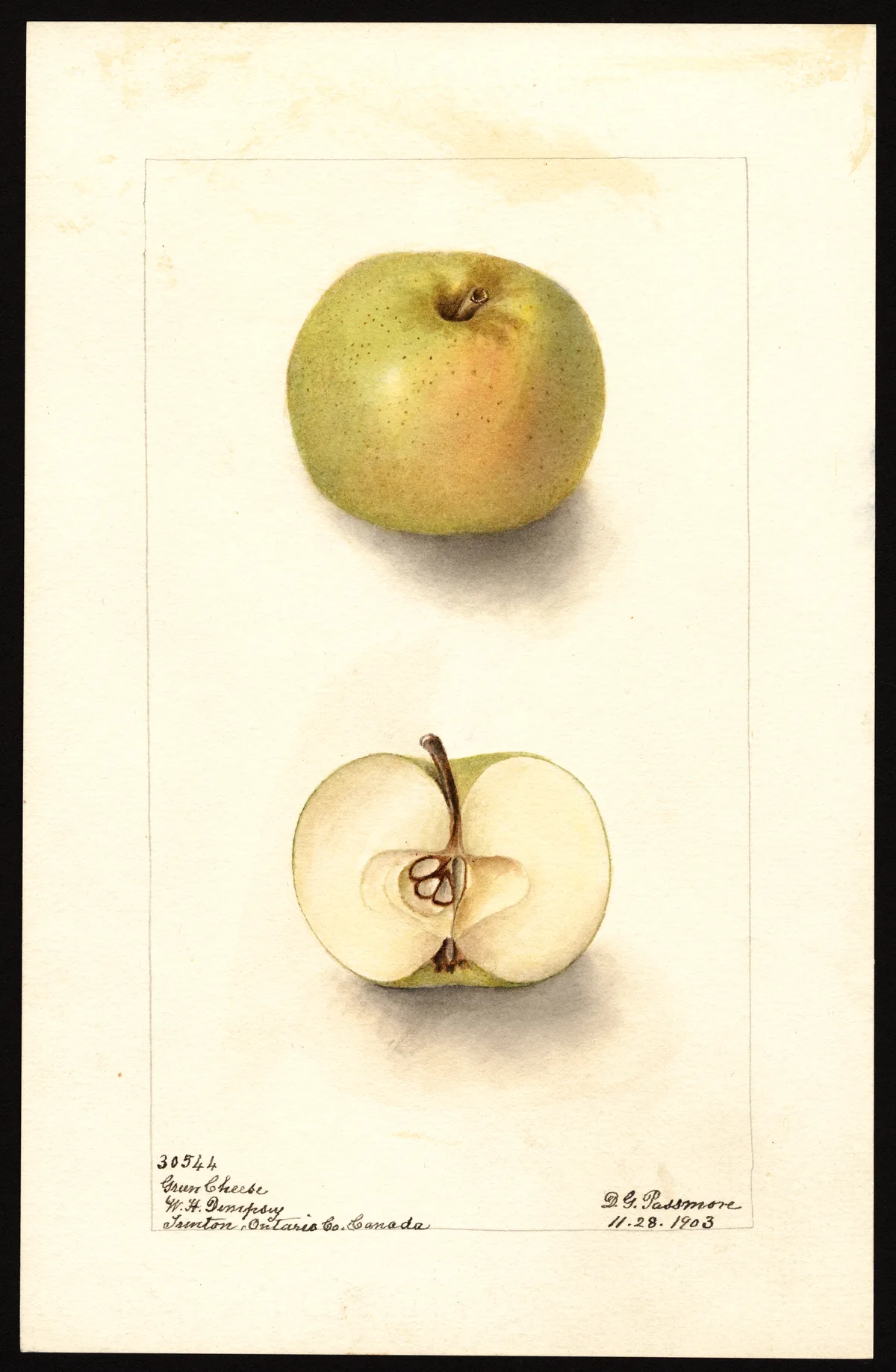
USDA Pomological Watercolor Collection
Green Cheese
Origin / History
An old variety of Southern/Southwestern American origin. Elliott and Budd & Hansen give the origin as Tennessee. Downing reports it as widely grown in Kentucky and other Southwestern States, noting that it has been extensively propagated by suckers but that the exact place of the original tree is unknown. Downing further observes that although it is not of the best quality, it has many good properties adapting it to the South and Southwest, and it is widely disseminated under numerous synonyms. Lowther (Encyclopedia of Practical Horticulture, 1914) reports it from 7 stations in the Central Division and 6 stations in the Southern Division of the American Pomological Society, both counts marked with an asterisk indicating the variety is adapted to more than one of the three divisions.
Tree
Elliott describes the tree as of rather slow growth, an early and abundant bearer. Downing describes it as moderately vigorous and upright, a good bearer, and a long keeper, with the notable habit of blooming late — a trait Downing considers of special value. Young shoots slender, grayish brown (Downing).
Fruit
Size: Medium (all book sources agree). Lowther also gives medium size.
Form: Oblate, occasionally oblique (Downing; Budd & Hansen). Elliott describes it as oblate, obliquely depressed. Lowther calls the form "flat."
Stem / Stalk: Short and slender (Downing; Budd & Hansen). Elliott describes the stalk as very short.
Cavity: Large, deep, russeted (Downing; Budd & Hansen). Elliott describes the cavity as broad and deep, surrounded by russet.
Calyx: Closed, with segments slightly recurved (Downing; Budd & Hansen). Elliott describes the calyx as partially closed.
Basin: Broad, deep, uneven (Downing; Budd & Hansen). Elliott describes the basin as broad, shallow, and uneven — conflicting with Downing and Budd & Hansen on depth (shallow vs. deep).
Skin: Pale greenish yellow (Downing); greenish yellow (Elliott); pale greenish yellow with red on the sunny side (Budd & Hansen); yellow (Lowther). Moderately sprinkled with brown dots (Downing); covered with brown dots (Elliott); dots few, brown (Budd & Hansen) — sources disagree on the abundance of the dots, ranging from "few" (Budd & Hansen) to "covered" (Elliott).
Flesh / Flavor: Yellowish white, tender, crisp, juicy, rich, sprightly subacid (Downing). Budd & Hansen give yellowish white, tender, delicate, crisp, juicy, rich, sprightly subacid. Elliott describes the flesh as rather fine, juicy, with a brisk sub-acid flavor. Rated "Very good" by Downing and Budd & Hansen; Lowther rates the quality "very good."
Core / Seeds: Core small, compact (Downing; Budd & Hansen). Seeds not described in source.
Season
November to April (Elliott); November to March (Downing; Budd & Hansen). Lowther places it in the winter season. A long keeper (Downing).
Uses
Used for both kitchen and market (Lowther).
Subtypes / Variants
Not described in source.
Other
Not described in source.
Book Sources
Described in 4 period pomological works
USDA Nomenclature (1905)
From W.H. Ragan, Nomenclature of the Apple, USDA Bulletin No. 56
May be Green Cheese.
This may also be Green Cheese.
Nursery Catalog Sources
Found in 2 catalogs (1886–1901) from Alabama, Illinois
- Huntsville Wholesale Nurseries (Jessie S. Moss , Proprietor; W.F. Heikes, Manager), Huntsville , Alabama — 1886 — listed as Southern Golden Pippin
- Benjamin Buckman (personal inventory) , Farmingdale , Illinois — 1901
View original book sources (4)
— F.R. Elliott, The Western Fruit Book (1865)Green Cheese. Winter Cheese, | Turner's Green. Origin, Tennessee. Tree, of rather slow growth, an early and abundant bearer. Fruit, medium, oblate, obliquely depressed ; skin, greenish yellow, covered with brown dots : stalk, very short, in a broad, deep cavity, surrounded by russet ; calyx, partially closed, in a broad, shallow, uneven basin; flesh, rather fine, juicy, with a brisk sub-acid flavor. November to April. (Downing.)
[Additional entry in this volume: "Yellow Crank", pp. 188–188]
Yellow Crank. Medium size, flat, greenish yellow ; high flavor. January to March.
— A.J. Downing, The Fruits and Fruit Trees of America (1900)Green Cheem.
Green Cheese. Green Crank. Yellow Crank. Southern Greening. Southern Golden Pippin. Winter Greening. Carolina Greening. Green Skin. Winter Cheese. Turner's Cheese. Greening.
An old variety, grown largely in Kentucky and other Southwestern States. It has been extensively propagated by suckers, but the exact place of the original tree is unknown. Although not best in quality, it has so many good properties adapting it to the South and Southwest, that it is widely disseminated under the various synonyms given above.
Tree moderately vigorous, upright, and has the habit of blooming late, which gives it a special value. A good bearer and long keeper. Young shoots slender, grayish brown.
Fruit medium, oblate, occasionally oblique, pale greenish yellow, moderately sprinkled with brown dots. Stalk short, slender. Cavity large, deep, russeted. Calyx closed. Segments slightly recurved. Basin broad, deep, uneven. Flesh yellowish white, tender, crisp, juicy, rich, sprightly subacid. Core small, compact. Very good. November to March.
— J.L. Budd & N.E. Hansen, American Horticultural Manual, Part II: Systematic Pomology (1914)Green Cheese. — Origin, Tennessee; an old variety which has been extensively propagated from suckers.
Fruit medium, oblate, occasionally oblique; surface pale greenish yellow, with red on sunny side; dots few, brown; cavity large, deep, russeted; stem short, slender; basin broad, deep, uneven; calyx closed: segments slightly recurved. Core small, compact; flesh yellowish white, tender, delicate, crisp, juicy, rich, sprightly subacid, very good. November to March.
— Granville Lowther (ed.), Encyclopedia of Practical Horticulture (1914)Green Cheese: medium size; flat form; yellow color; very good quality; used for both kitchen and market; winter season. Reported by 7 stations in the Central Division and 6 stations in the Southern Division, with both counts marked by an asterisk indicating the variety is reported as adapted to more than one of the three divisions of the American Pomological Society.