French Crab
Apple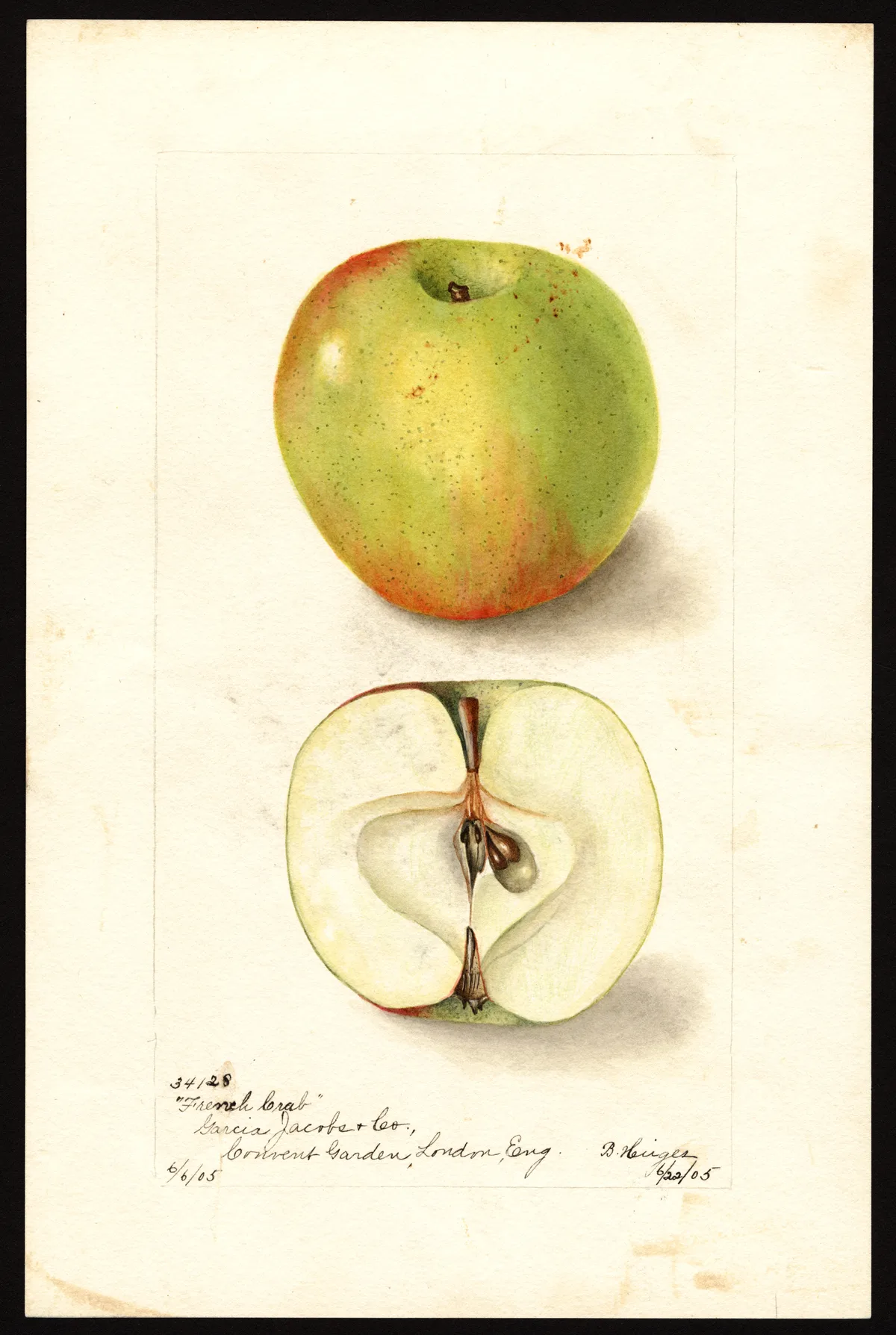
USDA Pomological Watercolor Collection
French Crab
Origin / History
Origin unknown, according to Bunyard; "probably imported into England at the end of the eighteenth century." Elliott calls it foreign, and Downing calls it "an English variety." Ronalds described it; Downing quotes his description, and Bunyard cites "Ronalds, p. 42." Bunyard also gives the German name Gruener Oster. Elliott enters French Crab under the heading Easter Pippin. Downing describes French Crab separately after Ronalds and also places the name under Easter Pippin. Thomas carries only a cross-reference, "Claremont Pippin. See Easter Pippin." Hogg wished to substitute the name Winter Greening, but Bunyard says "the desire of Hogg to substitute the name Winter Greening has not been adopted." Bunyard retains French Crab as "the name by which it is best known."
Tree
Very hardy, somewhat pendent in its growth (Ronalds, as quoted by Downing). Growth vigorous (Bunyard). Bears well and fertile; Veitch calls it "a great bearer." Forms a medium-sized pyramid and a good standard (Veitch). Leaf large, round oval, upfolded, coarsely serrate (Bunyard).
Fruit
Size: Medium to above medium. Ronalds alone gives above medium. Bunyard measures it at 3½ by 2½.
Form: Round or roundish, globular (Ronalds), fairly regular (Bunyard).
Stem: Rather short (Bunyard).
Cavity: Russet (Bunyard).
Calyx: Eye closed (Bunyard).
Basin: Shallow, wrinkled, with five prominent ribs at top (Bunyard).
Skin: Deep green, pea green in Bunyard's words, with a brownish or pale brown blush. Ronalds describes it as green, becoming yellow at maturity.
Dots: Not described in source.
Flesh and flavor: Flesh greenish, firm to very firm, crisp, not juicy. The flavor is pleasant and brisk (Ronalds); Downing gives "a good subacid flavor," and Bunyard calls it acid. Elliott rates the flesh "inferior."
Core and seeds: Not described in source.
Season
A long keeper and a late-season fruit, keeping from one to two years. Elliott gives November to June, and Bunyard says it keeps a year or more. Downing calls it "remarkable for keeping sound and firm two years," and Veitch also says it will keep for two years.
Uses
Culinary. Bunyard calls it "a valuable late season fruit, cooking excellently."
Subtypes / Variants
Not described in source.
Other
Not described in source.
Book Sources
Described in 4 period pomological works
- Bunyard, A Handbook of Hardy Fruits (1920)
- Downing, Fruits and Fruit Trees of America (1900)
- Elliott, The Western Fruit Book (1865) — listed as Easter Pippin
- Thomas, The American Fruit Culturist (1903) — listed as Easter Pippin
Nursery Catalog Sources
Found in 3 catalogs (1900–1913) from England, Illinois
- Central Experimental Farm , Dominion Department of Agriculture, Agassiz, British Columbia (under test; Bulletin No. 3, Second Series) — 1900 — listed as Easter Pippin
- James Veitch & Sons , Ltd., Royal Exotic Nursery, Chelsea, London (also Coombe Wood, Langley, and Feltham) , England — 1911 — listed as Easter Pippin
- Benjamin Buckman (personal inventory) , Farmingdale , Illinois — 1913 — listed as Easter Pippin
View original book sources (5)
— F.R. Elliott, The Western Fruit Book (1865)Easter Pippin. Young's Long Keeper, | Ironstone Pippin, Claremont Pippin, | French Crab. Foreign. Medium, roundish, deep green, brownish blush ; flesh, greenish, inferior. November to June.
— A.J. Downing, The Fruits and Fruit Trees of America (1900)French Crab. Ronalds describes this as follows : Tree very hardy, somewhat pendent in its growth, and bears well. A long keeper. Fruit above medium, globular, green, becoming yellow at maturity. Flesh firm, pleasant, brisk.
[Additional entry in this volume: "Easter Pippin", pp. 183–183]
Easter Pippin. Young's Long Keeping. Ironstone Pippin. Claremont Pippin. French Crab. Forsyth (not of Coxe). Remarkable for keeping sound and firm two years. It is an English variety. Fruit of medium size. Skin deep green, with a pale brown blush. Flesh very firm, and though not juicy, of a good subacid flavor.
— John J. Thomas, The American Fruit Culturist (1903)Claremont Pippin. See Easter Pippin.
— E.A. Bunyard, A Handbook of Hardy Fruits (1920)FRENCH CRAB. Ronalds, p. 42. G., Gruener Oster. (Easter Pippin, Ironstone Pippin, Iron King, John Apple, Winter Greening (Hogg).) Culinary, keeps a year or more, medium, 3½ by 2½, round, fairly regular. Colour, pea green. Flesh, greenish, crisp, acid. Eye, closed in a shallow wrinkled basin with five prominent ribs at top. Stem, rather short in a russet cavity. Growth, vigorous; fertile. Leaf, large, round oval, upfolded, coarsely serrate. Origin unknown. Probably imported into England at the end of the eighteenth century. A valuable late season fruit, cooking excellently. The desire of Hogg to substitute the name Winter Greening has not been adopted. I therefore retain the name by which it is best known.
— James Veitch & Sons, Veitch's Fruit Trees (1911) (1911)medium size, will keep for two years, the tree is a great bearer, forming a medium-sized pyramid and a good standard