Sweet Greening
Apple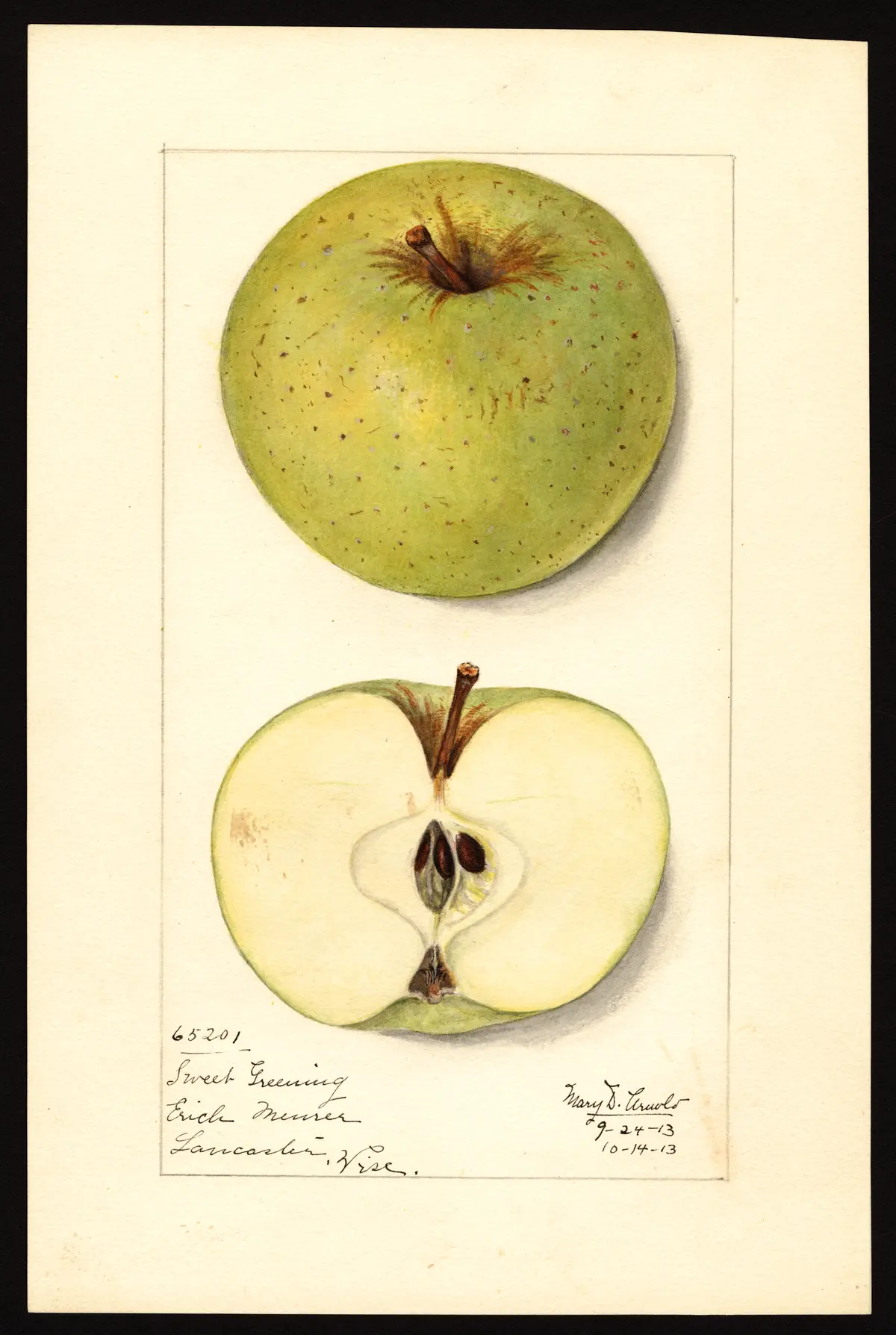
USDA Pomological Watercolor Collection
Sweet Greening
Origin/History
Origin unknown. From the statement of Thacher (1822), it is probable that the variety originated in the old Plymouth Colony, Massachusetts. Thacher described it as "a large, handsome apple, resembling in size and form, the Rhode Island greening. Ripens in autumn, and possesses the valuable property of retaining its soundness and flavour till the middle of June. It is an excellent apple for baking, and deserves to be more extensively cultivated. Its origin is uncertain, and it is doubtful whether this fine fruit is known out of the old Plymouth colony." (Beach)
As grown in New York state it is usually not as large as Rhode Island Greening, particularly when borne on overloaded trees, but under favorable conditions the fruit becomes large as Thacher describes it. It is grown in some localities in Central and Western New York but has not been reported from any other portion of that state. It is now seldom or never planted. (Beach)
Sweet Greening is quite distinct from Green Sweet. From the accounts of Sweet Greening and Sweet Rhode Island Greening given by Downing and some other pomologists, there seems to be some reason for questioning whether or not these are distinct varieties. The fruit of Sweet Greening obtained from various sources corresponds fairly well with Downing's description of Sweet Rhode Island Greening. Ragan makes Sweet Rhode Island Greening synonymous with New Greening and probably identical with Curtis Greening and Illinois Greening. (Beach)
Tree
Growth habit: Downing describes the tree as vigorous and spreading. Beach describes it as medium in size and upright — a conflict on both vigor and habit between the two sources.
Other characteristics (Beach): Hardy, long-lived, comes into bearing moderately young, a reliable biennial or sometimes almost annual bearer, and often yields heavy crops. The fruit hangs well to the tree.
Twigs (Beach): Medium to long, erect or spreading and stout.
Fruit
Size: Large (Downing). Medium to large, uniform in shape and size (Beach).
Form: Roundish oblate (Downing). Roundish oblate or sometimes approaching roundish conic, regular or somewhat elliptical; sides sometimes unequal (Beach).
Stem: Medium (Downing). Medium to short, moderately thick (Beach).
Cavity: Broad, acute, regular (Downing). Medium in size, acuminate or approaching acute, deep or moderately deep, rather broad, sometimes gently furrowed, russeted and with some outspreading or broken rays of russet (Beach).
Calyx: Partly open or closed; lobes convergent or connivent, broad, acute (Beach). Calyx tube truncate funnel-form. Stamens median or below. (Beach)
Basin: Broad, deep, slightly furrowed (Downing). Moderately shallow and somewhat obtuse to moderately deep and rather abrupt, medium in width, slightly furrowed and wrinkled (Beach). [Note: Downing characterizes the basin as deep; Beach gives a range from moderately shallow to moderately deep — a partial conflict.]
Skin: Greenish yellow, with dull bronzed red in the sun, many irregular scattered rough dots and marblings of russet (Downing). Thick, tough, smooth, bright, grass-green becoming yellowish or yellow; usually with no red, but sometimes slightly bronze with reddish spots or dots, or even with a well-developed brownish-red blush. Irregular, large, whitish dots and streaks of whitish scarf-skin appear about the cavity, sometimes mingled with a little russet. The whitish dots are rather conspicuous, numerous, and broad toward the basin; the rough or russet dots are more scattering. (Beach)
Flesh and Flavor: White, loose-grained, mild, sweet, rather dry; quality rated Good (Downing). Whitish with yellow tinge, firm, breaking or loose-grained, tender, moderately juicy or when over-ripe rather dry, very sweet; quality good to very good (Beach).
Core and Seeds: Core small (Downing). Core small to medium, nearly axile with a hollow cylinder in the axis; cells symmetrical, closed or slit; core lines clasping. Carpels broadly roundish, emarginate, mucronate, somewhat tufted. Seeds very numerous, below medium to rather small, moderately narrow to rather wide, obtuse to somewhat acute, plump, sometimes tufted. (Beach)
Season
December to February (Downing). December to April or May (Beach). [Note: Beach gives a substantially longer keeping season than Downing.]
Uses
An excellent apple for baking; also very good for dessert and other culinary uses. A good keeper. Generally not considered a good variety for the commercial orchard, as sweet fruit of this color meets with little demand in the general market. May be disposed of in limited quantities in some local markets. Some growers find it takes better in southern than in northern markets. (Beach)
Subtypes/Variants
Not described in source.
Other
Beach notes that this is, as the name indicates, a sweet apple of green color, and considers it quite highly esteemed for home use where the variety is known.
Book Sources
Described in 2 period pomological works
View original book sources (2)
— A.J. Downing, The Fruits and Fruit Trees of America (1900)Sweet Greening.
Origin unknown. Tree vigorous, spreading, productive.
Fruit large, roundish oblate, greenish yellow, with dull bronzed red in the sun, many irregular scattered rough dots and marblings of russet. Stalk medium. Cavity broad, acute, regular. Calyx in a broad, deep, slightly furrowed basin. Flesh white, loose-grained, mild, sweet, rather dry. Good. Core small. December to February.
— S.A. Beach, The Apples of New York, Vol. 1 (1905)SWEET GREENING.
REFERENCES. 1. Thacher, 1822:138. 2. Downing, 1869:375. 3. Bailey, Mich. Sta. Bul., 31:54. 1887. 4. Waugh, Vt. Sta. An. Rpt., 14:310. 1901. 5. Ragan, U. S. B. P. I. Bul., 56:303. 1905.
DOUBTFUL REFERENCES. 6. Warder, 1867:668, 716, 722. 7. Downing, 1881:109 app. 8. Ragan, U. S. B. P. I. Bul., 56:209. 1905.
SYNONYMS. CURTIS GREENING (6)? Curtis Greening (7, 8)? ILLINOIS GREENING (6)? NEW GREENING (8)? New Rhode Island Greening (7, 8)? SWEET GREENING (1). SWEET RHODE ISLAND GREENING (7)? Sweet Rhode Island Greening (8)?
This, as the name indicates, is a sweet apple of green color. Thacher (1) describes it as "a large, handsome apple, resembling in size and form, the Rhode Island greening. Ripens in autumn, and possesses the valuable property of retaining its soundness and flavour till the middle of June. It is an excellent apple for baking, and deserves to be more extensively cultivated. Its origin is uncertain, and it is doubtful whether this fine fruit is known out of the old Plymouth colony."
As grown in this state it is usually not as large as Rhode Island Greening particularly when it is borne on overloaded trees, but under favorable conditions the fruit becomes large as Thacher describes it. The tree is medium in size, upright, hardy, long-lived, comes into bearing moderately young, is a reliable biennial or sometimes almost annual bearer and often yields heavy crops. The twigs are medium to long, erect or spreading and stout. The fruit hangs well to the tree. Where this variety is known it is quite highly esteemed for home use because it is a good keeper and very good in quality for dessert and for baking or other culinary uses. Generally it is not considered a good variety for the commercial orchard because sweet fruit of this color meets with little demand in the general market. It may be disposed of in limited quantities in some local markets. Some growers find that it takes better in southern than in northern markets. It is in season from December to April or May.
Sweet Greening is quite distinct from Green Sweet, page 150. From the accounts of Sweet Greening and Sweet Rhode Island Greening given by Downing (2, 7) and some other pomologists, there seems to be some reason for questioning whether or not these are distinct. We have not seen the fruit of Sweet Rhode Island Greening but the fruit of Sweet Greening which we have obtained from various sources corresponds fairly well with Downing's description of Sweet Rhode Island Greening. Ragan makes Sweet Rhode Island Greening synonymous with New Greening and probably identical with Curtis Greening and Illinois Greening (8).
Historical. Origin unknown but from the statement of Thacher (1) it is probable that it originated in the old Plymouth Colony, Massachusetts. It is grown in some localities in Central and Western New York but has not been reported to us from any other portion of this state. It is now seldom or never planted.
FRUIT.
Fruit medium to large, uniform in shape and size. Form roundish oblate or sometimes approaching roundish conic, regular or somewhat elliptical; sides sometimes unequal. Stem medium to short, moderately thick. Cavity medium in size, acuminate or approaching acute, deep or moderately deep, rather broad, sometimes gently furrowed, russeted and with some outspreading or broken rays of russet. Calyx partly open or closed; lobes convergent or connivent, broad, acute. Basin moderately shallow and somewhat obtuse to moderately deep and rather abrupt, medium in width, slightly furrowed and wrinkled. Skin thick, tough, smooth, bright, grass-green becoming yellowish or yellow, usually with no red but sometimes slightly bronze with reddish spots or dots or even with a well-developed brownish-red blush. Irregular, large, whitish dots and streaks of whitish scarf-skin appear about the cavity, sometimes mingled with a little russet. The whitish dots are rather conspicuous, numerous and broad toward the basin; the rough or russet dots are more scattering. Calyx tube truncate funnel-form. Stamens median or below.
Core small to medium, nearly axile with a hollow cylinder in the axis; cells symmetrical, closed or slit; core lines clasping. Carpels broadly roundish, emarginate, mucronate, somewhat tufted. Seeds very numerous, below medium to rather small, moderately narrow to rather wide, obtuse to somewhat acute, plump, sometimes tufted.
Flesh whitish with yellow tinge, firm, breaking or loose-grained, tender, moderately juicy or when over-ripe rather dry, very sweet, good to very good.
Season December to April or May.