Early Strawberry
Apple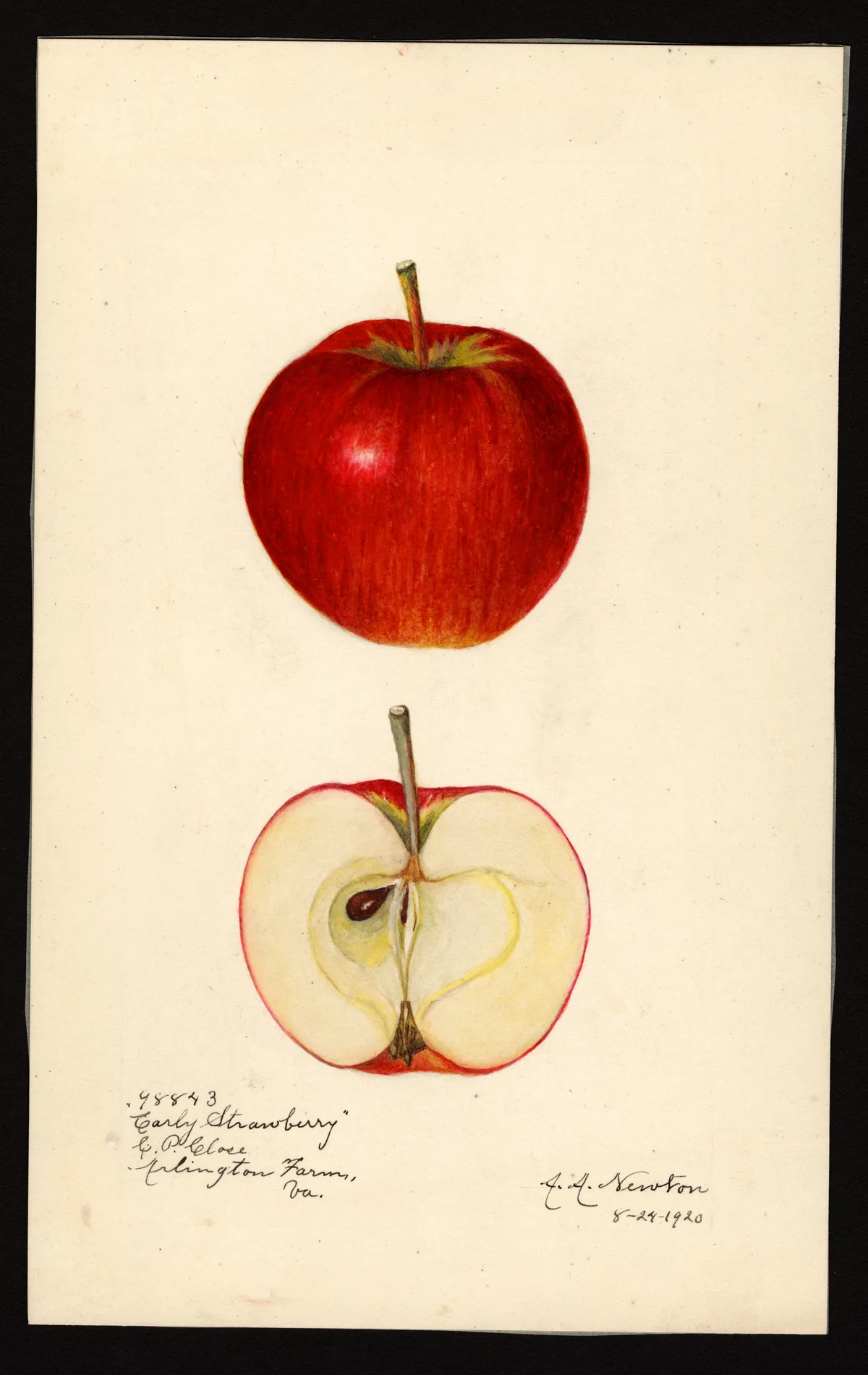
USDA Pomological Watercolor Collection
Early Strawberry
Origin / History
Early Strawberry is an American apple said to have originated in the vicinity of New York (Downing; Warder; Herefordshire Pomona; Beach; Budd-Hansen). Hedrick states more specifically that the variety was first known in what is now the City of New York, where it probably originated about 1800 or a little later. The Herefordshire Pomona records that it is supposed to be a seedling from the Margaret, "from which it is very distinct" — a comparison "seen at once on the plate."
It is quite distinct from the Early Red Margaret, which has no fragrance and a short stem (Downing; Budd-Hansen). Beach quotes Downing's 1846 published observations on the distinction between the two varieties: "The Early Strawberry has a long stalk, and is a high colored fruit, striped with dark red. The Early Red Margaret has a short stalk and is a dull colored fruit, with faint red stripes. We have had both fruits in bearing this year, and have compared them for several years past. The Early Red Margaret is correctly shown in the beautiful colored plates of Ronald's Pyrus Malus Brentfordiensis, and in the Pomological Magazine. Our Early Strawberry apple is not described in any European work that we have seen. It is greatly superior to the Early Red Margaret in productiveness, and especially in long keeping and ripening gradually, qualities that are rare in early apples and for which the market dealers in New York rate the Strawberry very highly."
The name Red Juneating has been applied also to the Margaret (Beach). The Herefordshire Pomona notes that the apple "has not very long been introduced into England." Beach reports that Early Strawberry "has been extensively disseminated and is generally catalogued by nurserymen throughout the apple-growing regions of America." It was tested at the Central Experimental Farm, Agassiz BC (planted Spring 1894), where the tree was characterized as a vigorous (or "strong") grower.
Tree
Tree medium in size (Beach; Hedrick) — the Herefordshire Pomona similarly describes it as "small, but very hardy" and bearing abundantly. Growth very erect, especially when young, with dark wood/dark-colored shoots, spreading and large with age, eventually becoming roundish and somewhat spreading (Elliott; Warder; Thomas; Beach; Budd-Hansen; Hedrick). Moderate grower (Beach) / moderately vigorous (Hedrick); at the Central Experimental Farm one planting was a vigorous grower and another a strong grower. Hardy, healthy, comes into bearing young, and yields moderate to good crops biennially or almost annually (Beach; Hedrick — Hedrick gives "moderately productive biennially"). Productive (Elliott; Thomas), and successful/good in all localities (Elliott; Thomas).
Foliage abundant on long stems/footstalks (Warder; Elliott), leaves bright green, almost shining, rather narrow, long, and erect (Warder; Elliott); leaves finely crenate (Thomas).
The Herefordshire Pomona adds that when grafted on the paradise stock it makes a good pyramid, and when grown in an orchard house forms a very attractive object.
Fruit
Size
Small (Elliott; Thomas; Budd-Hansen; Lowther) to medium, with sources also giving "small to medium" (Warder), "below medium to medium" (Beach), "middle sized" (Herefordshire Pomona), and "medium" (Hedrick). The Central Experimental Farm gives "medium size" for one planting and "below medium size" for another. Pretty uniform in shape and size (Beach; Hedrick). Beach notes that "a relatively high percentage of the apples are undersized or otherwise unmarketable"; Hedrick similarly notes "a high percentage of them are undersized and malformed."
The Herefordshire Pomona gives a specific dimension: two inches and a quarter broad by two inches high.
Form
Roundish, varying to angular and conical (Elliott); round-conic, regular or rarely angular (Warder); roundish, varying to round-ovate, and sometimes quite conical (Thomas); roundish, narrowing towards the eye (Downing); roundish conic or roundish, regular or somewhat ribbed, with sides often unequal (Beach; Hedrick); small, roundish, conical, rarely angular (Budd-Hansen); roundish (oblate) (Lowther). The Herefordshire Pomona: "broad at the base and narrowing towards the eye, where it becomes angular." Central Experimental Farm: "round, flat" for one planting and "roundish, tapering to the eye" for the other.
Stem
Stem long and rather slender (Beach; Hedrick; Warder; Budd-Hansen), often clubbed (Beach; Hedrick) — Warder and Budd-Hansen give "sometimes short, knobby" / "sometimes knobbed and uneven." Elliott describes it as varying from long, straight and slender to medium and curved. Downing gives "an inch and a half long, rather slender and uneven." Thomas: slender, three-quarters to an inch and a half long. The Herefordshire Pomona: "thin, from one to two inches in length."
Cavity
Cavity medium and regular (Warder); deep, regular (Budd-Hansen); acute or approaching acuminate, deep, broad, symmetrical, sometimes with faint radiating rays of russet (Beach; Hedrick gives "acute, deep, broad, symmetrical, sometimes with faint radiating rays of russet"). Downing: "inserted in a deep cavity." Herefordshire Pomona: "inserted in a deep narrow cavity."
Calyx / Eye
Calyx small (Elliott; Downing; Budd-Hansen) — Beach and Hedrick give "rather small, closed or sometimes open," with lobes long and narrow. Warder: "Eye medium, long; Segments reflexed." Budd-Hansen: "segments divergent." Herefordshire Pomona: "small, with converging segments." Beach further details: calyx tube short, moderately wide, conical or approaching funnel-shape, with fleshy pistil point projecting into the base; stamens median. Hedrick: calyx-tube short, wide, conical with fleshy pistil point projecting into the base; stamens median.
Basin
Narrow and shallow (Elliott; Downing; Budd-Hansen — "narrow, shallow, folded or plaited"); shallow, folded or plaited (Warder); small and narrow (Thomas); small, shallow to moderately deep, narrow, obtuse, slightly furrowed (Beach); small, shallow, narrow, obtuse, furrowed (Hedrick); shallow basin (Herefordshire Pomona).
Skin / Color
Yellowish white, striped and stained over with bright and dark red (Elliott); smooth, often shining, yellow, mostly covered with mixed red, striped crimson (Warder); finely striped and stained with bright and dark red on a yellowish white ground; smooth and fair (Downing); indistinctly and finely striped with bright and deep red (Thomas); smooth, almost covered with a clear bright red colour on a yellow ground as seen on the shaded side, but finely striped with a deeper red on the sunny side (Herefordshire Pomona); rather thick, tough, smooth, waxy, entirely red or yellow nearly covered with a rich dark red, mottled and irregularly striped and splashed with deeper red (Beach); thick, tough, smooth, waxy, yellow, covered with rich dark red, mottled and irregularly striped and splashed with deeper red (Hedrick); smooth and fair, often polished, yellow, mostly covered with mixed red with bright and dark crimson stripes (Budd-Hansen); striped or splashed (red) (Lowther). Surface sometimes sticky or "greasy" when house-ripened (Warder). Central Experimental Farm: one planting "yellow, with a reddish russet cheek, and red stripes over nearly the whole surface"; the other "greenish yellow, nearly covered with red, and sprinkled with whitish dots."
Beach summarizes the overall color as "very attractive bright deep red color."
Dots
Rare and very minute (Warder); minute, grayish (Beach; Hedrick); very few, minute, obscure (Budd-Hansen). Central Experimental Farm (one planting): "sprinkled with whitish dots."
Flesh / Flavor
Yellowish white, tinged with red, sub-acid, sprightly, tender (Elliott); whitish-yellow, breaking, fine grained, juicy; flavor sub-acid, aromatic; quality good to very good (Warder); white, slightly tinged with red next the skin, tender, subacid, and very sprightly and brisk in flavor, with an agreeable aroma — "Very good" (Downing); white, tender, sub-acid, rather brisk, pleasant, not very rich, with the striping faintly tinging the flesh (Thomas); white, or stained with red near the skin; tender, with a pleasant sub-acid flavour and an agreeable aroma (Herefordshire Pomona); whitish-yellow often with streaks of red, moderately coarse, crisp, moderately tender, juicy, subacid, aromatic, sprightly, very good (Beach); whitish yellow, slightly tinged with red next to the skin, tender, sprightly, brisk, agreeable aromatic subacid, very good (Budd-Hansen); yellow often with streaks of red, coarse, crisp, tender, juicy, subacid, aromatic, sprightly; very good (Hedrick). Quality very good (Lowther). Central Experimental Farm: one planting "white, with reddish tints next the skin, tender, sprightly, sub-acid, quality very good"; the other "white, crisp, sprightly, acid, quality good."
Hedrick characterizes its merits as "crisp, tender, sprightly, aromatic flesh."
Core / Seeds
Core medium (Elliott); regular, closed, not meeting the eye (Warder; Budd-Hansen — "Core regular, closed, not meeting"); large, axile or somewhat abaxile; cells usually open, sometimes partly closed; core lines nearly meeting (Beach); large, axile or abaxile; cells open, sometimes partly closed; core-lines meeting (Hedrick). Carpels broadly roundish to elliptical, much concave, emarginate (Beach); elliptical, concave, emarginate (Hedrick).
Seeds small (Elliott); numerous, broad, plump (Warder); many, plump (Budd-Hansen); medium or above, wide, plump, obtuse, dark brown (Beach); wide, plump, obtuse, dark brown (Hedrick).
Season
July (Elliott; Budd-Hansen gives "July, September"); July and August (Warder); August (Beach; Hedrick — "favorite August apple"); summer (Lowther). Thomas: "Ripens one to three weeks later than Yellow Harvest." Downing reports it "appears in the markets there [New York] from July till September." Central Experimental Farm: "early September" for one planting and "last of July" for the other.
Beach notes "the fruit does not keep well." Hedrick: "The apples are too delicate to ship." The Herefordshire Pomona: "like all early apples does not keep long." Downing, however, quoted in Beach, considered it "greatly superior to the Early Red Margaret … especially in long keeping and ripening gradually, qualities that are rare in early apples and for which the market dealers in New York rate the Strawberry very highly."
Uses
Dessert and market (Warder); a very favourite early dessert apple in America, very attractive in appearance and excellent in flavour (Herefordshire Pomona); "very desirable for dessert and good also for culinary uses" (Beach); family use (Lowther). Beach notes it is "not a very satisfactory variety for commercial planting because the demand for it is mostly limited to local markets, a relatively high percentage of the apples are undersized or otherwise unmarketable and the fruit does not keep well. On account of its productiveness and high quality it is a desirable variety for the home orchard." Hedrick: "not a good general market sort," but merits esteem for its quality and its hardy, healthy, early-bearing, fruitful trees.
Subtypes / Variants
Not described in source.
Other
Lowther's reporting-station data (1914): Northern Division S*; Central Division 11 reporting stations (reported in more than one division); Southern Division 5 reporting stations (reported in more than one division).
Book Sources
Described in 9 period pomological works
- Beach, The Apples of New York Vol. 2 (1905)
- Warder, American Pomology: Apples (1867)
- Budd & Hansen, Systematic Pomology (1914)
- Downing, Fruits and Fruit Trees of America (1900)
- Elliott, The Western Fruit Book (1865)
- Lowther (ed.), Encyclopedia of Practical Horticulture (1914)
- Hedrick, Cyclopedia of Hardy Fruits (1922)
- The Herefordshire Pomona (1876–1885)
- Thomas, The American Fruit Culturist (1903)
Nursery Catalog Sources
Found in 33 catalogs (1845–1921) from California, Illinois, Maryland, Massachusetts, Missouri, New Jersey, Oregon, Pennsylvania, Washington
- Winship's Nursery (Brighton Nurseries , operated by the Winship family), Brighton (Boston) , Massachusetts — 1845
- Hovey & Co. , Cambridge , Massachusetts — 1849
- Azell Bowditch (Nursery / Fruit Catalog) , Boston , Massachusetts — 1850
- Joseph Breck & Co. , Boston , Massachusetts — 1855
- St. Helena Nursery , Howell's Prairie, Marion County , Oregon — 1864
- California Nursery Co. , Niles , California — 1889
- William H. Moon Co. , Morrisville, Bucks County , Pennsylvania — 1890
- Rogers Nursery Co. , Moorestown , New Jersey — 1893
- Sherwood Hall Nursery Co. , Timothy Hopkins (Menlo Park Nurseries), San Francisco / Menlo Park , California — 1893
- The Vineland Nurseries (Kelsey & Co. , Proprietors), St. Joseph, Missouri (Office: 13th and Atchison Sts., 2 Blocks East of the Citizens St. Car Line) — 1894
- Reading Nursery , Jacob W. Manning, Proprietor, Reading , Massachusetts — 1898
- Brown Brothers Co. , Continental Nurseries, Rochester, NY (also operated from Toronto, Canada) — 1899
- Central Experimental Farm , Dominion Department of Agriculture, Agassiz, British Columbia (under test; Bulletin No. 3, Second Series) — 1900
- Washington Nursery Co. , Toppenish , Washington — 1901
- Brown Brothers Co. , Continental Nurseries, Rochester, NY (also operated from Toronto, Canada) — 1901
- Benjamin Buckman (personal inventory) , Farmingdale , Illinois — 1901
- Carlton Nursery Co. , Carlton , Oregon — 1909
- Wm. J. Corse (successor to Robert Sinclair / Sinclair Nurseries) , Baltimore , Maryland — 1909
- Washington Nursery Company , Toppenish , Washington — 1909
- Island Nurseries & Fruit Farm , Vashon (Vashon Island) , Washington — 1911
- Pacific Nursery Company , Portland , Oregon — 1912
- Stark Bros. Nurseries & Orchards Co. , Louisiana , Missouri — 1912
- Washington Nursery Company , Toppenish , Washington — 1912
- Benjamin Buckman (personal inventory) , Farmingdale , Illinois — 1913
- Island Nurseries & Fruit Farm , Vashon (Vashon Island) , Washington — 1914
- Island Nurseries & Fruit Farm , Vashon (Vashon Island) , Washington — 1915
- Union Nurseries , J.B. Weaver & Sons, Union , Oregon — 1915
- Island Nurseries & Fruit Farm , Vashon (Vashon Island) , Washington — 1916
- Island Nurseries & Fruit Farm , Vashon (Vashon Island) , Washington — 1917
- Oregon Nursery Co. , Orenco , Oregon — 1920
- Benedict Nursery Co. , Portland , Oregon — 1921
- Island Nurseries & Fruit Farm , Vashon , Washington — 1921
- North-Western Nurseries , Walla Walla , Washington
View original book sources (10)
— F.R. Elliott, The Western Fruit Book (1865)Early Strawberry. American Red Juneating. | Red Juneating. American. Tree, very erect in growth, dark wood, numerous leaves erect, with long footstalks ; productive, and successful in all localities, and, although not best in quality, yet generally esteemed. Size, small ; form, roundish, varying to angular and conical ; color, yellowish white, striped and stained over with bright and dark red ; stem, varying from long straight and slender, to medium, curved ; calyx, small ; basin, narrow and shallow ; flesh, yellowish white, tinged with red, sub-acid, sprightly, tender ; core, medium ; seeds, small. July.
— John A. Warder, American Pomology: Apples (1867)Early Strawberry. AMERICAN RED JUNEATING.
Origin New York; Tree thrifty, very upright, while young, spreading and large when older; Shoots dark colored; Foliage abundant on long stems, bright green, almost shining, rather narrow, long, erect.
Fruit small to medium, round-conic, regular or rarely angular; Surface smooth, often shining, yellow, mostly covered with mixed red, striped crimson; Dots rare, very minute; Surface sticky or "greasy" when house-ripened.
Basin shallow, folded or plaited; Eye medium, long; Segments reflexed.
Cavity medium, regular; Stem long, rather slender, sometimes short, knobby.
Core regular, closed, not meeting the eye; Seeds numerous, broad, plump; Flesh whitish-yellow, breaking, fine grained, juicy; Flavor sub-acid, aromatic; Quality good to very good; Use, dessert, market; Season, July and August.
— Woolhope Naturalists Field Club, The Herefordshire Pomona (1885)4 EARLY STRAWBERRY. [Syn : American Red Juneating.]
This bright beautiful apple is said to have originated near New York ; and is supposed to be a seedling from the Margaret from which it is very distinct. The comparison is seen at once on the plate.
Description.—Fruit : middle sized, broad at the base and narrowing towards the eye, where it becomes angular, two inches and a quarter broad by two inches high. Skin : smooth, almost covered with a clear bright red colour on a yellow ground as seen on the shaded side, but finely striped with a deeper red on the sunny side. Eye : small, with converging segments, and set in a shallow basin. Stalk : thin, from one to two inches in length, and inserted in a deep narrow cavity. Flesh : white, or stained with red near the skin ; tender, with a pleasant sub-acid flavour and an agreeable aroma.
This apple is a very favourite early dessert apple in America, and has not very long been introduced into England. It is very attractive in appearance and excellent in flavour, but like all early apples does not keep long.
The tree is small, but very hardy and bears abundantly. Grafted on the paradise stock it makes a good pyramid, and when grown in an Orchard house forms a very attractive object.
— A.J. Downing, The Fruits and Fruit Trees of America (1900)Early Strawberry.
American Red Juneating. Red Juneating.
A beautiful variety, which is said to have originated in the neighborhood of New York, and appears in the markets there from July till September. It is quite distinct from the Early Red Margaret, which has no fragrance, and a short stem.
Fruit roundish, narrowing towards the eye. Skin smooth and fair, finely striped and stained with bright and dark red, on a yellowish white ground. Stalk an inch and a half long, rather slender and uneven, inserted in a deep cavity. Calyx rather small, in a shallow, narrow basin. Flesh white, slightly tinged with red next the skin, tender, subacid, and very sprightly and brisk in flavor, with an agreeable aroma. Very good.
— John J. Thomas, The American Fruit Culturist (1903)Early Strawberry.* (American Red Juneating, of Manning.) Rather small, roundish, varying to round-ovate, and sometimes quite conical; surface indistinctly and finely striped with bright and deep red, tinging faintly the flesh; stalk slender, three-quarters to an inch and a half long; basin small and narrow; flesh white, tender, sub-acid, rather brisk, pleasant, not very rich. Ripens one to three weeks later than Yellow Harvest. Growth, very erect; leaves erect, finely crenate. Productive. Good in all localities. New York. Fig. 361.
— S.A. Beach, The Apples of New York, Vol. 2 (1905)EARLY STRAWBERRY.
REFERENCES. 1. Manning, 1838:46. 2. Downing, 1845:73. fig. 3. Horticulturist, 1:145. 1846. 4. Mag. Hort., 14:488. 1848. fig. 5. Thomas, 1849:139. fig. 6. Cole, 1849:101. fig. 7. Barry, 1851:280. 8. Am. Pom. Soc. Cat., 1852. 9. Elliott, 1854:76. 10. Hooper, 1857:31, 106, 109. 11. Gregg, 1857:36. 12. Horticulturist, 14:425. 1859. 13. Warder, 1867:514. fig. 14. Downing, 1869:157. 15. Fitz, 1872:143, 151, 160. 16. Leroy, 1873:310. figs. 17. Downing, 1881:12 index, app. 18. Wickson, 1889:243. 19. Watts, Tenn. Sta. Bul., 5:78. 1890. 20. Lyon, Mich. Hort. Soc. Rpt., 1890:290. 21. Bailey, An. Hort., 1892:238. 22. Budd-Hansen, 1903:75. fig.
SYNONYMS. AMERICAN RED JUNEATING (1). American Red Juneating (4, 5, 9, 13, 14, err. 5, ? 2). De La Madeleine Rouge (16). EARLY STRAWBERRY (2, 3, 4, 5, 6, 7, 8, 9, 10, 11, 12, 13, 14, 15, 17, 18, 19, 20, 21, 22). Early Strawberry (16). FRAISE (16). Louis XVIII (16). Red Juneating (3, 6, 9, 10, 14, 15, 16, err. 4, err. of some American gardens, 2). St. John Strawberry (17). Striped Shropshire (17). Tennessee Early Red (17).
Fruit of a very attractive bright deep red color, very desirable for dessert and good also for culinary uses. The tree is medium in size, a moderate grower, upright when young, but eventually becoming roundish and somewhat spreading. It is hardy, healthy, comes into bearing young and yields moderate to good crops biennially or almost annually. It is not a very satisfactory variety for commercial planting because the demand for it is mostly limited to local markets, a relatively high percentage of the apples are undersized or otherwise unmarketable and the fruit does not keep well. On account of its productiveness and high quality it is a desirable variety for the home orchard.
Historical. Early Strawberry is an American fruit which is said to have originated in the vicinity of New York (2, 3). It was formerly known to some under the name Red Juneating or American Red Juneating. The name Red Juneating has been applied also to the Margaret. In 1846 Downing published the following observations concerning these two varieties (3). "The Early Strawberry has a long stalk, and is a high colored fruit, striped with dark red. The Early Red Margaret has a short stalk and is a dull colored fruit, with faint red stripes. We have had both fruits in bearing this year, and have compared them for several years past. The Early Red Margaret is correctly shown in the beautiful colored plates of Ronald's Pyrus Malus Brentfordiensis, and in the Pomological Magazine. Our Early Strawberry apple is not described in any European work that we have seen. It is greatly superior to the Early Red Margaret in productiveness, and especially in long keeping and ripening gradually, qualities that are rare in early apples and for which the market dealers in New York rate the Strawberry very highly."
Early Strawberry has been extensively disseminated and is generally catalogued by nurserymen throughout the apple-growing regions of America (21).
FRUIT.
Fruit below medium to medium, pretty uniform in shape and size. Form roundish conic or roundish, regular or somewhat ribbed; sides often unequal. Stem long and rather slender, often clubbed. Cavity acute or approaching acuminate, deep, broad, symmetrical, sometimes with faint radiating rays of russet. Calyx rather small, closed or sometimes open; lobes long, narrow. Basin small, shallow to moderately deep, narrow, obtuse, slightly furrowed. Skin rather thick, tough, smooth, waxy, entirely red or yellow nearly covered with a rich dark red, mottled and irregularly striped and splashed with deeper red. Dots minute, grayish. Calyx tube short, moderately wide, conical or approaching funnel-shape, with fleshy pistil point projecting into the base. Stamens median. Core large, axile or somewhat abaxile; cells usually open, sometimes partly closed; core lines nearly meeting. Carpels broadly roundish to elliptical, much concave, emarginate. Seeds medium or above, wide, plump, obtuse, dark brown. Flesh whitish-yellow often with streaks of red, moderately coarse, crisp, moderately tender, juicy, subacid, aromatic, sprightly, very good.
Season August.
— J.L. Budd & N.E. Hansen, American Horticultural Manual, Part II: Systematic Pomology (1914)Early Strawberry.—Origin, New York; tree thrifty, very upright while young, spreading and large with age, quite distinct from the Early Red Margaret, which has no fragrance, and a short stem.
Fruit small, roundish, conical, rarely angular; surface smooth and fair, often polished, yellow, mostly covered with mixed red with bright and dark crimson stripes; dots very few, minute, obscure; cavity deep, regular; stem long, rather slender, sometimes knobbed and uneven; basin narrow, shallow, folded or plaited; calyx rather small; segments divergent. Core regular, closed, not meeting; seeds many, plump; flesh whitish yellow, slightly tinged with red next to the skin, tender, sprightly, brisk, agreeable aromatic subacid, very good. July, September.
— Granville Lowther (ed.), Encyclopedia of Practical Horticulture (1914)Early Strawberry (4): size small; form roundish (oblate); color striped or splashed (red); quality very good; use family; season summer; Northern Division S*; Central Division 11 reporting stations (reported in more than one division); Southern Division 5 reporting stations (reported in more than one division).
— U.P. Hedrick, Cyclopedia of Hardy Fruits (1922)EARLY STRAWBERRY. Red Juneating. Early Strawberry is a favorite August apple. It merits the esteem bestowed on it by virtue of fruits with crisp, tender, sprightly, aromatic flesh; and hardy, healthy, early-bearing, fruitful trees. The apples are too delicate to ship, and a high percentage of them are undersized and malformed, so that the variety is not a good general market sort. Early Strawberry was first known in what is now the City of New York, where it probably originated about 1800 or a little later. It is now widely distributed in eastern America. Tree medium in size, moderately vigorous, upright-spreading, hardy, healthy, coming in bearing young, moderately productive biennially. Fruit medium, uniform in shape and size, round-conic or round, regular or somewhat ribbed, sides often unequal; stem long and slender, often clubbed; cavity acute, deep, broad, symmetrical, sometimes with faint radiating rays of russet; calyx small, closed or open; lobes long, narrow; basin small, shallow, narrow, obtuse, furrowed; skin thick, tough, smooth, waxy, yellow, covered with rich dark red, mottled and irregularly striped and splashed with deeper red; dots minute, grayish; calyx-tube short, wide, conical with fleshy pistil point projecting into the base; stamens median; core large, axile or abaxile; cells open, sometimes partly closed; core-lines meeting; carpels elliptical, concave, emarginate; seeds wide, plump, obtuse, dark brown; flesh yellow often with streaks of red, coarse, crisp, tender, juicy, subacid, aromatic, sprightly; very good; August.
— Central Experimental Farm, Central Experimental Farm, Agassiz BC — Catalogue of Fruit Trees under Test (Bulletin No. 3, 1900) (1900)Planted Spring 1894. Tree a vigorous grower. Fruit of medium size, round, flat. Skin yellow, with a reddish russet cheek, and red stripes over nearly the whole surface. Flesh white, with reddish tints next the skin, tender, sprightly, sub-acid, quality very good. Season early September.
Planted Spring 1894. Tree a strong grower. Fruit below medium size, roundish, tapering to the eye. Skin greenish yellow, nearly covered with red, and sprinkled with whitish dots. Flesh white, crisp, sprightly, acid, quality good. Season last of July.