Margaret
Apple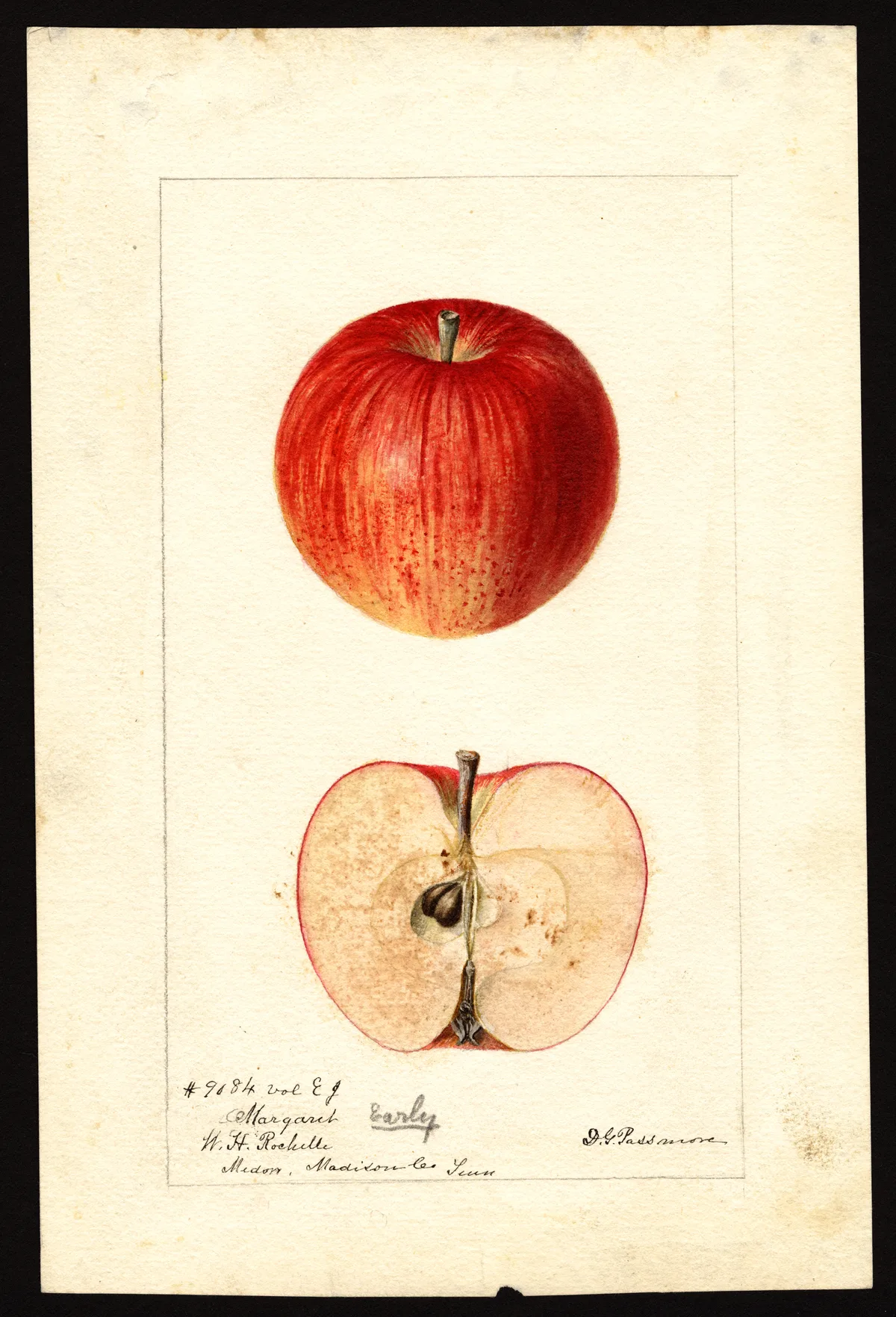
USDA Pomological Watercolor Collection
Editor's Note
Margaret
Origin/History
Margaret is a very old English variety, one of the oldest apples known to the early pomologists. Lindley (1841) calls it "one of the oldest varieties with which we are acquainted" and notes that from England it found its way into German and French gardens, where it is as much esteemed as in its country of origin. Hogg, as quoted in The Herefordshire Pomona (1885) and by Beach (1905), states that "It is without doubt the Margaret of Rea, Worlidge, Ray, and all our early pomologists" (Beach adds "except Miller"). The Herefordshire Pomona notes it is figured by Lindley, Pl. 46. Bunyard (1920) gives its origin as "probably English, dating from the seventeenth century" and describes it as "the second earliest of all apples." Beach (1905) records that it has long been cultivated in America, but only to a very limited extent, and by the early twentieth century was rarely propagated by nurserymen and seldom planted. Bunyard offers an additional taxonomic observation: "The Red Margaret is I think a red sport from this apple as it agrees in all respects save the colour is very much deeper and unstriped."
Tree
Sources broadly agree the tree is small to medium in size and only a moderate bearer, though details of vigor differ. The Herefordshire Pomona (1885) describes it as "small in size, and well adapted for growing dwarf either for potting, or for training as a pyramid, or espalier, when grafted on the paradise or pomme paradis stock. It bears freely and is very hardy, though somewhat liable to canker in light soils." Downing (1900) describes the tree while young as "rather slender, with reddish brown upright woolly shoots" and "a moderate bearer." Elliott (1865) calls it "a regular, moderate bearer, upright, downy shoots." Thomas (1903) reports "Shoots erect, downy; moderate bearer." Budd & Hansen (1914) describe it as "of slender growth; a moderate bearer." Beach (1905) records the tree as "of medium size, moderately vigorous, upright, hardy, long-lived, comes into bearing fairly young and is a pretty reliable biennial cropper." Bunyard (1920) gives "Growth, moderate, making a shapely upright spreading tree; fertility great."
Lindley (1841) describes the wood as "rather strong, gray, and woolly at the upper end; at the lower, sprinkled with well-marked whitish spots." The leaves he describes as "rather large, thick, cordate at the base, with particularly large leafy stipulæ." Bunyard (1920) gives the leaf as "large, roundish, pea green, upheld and upcupped, deeply bluntly serrate or nearly crenate." The flowers are described by Lindley as "in large dense clusters, cream-coloured, slightly tinged with red."
The Central Experimental Farm at Agassiz BC (Bulletin No. 3, 1900) reports two plantings under this name with differing tree vigor: a tree planted Spring 1894 was "a medium grower," while a tree planted Spring 1895 was "a vigorous grower" (this latter entry's fruit description differs markedly from all other sources — see Fruit).
Fruit
Size
Sources report size ranging from small to medium, mostly below medium. Lindley (1841) gives "middle-sized." The Herefordshire Pomona (1885) also gives "middle sized." Elliott (1865) gives "medium or below." Downing (1900) gives "below medium size." Thomas (1903) gives "Medium." Beach (1905) gives "small to nearly medium." Budd & Hansen (1914) give "below medium." Bunyard (1920) gives "small, 2¼ by 2¼." The Encyclopedia of Practical Horticulture (1914) records it as "medium-sized" (and lists a separate entry "Early Margaret" as "medium-sized"). The Central Experimental Farm (1900) reports "below medium size" for one planting and "small" for the other.
Form
Roundish ovate, tapering toward the eye, and rather angular. Lindley (1841): "roundish oblong, rather angular, tapering a little to the eye." Elliott (1865): "roundish oblong conical." The Herefordshire Pomona (1885): "roundish ovate, and narrowing towards the eye, when it is angular." Downing (1900): "roundish ovate, tapering towards the eye." Thomas (1903): "round-ovate." Beach (1905): "roundish ovate." Budd & Hansen (1914): "roundish ovate, somewhat conical, angular toward basin." Bunyard (1920): "oval, slightly irregular." The Encyclopedia of Practical Horticulture (1914) records the separate "Early Margaret" entry as "round form." The Central Experimental Farm (1900) reports "conical" for one planting and "roundish, flat" for the other.
Stem/Stalk
Short and thick or stout. Lindley (1841): "short, thick." Elliott (1865): "stem, short, thick." The Herefordshire Pomona (1885): "short and thick, about half an inch long." Thomas (1903): "stalk half an inch long, thick." Budd & Hansen (1914): "stem short, stout." Bunyard (1920): "short and stout."
Cavity
Small and shallow. The Herefordshire Pomona (1885): the stalk is "inserted in a small and shallow cavity." Elliott (1865): "cavity, medium." Budd & Hansen (1914): "cavity small, shallow." Bunyard (1920): "wide, not russet cavity."
Calyx / Eye
Contracted, plaited, or half-open with prominent, long, broad, erect segments, sometimes surrounded by puckered knobs. Lindley (1841): "Eye contracted, plaited." Elliott (1865): "calyx, half closed." The Herefordshire Pomona (1885): "Eye: half open and prominent, with long, broad, erect segments, surrounded with a number of puckered knobs." Budd & Hansen (1914): "calyx prominent, half open; segment long, broad, erect convergent." Bunyard (1920): "Eye, open, in a shallow, slightly ribbed basin."
Basin
Shallow, narrow, plaited or corrugated, sometimes with small knobs around the eye. Elliott (1865): "basin, shallow." Thomas (1903): "basin plaited, narrow, very shallow." Budd & Hansen (1914): "basin narrow, very shallow, corrugated, with small knobs around the eye." Bunyard (1920): "shallow, slightly ribbed basin."
Skin
Greenish yellow on the shaded side, becoming bright to dark red next the sun, closely and richly striped or streaked with dark red all over, and strewn with grey russety dots. Lindley (1841): "greenish yellow, richly and closely streaked with deep red." Elliott (1865): "green in shade, dark crimson red in sun." The Herefordshire Pomona (1885): "greenish yellow on the shaded side, but bright red next the sun, striped all over with dark red, and strewed with grey russetty dots." Downing (1900): "greenish yellow, pretty well covered by stripes of dark red." Thomas (1903): "striped with dull red, somewhat russeted." Beach (1905): "yellowish striped and marbled with dull red." Budd & Hansen (1914): "surface greenish yellow, nearly covered with dark red stripes, brighter red on sunny side; dots gray, russet, distinct." Bunyard (1920): "greenish-yellow, nearly covered with red stripes and flush." The Encyclopedia of Practical Horticulture (1914) records the main entry as "red skin" and the separate "Early Margaret" entry as "striped or splashed (red) skin."
Flesh and Flavor
Sources agree on white to greenish-white flesh, tender to breaking, juicy, subacid, and — critically for identification — rich and agreeable when eaten fresh, but quickly becoming mealy if left too long. Lindley (1841): "white, juicy, breaking, subacid, very rich and agreeable, without any perfume or spicy flavour." Elliott (1865): "flesh, white, fine grained, tender; 'very good.'" The Herefordshire Pomona (1885): "greenish white, brisk, juicy, and vinous, with a pleasant and very refreshing flavour"; also "a first rate early dessert apple, with a fresh, juicy, vinous flavour." Downing (1900): "white, subacid, and, when freshly gathered from the tree, of a rich, agreeable flavor. Good." Thomas (1903): "flesh sub-acid, tender, good when fresh." Beach (1905): "Flesh pleasant subacid, good." Budd & Hansen (1914): "flesh greenish white, brisk, juicy, pleasant, rich, refreshing subacid, good"; also "fruit good when freshly picked, but soon becomes mealy. It is desirable to gather it a few days before it ripens on the tree." Bunyard (1920): "soft, greenish-white, sub-acid." The Encyclopedia of Practical Horticulture (1914) rates quality as "very good."
Core and Seeds
Budd & Hansen (1914) alone give internal detail: "Core closed; cells roundish ovate, or obovate, axile; tube funnel-shaped; stamens median."
Season
An early summer apple, ripening in July, immediately after Early Harvest, and continuing into early August. Lindley (1841) notes it is "the earliest, or nearly so, of all the summer fruit." Elliott (1865): "July." Downing (1900): "ripening about the middle of July, or directly after the Early Harvest." Thomas (1903): "ripens at wheat harvest, scarcely earlier than Early Harvest." Beach (1905): "season late July and early August." Budd & Hansen (1914): "July, immediately after early harvest." The Herefordshire Pomona (1885): "ripe in the beginning of August." Bunyard (1920): "early August" and "the second earliest of all apples." The Encyclopedia of Practical Horticulture (1914): "summer." The Central Experimental Farm (1900) reports "Season end of July to end of August" for one planting.
Storage behavior: Lindley (1841) notes "It should be eaten fresh from the tree, to be tasted in perfection; but will keep several days without being materially injured." The Herefordshire Pomona (1885) warns it "should not be allowed to ripen on the tree or it will very quickly become mealy." Budd & Hansen (1914) echo: "fruit good when freshly picked, but soon becomes mealy. It is desirable to gather it a few days before it ripens on the tree."
Uses
Primarily a dessert apple. The Herefordshire Pomona (1885) calls it "a first rate early dessert apple." Beach (1905) describes it as "a dessert apple suitable for the home orchard only." Bunyard (1920) lists it as "Dessert." The Encyclopedia of Practical Horticulture (1914) records use as "both kitchen and market" (and lists the same for the separate "Early Margaret" entry).
Subtypes/Variants
Bunyard (1920) proposes a taxonomic relationship: "The Red Margaret is I think a red sport from this apple as it agrees in all respects save the colour is very much deeper and unstriped."
Other
Elliott (1865) warns: "This should not be confounded with Early Strawberry — oftener grown as Red Juneating."
The Encyclopedia of Practical Horticulture (1914) records a separate entry under "Early Margaret" with distribution data: "reported by 1 station in the Northern Division, 12 stations in the Central Division, and 9 stations in the Southern Division; the asterisk on each division figure indicates the variety is reported as adapted to more than one division."
The Central Experimental Farm at Agassiz BC (Bulletin No. 3, 1900) lists two plantings under this variety name. The first (planted Spring 1894) — "Tree a medium grower. Fruit below medium size, conical. Skin green, feebly covered with splashes of bright red. Flesh white, crisp, juicy, sprightly, acid, quality good. Season end of July to end of August" — is broadly consistent with Margaret. [NOTE: Source text may be incorrect — the second entry (planted Spring 1895), which reads "Tree a vigorous grower. Fruit small, roundish, flat. Skin green, sprinkled with whitish dots. Flesh greenish yellow, juicy, mildly acid, with a pleasant flavour, quality good. Season February," describes a small, flat, green-skinned, whitish-dotted, February-keeping apple that is inconsistent in every particular (form, color, dotting rather than striping, and especially season) with the Margaret described by all other sources, and likely refers to a different variety mislabelled under this name.]
Book Sources
Described in 9 period pomological works
- Beach, The Apples of New York Vol. 2 (1905)
- Bunyard, A Handbook of Hardy Fruits (1920) — listed as RED JOANETING
- Lowther (ed.), Encyclopedia of Practical Horticulture (1914) — listed as Margaret (Ha. M.)
- The Herefordshire Pomona (1876–1885)
- Lindley, Pomologia Britannica Vol. 1 (1841) — listed as Early Red Margaret Apple
- Downing, Fruits and Fruit Trees of America (1900) — listed as Early Red Margaret
- Elliott, The Western Fruit Book (1865) — listed as Early Red Margaret
- Thomas, The American Fruit Culturist (1903) — listed as Early Red Margaret
- Budd & Hansen, Systematic Pomology (1914) — listed as Margaret, Early Red
Nursery Catalog Sources
Found in 3 catalogs (1900–1911) from England
- George Bunyard & Co. , Royal Nurseries, Maidstone, Kent , England — 1900
- Central Experimental Farm , Dominion Department of Agriculture, Agassiz, British Columbia (under test; Bulletin No. 3, Second Series) — 1900
- James Veitch & Sons , Ltd., Royal Exotic Nursery, Chelsea, London (also Coombe Wood, Langley, and Feltham) , England — 1911
View original book sources (10)
— John Lindley, Pomologia Britannica, Vol. 1 (1841)THE EARLY RED MARGARET APPLE.
The Margaret Apple. Langley's Pomona, t. 74, f. 1. Early Red Margaret. Hort. Soc. Fruit Cat. p. 129. Early Margaret............. } Red Juneating.............. } of various Gardens. Early Striped Juneating.... } Eve Apple, of the Irish Gardens. Margaretha Apfel........... } Rother Jacobs Apfel........ } of the Germans.
This excellent summer Apple is one of the oldest varieties with which we are acquainted. It is the earliest, or nearly so, of all the summer fruit, and beyond comparison the best. From this country it has found its way into the German and French gardens, in which it is as much esteemed as in our own.
It should be eaten fresh from the tree, to be tasted in perfection; but will keep several days without being materially injured.
Wood rather strong, gray, and woolly at the upper end; at the lower, sprinkled with well-marked whitish spots.
Leaves rather large, thick, cordate at the base, with particularly large leafy stipulæ.
Flowers in large dense clusters, cream-coloured, slightly tinged with red.
Fruit middle-sized, roundish oblong, rather angular, tapering a little to the eye. Stalk short, thick. Eye contracted, plaited. Skin greenish yellow, richly and closely streaked with deep red. Flesh white, juicy, breaking, subacid, very rich and agreeable, without any perfume or spicy flavour.
— F.R. Elliott, The Western Fruit Book (1865)Early Red Margaret.
Early June, } of South, Red Juneating, Red June, } Striped Juneating, June, of Ohio, Early Red Juneating, Eve Apple, of the Irish, Margaretha Apfel, of Germans.
This should not be confounded with Early Strawberry — oftener grown as Red Juneating. Tree, a regular, moderate bearer, upright, downy shoots. Fruit, medium or below, roundish oblong conical ; green in shade, dark crimson red in sun ; stem, short, thick : cavity, medium : calyx, half closed ; basin, shallow ; flesh, white, fine grained, tender ; "very good." July.
— Woolhope Naturalists Field Club, The Herefordshire Pomona (1885)
- MARGARET.
[Syn : Early Red Margaret; Early Margaret; Early Red Juneating; Red Juneating; Striped Juneating; Early Striped Juneating; Striped Quarrenden ; Summer Traveller ; Eve Apple in Ireland; Marget Apple ; Maudlin; Magdalene ; Marguerite; Lammas.]
This is a very old English apple. It is without doubt the Margaret of Rea, Worlidge, Ray, and all our early pomologists. It is figured by Lindley, Pl. 46.
Description.—Fruit: middle sized ; roundish ovate, and narrowing towards the eye, when it is angular. Skin : greenish yellow on the shaded side, but bright red next the sun, striped all over with dark red, and strewed with grey russetty dots. Eye : half open and prominent, with long, broad, erect segments, surrounded with a number of puckered knobs. Stalk : short and thick, about half an inch long, inserted in a small and shallow cavity. Flesh : greenish white, brisk, juicy, and vinous, with a pleasant and very refreshing flavour.
The Margaret is a first rate early dessert apple, with a fresh, juicy, vinous flavour. It is ripe in the beginning of August and should not be allowed to ripen on the tree or it will very quickly become mealy.
The tree is small in size, and well adapted for growing dwarf either for potting, or for training as a pyramid, or espalier, when grafted on the paradise or pomme paradis stock. It bears freely and is very hardy, though somewhat liable to canker in light soils.
— A.J. Downing, The Fruits and Fruit Trees of America (1900)Early Red Margaret. Margaret, or Striped Juneating. Striped June. Early Red Juneating. Striped Juneating. Red Juneating. Eve Apple of the Irish. Margaretha Apfel of the Germans. An excellent early Apple, ripening about the middle of July, or directly after the Early Harvest. The tree while young is rather slender, with reddish brown upright woolly shoots. It is a moderate bearer. Fruit below medium size, roundish ovate, tapering towards the eye. Skin greenish yellow, pretty well covered by stripes of dark red. Flesh white, subacid, and, when freshly gathered from the tree, of a rich, agreeable flavor. Good.
— John J. Thomas, The American Fruit Culturist (1903)Early Red Margaret. Medium, round-ovate; striped with dull red, somewhat russeted; stalk half an inch long, thick; basin plaited, narrow, very shallow; flesh sub-acid, tender, good when fresh; ripens at wheat harvest, scarcely earlier than Early Harvest. Shoots erect, downy; moderate bearer. England.
— S.A. Beach, The Apples of New York, Vol. 2 (1905)MARGARET.
REFERENCES. 1. Forsyth, 1803:50. 2. Am. Gard. Cal., 1806:584. 3. Forsyth, 1824:114. 4. Pom. Mag., 1:No.46. 1828. col. pl. 5. London Hort. Soc. Cat., 1831:No. 708. 6. Kenrick, 1832:26. 7. Floy-Lindley, 1833:7. 8. Manning, 1838:46. 9. Downing, 1845:73. fig. 10. Cole, 1849:98. 11. Thomas, 1849:137. fig. 12. Emmons, Nat. Hist. N. Y., 3:11. 1851. 13. Elliott, 1854:145. 14. Hooper, 1857:31. 15. Warder, 1867:717. 16. Fitz, 1872:160. 17. Downing, 1872:10 index, app. 18. Leroy, 1873:454. fig. 19. Barry, 1883:332. 20. Hogg, 1884:141. 21. Bailey, An. Hort., 1892:238. 22. Jour. Roy. Hort. Soc., 1898:354. 23. Waugh, Vt. Sta. An. Rpt., 14:299. 1901. 24. Budd-Hansen, 1903:124.
SYNONYMS. D'Eve (18). Duverson's June (17). Early June of South (13). EARLY MARGARET (16). Early Margaret (4, 20). Early Red (24). EARLY RED JUNEATING (6). Early Red Juneating (7, 9, 11, 12, 13, 20). EARLY RED MARGARET (4, 7, 8, 9, 10, 11, 12, 14, 15, 17, 19, 21). Early Red Margaret (6, 13, 18, 20, 23). Early Striped Juneating (4, 5, 6, 7, 20). Eve Apple (7, of Ireland 4, 5, 6, 9, 12, 13, 20). Herr's June (17). June of some in Ohio (13). Lammas (3, 20). Magdalene (20). MARGARET (1, 2, 3, 13, 20, 22, 23, 24). Margaret (4, 5, 6, 7, 9, 12, 18). Margaret, Early (5). MARGARET, EARLY RED (5). Margaretha Apfel (4, 7, 9, 12, 13). Marget Apple (20). MARGUERITE (18). Marguerite (5, 20). Maudlin (18, 20). Red Joaneting (22). Red June of South (13). Red Juneating (4, 5, 6, 7, 9, 10, 11, 12, 13, 20). Red Juneting (3). Reinette Quarrendon (18). Rother Jacobs (18). Rother Jacobs Apfel (4, 7). Striped Juneating (5, 9, 11, 12, 13, 18, 20). Striped Quarendon (17). Striped Quarrenden (5, 18, 20). Summer Traveller (5, 17, 20). Virginia June (17).
An early summer apple, small to nearly medium, roundish ovate, yellowish striped and marbled with dull red. Flesh pleasant subacid, good; season late July and early August. It is a dessert apple suitable for the home orchard only. The tree is of medium size, moderately vigorous, upright, hardy, long-lived, comes into bearing fairly young and is a pretty reliable biennial cropper.
Historical. This is a very old English variety. Hogg (20) states that "It is without doubt the Margaret of Rea, Worlidge, Ray, and all our early pomologists except Miller." It has long been cultivated in this country, but only to a very limited extent. It is now rarely propagated by our nurserymen and seldom planted.
— J.L. Budd & N.E. Hansen, American Horticultural Manual, Part II: Systematic Pomology (1914)Margaret, Early Red.—A very old English variety, of slender growth; a moderate bearer; fruit good when freshly picked, but soon becomes mealy. It is desirable to gather it a few days before it ripens on the tree.
Fruit below medium, roundish ovate, somewhat conical, angular toward basin; surface greenish yellow, nearly covered with dark red stripes, brighter red on sunny side; dots gray, russet, distinct; cavity small, shallow; stem short, stout; basin narrow, very shallow, corrugated, with small knobs around the eye; calyx prominent, half open; segment long, broad, erect convergent. Core closed; cells roundish ovate, or obovate, axile; tube funnel-shaped; stamens median; flesh greenish white, brisk, juicy, pleasant, rich, refreshing subacid, good. July, immediately after early harvest.
— Granville Lowther (ed.), Encyclopedia of Practical Horticulture (1914)Margaret (Ha. M.) is a medium-sized apple with red skin. Quality: very good. Use: both kitchen and market. Season: summer. Division reporting stations: not recorded.
[Additional entry in this volume: "Early Margaret", pp. 449–449]
Early Margaret is a medium-sized apple of round form with striped or splashed (red) skin. Quality is very good; use is both kitchen and market. Season is summer. It was reported by 1 station in the Northern Division, 12 stations in the Central Division, and 9 stations in the Southern Division; the asterisk on each division figure indicates the variety is reported as adapted to more than one division.
— E.A. Bunyard, A Handbook of Hardy Fruits (1920)RED JOANETING. Ronalds, P. 6. F., Marguerite; G., Roter Morgareten. (Eve, Lammas, Striped Quarrenden, Margaret.) Dessert, early August, small, 2¼ by 2¼, oval, slightly irregular. Colour, greenish-yellow, nearly covered with red stripes and flush. Flesh, soft, greenish-white, sub-acid. Eye, open, in a shallow, slightly ribbed basin. Stem, short and stout, in a wide, not russet cavity. Growth, moderate, making a shapely upright spreading tree; fertility great. Leaf, large, roundish, pea green, upheld and upcupped, deeply bluntly serrate or nearly crenate. Origin, probably English, dating from the seventeenth century. The second earliest of all apples. The Red Margaret is I think a red sport from this apple as it agrees in all respects save the colour is very much deeper and unstriped.
— Central Experimental Farm, Central Experimental Farm, Agassiz BC — Catalogue of Fruit Trees under Test (Bulletin No. 3, 1900) (1900)Planted Spring 1894. Tree a medium grower. Fruit below medium size, conical. Skin green, feebly covered with splashes of bright red. Flesh white, crisp, juicy, sprightly, acid, quality good. Season end of July to end of August.
Planted Spring 1895. Tree a vigorous grower. Fruit small, roundish, flat. Skin green, sprinkled with whitish dots. Flesh greenish yellow, juicy, mildly acid, with a pleasant flavour, quality good. Season February.