Gladstone
Apple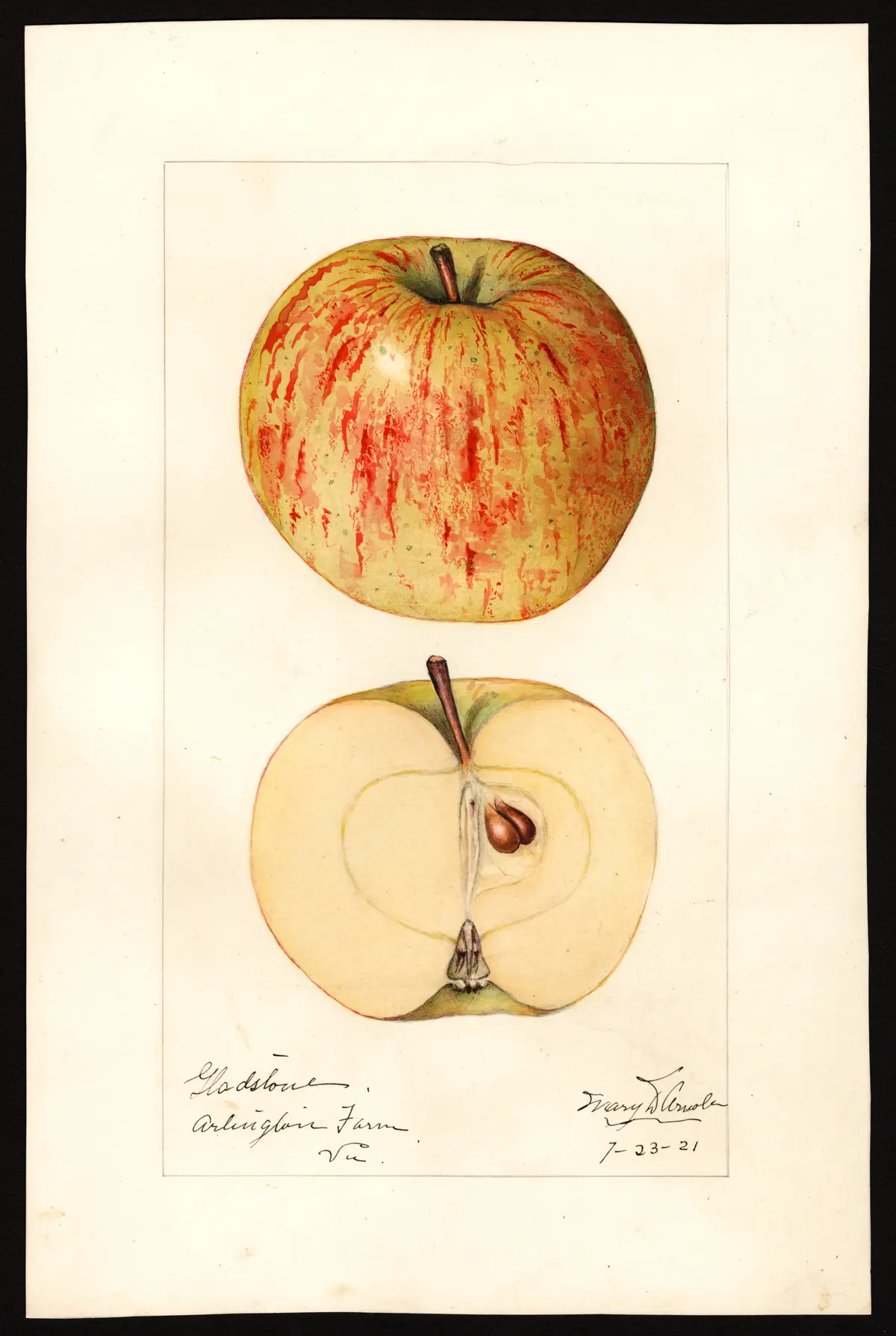
USDA Pomological Watercolor Collection
Gladstone
Origin / History
Gladstone is an English variety, found near Kidderminster by Mr. Jackson of Blakedown Nursery and introduced by him in 1868 (Bunyard). It is a comparatively recent introduction to America, but has been grown for half a century in England (Hedrick). It has not been extensively disseminated in the United States, and so far as Beach could learn, its cultivation was not increasing in this country. Hansen (1902) describes it as "a new variety from England." Bunyard notes it was much grown for market purposes in England and considered a valuable early sort.
Tree
Tree rather small (Beach) to small (Hedrick), moderately vigorous (Beach) — Hedrick characterizes the tree simply as "vigorous." Form spreading and inclined to droop, with short, stout branches. Bunyard describes growth as moderate and the tree as very regularly fertile; it comes into bearing young, is an annual cropper, and productive (Beach). Veitch notes it is very hardy and a good bearer.
Twigs moderately long, curved, stout, with large terminal buds; internodes medium in size. Bark brown, tinged with olive-green, lightly streaked with scarf-skin; pubescent. Lenticels numerous, conspicuous, medium size, round, slightly raised. Buds medium size, broad, flat, obtuse, appressed, slightly pubescent (Beach).
Leaf rather small, roundish, pea green, upfolded, undulating, shallow serrate (Bunyard).
Fruit
Size
Medium to large, uniform (Beach, Hedrick). Hansen describes the fruit as large. Bunyard gives medium, 2½ by 2 inches. Veitch gives medium size.
Form
Roundish, somewhat tapering (Hansen); roundish oblate, slightly conic (Beach) to round-oblate, sometimes conic (Hedrick), obscurely ribbed; sides usually unequal. Bunyard gives round conical, irregular. Hansen describes it as regular.
Stem
Short to medium (Hansen); medium in length, moderately slender (Beach); medium in length, slender (Hedrick); medium, in a shallow cavity (Bunyard).
Cavity
Regular, acute, with small radiating russet patch (Hansen); acuminate to acute, rather wide, moderately deep to deep, sometimes with outspreading russet (Beach); acuminate, wide, deep, sometimes with outspreading russet (Hedrick); shallow (Bunyard).
Calyx
Closed, segments connivent (Hansen); below medium to rather large, closed or somewhat open (Beach); large, closed or open (Hedrick); closed, in a much ribbed basin (Bunyard, who terms it the "eye").
Basin
Nearly smooth, regular, rather shallow (Hansen); rather small, shallow to medium in depth, medium in width to rather wide, a little abrupt, slightly furrowed and wrinkled (Beach); small, medium in depth and width, abrupt, furrowed and wrinkled (Hedrick); much ribbed (Bunyard).
Skin
Surface yellow, mostly covered with dark crimson stripes, much like Oldenburg (Hansen). Thin, smooth, greenish-yellow or pale yellow, more or less thinly overspread with red, irregularly mottled, splashed and distinctly striped with pinkish carmine (Beach); thin, smooth, pale yellow, thinly overspread with red, irregularly mottled, splashed and distinctly striped with carmine (Hedrick). Bunyard: greenish-yellow, almost covered with dark red, occasionally with broken stripes. Veitch: red striped with yellow.
In general appearance the fruit is intermediate between Oldenburg and Gravenstein, perhaps resembling Gravenstein in color more than Oldenburg (Beach); the relationship to Oldenburg and Gravenstein is immediately apparent, the apples resembling Gravenstein more than Oldenburg (Hedrick).
Dots
Obscure, few, minute, whitish (Hansen); rather numerous, inconspicuous, light colored, submerged (Beach); numerous, inconspicuous, light colored, submerged (Hedrick).
Flesh / Flavor
Yellow, fine grained, juicy, acid (Hansen); slightly tinged with yellow, moderately firm, a little coarse, crisp, tender, juicy, mild subacid, fair in quality (Beach); yellow, firm, coarse, crisp, tender, juicy, mild subacid; fair in quality (Hedrick); soft, greenish-white, pleasantly flavoured (Bunyard); juicy, with good flavour (Veitch); "very nicely a dank yellow flesh" (Rivers — text appears garbled).
On quality: Hansen reports "cooking only, rather poor," and quotes J. P. Jackson of Glenwood, Iowa: "Quality as good as Haas, but inferior to Duchess." Beach notes it is not equal to either Oldenburg or Gravenstein in quality. Hedrick concurs that the variety is hardly equal to either Oldenburg or Gravenstein in quality of fruit or in tree-characters. Beach does not recommend it for planting in New York.
Core / Seeds
Core closed, central; cells ovate, axile, slit; tube funnel-shaped; stamens basal; seeds large, plump (Hansen). Beach: calyx tube rather short, cone-shape to funnel-form; stamens median; core medium to rather large, usually axile; cells symmetrical, closed or slightly open; core lines clasping; carpels broadly roundish, very slightly emarginate; seeds rather dark brown, very wide, flat, obtuse to acute. Hedrick: calyx-tube short cone-shape; stamens median; core large, usually axile; cells symmetrical, closed or open; core-lines clasping; carpels broadly roundish, emarginate; seeds dark brown, very wide, flat, obtuse.
Season
August, September (Hansen); September and October (Beach, Hedrick); July to August (Bunyard); July and August (Veitch, Rivers). It is suited to a cool locality (Veitch).
Uses
Hansen: cooking only. Bunyard classifies it as a dessert apple and notes it was much grown for market purposes as a valuable early sort.
Subtypes / Variants
Not described in source.
Other
Hardy fruit (Rivers, who also describes it as "hardy"); very hardy (Veitch).
Book Sources
Described in 4 period pomological works
Nursery Catalog Sources
Found in 6 catalogs (1900–1917) from England, Illinois
- George Bunyard & Co. , Royal Nurseries, Maidstone, Kent , England — 1900 — listed as Mr. Gladstone, or Jackson's Seedling
- Benjamin Buckman (personal inventory) , Farmingdale , Illinois — 1901 — listed as Mr. Gladstone
- James Veitch & Sons , Ltd., Royal Exotic Nursery, Chelsea, London (also Coombe Wood, Langley, and Feltham) , England — 1911 — listed as Mr. Gladstone
- Benjamin Buckman (personal inventory) , Farmingdale , Illinois — 1913 — listed as Mr. Gladstone
- George Bunyard & Co. , Royal Nurseries, Maidstone, Kent , England — 1914 — listed as Mr. Gladstone
- George Bunyard & Co. , Royal Nurseries, Maidstone, Kent , England — 1917 — listed as Mr. Gladstone
View original book sources (6)
— N.E. Hansen, A Study of Northwestern Apples (1902)Gladstone—A new variety from England—Fruit large, regular, roundish, somewhat tapering; surface yellow, mostly covered with dark crimson stripes, much like Oldenburg; dots obscure, few, minute, whitish; cavity regular, acute, with small radiating russet patch; stem short to medium; basin nearly smooth, regular, rather shallow; calyx closed, segments connivent. Core closed, central; cells ovate, axile, slit; tube funnel-shaped; stamens basal; seeds large, plump; flesh yellow, fine grained, juicy, acid; cooking only, rather poor. August, September. J. P. Jackson, Glenwood, Iowa, says: "Quality as good as Haas, but inferior to Duchess."
— S.A. Beach, The Apples of New York, Vol. 2 (1905)GLADSTONE.
REFERENCES. 1. Hogg, 1884:150. 2. N. Y. Sta. An. Rpt., 11:224. 1892. 3. Hansen, S. D. Sta. Bul., 76:52. 1902.
SYNONYMS. GLADSTONE (2, 3). MR. GLADSTONE (1).
Fruit of good size, and when highly colored rather attractive. In general appearance it is intermediate between Oldenburg and Gravenstein, perhaps resembling Gravenstein in color more than Oldenburg. It is not equal to either of these varieties in quality. The tree comes into bearing young, is an annual cropper and productive. Not recommended for planting in New York.
Historical. This is a comparatively recent introduction from England. It has not been extensively disseminated and so far as we can learn its cultivation is not increasing in this country.
TREE.
Tree rather small, moderately vigorous with short, stout branches. Form spreading and inclined to droop. Twigs moderately long, curved, stout, with large terminal buds; internodes medium in size. Bark brown, tinged with olive-green, lightly streaked with scarf-skin; pubescent. Lenticels numerous, conspicuous, medium size, round, slightly raised. Buds medium size, broad, flat, obtuse, appressed, slightly pubescent.
FRUIT.
Fruit medium to large, uniform. Form roundish oblate, slightly conic, obscurely ribbed; sides usually unequal. Stem medium in length, moderately slender. Cavity acuminate to acute, rather wide, moderately deep to deep, sometimes with outspreading russet. Calyx below medium to rather large, closed or somewhat open. Basin rather small, shallow to medium in depth, medium in width to rather wide, a little abrupt, slightly furrowed and wrinkled. Skin thin, smooth, greenish-yellow or pale yellow, more or less thinly overspread with red, irregularly mottled, splashed and distinctly striped with pinkish carmine. Dots rather numerous, inconspicuous, light colored, submerged. Calyx tube rather short, cone-shape to funnel-form. Stamens median. Core medium to rather large, usually axile; cells symmetrical, closed or slightly open; core lines clasping. Carpels broadly roundish, very slightly emarginate. Seeds rather dark brown, very wide, flat, obtuse to acute. Flesh slightly tinged with yellow, moderately firm, a little coarse, crisp, tender, juicy, mild subacid, fair in quality. Season September and October.
— E.A. Bunyard, A Handbook of Hardy Fruits (1920)GLADSTONE. F., Monsieur Gladstone. (Jackson's Seedling, Striped Quarrenden.) Dessert, July to August, medium, 2½ by 2, round conical, irregular. Colour, greenish-yellow, almost covered with dark red, occasionally with broken stripes. Flesh, soft, greenish-white, pleasantly flavoured. Eye, closed, in a much ribbed basin. Stem, medium in a shallow cavity. Growth, moderate; very regularly fertile. Leaf, rather small, roundish, pea green, upfolded, undulating, shallow serrate. Origin, found near Kidderminster, by Mr. Jackson, of Blakedown Nursery, and introduced by him in 1868. Much grown for market purposes, and a valuable early sort.
— U.P. Hedrick, Cyclopedia of Hardy Fruits (1922)GLADSTONE.
Relationship to Oldenburg and Gravenstein is immediately apparent in the fruit of Gladstone, the apples resembling the latter more than the former. The variety, however, is hardly equal to either in quality of fruit or in tree-characters. It is of comparatively recent introduction in America, but has been grown for half a century in England.
Tree small, vigorous, spreading or drooping, with short, stout branches. Fruit medium to large, uniform, round-oblate, sometimes conic, obscurely ribbed, sides usually unequal; stem medium in length, slender; cavity acuminate, wide, deep, sometimes with outspreading russet; calyx large, closed or open; basin small, medium in depth and width, abrupt, furrowed and wrinkled; skin thin, smooth, pale yellow, thinly overspread with red, irregularly mottled, splashed and distinctly striped with carmine; dots numerous, inconspicuous, light colored, submerged; calyx-tube short cone-shape; stamens median; core large, usually axile; cells symmetrical, closed or open; core-lines clasping; carpels broadly roundish, emarginate; seeds dark brown, very wide, flat, obtuse; flesh yellow, firm, coarse, crisp, tender, juicy, mild subacid; fair in quality; September and October.
— James Veitch & Sons, Veitch's Fruit Trees (1911) (1911)medium size, very hardy, red striped with yellow, good for a cool locality, flesh juicy, with good flavour, a good bearer. July & Aug.
— Thomas Rivers & Son, Thomas Rivers Catalogue of Fruits (1914) (1914)very nicely a dank yellow flesh; hardy fruit - July & Aug.