Duchess of Oldenburg
Apple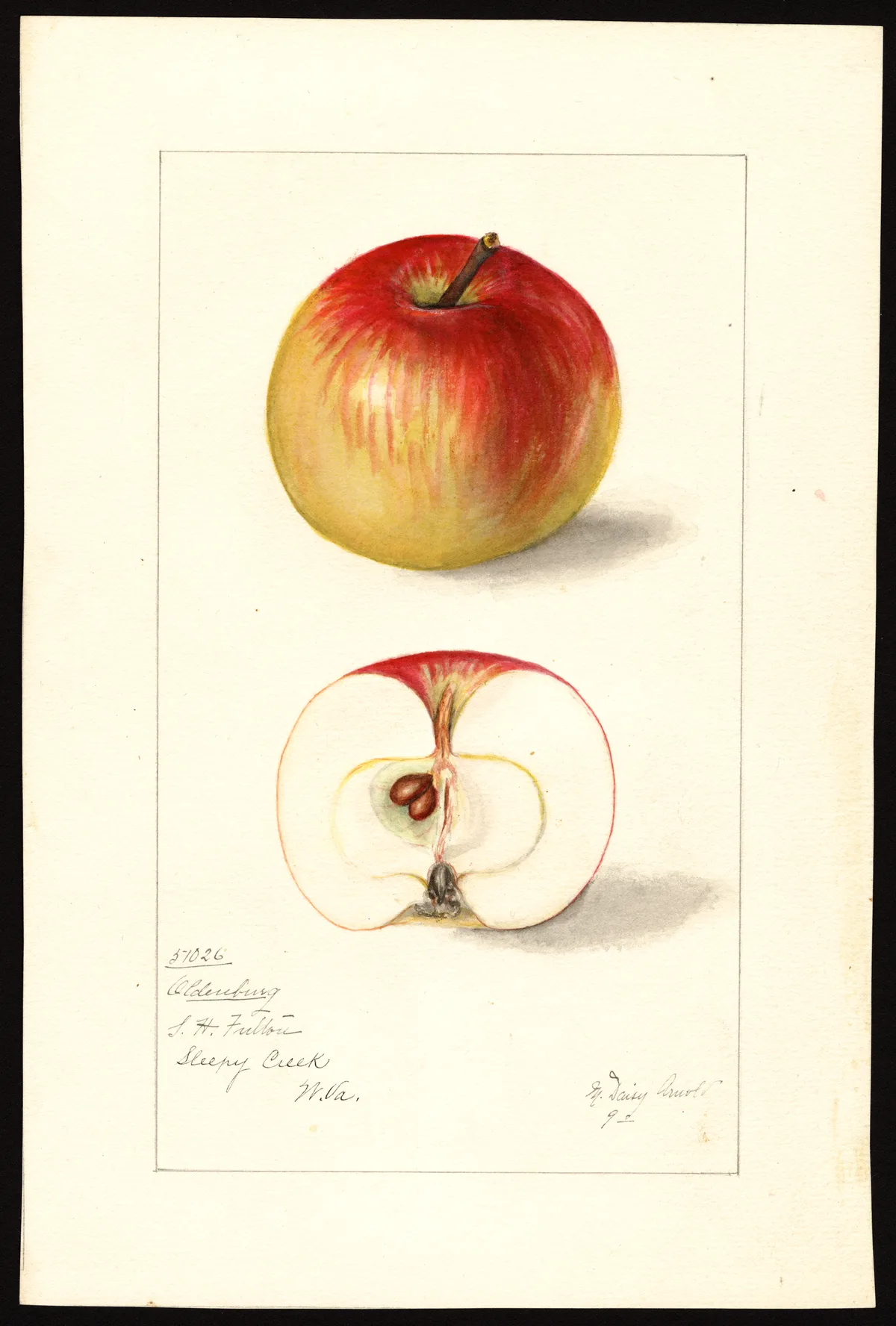
USDA Pomological Watercolor Collection
Duchess of Oldenburg
Origin / History
A Russian variety whose precise origin is nowhere given (Herefordshire Pomona). It was sent from the Taurida Gardens, near St. Petersburg, to the London Horticultural Society in 1824 (Herefordshire Pomona; Bunyard 1920), and was figured in the Pomological Magazine, Plate 10 (Herefordshire Pomona). Robert Manning, Superintendent of the Test Garden of the Massachusetts Horticultural Society at Salem, was credited by Hovey as having first proved the Duchess of Oldenburg in America, giving a brief account of it in his Book of Fruits. Manning's 1838 description read: "A valuable and handsome apple said to be of Russian origin. The size is middling, form round and rather flat; skin of a beautiful yellow, striped with red; flavor very pleasant and good. It bears well and ripens in September and October" (Beach).
The variety was imported from England to America about 1835 (Beach; Hedrick), brought across by the Massachusetts Horticultural Society from the London Horticultural Society. It is one of the four pioneers among Russian apples in America, the other three being Alexander, Tetofsky, and Red Astrachan (Beach). Oldenburg had been brought to England from Russia about twenty years prior to that — i.e., circa 1815 (Beach), consistent with the 1824 Taurida shipment cited by other sources.
Once disseminated through the Middle West and Northwest, it proved much superior in hardiness to Baldwin, Rhode Island Greening, Northern Spy and other commonly cultivated varieties (Beach). Its extreme hardiness in the early test winters kept up the hopes of prairie orchardists in time of great discouragement and led to the importation of more varieties from Russia (Hansen; Beach; Budd-Hansen; Lowther). It became popular with settlers on the prairies of Illinois, Iowa, and other north central states where the winters are severe (Lowther). Dr. John A. Kennicott, the pioneer cultivator of Northern Illinois, considered this apple "the ne plus ultra" for that and higher latitudes (Warder). It is reported to be "very fine at the North in Canada" (Elliott).
The variety is known throughout the West either by the name Duchess or by the full name Duchess of Oldenburg; the American Pomological Society abbreviated the full name to Oldenburg, but this name has not been generally accepted by Western fruit growers (Hansen; Beach; Lowther). In European nurseries it is propagated under the names Charlamowsky and Borowitsky (Hansen; Beach; Lowther). Beach lists it among the American Pomological Society catalog entries from 1862 and 1883.
Hansen records an associated "Duchess Group" grouping by the Russian Pomological Commission: "Duchess; Duchess of Oldenburg; Oldenburg; Arabian, 184; Borovinka, 245; White Krim; Anisovka or Anisette, 185; Glass Green." Discussion within that record (Hansen): A. G. Tuttle stated, "My Glass Green colors up more than Duchess, and keeps its flavor longer than Duchess after coloring. It is a better apple in my experience to grow than Duchess. Of late years I have set Glass Green instead of Duchess, as it is a better tree, and more valuable because keeping its quality longer after coloring." C. G. Patten reported, "The Anisovka I got from Dr. Regel is distinctly of the Anis family and of very upright habit. Peterson of Waconia and Reeves of Waverly say that Borovinka is better than Duchess." S. B. Green added, "That is J. M. Underwood's opinion." C. Wedge clarified, "Mr. Peterson said his Borovinka was a better keeper, but his Duchess were old decrepit trees, while his Borovinka were young trees."
On Borovitsky as a separate variety: Downing notes, "There may be a distinct variety under this name, but, so far as received by me, it has proved to be identical with Duchess of Oldenburg," and his Borovitsky entry describes "A Russian Apple of medium size, roundish, angular. Skin pale whitish yellow, faintly striped. Flesh white, firm, subacid. August." Elliott's separate Borovitsky entry similarly reads: "Foreign. Medium, roundish, pale green striped red; flesh, white, sub-acid. August, September." Thomas's separate Borovitsky entry reads: "Medium, roundish, striped; firm, sub-acid. August. Russian."
Tree
Tree medium in size (Warder; Beach; Hedrick), round-headed (Warder), at first upright spreading but eventually roundish (Beach; Lowther; Hedrick describes simply as upright-spreading). Downing describes the tree as vigorous, forming a roundish, upright, spreading head, requiring little or no pinning, and producing abundantly. Elliott calls the tree vigorous, with dark, upright shoots, and productive. Thomas notes the strong growth of the tree, its early bearing, and endurance of severe winters; the shoots are dark and ascending. Bunyard describes growth as vigorous, upright; fertility good.
Beach gives detailed structure: vigorous when young but with age becomes a rather moderate or slow grower; only moderately long-lived; a reliable cropper, yielding good crops biennially, often with lighter crops alternating; the trees generally require good cultivation, thorough fertilizing, and careful spraying for best commercial results; fruit hangs fairly well to the tree till ripe. Hedrick notes trees are neither large nor long-lived and are quite susceptible to disease, but come into bearing early, are hardy and productive, and are especially fitted for planting as fillers among permanent trees. Hansen summarizes the tree as "medium upright." Central Experimental Farm describes it as "a strong upright grower" (planted Spring 1890).
Twigs moderately long, curved, slender; internodes long (Beach); twigs moderately long, curved, slender, with dark brown bark (Lowther). Downing notes young shoots smooth, reddish. Bark dark brown, lightly mottled with scarf-skin; slightly pubescent (Beach). Lenticels scattering, small to medium, oblong, not raised (Beach). Buds medium size, plump, obtuse, free, slightly pubescent (Beach). Leaf medium, upfolded, undulating, nearly serrate (Bunyard).
The variety's hardiness is repeatedly singled out: "the hardiest of the old list" (Hansen; Budd-Hansen); "perfectly hardy" (Warder); "the tree is hardy, grows freely and bears well" (Herefordshire Pomona); "very hardy" (Thomas).
Fruit
Size
Medium to large, averaging above medium, uniform in size and shape (Beach; Lowther; Hedrick). Downing, Warder, and Hansen's first description give size as medium; Elliott as medium to large; Thomas as medium or rather large; Bunyard as medium; the Veitch catalog as large; the George Bunyard catalog as medium to large; Hansen's Oldenburg entry as large; Budd-Hansen as large; Central Experimental Farm as medium. Herefordshire Pomona gives precise dimensions: above medium size, sometimes larger, about three inches and a quarter wide and two inches and a half high. Bunyard 1920 gives 3¼ by 2¼ (round, flattened, regular).
Form
Roundish (Elliott — roundish flattened; Bunyard — round, flattened, regular; Central Experimental Farm — roundish; Veitch — roundish); roundish oblate (Warder — roundish-oblate; Downing — roundish oblate; Hansen — roundish oblate; Budd-Hansen — roundish oblate; Hansen's Oldenburg description — large, roundish oblate, regular); roundish oblate to oblate, regular, symmetrical (Beach); roundish to oblate, regular, symmetrical (Lowther); round-oblate or oblate, regular, symmetrical (Hedrick); roundish, a little flattened at the ends (Thomas). Herefordshire Pomona adds that it is round, and sometimes prominently ribbed on the sides and around the eye.
Stem
Short (Elliott; Downing's Borovitsky-derived material; Thomas; Hansen — medium; Budd-Hansen — short to medium; Beach — short to sometimes medium, moderately slender; Hedrick — short, slender); long and slender (Herefordshire Pomona); medium to long, rather slender (Warder); slender (Bunyard 1920).
Cavity
Acuminate (Elliott; Thomas); regular, acute (Warder); acute to acuminate, deep, broad, usually partly covered with greenish-russet (Beach); acute, deep, broad, usually partly covered with green-russet (Hedrick); deep, regular, acute, with a small radiating patch of russet in the bottom (Hansen's Oldenburg description; Budd-Hansen); regular, medium deep, narrow, light russeted (Hansen's Duchess description); narrow and angular, with the stalk deeply inserted (Herefordshire Pomona); deep and narrow (Bunyard 1920).
Calyx / Eye
Eye large and closed (Warder; Herefordshire Pomona — with long broad segments); calyx pretty large and nearly closed (Downing); calyx half open (Hansen's Duchess description); calyx closed, segments long, broad, connivent (Hansen's Oldenburg description; Budd-Hansen); calyx medium to rather large, usually closed; lobes rather broad, acute (Beach); calyx large, usually closed; lobes broad, acute (Hedrick); eye closed (Bunyard 1920).
Basin
Deep (Elliott; Thomas — deep and narrow); regular, pretty wide (Warder); deep and angular (Herefordshire Pomona); wide, even hollow (Downing); broad, corrugated (Hansen's Duchess description); abrupt, regular, with small protuberances around the eye (Hansen's Oldenburg description; Budd-Hansen); moderately deep to deep, wide, abrupt, smooth or with small mammiform protuberances (Beach); deep, wide, abrupt, smooth or with small mammiform protuberances (Hedrick); deep, even (Bunyard 1920).
Skin
Smooth (Warder; Beach — moderately thick, tender, smooth; Hedrick — thick, tender, smooth; Lowther — moderately thick, tender, smooth; Herefordshire Pomona; Central Experimental Farm). Ground color is pale greenish-yellow or pale yellow (Beach; Lowther); waxen-yellow (Warder); golden or yellow (Downing); greenish yellow (Hansen; Budd-Hansen; Herefordshire Pomona — greenish yellow on the shaded side; Central Experimental Farm — yellow); palest yellow (Bunyard 1920); pale whitish yellow in Downing's Borovitsky entry.
The ground is partially or almost wholly covered with distinct and regular stripes and splashes of brilliant red and carmine (Warder); finely washed and streaked with red on a golden or yellow ground (Downing); light red in broad broken stripes and splashes on yellow ground (Thomas); light red, striped and splashed on yellow (Elliott); washed and splashed with red (Central Experimental Farm); almost covered with irregular splashes and stripes of bright red mottled and shaded with crimson (Beach; Lowther); covered with irregular splashes and stripes of bright red, mottled and shaded with crimson (Hedrick); greenish yellow with red stripes (Hansen's Duchess description); greenish yellow, almost wholly covered with stripes and splashes, mixed on sunny side with crimson (Hansen's Oldenburg description; Budd-Hansen); strong red stripes on palest yellow (Bunyard 1920); striped red (Veitch); pale yellow striped red (George Bunyard); large, roundish, striped red (Veitch).
Herefordshire Pomona adds that the skin is streaked with broken patches of fine bright red on the side next the sun, sometimes assuming a beautiful dark crimson cheek. The prevailing effect is red striped, and the fruit is described as attractive and handsome (Beach; Lowther; Hedrick; Warder; Thomas; Hansen — "a handsome fruit"; Bunyard 1920 — "of most attractive appearance").
Dots: scattering, small, light colored (Beach; Hedrick); white, numerous, minute (Hansen's Oldenburg description; Budd-Hansen). Herefordshire Pomona reports the skin "covered all over with numerous russety dots, particularly round the eye, where they are large, dark and rough."
A faint blue or light bloom is often present, such as is found on most Russian apples (Warder — light bloom; Downing — faint blue bloom).
Flesh & Flavor
Flesh white (Elliott — yellowish white; Herefordshire Pomona — yellowish white; Thomas — yellowish white; Warder — white; Hansen — light yellow; Hansen's Oldenburg description — white; Budd-Hansen — white; Bunyard 1920 — white; Beach — tinged with yellow; Lowther — tinged with yellow; Hedrick — yellow; Central Experimental Farm — white).
Texture: firm, crisp and very juicy (Herefordshire Pomona); rather coarse (Hansen's Duchess description); tender, juicy (Warder); juicy (Downing); soft (Bunyard 1920); rather firm, moderately fine, crisp, tender, juicy (Beach; Lowther); firm, fine, crisp, tender, juicy (Hedrick); juicy, crisp, sprightly (Central Experimental Farm); firm (Thomas; Downing's Borovitsky); firm (Elliott's Borovitsky — "white, firm, sub-acid").
Flavor: sharp sub-acid (Elliott); sour and suitable for cooking, though attractive to the eye unsuited for the dessert (Warder); sprightly subacid (Downing; Beach; Lowther; Hedrick); pleasant, brisk and refreshing (Herefordshire Pomona); sub-acid (Thomas; Bunyard 1920; George Bunyard catalog implicit in culinary use); rather sharp acid (Hansen's Duchess description); sprightly acid (Hansen's Oldenburg description; Budd-Hansen); aromatic (Beach; Lowther; Hedrick); sprightly (Central Experimental Farm). Beach summarizes the eating quality as "good to very good for culinary purposes" but adds it "has too much acidity for a good dessert apple." Downing calls it "passably good for dessert." Herefordshire Pomona, by contrast, calls it "an excellent early dessert apple of the first quality." The Veitch catalog calls the flavor pleasant.
Core & Seeds
Core medium (Hansen's Duchess description — medium, closed); core closed (Hansen's Oldenburg description; Budd-Hansen); core medium to rather large, axile; cells symmetrical, closed or slightly open; core lines clasping (Beach); core large, axile; cells symmetrical, closed or open; core-lines clasping (Hedrick). Cells ovate, axile (Hansen's Oldenburg description; Budd-Hansen); carpels broadly ovate, slightly emarginate (Beach); carpels broad-ovate, emarginate (Hedrick). Calyx tube moderately long, rather wide, funnel-shape with broad truncate cylinder or approaching urn-shape (Beach); calyx-tube long, wide, funnel-shape with broad truncate cylinder (Hedrick); tube funnel-shaped (Hansen's Oldenburg description; Budd-Hansen). Stamens median (Beach; Hedrick; Budd-Hansen); stamens basal (Hansen's Oldenburg description).
Seeds medium to rather large, wide, obtuse to acute, moderately plump, dark brown (Beach); seeds large, wide, obtuse, plump, dark brown (Hedrick).
Season
Late August and September (Beach); August and September (Elliott; Warder — though Warder gives the description as ripening early in September; Downing — "Ripens early in September"; Hansen; Hedrick; Central Experimental Farm); August (Hansen's Oldenburg description; Budd-Hansen; Bunyard's Borovitsky); from the middle of August to the end of September (Herefordshire Pomona); early autumn (Thomas); August to September, July–September (George Bunyard catalog gives July–September); August and September (Veitch). The fruit ripens in succession so that several pickings are required in order to secure the crop in prime marketable condition (Beach). It may be used for culinary purposes before it is fully ripe (Beach). Lowther notes ripening in the northern states about the last of August and the first of September.
Uses
Valued for cooking and market (Elliott; Downing — valuable for market and cooking, passably good for dessert); especially suitable for culinary uses (Hedrick); excellent culinary qualities, highly esteemed for home use (Beach); good for cooking (Thomas); culinary or dessert (Bunyard 1920 — culinary or dessert); culinary, excellent for cooking (George Bunyard catalog); a refreshing summer fruit (Bunyard 1920); a good cooker (Lowther). Warder calls it sour and suitable for cooking but unsuited for the dessert; Herefordshire Pomona, by contrast, calls it an excellent early dessert apple of the first quality.
Commercially: when properly grown and carefully handled it stands shipment pretty well and sells well for a variety of its season; in some few localities in Western New York it is grown in sufficient quantities so that it can be shipped in car lots to distant markets, but in very many places it is produced in greater quantities than the local markets can absorb yet not enough to be economically shipped to distant markets (Beach). The fruit is quite perishable, does not stand heat well before shipment, and goes down rather quickly, particularly if the weather is unfavorable; when sent to distant markets it should be shipped under ice (Beach). Lowther echoes that the fruit is perishable and does not stand shipment well but, when carefully handled, may be considered a fair commercial variety for its season. The fruit is quite uniform in size and quality, with but a small percentage of loss from unmarketable fruit (Beach). Hedrick calls the variety "preeminently an apple of commerce" that thrives north and south, east and west, on many soils, but always requires good care. Bunyard 1920 calls fertility good. The Veitch catalog calls it "a good keeping, regularly stowing productive variety for market."
Subtypes / Variants
Hansen lists an associated "Duchess Group" comprising Duchess; Duchess of Oldenburg; Oldenburg; Arabian, 184; Borovinka, 245; White Krim; Anisovka or Anisette, 185; and Glass Green (per the Russian Pomological Commission). Within Hansen's discussion of that group, A. G. Tuttle's Glass Green is noted as coloring up more than Duchess, keeping its flavor longer after coloring, and being a better apple to grow than Duchess in his experience. C. G. Patten's Anisovka (from Dr. Regel) is described as distinctly of the Anis family and of very upright habit. Borovinka was reported by Peterson of Waconia and Reeves of Waverly as better than Duchess; with Mr. Peterson's Borovinka noted as a better keeper, though comparative tree ages confounded that judgment.
Downing notes the possibility that a distinct variety may exist under the name Borovitsky, although the specimens he received proved to be identical with Duchess of Oldenburg. The separate Borovitsky entries given by Elliott ("Foreign. Medium, roundish, pale green striped red; flesh, white, sub-acid. August, September.") and Thomas ("Medium, roundish, striped; firm, sub-acid. August. Russian.") describe what may be either the same variety or a closely related one.
Other
Beach's full synonymy and reference list is exhaustive, citing forty-nine references from 1831 through 1904. Hedrick notes the variety is "especially fitted for planting as fillers among permanent trees." Central Experimental Farm (Agassiz BC) records its trees were planted Spring 1890 and the variety is "a strong upright grower" producing fruit of medium size, roundish, with smooth yellow skin washed and splashed with red, white juicy crisp sprightly flesh of good quality, in season August and September. The Veitch catalog of 1911 highlights it as "a good keeping, regularly stowing productive variety for market," in season August and September. The George Bunyard catalog of 1914 marks it culinary, July–September, medium to large, pale yellow striped red, "a reliable early autumn sort. Excellent for cooking."
Book Sources
Described in 11 period pomological works
- Beach, The Apples of New York Vol. 2 (1905) — listed as Oldenburg
- Budd & Hansen, Systematic Pomology (1914) — listed as Oldenburg, Duchess of
- Warder, American Pomology: Apples (1867) — listed as Duchess of Oldenburgh
- Downing, Fruits and Fruit Trees of America (1900) — listed as Duchess of Oldenburgh
- Lowther (ed.), Encyclopedia of Practical Horticulture (1914) — listed as Oldenburg
- Hansen, A Study of Northwestern Apples (1902) — listed as Duchess
- Bunyard, A Handbook of Hardy Fruits (1920) — listed as Duchess
- Elliott, The Western Fruit Book (1865) — listed as Borovitsky
- Hedrick, Cyclopedia of Hardy Fruits (1922) — listed as Oldenburg
- The Herefordshire Pomona (1876–1885) — listed as Borovitsky
- Thomas, The American Fruit Culturist (1903) — listed as Borovitsky
USDA Nomenclature (1905)
From W.H. Ragan, Nomenclature of the Apple, USDA Bulletin No. 56
This may be Oldenburg.
Nursery Catalog Sources
Found in 75 catalogs (1881–1947) from Arkansas, California, England, Illinois, Maryland, Massachusetts, Missouri, New Jersey, New York, Oregon, Pennsylvania, Washington
- Hutchison Nursery , James Hutchison, Oakland , California — 1881 — listed as Duchess
- Felix Gillet , Barren Hill Nursery, Nevada City , California — 1884 — listed as Duchess
- Felix Gillet , Barren Hill Nursery, Nevada City , California — 1888 — listed as Duchess
- Felix Gillet , Barren Hill Nursery, Nevada City , California — 1889 — listed as Duchess
- Palouse Nursery and Pleasant Dale Fruit Farm , Colfax, Washington Territory (situated two miles northeast of Colfax) - undated (single-page broadside flyer; "Washington Territory" suggests pre — 1889 — listed as Duchess
- Felix Gillet , Barren Hill Nursery, Nevada City , California — 1890 — listed as Duchess
- William H. Moon Co. , Morrisville, Bucks County , Pennsylvania — 1890 — listed as Duchess
- Felix Gillet , Barren Hill Nursery, Nevada City , California — 1891 — listed as Duchess
- Puyallup & Yakima Nurseries , Puyallup, Washington (Lock Box 191) and North Yakima , Washington — 1892 — listed as Duchess
- Milwaukie-Canby Nurseries , Canby, OR (and Milwaukie, OR) — 1893 — listed as Duchess
- Rogers Nursery Co. , Moorestown , New Jersey — 1893 — listed as Duchess
- Multnomah Nurseries , Russellville , Oregon — 1894 — listed as Duchess
- The Vineland Nurseries (Kelsey & Co. , Proprietors), St. Joseph, Missouri (Office: 13th and Atchison Sts., 2 Blocks East of the Citizens St. Car Line) — 1894 — listed as Duchess
- Woodburn Nurseries , Woodburn, Marion Co. , Oregon — 1894 — listed as Duchess
- Green's Nursery Co. (Charles A. Green) , Rochester , New York — 1894 — listed as Duchess
- Felix Gillet , Barren Hill Nursery, Nevada City , California — 1895 — listed as Duchess
- The Lovett Company , Little Silver , New Jersey — 1896 — listed as Duchess
- Felix Gillet , Barren Hill Nursery, Nevada City , California — 1897 — listed as Duchess
- Kelway & Son , Langport, Somerset , England — 1897 — listed as Duchess
- Arthur J. Collins & Sons , Moorestown , New Jersey — 1898 — listed as Duchess
- Reading Nursery , Jacob W. Manning, Proprietor, Reading , Massachusetts — 1898 — listed as Duchess
- Brown Brothers Co. , Continental Nurseries, Rochester, NY (also operated from Toronto, Canada) — 1899 — listed as Duchess
- George Bunyard & Co. , Royal Nurseries, Maidstone, Kent , England — 1900 — listed as Duchess
- Central Experimental Farm , Dominion Department of Agriculture, Agassiz, British Columbia (under test; Bulletin No. 3, Second Series) — 1900 — listed as Duchess
- Central Experimental Farm , Dominion Department of Agriculture, Agassiz, British Columbia (under test; Bulletin No. 3, Second Series) — 1900 — listed as Anisette
- Central Experimental Farm , Dominion Department of Agriculture, Agassiz, British Columbia (under test; Bulletin No. 3, Second Series) — 1900 — listed as Duchess of Oldenburgh
- Washington Nursery Co. , Toppenish , Washington — 1901 — listed as Duchess
- Brown Brothers Co. , Continental Nurseries, Rochester, NY (also operated from Toronto, Canada) — 1901 — listed as Duchess
- Mountain Grove Nurseries (Tippin & Moore , Proprietors; Geo. T. Tippin, J. W. Tippin, J. C. Moore), Mountain Grove , Missouri — 1901 — listed as Duchess
- S.L. Watkins , Grizzly Flats, El Dorado County , California — 1901 — listed as Duchess
- Yarbrough Bros. , Stephens , Arkansas — 1901 — listed as Duchess
- Benjamin Buckman (personal inventory) , Farmingdale , Illinois — 1901 — listed as Duchess
- Forestville Nurseries , T.J. True, Forestville , California — 1902 — listed as Duchess
- Pacific Nursery Company (W. O. Hudson & A. D. Hudson) , Tangent , Oregon — 1903 — listed as Duchess
- Russellville Nursery Co. , Russellville, OR (three miles east of Portland, one mile from Montavilla car line) — 1903 — listed as Duchess
- Phoenix Nursery Company (W. E. Rossney , President; Sidney Tuttle, Vice-President), Bloomington , Illinois — 1904 — listed as Duchess
- The Dalles Nurseries , The Dalles , Oregon — 1906 — listed as Duchess
- Stark Bros. Nurseries & Orchards Co. , Louisiana , Missouri — 1906 — listed as Duchess
- Russellville Nursery Co. , Montavilla Station, Portland, OR (three miles east of Portland, one mile from Montavilla car line) — 1907 — listed as Duchess
- Carlton Nursery Co. , Carlton , Oregon — 1909 — listed as Duchess
- Milton Nursery Co. (A. Miller & Sons , Proprietors), Milton , Oregon — 1909 — listed as Duchess
- Wm. J. Corse (successor to Robert Sinclair / Sinclair Nurseries) , Baltimore , Maryland — 1909 — listed as Duchess
- Washington Nursery Company , Toppenish , Washington — 1909 — listed as Duchess
- C.F. Lansing , Salem , Oregon — 1910 — listed as Duchess
- Island Nurseries & Fruit Farm , Vashon (Vashon Island) , Washington — 1910 — listed as Duchess
- Stark Bros. Nurseries & Orchards Co. , Louisiana , Missouri — 1910 — listed as Duchess
- Island Nurseries & Fruit Farm , Vashon (Vashon Island) , Washington — 1911 — listed as Duchess
- Stark Bros. Nurseries & Orchards Co. , Louisiana , Missouri — 1911 — listed as Duchess
- James Veitch & Sons , Ltd., Royal Exotic Nursery, Chelsea, London (also Coombe Wood, Langley, and Feltham) , England — 1911 — listed as Duchess
- Ballygreen Nurseries , Hanford , Washington — 1912 — listed as Duchess
- Pacific Nursery Company , Portland , Oregon — 1912 — listed as Duchess
- Stark Bros. Nurseries & Orchards Co. , Louisiana , Missouri — 1912 — listed as Duchess
- Vineland Nurseries Company , Clarkston , Washington — 1912 — listed as Duchess
- Washington Nursery Company , Toppenish , Washington — 1912 — listed as Duchess
- Samuel Fraser , Geneseo , New York — 1913 — listed as Duchess
- Thomas Rivers & Son , Sawbridgeworth, Hertfordshire , England — 1913 — listed as Duchess
- Van Holderbeke Nursery Co. , Incorporated, Spokane, Washington (nurseries at Otis Orchards WA, Pasadena WA, Kennewick WA) — 1913 — listed as Duchess
- Benjamin Buckman (personal inventory) , Farmingdale , Illinois — 1913 — listed as Duchess
- George Bunyard & Co. , Royal Nurseries, Maidstone, Kent , England — 1914 — listed as Duchess
- Island Nurseries & Fruit Farm , Vashon (Vashon Island) , Washington — 1914 — listed as Duchess
- Island Nurseries & Fruit Farm , Vashon (Vashon Island) , Washington — 1915 — listed as Duchess
- Union Nurseries , J.B. Weaver & Sons, Union , Oregon — 1915 — listed as Duchess
- Island Nurseries & Fruit Farm , Vashon (Vashon Island) , Washington — 1916 — listed as Duchess
- Manalapan Nurseries , Englishtown , New Jersey — 1916 — listed as Duchess
- George Bunyard & Co. , Royal Nurseries, Maidstone, Kent , England — 1917 — listed as Duchess
- Island Nurseries & Fruit Farm , Vashon (Vashon Island) , Washington — 1917 — listed as Duchess
- Fancher Creek Nurseries , George C. Roeding, Fresno , California — 1918 — listed as Duchess
- Oregon Nursery Co. , Orenco , Oregon — 1920 — listed as Duchess
- Christopher Nurseries / John Stewart & Sons , Christopher , Washington — 1920 — listed as Duchess
- Benedict Nursery Co. , Portland , Oregon — 1921 — listed as Duchess
- Columbia & Okanogan Nursery Co. , Wenatchee , Washington — 1925 — listed as Duchess
- Stark Bro's Nurseries , Louisiana , Missouri — 1932 — listed as Duchess
- Hudson's Wholesale Nurseries , Tangent , Oregon — 1936 — listed as Duchess
- Milton Nursery Co. , Milton-Freewater , Oregon — 1947 — listed as Duchess
- North-Western Nurseries , Walla Walla , Washington — listed as Duchess
View original book sources (14)
— F.R. Elliott, The Western Fruit Book (1865)BOROVITSKY.
Foreign. Medium, roundish, pale green striped red ; flesh, white, sub-acid. August, September.
[Additional entry in this volume: "Duchess of Oldenburgh", pp. 78–78]
Duchess of Oldenburgh.
Foreign. Tree, vigorous, with dark, upright shoots, productive, valued for cooking and market. Fruit, medium to large, roundish flattened, light red, striped and splashed on yellow ; stem, short ; cavity, acuminate ; basin, deep; flesh, yellowish white, sharp sub-acid. August and September Very fine at the North in Canada.
— John A. Warder, American Pomology: Apples (1867)Duchess of Oldenburgh.
This very beautiful striped apple is from Russia, and has proved one of the hardiest apples in our trying climate. Reports from the Northwest are entirely satisfactory as to its hardiness.
Tree medium size, round-headed, sufficiently vigorous and perfectly hardy.
Fruit medium, regular, roundish-oblate; Surface smooth, waxen-yellow, partially covered with distinct and regular stripes and splashes of brilliant red and carmine; often having a light bloom, such as is found on most Russian apples.
Basin regular, pretty wide; Eye large and closed.
Cavity regular, acute; Stem medium to long, rather slender.
Flesh white, tender, juicy; Sour and suitable for cooking. Though attractive to the eye, it is unsuited for the dessert.
By Dr. Jno. A. Kennicott, the pioneer cultivator of Northern Illinois, this apple was considered the ne plus ultra for that and higher latitudes.
— Woolhope Naturalists Field Club, The Herefordshire Pomona (1885)PLATE XXVII.
- BOROVITSKY.
[Syn : Duchess of Oldenburgh ; Smith's Beauty of Newark ; New Brunswick?]
A Russian variety, whose origin is nowhere given. It was sent from the Taurida Gardens, near St. Petersburgh, to the London Horticultural Society, in 1824. It has been figured in the Pomological Magazine, Plate 10.
Description. Fruit : above medium size, sometimes larger, about three inches and a quarter wide, and two inches and a half high ; round, and sometimes prominently ribbed on the sides, and around the eye. Skin : smooth, greenish yellow on the shaded side, and streaked with broken patches of fine bright red on the side next the sun, sometimes assuming a beautiful dark crimson cheek ; it is covered all over with numerous russety dots, particularly round the eye, where they are large, dark and rough. Eye : large and closed, with long broad segments, placed in a deep and angular basin. Stalk : long and slender, deeply inserted in a narrow and angular cavity. Flesh : yellowish white, firm, crisp and very juicy, with a pleasant, brisk and refreshing flavour.
An excellent early dessert apple of the first quality, in season from the middle of August, to the end of September.
The tree is hardy, grows freely and bears well.
— A.J. Downing, The Fruits and Fruit Trees of America (1900)Duchess of Oldenburgh.
Smith's Beauty of Newark. New Brunswick.
This handsome Russian Apple proves one of the most hardy and profitable varieties in cultivation, and especially in our northwestern sections. The tree is vigorous, forming a roundish, upright, spreading head, requiring little or no pinning, and producing abundantly a fruit of fair, even, and regular size, that, although not of the first quality, always commands a ready sale, as it is valuable for market and cooking, and passably good for dessert. Young shoots smooth, reddish.
Fruit medium size, regularly formed, roundish oblate. Skin smooth, finely washed and streaked with red on a golden or yellow ground. Calyx pretty large and nearly closed, set in a wide, even hollow. There is a faint blue bloom on this fruit. The flesh is juicy, sprightly subacid. Ripens early in September.
[Additional entry in this volume: "Borovitsky", pp. 127–127]
Borovitsky.
A Russian Apple of medium size, roundish, angular. Skin pale whitish yellow, faintly striped. Flesh white, firm, subacid. August. There may be a distinct variety under this name, but, so far as received by me, it has proved to be identical with Duchess of Oldenburg.
— N.E. Hansen, A Study of Northwestern Apples (1902)Duchess—This Russian apple is known throughout the west as Duchess; the full name is Duchess of Oldenburg; the American Pomological Society has abbreviated the name to Oldenburg, but this name has not been generally accepted by western fruit growers. In European nurseries it is propagated under the name of Charlamowsky and Borowitsky. It was early imported into the west coming to us by way of England and it was the extreme hardiness of this variety in the early test winters that kept up the hopes of prairie orchardists in time of great discouragement and led to the importations of more varieties from Russia. For cut see frontispiece and for description see Oldenburg.
"DUCHESS GROUP. Duchess; Duchess of Oldenburg; Oldenburg; Arabian, 184; Borovinka, 245; White Krim; Anisovka or Anisette, 185; Glass Green.
DESCRIPTION: Duchess—Size, 6; form, roundish oblate; color, greenish yellow with red stripes; cavity, regular, medium deep, narrow, light russeted; stem, medium; basin, broad, corrugated; calyx, half open; flesh, light yellow, rather coarse; core, medium, closed; flavor, rather sharp acid; season, August; origin, Russia; tree, medium upright.
A. G. Tuttle: My Glass Green colors up more than Duchess, and keeps its flavor longer than Duchess after coloring. It is a better apple in my experience to grow than Duchess. Of late years I have set Glass Green instead of Duchess, as it is a better tree, and more valuable because keeping its quality longer after coloring.
C. G. Patten: The Anisovka I got from Dr. Regel is distinctly of the Anis family and of very upright habit. Peterson of Waconia and Reeves of Waverly say that Borovinka is better than Duchess.
S. B. Green: That is J. M. Underwood's opinion.
C. Wedge: Mr. Peterson said his Borovinka was a better keeper, but his Duchess were old decrepit trees, while his Borovinka were young trees.'' (Rus. Pom. Com.)
[Additional entry in this volume: "Oldenburg, Duchess of", pp. 79–79]
Oldenburg, Duchess of—For cut see frontispiece; for synonymns and allied varieties see Duchess and "Duchess Group." This well known Russian variety is the hardiest of the old list; its endurance of severe winters encouraged the importation of other sorts from Russia—Fruit large, roundish oblate, regular; surface smooth, greenish yellow, almost wholly covered with stripes and splashes, mixed on sunny side with crimson, a handsome fruit; dots white, numerous, minute; cavity deep, regular, acute, small radiating patch of russet in bottom; stem short to medium; basin abrupt, regular, small protuberances around the eye; calyx closed, segments long, broad, connivent. Core closed; cells ovate, axile; tube funnel-shaped; stamens basal; flesh white, sprightly acid, good. August, September.
— John J. Thomas, The American Fruit Culturist (1903)Borovitsky. Medium, roundish, striped; firm, sub-acid. August. Russian.
[Additional entry in this volume: "Oldenburgh", pp. 338–338]
Oldenburgh.* Medium or rather large, roundish, a little flattened at the ends; light red in broad broken stripes and splashes on yellow ground; stem short, in an acuminate cavity; basin deep and narrow; flesh yellowish white, sub-acid, very handsome. Good for cooking. Early autumn. Shoots dark, ascending. Very hardy. Succeeds well at the West and North. The strong growth of the tree, its early bearing and endurance of severe winters, and the fair and handsome appearance of the fruit, render it one of the most valuable sorts for the West. Russian. Fig. 387.
— S.A. Beach, The Apples of New York, Vol. 2 (1905)OLDENBURG.
REFERENCES. 1. London Hort. Soc. Cat., 1831:No. 341. 2. Kenrick, 1832:64. 3. Manning, 1838:52. 4. Ives, Mag. Hort., 6:125. 1840. 5. Manning, Ib., 7:144. 1841. 6. Downing, 1845:82. 7. Cole, 1849:102. 8. Thomas, 1849:147. 9. Hovey, Mag. Hort., 16:495. 1850. fig. 10. Emmons, Nat. Hist. N. Y., 3:34. 1851. 11. Barry, 1851:283. 12. Waring, 1851:28. 13. Elliott, 1854:131. 14. Hooper, 1857:30. 15. Gregg, 1857:42. 16. Am. Pom. Soc. Cat., 1862. 17. Barry, Horticulturist, 22:148. 1867. 18. Warder, 1867:431. 19. Todd, 1871:186. fig. 20. Leroy, 1873:148. fig. 21. Montreal Hort. Soc. Rpt., 1876:6. 22. Ib., 6:97. 1880. 23. Am. Pom. Soc. Cat., 1883:12. 24. Hogg, 1884:64. 25. Can. Hort. 11:221. 1888. 26. Hoskins, Rural N. Y., 47:646. 1888. 27. Dunlap, Ill. Hort. Soc. Rpt., 1889:23. 28. Can. Hort., 12:75, 110. 1889. 29. Montreal Hort. Soc. Rpt., 15:26. 1890. 30. Lyon, Mich. Hort. Soc. Rpt., 1890:294. 31. Bailey, An. Hort., 1892:237. 32. Am. Gard., 14:519. 1893. 33. Can. Hort., 17:291. 1894. 34. Rural N. Y., 53:28. 1894. 35. Am. Gard., 17:519. 1896. 36. Bunyard, Jour. Roy. Hort. Soc., 1898:354. 37. Woolverton, Ont. Fr. Stas. An. Rpt., 6:8. 1899. figs. 38. Craig, Cyc. of Hort., 1901:1404. 39. Van Deman, Rural N. Y., 60:248. 1901. 40. Alwood, Va. Sta. Bul., 130:121. 1901. 41. Waugh, Vt. Sta. An. Rpt., 14:302. 1901. 42. Hansen, S. D. Sta. Bul., 76:46. 1902. 43. Ib., 76:79. 1902. fig. 44. Dickens and Greene, Kan. Sta. Bul., 106:52. 1902. 45. Bruner, N. C. Sta. Bul., 182:21. 1903. 46. Farrand, Mich. Sta. Bul., 205:45. 1903. 47. Budd-Hansen, 1903:141. fig. 48. Powell and Fulton, U. S. B. P. I. Bul., 48:51. 1903. 49. Beach and Clark, N. Y. Sta. Bul., 248:136. 1904.
SYNONYMS. Barovski (20). Barowiski (20). Borovitsky (20, 37, 38). BOROWICKI (20). Borowitski (24). Borowitsky (43). Charlamowiski (24). Charlamowski d'Automne (20). Charlamowskircher Nalleoid (20). Charlamowsky (43). DUCHESS (27, 29, 32, 35, 37, 38, 43). DUCHESS OF OLDENBURG (3, 4, 11, 12, 16, 17, 19, 21, 22, 24, 25, 28, 31, 33, 36, 44). Duchess of Oldenburg (23, 41, 48, 49). DUCHESS OF OLDENBURGH (1, 2, 5, 9, 10, 14, 18). Duchesse d'Oldenbourg (20). DUTCHESS (13). DUTCHESS OF OLDENBERG (15). DUTCHESS OF OLDENBURGH (6, 7, 8). Dutchess of Oldenburgh (13). New Brunswick (34). OLDENBURG (23, 26, 39, 45, 48, 49). Oldenburg (35, 37). OLDENBURGH (30, 34). OLDENBURG, Duchess of (40, 42, 46, 47).
This Russian apple is known throughout the West either by the name Duchess, or by the full name Duchess of Oldenburg; the American Pomological Society has abbreviated the full name to Oldenburg, but this has not been generally accepted by Western fruit growers. In European nurseries it is propagated under the names of Charlamowsky and Borowitsky. It was early imported into the West, coming to this country by the way of England and it was the extreme hardiness of this variety in the early test winters that kept up the hopes of prairie orchardists in time of great discouragement and led to the importations of more varieties from Russia (42).
Oldenburg is one of the most valuable of the Russian apples thus far introduced into this country. It is of good size and attractive appearance. It is generally highly esteemed for home use on account of its excellent culinary qualities and with some fruit growers it has proved a very profitable variety for the commercial orchard. When properly grown and carefully handled it stands shipment pretty well and sells well for a variety of its season. In some few localities in Western New York it is grown in sufficient quantities so that it can be shipped in car lots to distant markets, but in very many places it is produced in greater quantities than the local markets can absorb and yet not in quantities large enough so that it can be economically shipped to distant markets. Since the fruit is quite perishable it does not stand heat well before shipment and goes down rather quickly, particularly if the weather is unfavorable. When sent to distant markets it should be shipped under ice. The fruit ripens in succession so that several pickings are required in order to secure the crop in prime marketable condition. It is in season during late August and September, but it may be used for culinary purposes before it is fully ripe. The tree is highly valued because of its great hardiness. It is vigorous when young but with age it becomes a rather moderate or slow grower. It is only moderately long-lived, but is a reliable cropper, yielding good crops biennially, often with lighter crops alternating. Generally speaking, the trees require good cultivation, thorough fertilizing and careful spraying in order to secure the best commercial results. The fruit hangs fairly well to the tree till it is ripe. It is quite uniform in size and quality, with but a small percentage of loss from unmarketable fruit.
Historical. This is one of the four pioneers among Russian apples in America, the other three being Alexander, Tetofsky and Red Astrachan (38). These four varieties were imported by the Massachusetts Horticultural Society from the London, England, Horticultural Society about 1835. Oldenburg was brought to England from Russia about twenty years prior to that date. It was tested by Robert Manning, Superintendent of the Test Garden of the Massachusetts Horticultural Society at Salem who published the following description in 1838 (3): "A valuable and handsome apple said to be of Russian origin. The size is middling, form round and rather flat; skin of a beautiful yellow, striped with red; flavor very pleasant and good. It bears well and ripens in September and October." In 1850 Hovey wrote, "Mr. Manning, we believe, first proved the Duchess of Oldenburg and gave a brief account of it in his Book of Fruits. Since then it has been considerably disseminated, and though yet far from being common is to be found in many fine collections of fruit" (9). Later it became disseminated throughout the Middle West and Northwest where it proved to be much superior in hardiness to Baldwin, Rhode Island Greening, Northern Spy and other varieties which have been commonly cultivated in this state. Its ability to withstand severe climates encouraged the importation of other Russian sorts some of which have proved valuable in the northern portion of the apple belt. Oldenburg is commonly listed by nurserymen (31) and its planting both in home orchards and in commercial orchards is increasing in this state.
TREE. Tree medium in size. Form at first upright spreading but eventually roundish. Twigs moderately long, curved, slender; internodes long. Bark dark brown, lightly mottled with scarf-skin; slightly pubescent. Lenticels scattering, small to medium, oblong, not raised. Buds medium size, plump, obtuse, free, slightly pubescent.
FRUIT. Fruit medium to large, averaging above medium, uniform in size and shape. Form roundish oblate to oblate, regular, symmetrical. Stem short to sometimes medium, moderately slender. Cavity acute to acuminate, deep, broad, usually partly covered with greenish-russet. Calyx medium to rather large, usually closed; lobes rather broad, acute. Basin moderately deep to deep, wide, abrupt, smooth or with small mammiform protuberances. Skin moderately thick, tender, smooth, pale greenish-yellow or pale yellow, almost covered with irregular splashes and stripes of bright red mottled and shaded with crimson. Dots scattering, small, light colored. Prevailing effect red striped; attractive. Calyx tube moderately long, rather wide, funnel-shape with broad truncate cylinder or approaching urn-shape. Stamens median. Core medium to rather large, axile; cells symmetrical, closed or slightly open; core lines clasping. Carpels broadly ovate, slightly emarginate. Seeds medium to rather large, wide, obtuse to acute, moderately plump, dark brown. Flesh tinged with yellow, rather firm, moderately fine, crisp, tender, juicy, sprightly subacid, aromatic, good to very good for culinary purposes. It has too much acidity for a good dessert apple. Season late August and September.
[Additional entry in this volume: "Duchess", pp. 87–87]
DUCHESS OF OLDENBURG.
This variety is often called Duchess or Duchess of Oldenburg, but the name now accepted for it by pomologists is Oldenburg, under which name it is described on page 150.
— J.L. Budd & N.E. Hansen, American Horticultural Manual, Part II: Systematic Pomology (1914)Oldenburg, Duchess of. — This well-known Russian variety is the hardiest of the old list, its endurance of severe winters encouraged the importation of other sorts from Russia.
Fruit large; form roundish oblate, regular; surface smooth, greenish yellow, almost wholly covered with stripes and splashes, mixed on sunny side with crimson; a handsome fruit; dots white, numerous, minute; cavity deep, regular, acute, small radiating patch of russet in bottom; stem short to medium; basin abrupt, regular, small protuberances around the eye; calyx closed; segments long, broad, connivent. Core closed; cells ovate, axile; tube funnel-shaped; stamens median; flesh white, sprightly acid. August.
— Granville Lowther (ed.), Encyclopedia of Practical Horticulture (1914)Oldenburg
The Oldenburg, generally called the Duchess of Oldenburg, is a Russian apple. In European nurseries is called Charlmowsky and Borowitsky. It was brought to this country from England, and because of its extreme hardiness became popular with the settlers on the prairies of Illinois, Iowa, and other north central states where the winters are severe. It is of good size, attractive in appearance, and is one of the most valuable Russian varieties ever brought to this country. It ripens in the northern states about the last of August and the first of September, and is generally highly esteemed for home use on account of being a good cooker. The fruit is perishable and does not stand shipment well, but when carefully handled it may be considered a fair commercial variety for its season.
The tree is vigorous and hardy, but inclines to slow growth with age. Its form is at first upright, spreading; but later becomes roundish; twigs moderately long, curved, slender, with dark brown bark.
Fruit medium to large, average above medium, uniform in size and shape. Form roundish to oblate, regular, symmetrical. Skin moderately thick, tender, smooth, pale greenish yellow or pale yellow, almost covered with irregular splashes and stripes of bright red mottled and shaded with crimson; prevailing effect, red striped. The flesh is tinged with yellow, rather firm, moderately fine, crisp, tender, juicy, sprightly subacid, aromatic.
— E.A. Bunyard, A Handbook of Hardy Fruits (1920)DUCHESS OF OLDENBURG. Ronalds, p. 6. F., Borovitsky ; G., Charlamovski. (Baroveski, Borowinka.) Culinary or dessert, August to September, medium, 3¼ by 2¼, round, flattened, regular. Colour, palest yellow, with strong red stripes. Flesh, soft, white, sub-acid. Eye, closed in a deep even basin. Stem, slender in a deep narrow cavity. Growth, vigorous, upright ; fertility, good. Leaf, medium, upfolded, undulating, nearly serrate. Origin, Russian. Introduced into England in 1824. Of most attractive appearance, and a refreshing summer fruit.
— U.P. Hedrick, Cyclopedia of Hardy Fruits (1922)OLDENBURG. Fig. 39. Duchess. Duchess of Oldenburg. Oldenburg, still one of the best general purpose apples of its season, was the first of the Russian apples, and inspired interest in a group of varieties which has made fruit-growing possible in the colder parts of America. The apples are handsome and well flavored, being especially suitable for culinary uses. The trees, while neither large nor long-lived and while quite susceptible to disease, come in bearing early, are hardy and productive, and are especially fitted for planting as fillers among permanent trees. The variety is preeminently an apple of commerce and thrives north and south, east and west, on many soils, but always requires good care. Oldenburg was imported from England to America in 1835.
Tree medium in size, upright-spreading. Fruit medium to large, uniform in size and shape, round-oblate or oblate, regular, symmetrical; stem short, slender; cavity acute, deep, broad, usually partly covered with green-russet; calyx large, usually closed; lobes broad, acute; basin deep, wide, abrupt, smooth or with small mammiform protuberances; skin thick, tender, smooth, pale yellow, covered with irregular splashes and stripes of bright red, mottled and shaded with crimson; dots scattering, small, light colored; prevailing effect red-striped; calyx-tube long, wide, funnel-shape with broad truncate cylinder; stamens median; core large, axile; cells symmetrical, closed or open; core-lines clasping; carpels broad-ovate, emarginate; seeds large, wide, obtuse, plump, dark brown; flesh yellow, firm, fine, crisp, tender, juicy, sprightly subacid, aromatic; good to very good for culinary purposes; August and September.
— Central Experimental Farm, Central Experimental Farm, Agassiz BC — Catalogue of Fruit Trees under Test (Bulletin No. 3, 1900) (1900)Planted Spring 1890. Tree a strong upright grower. Fruit of medium size, roundish. Skin smooth, yellow, washed and splashed with red. Flesh white, juicy, crisp, sprightly, quality good. Season August and September.
— James Veitch & Sons, Veitch's Fruit Trees (1911) (1911)DUCHESS OF OLDENBURG. (Large, roundish, striped red, yellow flesh, pleasant; a good keeping, regularly stowing productive variety for market). Aug. & Sept.
— George Bunyard & Co., George Bunyard Catalog of Fruit Trees (1914) (1914)Culinary; July-Sept. Medium to large, pale yellow striped red. A reliable early autumn sort. Excellent for cooking. (H, B.T., P.)