Pryor's Red
Apple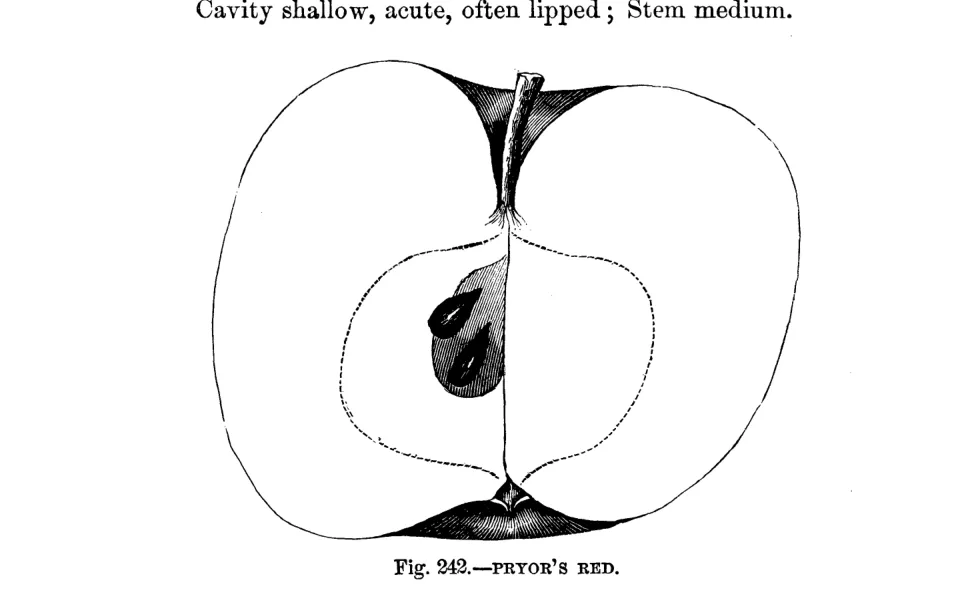
Origin / History
Origin unknown, though probably from Virginia. Warder calls it "this southern apple, probably from Virginia," and Thomas assigns it to Virginia. Elliott speculates it is "evidently a seedling from seed crossed with Westfield Seek-no-further and Roxbury Russet, partaking most largely of the Seek-no-further," though he notes "its certain origin we have not learned." The variety has been carried through all the Western States, where it is a great favorite, though Warder notes "there are some objectors, on account of its having shown signs of failure in certain situations." It is highly esteemed in Indiana, Kentucky, and Virginia.
Tree
Tree upright. Warder describes the growth as "upright, twiggy, attaining large size, productive when old." Downing describes it as "upright, spreading, not very vigorous, nor an early bearer," requiring "a deep, rich soil, and a warm season or a southern climate for the full development of its excellence." Elliott concurs it is "not regarded as an early bearer, but as very hardy," noting that "grown at the North, the trees come into bearing at about eight years." Thomas notes it is "often a poor bearer."
Shoots slender, reddish olive, speckled (Warder). Downing describes the young wood and buds as clear reddish brown, with many large conspicuous gray dots. Foliage scattering, folded, grayish green; subject to leaf-blight (Warder).
Fruit
Size: Warder describes the fruit as large. Elliott says medium to very large, noting that grown South in good culture it attains a size of four inches diameter by three inches from stem to eye. Thomas describes it as medium or rather large. Downing says medium.
Form: The fruit is notably variable with soil and climate. Warder describes it as globular-oblate, often unequal. Downing says somewhat globular oblate, obliquely depressed. Thomas says roundish, irregular, varying, apex often broad, sometimes narrow, considerably or slightly ribbed. Elliott describes the form at the North as regular roundish, tapering to the eye, and in the South as always angular, sometimes even broad at apex, being roundish angular, flattened.
Warder provides a detailed account of the fruit's variability: "on the Ohio River, it is seen quite flat and regular, with a dull green russeted skin, becoming yellow and ruddy; in one part of the State of Indiana, on limestone, it is gibbous, round, often very large, and covered with a rich cinnamon russet, while on the coal measures, west of the center of the State, it is smaller, regular, and distinctly striped deep red on red, with very little russet." Specimens from Rochester, New York, had "scarcely a trace of russet, and having the stripes as distinct and almost as beautiful as those of a Duchess of Oldenburg, so that no southern or western man would have recognized it for his home favorite."
Stem: Downing describes the stalk as short and thick. Elliott says short. Thomas says long or short. Warder says medium.
Cavity: Downing describes a small acute cavity, surrounded by traces of russet, which sometimes considerably overspreads the fruit. Warder says shallow, acute, often lipped. Elliott says narrow. Thomas says small.
Calyx: Downing says firmly closed. Warder says the eye is small, closed. Thomas says open. Elliott says small, segments erect.
Basin: Warder describes it as shallow, regular or plaited, leather-cracked. He specifically notes: "The distinctive leather-cracking about the eye was present, however, in all" variants. Elliott describes the basin as abrupt, pretty deep, round and even, occasionally shallow. Thomas says narrow. Downing says small.
Skin: The skin color is highly variable by region and season. Warder gives the surface as greenish, or dull red, striped, russeted, with dots numerous, large, gray. Downing describes the color as greenish yellow, shaded with red, striped with dark crimson, and thickly sprinkled with greenish gray dots, and some seasons much covered with russet. Thomas says dull brick red on greenish yellow in dots, shades, and obscure streaks, slightly russeted. Elliott describes the color as pale yellow ground mostly overspread with rich, warm red and russet, marbled and splashed with bronzed yellow near the stem, with dark yellow russet spots surrounded with a lighter shade.
The amount of russet varies dramatically by location and season: heavily russeted in rich cinnamon in parts of Indiana, nearly absent at the North (Warder). Elliott notes that grown at the North the fruit has very little russet except at the stem end unless the season is unusually warm, while grown South in good culture it is mostly covered with russet.
Flesh / Flavor: Warder: "yellow, tender, melting, fine-grained, juicy." Flavor "sub-acid, rich." Quality "best." Downing: "yellowish, tender, juicy, very rich, pleasant subacid. Very good." Thomas: "very tender, mild, rich, sub-acid, agreeable." Elliott: "yellowish, tender, mild sub-acid, much resembling Westfield Seek-no-further."
Core / Seeds: Warder describes the core as round, regular, closed, meeting the eye, with seeds numerous, angular, pointed. Elliott says the core is medium, marked at distance with a line encircling, with seeds varying, generally ovate. Thomas says the core is medium (from the Encyclopedia table notation).
Season
Warder gives December to February. Downing says January to March. Elliott says January to April. Thomas notes it keeps till spring in Virginia, Kentucky, and Indiana. Elliott adds that the fruit keeps well when grown South and on rich alluvial soils.
Uses
Warder lists table and kitchen use. The Encyclopedia of Practical Horticulture classifies it as "VG" (very good) quality, winter season ("W"), with a large fruit ("L"), roundish oblate form ("rob"), and yellow with red skin ("yr").
Subtypes / Variants
Downing notes: "There is an apple under name of Pryor's Blue, which may be distinct from the above, and may prove identical."
Other
The Encyclopedia of Practical Horticulture entry in full:
Description absent; variety present in variety-characteristic table.
Pryor Red (17)............ L rob yr VG b W
Book Sources
Described in 5 period pomological works
Nursery Catalog Sources
Found in 11 catalogs (1901–1918) from Arkansas, Illinois, Missouri, Oregon, Washington
- Washington Nursery Co. , Toppenish , Washington — 1901
- Yarbrough Bros. , Stephens , Arkansas — 1901
- Phoenix Nursery Company (W. E. Rossney , President; Sidney Tuttle, Vice-President), Bloomington , Illinois — 1904
- Stark Bros. Nurseries & Orchards Co. , Louisiana , Missouri — 1906
- Washington Nursery Company , Toppenish , Washington — 1909
- Stark Bros. Nurseries & Orchards Co. , Louisiana , Missouri — 1910
- Stark Bros. Nurseries & Orchards Co. , Louisiana , Missouri — 1911
- Pacific Nursery Company , Portland , Oregon — 1912
- Stark Bros. Nurseries & Orchards Co. , Louisiana , Missouri — 1912
- Washington Nursery Company , Toppenish , Washington — 1912
- Stark Bros. Nurseries & Orchards Co. , Louisiana , Missouri — 1918
View original book sources (5)
— John A. Warder, American Pomology: Apples (1867)Pryor's Red.
This southern apple, probably from Virginia, has been carried through all the Western States, where it is a great favorite, though there are some objectors, on account of its having shown signs of failure in certain situations.
The fruit is singularly affected by change of soil and climate; thus, on the Ohio River, it is seen quite flat and regular, with a dull green russeted skin, becoming yellow and ruddy; in one part of the State of Indiana, on limestone, it is gibbous, round, often very large, and covered with a rich cinnamon russet, while on the coal measures, west of the center of the State, it is smaller, regular, and distinctly striped deep red on red, with very little russet.
Specimens from Rochester, New York, have been shown with scarcely a trace of russet, and having the stripes as distinct and almost as beautiful as those of a Duchess of Oldenburg, so that no southern or western man would have recognized it for his home favorite. The distinctive leather-cracking about the eye was present, however, in all.
Tree thrifty, growth upright, twiggy, attaining large size, productive when old; Shoots slender, reddish olive, speckled; Foliage scattering, folded, grayish green; Subject to leaf-blight.
Fruit large, globular-oblate, often unequal; Surface greenish, or dull red, striped, russeted; Dots numerous, large, gray.
Basin shallow, regular or plaited, leather-cracked; Eye small, closed.
Cavity shallow, acute, often lipped; Stem medium.
Core round, regular, closed, meeting the eye; Seeds numerous, angular, pointed; Flesh yellow, tender, melting, fine-grained, juicy; Flavor sub-acid, rich; Quality best; Use, table, kitchen; Season, December, February.
— A.J. Downing, The Fruits and Fruit Trees of America (1900)Pryor's Red.
Pitzer Hill. Big Hill. Prior's Red.
Origin unknown. Tree upright, spreading, not very vigorous, nor an early bearer, requires a deep, rich soil, and a warm season or a southern climate for the full development of its excellence. Young wood and buds clear reddish brown, many large conspicuous gray dots.
Pryor's Red.
Fruit medium, somewhat globular oblate, obliquely depressed. Color greenish yellow, shaded with red, striped with dark crimson, and thickly sprinkled with greenish gray dots, and some seasons much covered with russet. Stalk short and thick, inserted in a small acute cavity, surrounded by traces of russet, which sometimes considerably overspread the fruit. Calyx firmly closed, set in a small basin. Flesh yellowish, tender, juicy, very rich, pleasant subacid. Very good. January to March.
There is an apple under name of Pryor's Blue, which may be distinct from the above, and may prove identical.
— Granville Lowther (ed.), Encyclopedia of Practical Horticulture (1914)Pryor Red (17)............ L rob yr VG b W
— F.R. Elliott, The Western Fruit Book (1865)Pryor's Red.
Prior's Red, | Pitzer Hill, | Big Hill.
This is evidently a seedling from seed crossed with Westfield Seek-no-further and Roxbury Russet, partaking most largely of the Seek-no-further. Its certain origin we have not learned. It is not regarded as an early bearer, but as very hardy, and the fruit keeping well when grown South, and on rich alluvial soils. Grown at the North, the trees come into bearing at about eight years, and the fruit has very little russet (unless unusually warm seasons), except at stem end ; South, in good culture, it attains a size of four inches diameter, by three inches from stem to eye, and mostly covered with russet. Popular in Kentucky, not so, farther North.
Fruit, medium to very large ; form, at North, regular roundish, tapering to the eye — South, always angular, sometimes even broad at apex, being roundish angular, flattened ; color, pale yellow, ground mostly overspread with rich, warm red and russet, marbled and splashed with bronzed yellow near the stem, dark yellow russet spots surrounded with a lighter shade ; stem, short ; cavity, narrow ; calyx, small, segments erect : basin, abrupt, pretty deep, round and even, occasionally shallow ; flesh, yellowish, tender, mild sub-acid, much resembling Westfield Seek-no-further ; core, medium, marked at distance with a line encircling ; seeds, varying, generally ovate. January to April.
— John J. Thomas, The American Fruit Culturist (1903)Pryor's Red.* (Pryor's Pearmain.) Medium or rather large, roundish, irregular, varying, apex often broad, sometimes narrow, considerably or slightly ribbed; color dull brick red on greenish yellow in dots, shades, and obscure streaks, slightly russeted; stalk long or short, cavity small; calyx open, basin narrow; flesh very tender, mild, rich, sub-acid, agreeable. Highly esteemed in Indiana, Kentucky, and Virginia—where it keeps till spring—and succeeds well farther North. Often a poor bearer. Fig. 411. Va.