Nickajack
Apple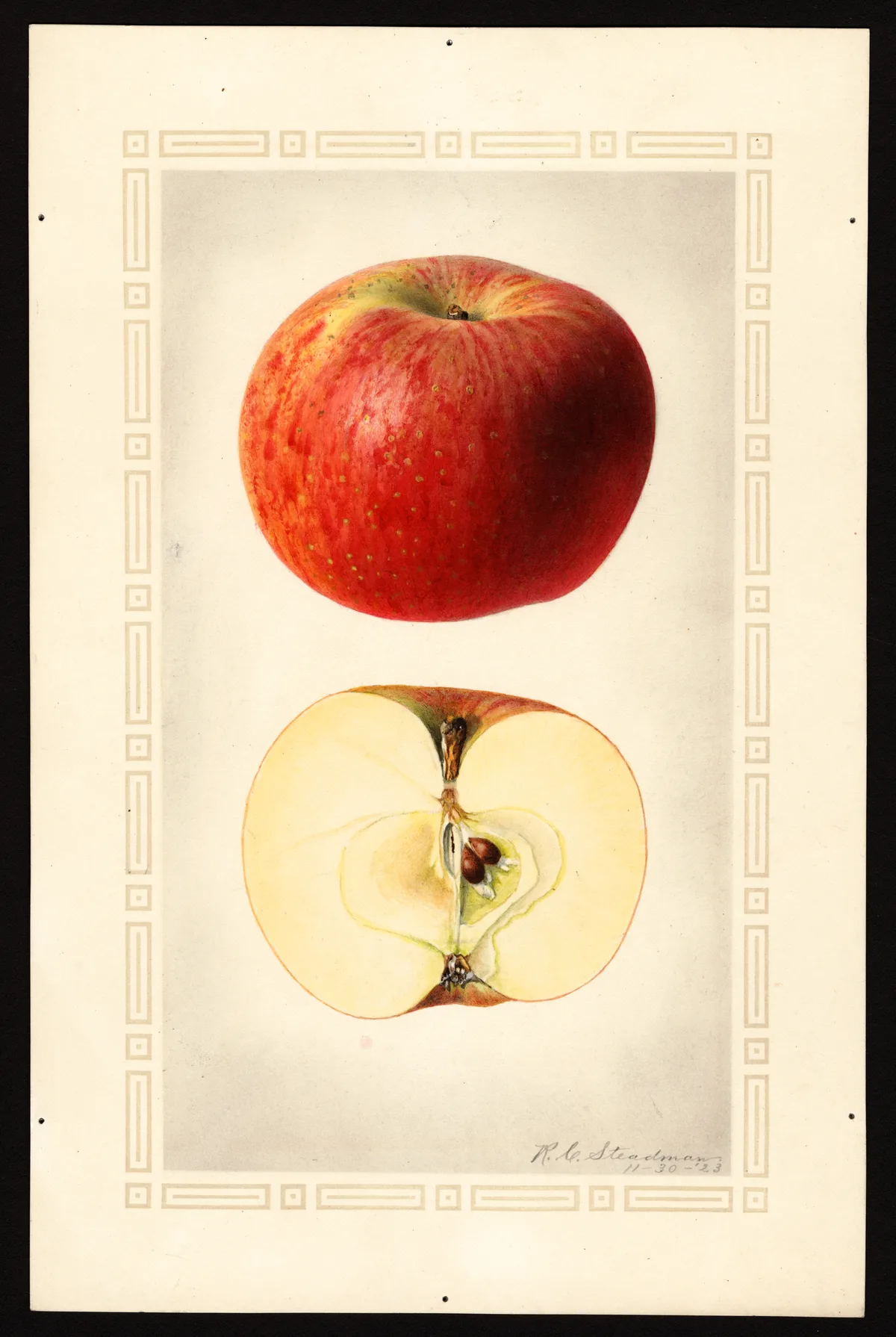
USDA Pomological Watercolor Collection
Nickajack
Origin / History
Nickajack is an American apple, supposed to have originated near a stream of the same name among the Cherokee Indians. Beach and Hedrick place the origin in Macon County, North Carolina; Warder (American Pomology, 1867) places it in Macon County, Georgia — Beach explicitly notes that Warder gives the county erroneously as being in Georgia. Budd & Hansen state the origin as Georgia. Elliott records the variety simply as "American. From North Carolina."
The exact time of origin is not definitely known, but by 1861 it was referred to as an old variety cultivated in at least three states and already bearing over twenty synonyms, indicating that it has probably been under cultivation for a century or more. It was first described in 1853 (Hedrick). Colonel Summerour of Lincoln County, North Carolina, early disseminated the variety under the name "Winter Rose"; Silas McDowell of Franklin, North Carolina, at about the middle of the last century brought it to notice under the name "Nickajack," which became the generally accepted name. Downing offers a slightly different account: that the first known dissemination was by a Colonel Summerour of Lincoln County, N.C., under the name "Winter Rose," but as it was found on Nickajack Creek it soon took that name.
The variety is very widely disseminated in sections of the South and Southwest. It has the habit of reproducing itself so nearly from seed that its seedlings in some cases can hardly be distinguished from the parent — one cause of its host of synonyms. Elliott considered it well adapted to the Southern and Southwestern States. Beach considered it not well adapted to regions as far north as New York, where it has been planted but sparingly. Hedrick notes that a long season is necessary for the full development of its fruit, so the variety cannot be grown in the North. Lowther's Encyclopedia (1914) reports the variety from 4 stations in the Northern Division (also reported in another division) and 14 stations in the Central Division (also reported in another division). Thomas calls it "a standard Southern variety, and a good market sort in lower Ohio valley."
Tree
Tree large, very vigorous, robust, upright to upright-spreading and moderately spreading, forming a very large head. Warder describes the habit as "robust, spreading, large, very productive." Thomas notes "Growth irregular—a good bearer." Budd & Hansen: "upright, spreading, large, very productive."
Young shoots stout and red (Warder); bright, clear, dark reddish (Downing). Twigs rather short, slender to rather stout, nearly straight, heavily pubescent; internodes medium to long. Bark smooth, of a rather clear dark red with some olive-green. Lenticels moderately conspicuous, quite narrow, small, raised. Buds small, rather projecting, sharply acute, appressed, moderately pubescent.
Downing notes a distinctive feature: on branches two, three, or four years old, there are woody knobs or warts of various sizes, which, when cut from the branch, are found to contain kernels entirely detached from the regular grain of the wood. Downing also remarks that the great value of the variety consists in the hardihood and productiveness of the tree rather than the character of the fruit.
Fruit
Size. Above medium to large; usually large; rather uniform in size and shape (Beach, Hedrick).
Form. Variously described: roundish to roundish-oblate, slightly conic, sometimes oblique (Downing, Budd & Hansen); globular-oblate, regular, not handsome (Warder); inclined to roundish-conic, varying sometimes to roundish-oblate or rarely to roundish-oblong, sides usually somewhat unequal, axis often slightly oblique (Beach); round-conic to round-oblate or rarely round-oblong, sides unequal, axis often oblique (Hedrick); rather large, smooth, handsome, roundish, slightly oblong (Thomas); large, oblate (Elliott); roundish (oblate) (Lowther).
Surface / skin. Surface even but not smooth (Warder). Skin thick, tough, rather smooth, sometimes a little glossy (Beach); thick, tough, smooth, glossy (Hedrick).
Color. Yellowish ground (or greenish-yellow per Elliott; yellow per Hedrick), striped, shaded, and splashed with two shades of red, with a grayish appearance as if covered with a thin bloom (Downing, Budd & Hansen). Mostly covered with mixed brick-dust red, striped indistinctly with dark red, some stripes very distinct (Warder). Splashed, striped, and mottled with deep red, and with large whitish spots (Thomas). Red striped and mottled on greenish yellow (Elliott). Skin yellow or greenish, mottled and shaded with orange-red or red, irregularly splashed and streaked with bright carmine and somewhat flecked with russet; usually streaked over the base with grayish scarf-skin and overspread with thin bloom, giving it a rather dull appearance (Beach). Hedrick describes the skin similarly: yellow, mottled and shaded with orange-red or red, irregularly splashed and streaked over the base with scarf-skin and overspread with thin bloom. Lowther gives the color simply as "yellow-red." Beach summarizes the prevailing effect as grayish-red, and Hedrick concurs. The fruit is sometimes well colored and showy but usually rather dull colored and not very attractive (Beach).
Dots. Scattered, yellow (Warder); many large areole dots (Downing, Budd & Hansen); numerous, usually irregular in shape and of variable size, very conspicuous, pale or russet (Beach, Hedrick).
Stem / Stalk. Short (Downing, Thomas); medium slender (Warder); usually short and thick (Beach, Hedrick); short (Budd & Hansen). Thomas adds "deep set."
Cavity. Deep, russeted (Elliott); acute, regular, yellow and brown (Warder); large, medium depth (Downing); large, acute, medium deep, yellow and russet (Budd & Hansen); acuminate to acute, deep, rather broad, obscurely furrowed and partly covered with thin greenish-russet (Beach); acuminate, deep, broad, obscurely furrowed and partly covered with thin greenish-russet (Hedrick).
Calyx. Large, partially open (Elliott); small, closed (Warder); partially open (Downing, Budd & Hansen); open (Thomas); rather large to below medium, closed or somewhat open, with lobes short to medium in length, rather broad, acute (Beach); rather large, closed or open, with lobes short, broad, acute (Hedrick).
Basin. Shallow, regular, even (Warder); medium, slightly corrugated (Downing, Budd & Hansen); moderate, rim obtuse (Thomas); often oblique, rather shallow, medium in width to wide, obtuse to somewhat abrupt, obscurely furrowed and slightly wrinkled (Beach); often oblique, shallow, medium in width, obtuse to abrupt, obscurely furrowed and wrinkled (Hedrick).
Calyx tube and stamens. Calyx tube rather large, wide, varying from short and urn-shape or cone-shape to very long, approaching funnel-form (Beach); calyx-tube large, wide, short and urn-shaped or long funnel-form (Hedrick). Stamens median to marginal (Beach); median (Hedrick).
Core. Small (Elliott); closed (Warder); small, closed (Downing, Budd & Hansen); medium or above, axile, cells closed or partly open, core lines clasping (Beach); large, axile, cells closed or partly open, core-lines clasping (Hedrick). Carpels rather concave, broadly ovate approaching roundish, tufted (Beach); concave, broadly-ovate to round, tufted (Hedrick).
Seeds. Light brown (Elliott); numerous, large, plump (Warder); many, large, plump (Budd & Hansen); below medium to above, light to dark brown, rather short and wide, plump, acute to somewhat obtuse, tufted (Beach); light to dark brown, short and wide, plump, acute, tufted (Hedrick).
Flesh and flavor. Sources differ markedly on the eating quality:
- Elliott: "tender, juicy, delicate; 'best.'"
- Warder: "greenish-yellow, breaking, firm, coarse; Flavor sub-acid, not rich; Quality only good, a market fruit, keeping well."
- Downing: "yellowish, compact, moderately tender and juicy, negative subacid. Good."
- Thomas: "yellow, rather firm, sub-acid, spicy, very good."
- Budd & Hansen: "yellowish, compact, moderately tender and juicy, negative subacid, good."
- Beach: "yellowish, very firm, somewhat coarse, rather crisp, moderately tender, juicy, mildly subacid becoming nearly sweet, slightly aromatic. It ranks good but not high in flavor and quality."
- Hedrick: "yellow, very firm, coarse, crisp, tender, juicy, mild subacid becoming nearly sweet, aromatic; good."
- Lowther: "Quality: very good."
Beach ranks it only second rate in quality but a remarkably good keeper; Hedrick concurs that the quality is but second-rate. Downing, similarly, notes the fruit "is not more than good in quality."
Season
A late-keeping winter apple, with sources giving slightly different ranges:
- Elliott: November to April.
- Warder: March until May.
- Downing: December to April.
- Thomas: "Keeps till spring."
- Budd & Hansen: Late winter.
- Lowther: Winter.
- Beach: December to May.
- Hedrick: December to May.
Beach emphasizes that it is a remarkably good keeper; Hedrick concurs ("The fruits keep remarkably well").
Uses
A market fruit (Warder); a good market sort in the lower Ohio valley (Thomas); both kitchen and market (Lowther).
Subtypes / Variants
Not described in source. (Sources note that the variety reproduces so nearly true from seed that seedlings are often indistinguishable from the parent, which has contributed to its great number of synonyms but no formally named subtypes.)
Other
Beach gives an extensive reference list tracing publication of the variety from Hovey (Mag. Hort., 19:565, 1853) through Budd-Hansen (1903). Warder includes a figure labeled "Fig. 101.— NICKAJACK," and Thomas references "Fig. 430."
Book Sources
Described in 8 period pomological works
- Beach, The Apples of New York Vol. 1 (1905)
- Warder, American Pomology: Apples (1867)
- Downing, Fruits and Fruit Trees of America (1900)
- Budd & Hansen, Systematic Pomology (1914)
- Lowther (ed.), Encyclopedia of Practical Horticulture (1914)
- Hedrick, Cyclopedia of Hardy Fruits (1922)
- Thomas, The American Fruit Culturist (1903)
- Elliott, The Western Fruit Book (1865) — listed as Nickejack
Nursery Catalog Sources
Found in 11 catalogs (1886–1913) from Alabama, Arkansas, California, Illinois, Oregon
- Fancher Creek Nursery , Fresno , California — 1886
- Huntsville Wholesale Nurseries (Jessie S. Moss , Proprietor; W.F. Heikes, Manager), Huntsville , Alabama — 1886
- W.R. Strong & Co. , Capital and Orange Hill Nurseries (Robert Williamson, prop.), Sacramento , California — 1886
- Woodburn Nurseries , Woodburn, Marion Co. , Oregon — 1894
- The Vineland Nurseries (Kelsey & Co. , Proprietors), St. Joseph, Missouri (Office: 13th and Atchison Sts., 2 Blocks East of the Citizens St. Car Line) — 1894
- Alabama Nursery Co. , Huntsville , Alabama — 1900
- Central Experimental Farm , Dominion Department of Agriculture, Agassiz, British Columbia (under test; Bulletin No. 3, Second Series) — 1900
- Yarbrough Bros. , Stephens , Arkansas — 1901
- Benjamin Buckman (personal inventory) , Farmingdale , Illinois — 1901
- Phoenix Nursery Company (W. E. Rossney , President; Sidney Tuttle, Vice-President), Bloomington , Illinois — 1904
- Benjamin Buckman (personal inventory) , Farmingdale , Illinois — 1913
View original book sources (8)
— F.R. Elliott, The Western Fruit Book (1865)Nickejack.
Summerour.
American. From North Carolina. Fruit, large, oblate, red striped and mottled on greenish yellow; cavity, deep, russeted; calyx, large, partially open; core, small; seed, light brown; flesh, tender, juicy, delicate; "best." Well adapted to the Southern and Southwestern States. November to April.
[Additional entry in this volume: "Nickajack", pp. 166–166]
Nickejack.
Summerour.
American. From North Carolina. Fruit, large, oblate, red striped and mottled on greenish yellow ; cavity, deep, russeted ; calyx, large, partially open ; core, small ; seed, light brown ; flesh, tender, juicy, delicate ; "best." Well adapted to the Southern and Southwestern States. November to April.
— John A. Warder, American Pomology: Apples (1867)Nickajack.
SUMMEROUR—JACKSON RED—BIG HILL—CAROLINA, AND MANY OTHERS.*
This southern apple, which has extended more widely northward than most of its congeners, is believed to be a native of Macon County, Georgia,
Tree robust, spreading, large, very productive, young shoots stout and red.
The following description is that of a specimen sent by my friend, R. Peters, of Atlanta, Georgia, but it corresponds in all important particulars with those of fruits obtained from a dozen different sources in our own latitude:
Fruit large, globular-oblate, regular, not handsome; surface even but not smooth, mostly covered with mixed brick-dust red, striped indistinctly with dark red, some stripes very distinct; dots scattered, yellow.
Basin shallow, regular, even; eye small, closed.
*Vide Horticulturist for 1861 p. 40.
Cavity acute, regular, yellow and brown; Stem medium slender.
Core closed; Seeds numerous, large, plump; Flesh greenish-yellow, breaking, firm, coarse; Flavor sub-acid, not rich; Quality only good, a market fruit, keeping well; Season March until May.
Fig. 101.— NICKAJACK.
— A.J. Downing, The Fruits and Fruit Trees of America (1900)NICKAJACK.
Alleghany. Caroline. Chaltram Pippin. Aberdeen. Gowden. Berry. Graham's Red Warrior. Trenham. Walb. Summerour. Winter Horse. Big Hill. Missouri Pippin. Accidental. Missouri Red. Carolina Spice. Leanham. Red Pippin. Winter Horse. Cheatan Pippin. Jackson Red. Howard. World's Wonder. Chatham Pippin. Hubbard. Winter Rose. Mobbs. Red Hazel. Cheataw. Wander. Edward Shantee. Red Warrior, erroneously. Pound. Forsythe's Seedling. Wall. Ruckman's Red.
This Apple is very widely disseminated in sections of the South and Southwest, it having as it were the habit of reproducing itself from seed, or at least so nearly identical as to be impossible to distinguish the seedling from the parent, hence one cause of so many synonyms. The first dissemination of it known was by a Colonel Summerour, of Lincoln County, N. C., under the name of Winter Rose; but as it was found on Nickajack Creek, it soon took that name, and is now best known thereby. The habit of the tree is upright spreading, forming a very large head. On branches two, three, or four years old, there are woody knobs or warts of various sizes, which, when cut from the branch, are found to contain kernels entirely detached from the regular grain of the wood. The great value of the variety consists in the hardihood and productiveness of the tree rather than the character of the fruit, which is not more than good in quality. Young shoots bright clear dark reddish.
Nickajack.
Fruit large. Form roundish to roundish oblate, slightly conic, sometimes oblique. Color yellowish, striped, shaded, and splashed with two shades of red, and with a grayish appearance, as if covered with a thin bloom, many large areole dots. Stalk short. Cavity large, medium depth. Calyx partially open. Basin medium, slightly corrugated. Flesh yellowish, compact, moderately tender and juicy, negative subacid. Good. Core small, closed. December to April.
— John J. Thomas, The American Fruit Culturist (1903)Nickajack.* (Summerour, Berry, Edwards, Carolina Spice, Red Hazel.) Rather large, smooth, handsome, roundish, slightly oblong; splashed, striped, and mottled with deep red, and with large whitish spots; stalk short, deep set, basin moderate, rim obtuse, calyx open; flesh yellow, rather firm, sub-acid, spicy, very good. Fig. 430. Keeps till spring. Growth irregular—a good bearer. A standard Southern variety, and a good market sort in lower Ohio valley. Georgia.
— S.A. Beach, The Apples of New York, Vol. 1 (1905)NICKAJACK.
REFERENCES. 1. Hovey, Mag. Hort., 19:565. 1853. 2. Stanford, Horticulturist, 11:255. 1856. fig. 3. Downing, 1857:175. fig. 4. Hooper, 1857:65. 5. Downing, Horticulturist, 16:40. 1861. fig. 6. Warder, 1867:445. fig. 7. Downing, 1869:286. fig. 8. Am. Pom. Soc. Cat., 1871:8. 9. Fitz, 1872:143, 156, 166, 172. 10. Leroy, 1873:488. fig. 11. Barry, 1883:351. 12. Thomas, 1885:237. 13. Wickson, 1889:248. 14. Lyon, Mich. Hort. Soc. Rpt., 1890:294. 15. Bailey, An. Hort., 1892:245. 16. Budd-Hansen, 1903:136. fig.
SYNONYMS. Aberdeen (5, 7). Accidental (5, 7). Alleghany (5, 7). Berry (5, 7, 10, 12). Big Hill (5, 6, 7). Carolina (5, 6, 10). Carolina Spice (5, 7, 10, 12). Caroline (7). Chatham Pippin (7). Chaltram Pippin (5, 7). Cheatan Pippin (5, 7). Cheataw (7). Dahlonega (5). Edwards (12). Edward Shantee (7). Forsythe's Seedling (7). Gowden (7). Gowdie (5). Graham's Red Warrior (7). Howard (5, 7). Hubbard (5, 7, 10). Jackson Red (5, 6, 7). Leanham (7). Missouri Pippin (7). Missouri Red (7). Mobbs (5, 7). NICKEJACK (1). North Carolina (13). Pound (5, 7). Red Hazel (7, 12). Red Pippin (5, 7). Red Warrior (5, 7). Rickmans Red (5). Ruckman (5). Ruckmans Red (7). SUMMEROUR (1). Summerour (3, 5, 6, 7, 12). Treanham (5). Trenham (7). Walb (7). Wall (5, 7, 10). Wander (7). Winter Horse (7). Winter Rose (5, 7, 11). Wonder (3, 5). Worlds Wonder (7).
This variety has long been known in various portions of the South and Southwest. Its popularity in those regions is attested by its host of synonyms. It is said to have the habit of reproducing itself so nearly from seed that its seedlings in some cases can hardly be distinguished from the parent (7). In localities favorable to its proper development the tree is a strong grower and very productive and the fruit is large and sometimes well colored and showy but usually it is rather dull colored and not very attractive. It ranks only second rate in quality but it is a remarkably good keeper. It is evidently not well adapted for regions as far north as this. It has failed to gain favorable recognition among New York fruit growers and has been planted but sparingly in this state.
Historical. This variety is supposed to have originated near a stream of the same name in Macon county, N. C.,¹ among the Cherokee Indians (1, 2, 3, 6, 7). The time of its origin is not definitely known but the fact that in 1861 it is referred to as an old variety cultivated in at least three states and having over twenty synonyms (5) indicates that it has probably been under cultivation for a century or more. Colonel Summerour of Lincoln county, N. C., early disseminated this variety under the name of Winter Rose (7), but Silas McDowell of Franklin, N. C., at about the middle of the last century brought it to notice under the name Nickajack (2), which has now become the generally accepted name for the variety.
TREE.
Tree large, very vigorous. Form upright, moderately spreading. Twigs rather short, slender to rather stout, nearly straight, heavily pubescent; internodes medium to long. Bark smooth, of a rather clear dark red with some olive-green. Lenticels moderately conspicuous, quite narrow, small, raised. Buds small, rather projecting, sharply acute, appressed, moderately pubescent.
FRUIT.
Fruit above medium to large, rather uniform in size and shape. Form inclined to roundish conic varying sometimes to roundish oblate or rarely to roundish oblong; sides usually somewhat unequal; axis often slightly oblique. Stem usually short and thick. Cavity acuminate to acute, deep, rather broad, obscurely furrowed and partly covered with thin greenish-russet. Calyx rather large to below medium, closed or somewhat open; lobes short to medium in length, rather broad, acute. Basin often oblique, rather shallow, medium in width to wide, obtuse to somewhat abrupt, obscurely furrowed and slightly wrinkled. Skin thick, tough, rather smooth, sometimes a little glossy, yellow or greenish, mottled and shaded with orange-red or red, irregularly splashed and streaked with bright carmine and somewhat flecked with russet. It is usually streaked over the base with grayish scarf-skin and overspread with thin bloom, giving it a rather dull appearance. Dots numerous, usually irregular in shape and of variable size, very conspicuous, pale or russet. Prevailing effect grayish-red. Calyx tube rather large, wide, varying from short and urn-shape or cone-shape to very long, approaching funnel-form. Stamens median to marginal. Core medium or above, axile; cells closed or partly open; core lines clasping. Carpels rather concave, broadly ovate approaching roundish, tufted. Seeds below medium to above, light to dark brown, rather short and wide, plump, acute to somewhat obtuse, tufted.
¹ Warder gives it erroneously as Macon county, Ga.
Flesh yellowish, very firm, somewhat coarse, rather crisp, moderately tender, juicy, mildly subacid becoming nearly sweet, slightly aromatic. It ranks good but not high in flavor and quality. Season December to May.
— J.L. Budd & N.E. Hansen, American Horticultural Manual, Part II: Systematic Pomology (1914)Nickajack. — Origin, Georgia; widely distributed in the South and known under many synonyms; it reproduces itself quite closely from seed: tree upright, spreading, large, very productive.
Nickajack.
Fruit large, roundish to roundish oblate, slightly conic, sometimes oblique; surface yellowish, striped, shaded, and splashed with two shades of red and with a grayish appearance, as if covered with a thin bloom; dots many, large, areole; cavity large, acute, medium deep, yellow and russet; stem short; basin medium, slightly corrugated; calyx partially open. Core small, closed; seeds many, large, plump; flesh yellowish, compact, moderately tender and juicy, negative subacid, good. Late winter.
— Granville Lowther (ed.), Encyclopedia of Practical Horticulture (1914)Nickajack. Size: large. Form: roundish (oblate). Color: yellow-red. Quality: very good. Use: both kitchen and market. Season: winter. Reported by 4 stations in the Northern Division (also reported in another division) and 14 stations in the Central Division (also reported in another division).
— U.P. Hedrick, Cyclopedia of Hardy Fruits (1922)NICKAJACK. Chatham Pippin. Missouri Pippin. Missouri Red. Pound. Red Pippin. Red Warrior. Winter Horse. This variety has long been held in high esteem in the South. The fruits keep remarkably well, but the quality is but second-rate; and, as generally grown, the apples are dull in color and unattractive. A long season is necessary for the full development of its fruit; therefore the variety cannot be grown in the North. The trees are vigorous and productive. The variety is supposed to have originated near a stream of the same name in Macon County, North Carolina, and was first described in 1853.
Tree large, very vigorous, upright-spreading. Fruit medium to large, uniform in size and shape, round-conic to round-oblate or rarely round-oblong, sides unequal, axis often oblique; stem short and thick; cavity acuminate, deep, broad, obscurely furrowed and partly covered with thin greenish-russet; calyx rather large, closed or open; lobes short, broad, acute; basin often oblique, shallow, medium in width, obtuse to abrupt, obscurely furrowed and wrinkled; skin thick, tough, smooth, glossy, yellow, mottled and shaded with orange-red or red, irregularly splashed and streaked over the base with scarf-skin and overspread with thin bloom; dots numerous, irregular in shape, very conspicuous, pale or russet; prevailing effect grayish-red; calyx-tube large, wide, short and urn-shaped or long funnel-form; stamens median; core large, axile; cells closed or partly open; core-lines clasping; carpels concave, broadly-ovate to round, tufted; seeds light to dark brown, short and wide, plump, acute, tufted; flesh yellow, very firm, coarse, crisp, tender, juicy, mild subacid becoming nearly sweet, aromatic; good; December to May.