Ralls
Apple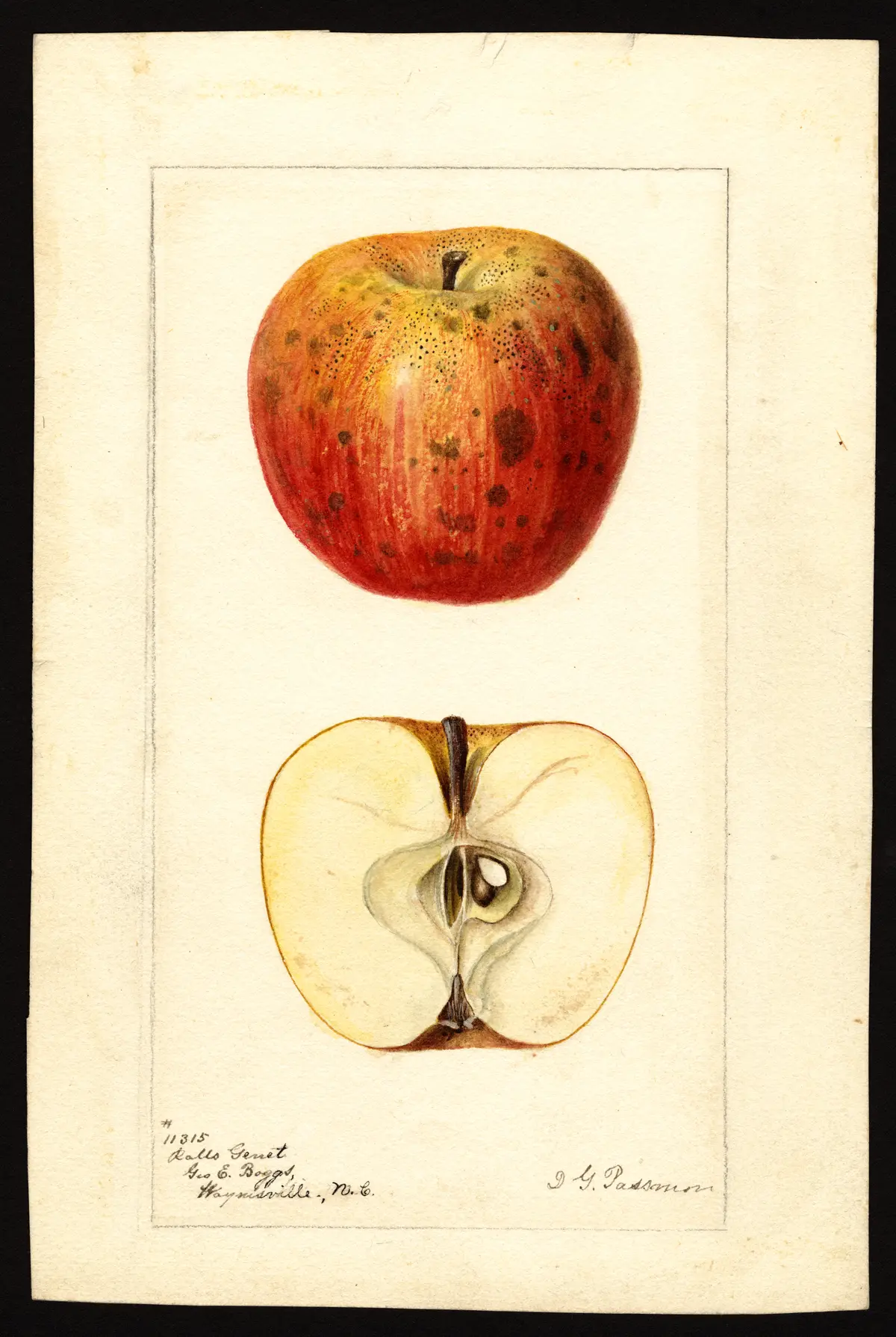
USDA Pomological Watercolor Collection
Ralls
Origin/History
Ralls originated in Amherst County, Virginia, on the farm of Caleb Ralls (also spelled Rawle or Raules in early sources). The first definite record of the variety is of trees growing on Caleb Ralls's farm something over a hundred years before 1905 — Hedrick places its first notice with fruit-growers at about 1800. Elliott records that according to H. P. Byram, Esq., it was first brought to the South-western sections from Amherst Co., Va., near the Blue Ridge, where it was originated by Caleb Raules, who named it Janet, hence the name. According to Geo. Hoadley, Esq., Gov. Worthington had it in his orchard 40 years before Elliott's 1865 writing, and from thence it was brought to northern Ohio. The Scriptural name of Rock-Rimmon, given it in the Scioto valley, was probably on account of its sure bearing and long-keeping qualities.
There is no evidence to show whether it was a local Virginia seedling or an importation from some other section. Howsley states that it was brought from France to President Jefferson by M. Genet, at that time the minister from that country; this claim does not seem to have been made in print till about one hundred years after the alleged occurrence, and as there are no records to verify it, its truth seems problematical — Beach regards it as probably a Virginia seedling. Thomas attributes the variety to France.
Spreading from Virginia, Ralls has come into more or less common cultivation southward into the Carolinas and Georgia, northward into Southern Michigan, and westward across the Mississippi valley to and beyond the Ozarks, but it remains practically unknown among New York fruit-growers. In Missouri it is regarded by Elliott as essential to every orchard; Warder notes that some recommend fifty trees of this variety in an orchard of one hundred. It is hardy far West (Thomas), and is one of the hardier of the old eastern varieties, but not sufficiently so for the far north — Hansen reports that some near Vermillion, S.D., have done quite well, but the variety has not proved hardy in the Northwest. At the North it is not desirable, but south of Cincinnati it is highly so, as it succeeds when many others often fail. Beach notes that in the Ben Davis apple regions generally it produces fruit of superior quality, is held in high esteem for home use, and has a recognized standing in market, where it has been cultivated extensively under the common names of Jeniton or Ralls Janet or variations thereof, and to a limited extent as Neverfail and Rock Rimmon. The name "Neverfail" derives from the variety's late bloom escaping spring frosts (Thomas).
Tree
Tree medium in size, moderately vigorous (Beach, Hedrick); thrifty, not large, spreading (Warder); hardy, vigorous, spreading (Downing); vigorous, spreading, very productive (Hansen); growth slow (Thomas). Form upright becoming spreading and inclined to droop, dense (Beach, Hedrick).
Twigs short, curved, moderately stout; internodes short (Beach). Warder describes the twigs as brownish; Downing describes the young wood as clear reddish brown. Bark dull brown mingled with olive-green, lightly mottled with scarf-skin, slightly pubescent (Beach). Lenticels numerous, small, oblong, not raised (Beach). Buds medium in size, broad, plump, obtuse, free or nearly so, slightly pubescent (Beach). Foliage medium, rather whitish (Warder).
The tree is tardy in spring in leafing out, and blossoms some ten days after other varieties, thus escaping late spring frosts (Elliott, Warder, Downing, Hansen, Thomas, Beach, Hedrick) — this lateness of bloom is the variety's most-cited cultural trait and the source of the "Neverfail" name. The younger trees frequently bear annually and yield fruit of fairly good size, but with increasing age the trees often become biennial or occasional croppers, and in bearing years are apt to be so overloaded that the fruit is small (Beach, Hedrick). Thomas calls it a profuse bearer, with a portion of the crop knotty or under size. Warder notes the fault of over-bearing, when the fruit is often small and insipid.
Fruit
Size
Medium to large (Elliott); medium, sometimes large when thinned (Warder); rather large (Downing); medium or above (Hansen); medium (Thomas); below medium to above, pretty uniform in size and shape (Beach); medium in size, uniform in size and shape (Hedrick); large (Lowther). As grown in Western New York it seldom reaches marketable size unless it is thinned (Beach).
Form
Roundish conical, flattened at stem end (Elliott); flattened, conic, regular (Warder); oblate conic (Downing); oblate, conic, regular (Hansen); roundish, approaching oblong or obtuse-conical, often oblique (Thomas); roundish oblate varying to roundish inclined to conic, rather symmetrical (Beach); round-oblate or round-conic, symmetrical (Hedrick); round (Lowther).
Stem
Slender, rather long (Elliott); long, curved (Warder); short and thick (Downing); medium, stout (Hansen); half an inch long (Thomas); often long and slender (Beach, Hedrick).
Cavity
Deep, regular (Elliott); acute, deep, regular, brown (Warder); broad, open (Downing); regular, acuminate (Hansen); obtuse to acute, deep, sometimes compressed or somewhat furrowed, often russeted (Beach); obtuse, deep, sometimes compressed or furrowed, often russeted (Hedrick).
Calyx
Nearly closed, with short segments (Elliott); small, closed, segments reflexed (Warder); partially open (Downing); closed, segments connivent (Hansen); small to medium, usually somewhat open (Beach); small, open (Hedrick).
Basin
Open, regular, not deep, sometimes slightly furrowed near the calyx (Elliott); wide, regular (Warder); rather shallow (Downing); wide, smooth, shallow (Hansen); often a little oblique, wide, rather shallow to moderately deep, inclined to abrupt, wrinkled (Beach); often oblique, wide, shallow, abrupt, wrinkled (Hedrick).
Skin
Thick, tough (Elliott). Color: a ground of light pale yellowish green, mostly overspread, striped and stained with dull red, and with a blue or grayish shade lying within as of a bloom (Elliott); surface smooth, mixed and striped crimson on yellow and green (Warder); yellowish, shaded with red and striped with crimson (Downing); surface smooth, yellowish green, striped thinly with dull red, mixed red on sunny side (Hansen); pale red, distinct stripes on light yellow ground (Thomas); smooth, yellow or greenish blushed and mottled with pinkish red, indistinctly striped with dull carmine, overspread with a light bloom which together with broken stripes of thin whitish scarf-skin combine to give the fruit a rather dull appearance (Beach); smooth, yellow blushed and mottled with red, indistinctly striped with carmine, overspread with light bloom which with broken stripes of thin scarf-skin gives the fruit a dull appearance (Hedrick); color yellow-red (Lowther). Beach notes the fruit is rather dull in color, being at best only moderately attractive.
Dots
Small russet dots, that show most when the fruit is high-colored; in the South, many patches of mould or fungus (Elliott); dots numerous, small (Warder); dots distinct, many, minute, white (Hansen); dots numerous, small, whitish or russet (Beach); dots numerous, small, white or russet (Hedrick).
Flesh and Flavor
Yellowish, tender, mild sub-acid (Elliott); yellowish, crisp, breaking, fine-grained, juicy; flavor sub-acid, vinous, refreshing; quality good to very good (Warder); whitish yellow, tender, juicy, pleasant subacid; good to very good (Downing); whitish yellow, tender, juicy, sprightly subacid, very good (Hansen); nearly white, fine, mild, sub-acid, fine texture, crisp, juicy (Thomas); whitish, firm, moderately fine-grained, crisp, moderately tender, juicy, subacid with a slight mingling of sweet, aromatic, pleasant, very good for dessert (Beach); white, firm, fine-grained, crisp, tender, juicy, subacid, aromatic, pleasant; very good (Hedrick). Elliott rates the quality only second rate, and not desirable at the North. Beach notes that, although a southern variety, Ralls often develops pretty good quality when grown as far north as Western New York and Southern Michigan, and holds its flavor well till late in the season.
Core and Seeds
Core medium; seeds angular ovate (Elliott). Core regular, heart-shaped, closed, clasping; seeds numerous, plump (Warder). Core closed, clasping, small; cells axile, ovate, slit; tube funnel-shaped; stamens median; seeds large, flattened (Hansen). Calyx tube broad cone-shape or frequently funnel-shape; stamens marginal or nearly so; core medium in size, axile or slightly abaxile; cells closed or partly open; core lines meeting or slightly clasping; carpels rather flat, broadly roundish, emarginate, slightly tufted; seeds medium or above, narrow, plump, acute, dark (Beach). Calyx-tube broad cone-shape; stamens marginal; core axile or abaxile; cells closed or partly open; core-lines meeting or clasping; carpels flat, broadly round, emarginate, tufted; seeds narrow, plump, acute, dark (Hedrick).
Season
Late spring (Elliott); February, March, and later (Warder); February to June (Downing); late winter and spring (Hansen); keeps through spring (Thomas); in ordinary storage in season from December to May, with April as the commercial limit (Beach); November to April (Hedrick); summer (Lowther — likely an error for a long-keeping winter apple). A noted long-keeper.
Uses
Dessert, kitchen, market, and cider (Warder); both kitchen and market (Lowther); very good for dessert (Beach). Held in high esteem for home use and has a recognized standing in market in the Ben Davis apple regions of the South and West (Beach). Particularly valued in the South where the poorly flavored Ben Davis and York Imperial are the chief commercial apples (Hedrick).
Subtypes/Variants
Not described in source.
Other
Lowther's tabulation reports geographic distribution as 25 stations in the Northern Division (also reported in another division), 26 stations in the Central Division (also reported in another division), and 14 stations in the Southern Division (also reported in another division). Listed in the American Pomological Society Catalog from 1862 (Beach references). Downing notes that the variety has not succeeded well at the North.
Book Sources
Described in 8 period pomological works
- Beach, The Apples of New York Vol. 1 (1905)
- Warder, American Pomology: Apples (1867) — listed as Rawle's Janet
- Downing, Fruits and Fruit Trees of America (1900) — listed as Rawle's Janet
- Elliott, The Western Fruit Book (1865) — listed as Raules' Janet
- Hansen, A Study of Northwestern Apples (1902) — listed as Ralls Genet
- Hedrick, Cyclopedia of Hardy Fruits (1922)
- Lowther (ed.), Encyclopedia of Practical Horticulture (1914) — listed as Rawle's Genet
- Thomas, The American Fruit Culturist (1903) — listed as Rall's Genet
Nursery Catalog Sources
Found in 13 catalogs (1893–1918) from Illinois, Kansas, Missouri, Nebraska, Oregon, Washington
- Oregon Wholesale Nurseries , Salem , Oregon — 1893 — listed as Janet
- Woodburn Nurseries , Woodburn, Marion Co. , Oregon — 1894 — listed as Jeniton
- Stark Bros. Nurseries & Orchards Co. , Louisiana , Missouri — 1896 — listed as Jeniton
- Phoenix Nursery Company (W. E. Rossney , President; Sidney Tuttle, Vice-President), Bloomington , Illinois — 1904 — listed as Janet
- Stark Bros. Nurseries & Orchards Co. , Louisiana , Missouri — 1906 — listed as Jeniton
- Stark Bros. Nurseries & Orchards Co. , Louisiana , Missouri — 1910 — listed as Jeniton
- Galbraith Nursery Co. (DeWitt Hansen , Pres.-Mgr.), Fairbury , Nebraska — 1911 — listed as Jeniton
- Stark Bros. Nurseries & Orchards Co. , Louisiana , Missouri — 1911 — listed as Jeniton
- Stark Bros. Nurseries & Orchards Co. , Louisiana , Missouri — 1912 — listed as Jeniton
- Vineland Nurseries Company , Clarkston , Washington — 1912 — listed as Jeniton
- Benjamin Buckman (personal inventory) , Farmingdale , Illinois — 1913 — listed as Ralls Janet
- Holsinger Bros. Nurseries (Holsinger Brothers Nursery) , Rosedale , Kansas — 1916 — listed as Janet
- Stark Bros. Nurseries & Orchards Co. , Louisiana , Missouri — 1918 — listed as Jeniton
View original book sources (8)
— F.R. Elliott, The Western Fruit Book (1865)RAULES' JANET.
Paul's Gennetting, Jennette, Rock-Rimmon, Rawl's Janet, Jeniton, Neverfail, Winter Gennetting, Raules' Janette, Yellow Janette, Rock Remain, Rawle's Jenaette, Indiana Jannetting.
This variety, according to H. P. Byram, Esq., was first brought to the South-western sections, from Amherst Co., Va., near the Blue Ridge, where it was originated by Caleb Raules, who named it Janet, hence the name. According to Geo. Hoadley, Esq., Gov. Worthington had it in his orchard 40 years since, and from thence it was brought to northern Ohio. The Scriptural name of Rock-Rimmon, given it in the Sciota valley, was probably on account of its sure bearing, and long keeping qualities. The tree is tardy in Spring in leaving out, and blossoms some ten days after other varieties; thus escaping late Spring frosts. In quality it is only second rate, and at the North is not desirable, but south of Cincinnati is highly so, as it succeeds when many others often fail. In Missouri it is regarded as essential to every orchard.
Fruit, medium to large; form, roundish conical, flattened at stem end; skin, thick, tough; color, a ground of light pale yellowish green, mostly overspread, striped and stained with dull red, and with a blue or grayish shade lying within as of a bloom: small russet dots, that show most when the fruit is high colored — South, many patches of mould or fungus; stem, slender, rather long; cavity, deep, regular; calyx, nearly closed, short segments; basin, open, regular, not deep, sometimes slightly furrowed near the calyx; flesh, yellowish, tender, mild sub-acid; core, medium; seeds, angular ovate. Late Spring.
— John A. Warder, American Pomology: Apples (1867)Rawle's Janet. JANETTING OR GENETON — NEVER FAIL — ROCK RIMMON, ETC., ETC.
This famous southern apple has been spread throughout the West, and even the Northwest where, however, it has not proved hardy. It also has the fault of over-bearing, when the fruit is often small and insipid. In suitable soils it is very fine and deservedly a favorite with planters, some of whom recommend fifty trees of this variety in an orchard of one hundred. Origin Virginia.
Tree thrifty, not large, spreading; Twigs brownish, foliage medium, rather whitish. Blossoms appear later than other sorts, and thus they sometimes escape a spring frost.
Fruit medium, sometimes large when thinned, flattened, conic, regular; Surface smooth, mixed and striped crimson on yellow and green; Dots numerous, small.
Basin wide, regular; Eye small, closed; Segments reflexed.
Cavity acute, deep, regular, brown; Stem long, curved.
Core regular, heart-shaped, closed, clasping; Seeds numerous, plump; Flesh yellowish, crisp, breaking, fine grained, juicy; Flavor sub-acid, vinous, refreshing; Quality good to very good; Use, dessert, kitchen, market and cider; Season, February, March, and later.
— A.J. Downing, The Fruits and Fruit Trees of America (1900)Rawle's Janet.
Missouri Janet ? Rock Remain. Jennett. Red Neverfail ? Rock Rimmon. Neverfail. Rawle's Jannet. Yellow Janett. Indiana Jannetting. Rawle's Jannetting. Winter Jannetting. Rawle's Gennetting. Rawle's Genet. Jeniton.
Originated in Amherst Co., Va., on the farm of Caleb Rawle. Tree hardy, vigorous, spreading; it puts forth its leaves and blossoms much later than other varieties in the spring, and consequently avoids injury by late frost; it is, therefore, particularly valuable for the South and Southwest, where it is much cultivated. Young wood clear reddish brown.
Fruit rather large, oblate conic, yellowish, shaded with red and striped with crimson. Stalk short and thick, inserted in a broad open cavity. Calyx partially open, set in a rather shallow basin. Flesh whitish yellow, tender, juicy, pleasant subacid. Good to very good. February to June. So far has not succeeded well at the North.
— N.E. Hansen, A Study of Northwestern Apples (1902)Ralls Genet—(Janet, Neverfail, Jeniton)—Origin, Amherst county, Virginia, on the farm of Caleb Rall; tree vigorous, spreading, very productive. It puts forth leaves and blossoms much later than other varieties and thus escapes late frosts—Fruit medium or above, oblate, conic, regular; surface smooth, yellowish green, striped thinly with dull red, mixed red on sunny side; dots distinct, many, minute, white; cavity regular, acuminate; stem medium, stout; basin wide, smooth, shallow; calyx closed, segments connivent. Core closed, clasping, small; cells axile, ovate, slit; tube funnel-shaped; stamens median; seeds large, flattened; flesh whitish yellow, tender, juicy, sprightly subacid, very good. Late winter and spring. This is one of the hardier of the old eastern varieties, but not sufficiently so for the north; some near Vermillion, S. D., have done quite well.
— John J. Thomas, The American Fruit Culturist (1903)Rall's Genet.* (Rawle's Jenneting. Neverfail, Rockremain.) Medium in size, roundish, approaching oblong or obtuse-conical, often oblique; color pale red, distinct stripes on light yellow ground; stalk half an inch long; flesh nearly white, fine, mild, sub-acid, fine texture, crisp, juicy. Growth slow; a profuse bearer, with a portion of the crop knotty or under size. Keeps through spring. Highly esteemed in the Ohio valley; does not succeed farther North. The blossoms open ten days later than usual, thus sometimes escaping spring frosts; hence the name Neverfail. Hardy far West. Fig. 428. France.
— S.A. Beach, The Apples of New York, Vol. 1 (1905)RALLS.
REFERENCES. 1. Cat. Hort. Soc. London, 1831:22. 2. Kenrick, 1832:59. 3. Mag. Hort., 1:149. 1835. 4. Hovey, Ib., 10:207. 1844. 5. Byram, Horticulturist, 2:19. 1847. fig. 6. Springer, Ib., 2:147. 1847. 7. Ib., 2:291, 388, 483. 1847. 8. Mallinckrott, Ib., 3:369. 1848. 9. Phoenix, Ib., 4:470. 1849. 10. Cole, 1849:136. fig. 11. Thomas, 1849:170. 12. Emmons, Nat. Hist. N. Y., 3:63. 1851. 13. Elliott, 1854:100. fig. 14. Downing, 1857:99. 15. Hooper, 1857:75. 16. Mag. Hort., 26:102. 1860. 17. Ib., 27:101. 1861. 18. Ib., 27:262. 1861. 19. Am. Pom. Soc. Cat., 1862. 20. Mag. Hort., 30:162. 1864. 21. Warder, 1867:517. fig. 22. Downing, 1869:321. fig. 23. Howsley, Am. Pom. Soc. Rpt., 1871:74. 24. Fitz, 1872:141, 143, 147, 149, 156, 165, 175, 177. 25. Leroy, 1873:713. 26. Downing, 1881:ii index, app. 27. Barry, 1883:353. 28. Wickson, 1889:248. 29. Lyon, Mich. Hort. Soc. Rpt., 1890:296. 30. Bailey, An. Hort., 1893:242. 31. Ib., 1892:247. 32. Mathews, Ky. Sta. Bul., 50:32. 1894. 33. Taylor, Am. Pom. Soc. Rpt., 1895:198. 34. Heiges, Meehan's Monthly, 6:136. 1896. 35. Card, and For., 9:310. 1896. 36. Munson, Me. Sta. An. Rpt., 18:95. 1902. 37. Hansen, S. D. Sta. Bul., 76:88. 1902. 38. Stinson, Mo. Fr. Sta. Bul., 3:27. 1902. 39. Powell and Fulton, U. S. B. P. I. Bul., 48:53. 1903. 40. Budd-Hansen, 1903:156. fig. 41. Bruner, N. C. Sta. Bul., 182:27. 1903. 42. Beach and Clark, N. Y. Sta. Bul., 248:139. 1904. 43. Ragan, U. S. B. P. I. Bul., 56:10. 1905.
SYNONYMS. Genet (23). Geneton (21, 23). GENITON (8). Geniton (39). GENNETIN (4). Genneting (14). Gennetting (42). Ginct (23). Indiana Jannetting (13, 14, 22). JANET (30). Janet (31, 37, 40, 41, 42). Janetting (21). Jefferson Pippin (23, 26). Jeniton (22, 27, 37, 38). Jennett (14, 22). Jennette (13). Jenniton (42). MISSOURI JANET (18). Missouri Janet? (22). Never Fail (21). Neverfail (4, 6, 11, 12, 13, 14, 15, 22, 33, 37, 39, 40, 41, of Ohio 10). RALLS GENET (33, 35, 37, 40, 41). Ralls Genet (39, 42). RALLS JANET (36). Raule Jannet (12). RAULE'S GENET (24). RAULE'S JANET (13, 15). RAULE'S JANETT (5). RAULE'S JANETTE (10). RAULE'S JANNET (14). Raule's Jannette (13). Raule's Jannetting (14, 22). Raule's Jennetting (10). RAUL'S GENNETTING (6, 22). Raul's Gennetting (13). RAWLE'S GENET (23, 24, 26). Rawle's Genet (22). RAWLE'S JANET (9, 16, 17, 20, 21, 22, 27, 28, 29, 31, 32, 38). Rawle's Janet (30, 35). RAWLE'S JANETT (2, 3). RAWLE'S JANNET (11). Rawle's Jannet (22). Rawle's Jennet (8). Rawle's Jenneting (11). Rawle's Jennette (13). Rawl's Janet (13). Red Neverfail? (22). ROCKREMAIN (12). Rockremain (6, 11). Rock Remain (13, 14, 22). Rockrimmon (10). Rock Rimmon (13, 14, 21, 22). Royal Janette (33). Winter Genneting (13). Winter Jannetting (14, 22). Yellow Janette (13). Yellow Janett (14, 22).
Ralls, although a southern variety, often develops pretty good quality when grown as far north as Western New York and Southern Michigan. As grown here it seldom reaches marketable size unless it is thinned and it is rather dull in color being at the best only moderately attractive but It has the merit of being a good keeper and holds its flavor well till late in the season. In ordinary storage it is in season from December to May with April as the commercial limit (42). In districts farther south and west and, generally speaking, throughout the Ben Davis apple regions it produces fruit of superior quality, is generally held in high esteem for home use and has a recognized standing in market. It has there been cultivated extensively either under the common names of Jeniton or Ralls Janet or under some variation of these names. It has also been grown to a limited extent under the names Neverfail and Rock Rimmon. The younger trees frequently bear annually and yield fruit of fairly good size but with increasing age the trees often become biennial or occasional croppers and in bearing years are apt to be so overloaded that the fruit is small. On account of the lateness of its blooming season Ralls frequently sets a good crop of fruit when earlier blooming varieties fail on account of unfavorable weather during the blossoming season. Ralls is but little known among New York fruit growers and is not recommended for planting in this state.
Historical. The first that is definitely known of this variety is that trees of it were growing on the farm of Mr. Caleb Ralls in Amherst county, Virginia, something over a hundred years ago. There is no evidence to show whether it was a local seedling or an importation from some other section. Howsley (23) states that it was brought from France to President Jefferson by M. Genet at that time the minister from that country. This claim does not seem to have been made in print till about one hundred years after the time of its alleged occurrence and as there are no records to verify it, its truth seems problematical. We regard it as probably a Virginia seedling. Spreading from Virginia it has come into more or less common cultivation southward into the Carolinas and Georgia, northward into Southern Michigan and westward across the Mississippi valley to and beyond the Ozarks, but it remains practically unknown among New York fruit growers.
TREE. Tree medium in size, moderately vigorous. Form upright becoming spreading and inclined to droop, dense. Twigs short, curved, moderately stout; internodes short. Bark dull brown mingled with olive-green, lightly mottled with scarf-skin, slightly pubescent. Lenticels numerous, small, oblong, not raised. Buds medium in size, broad, plump, obtuse, free or nearly so, slightly pubescent.
FRUIT. Fruit below medium to above, pretty uniform in size and shape. Form roundish oblate varying to roundish inclined to conic, rather symmetrical. Stem often long and slender. Cavity obtuse to acute, deep, sometimes compressed or somewhat furrowed, often russeted. Calyx small to medium, usually somewhat open. Basin often a little oblique, wide, rather shallow to moderately deep, inclined to abrupt, wrinkled. Skin smooth, yellow or greenish blushed and mottled with pinkish red, indistinctly striped with dull carmine, overspread with a light bloom which together with broken stripes of thin whitish scarf-skin combine to give the fruit a rather dull appearance. Dots numerous, small, whitish or russet. Calyx tube broad cone-shape or frequently funnel-shape. Stamens marginal or nearly so. Core medium in size, axile or slightly abaxile; cells closed or partly open; core lines meeting or slightly clasping. Carpels rather flat, broadly roundish, emarginate, slightly tufted. Seeds medium or above, narrow, plump, acute, dark. Flesh whitish, firm, moderately fine-grained, crisp, moderately tender, juicy, subacid with a slight mingling of sweet, aromatic, pleasant, very good for dessert.
— Granville Lowther (ed.), Encyclopedia of Practical Horticulture (1914)Rawle's Genet (18). Size: large. Form: round. Color: yellow-red. Quality: good. Use: both kitchen and market. Season: summer. N. Div.: 25 stations (also reported in another division). C. Div.: 26 stations (also reported in another division). S. Div.: 14 stations (also reported in another division).
— U.P. Hedrick, Cyclopedia of Hardy Fruits (1922)RALLS. Genet. Geneton. Genneting. Janet. Ralls Genet. Winter Genneting. Ralls is a southern apple, but its good characters have enabled it to gain a foothold in parts of the North and West as well. The apples are not large, nor are they attractive in shape or color; but they are excellent in quality, and this has given the variety high place in the South, particularly in regions where the poorly flavored Ben Davis and York Imperial are the chief commercial apples. The young trees annually bear large crops of apples of fair size, but the old trees are biennial in bearing, and the apples, though borne in great abundance, are small. The variety is noted as one of the latest to bloom, so that it often escapes unfavorable weather at blooming time. The origin of Ralls is not known, but it first came to the notice of fruit-growers about 1800 on the farm of Caleb Ralls, Amherst County, Virginia.
Tree of medium size, vigorous, upright-spreading, inclined to droop, dense. Fruit medium in size, uniform in size and shape, round-oblate or round-conic, symmetrical; stem long and slender; cavity obtuse, deep, sometimes compressed or furrowed, often russeted; calyx small, open; basin often oblique, wide, shallow, abrupt, wrinkled; skin smooth, yellow blushed and mottled with red, indistinctly striped with carmine, overspread with light bloom which with broken stripes of thin scarf-skin gives the fruit a dull appearance; dots numerous, small, white or russet; calyx-tube broad cone-shape; stamens marginal; core axile or abaxile; cells closed or partly open; core-lines meeting or clasping; carpels flat, broadly round, emarginate, tufted; seeds narrow, plump, acute, dark; flesh white, firm, fine-grained, crisp, tender, juicy, subacid, aromatic, pleasant; very good; November to April.