York Imperial
Apple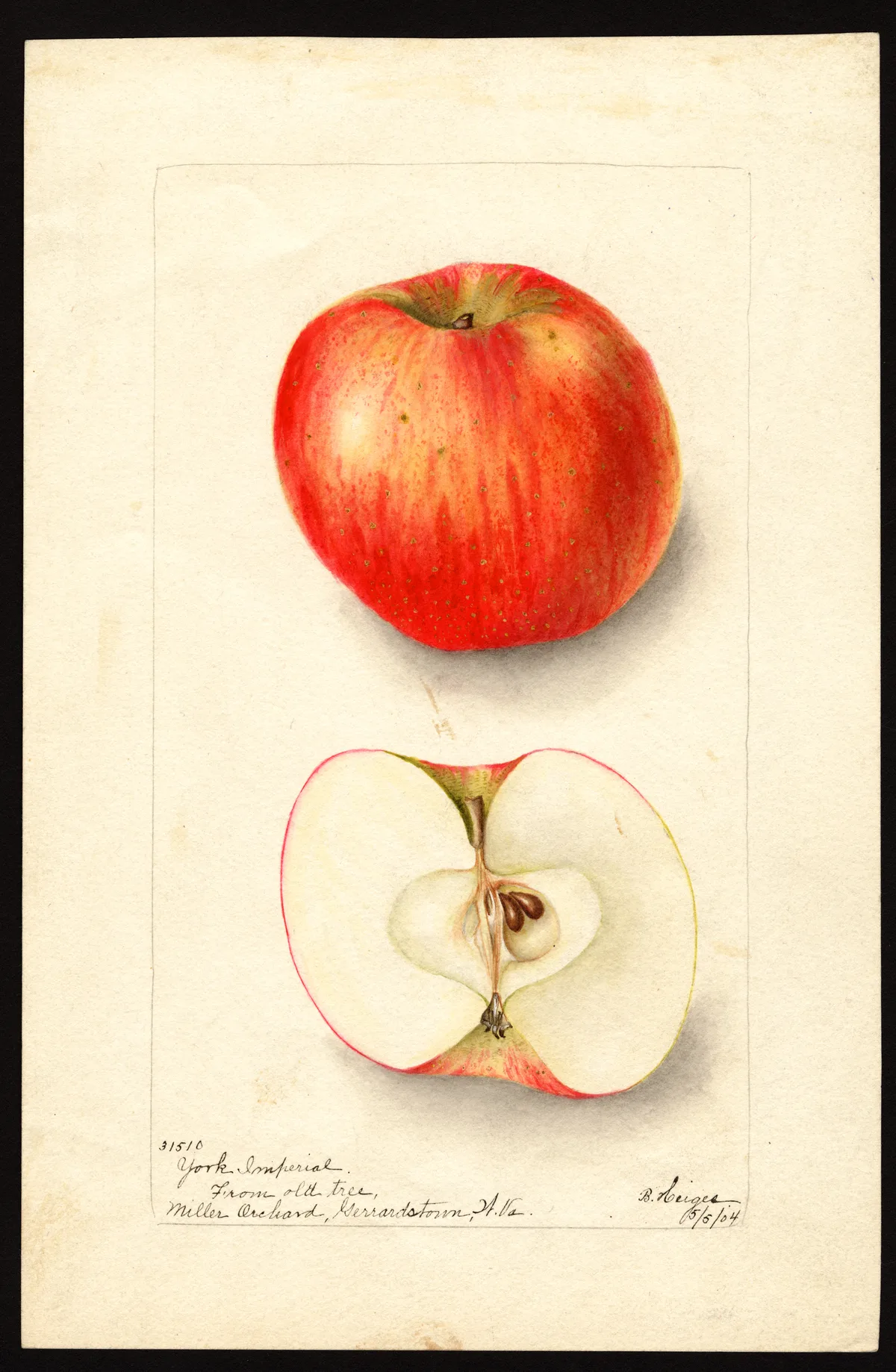
USDA Pomological Watercolor Collection
York Imperial
Origin / History
York Imperial originated near York, Pennsylvania. Hedrick places its origin "soon after the Revolutionary War," while Budd-Hansen and Beach date it to early in the nineteenth century, and Lowther states "about the year 1830." Downing notes the origin is "thought to be York Co., Pa."
Beach, quoting Taylor (U.S. Pomological Bulletin 7, 1898), gives the most detailed account: the variety originated early in the nineteenth century on a farm adjoining the then borough of York, Pennsylvania. The attention of the owner, a Mr. Johnson, was attracted to the tree by the presence of schoolboys who visited it in early spring to get the apples that had passed the winter on the ground, covered by leaves. On securing some of the fruit he found it in fine condition, and when the next crop was ripe took specimens to Mr. Jonathan Jessop, a local nurseryman, who began propagation of the variety before 1830 under the name "Johnson's Fine Winter." Under this name it was known until after the middle of the century, when, after an inspection of specimens, the late Charles Downing pronounced it the "imperial of keepers" and suggested it be named "York Imperial." Mr. Jessop did not find ready sale for trees of the variety at first, and dumped the surplus trees from his nursery into a hollow beside the turnpike passing his place. They were picked up by farmers returning from market and taken home for planting on their farms in the lower end of York county. After its merit as a variety for market orchards was established, it became widely distributed throughout Pennsylvania, Maryland, and Virginia, and soon became a leading market variety in those states. So far as known, the variety was first described in print by Dr. W. D. Brinckle in 1853. Warder states that specimens were exhibited at the meeting of the Ohio State Pomological Society in 1855 (Lowther also notes the 1855 Ohio exhibition; Warder himself locates the exhibition at the State Society meeting in Lebanon, 1855). It did not become generally popular west of the Alleghany Mountains until a comparatively recent date, but since about 1880 it has been widely disseminated through the Middle Western states and become one of the leading market varieties of that region.
Beach and Lowther note that the variety is grown commercially in the Middle Atlantic states and over a belt of country extending from these states westward into Missouri and Kansas. Hedrick describes it as a popular southern apple, more generally cultivated in the Virginias and neighboring states, possibly, than any other variety. Budd-Hansen call it a leading commercial variety and growing in favor for export.
Tree
Warder describes the tree as healthy and productive. Downing calls it moderately vigorous and productive. Budd-Hansen call it a moderate grower, productive. Beach and Lowther describe it as vigorous or moderately vigorous, a thrifty, vigorous grower, and a pretty regular annual or biennial bearer. Hedrick describes it as vigorous, upright-spreading, dense. The Central Experimental Farm at Agassiz BC (planted spring 1892) describes the tree as "a vigorous but slender grower."
Form upright spreading or roundish, rather dense (Beach, Lowther, Hedrick).
Twigs short to above medium, straight or nearly so, stout or moderately stout and tapering at the tips; internodes medium to long (Beach, Lowther).
Bark dull brownish-red streaked and mottled with scarf-skin, quite pubescent (Beach); dull brownish red (Lowther). Downing notes the young wood is rich brown and downy.
Lenticels dull, moderately conspicuous, rather scattering, small to medium, roundish, not raised (Beach).
Buds deeply set in bark, small to medium, plump, obtuse to somewhat acute, appressed except the largest which are free, pubescent (Beach).
Beach and Lowther note that it seems to prefer rather heavy clay soils and seldom does well on soils that are light or in any way thin or leachy. Hedrick concurs: York Imperial can be grown well only on heavy fertile soils, such, usually, as have a substantial foundation of clay.
Fruit
Size
Sources disagree on size. Warder calls the fruit large. Downing says medium. Elliott says "rather below medium." Thomas says medium. Budd-Hansen say medium to large. The Central Experimental Farm catalogue says medium. Beach says the fruit is pretty uniform in size and shape, varying from above medium to large when well grown, but in many parts of New York state when the trees become mature the fruit usually averages below medium to small; in the North, the apples are deficient in size, color, and quality (also noted by Hedrick and Beach). Hedrick says medium to large.
Form
Warder: rather oblong, somewhat angular. Downing: oblate oblique. Elliott: truncated oval, angular. Thomas: oblong, angular, oblique, often varies in form, smooth. Budd-Hansen: roundish to roundish oblate, truncated, somewhat obliquely cylindrical. Central Experimental Farm: oblate. Beach and Lowther: roundish oblate or truncate, usually with an oblique axis. Hedrick: round-oblate, usually with an oblique axis; both ends distinctly truncate and the axis very oblique, so that the apples are lopsided. Beach notes this oblique or lopsided shape is an objection because it makes the fruit difficult to pare with a machine (also noted by Lowther and Hedrick, with Hedrick adding that this defect makes the fruits fit only for culinary purposes when machine-pared).
Stem
Short (Warder, Downing, Elliott, Thomas, Hedrick, Beach). Budd-Hansen: short, moderately stout. Elliott: short and moderately stout.
Cavity
Warder: deep, wide. Elliott: wide, and rather deep. Thomas: deep, narrow, russeted. Budd-Hansen: regular, narrow, acute, with some stellate russet. Beach and Hedrick: medium to rather large (Hedrick: large), acuminate to acute, deep, medium to rather broad (Hedrick: broad), often gently furrowed, smooth and green or partly russeted.
Calyx / Eye
Warder: eye medium, closed. Downing: calyx closed or partially open. Elliott: calyx small, closed. Thomas: eye nearly closed. Budd-Hansen: calyx closed or open; segments small, flat convergent. Beach and Hedrick: calyx small to medium (Hedrick: small), closed or sometimes partly open.
Basin
Warder: wide, plaited. Downing: large, deep. Elliott: deep, wide, plaited. Thomas: deep, wide. Budd-Hansen: smooth, deep, abrupt, slightly leather-cracked. Beach: rather large, abrupt, deep or moderately deep, wide to medium, often slightly furrowed. Hedrick: large, abrupt, deep, wide, often furrowed.
Skin and Color
Warder: surface smooth, mixed bright red on greenish yellow. Downing: whitish, shaded with crimson in the sun, thinly sprinkled with light and gray dots. Elliott: the unexposed side is mottled and striped, so as to present a grayish red aspect on a greenish yellow ground, and, on the sunny side, the color is a dull crimson. Thomas: yellow, shaded red, indistinct red stripes. Budd-Hansen: surface light yellow, almost wholly covered with washed, marbled, and mixed bright red, indistinctly striped, overlaid with grayish; dots few, yellow and gray, distinct. Central Experimental Farm: skin whitish yellow, nearly overspread with crimson in the sun, and with a few grayish dots. Beach: skin tough, bright, smooth, green or yellow blushed with moderately light red or pinkish-red and indistinctly striped with carmine. Hedrick: skin tough, bright, smooth, yellow blushed with light red and striped with carmine; the apple is easily recognized by its bright red color, indistinctly striped with carmine.
Dots (Beach, Hedrick): pale or russet, often conspicuous (Hedrick: conspicuous), rather numerous toward the eye, scattering, very large and elongated toward the cavity where they are often mingled with narrow, broken streaks of grayish (Hedrick: gray) scarf-skin.
Flesh and Flavor
Warder: flesh yellowish, tender, juicy; flavor sub-acid, aromatic; quality quite good. Downing: yellowish, firm, crisp, juicy, pleasant, mild subacid; good to very good. Elliott: greenish white, tender, crisp, juicy; flavor pleasant and agreeably saccharine; quality at least "good"—to many tastes, "very good." Thomas: yellow, firm, juicy, sub-acid, good. Budd-Hansen: yellow, with yellow veinings, firm, crisp, juicy, pleasant, sprightly subacid, good to very good. Central Experimental Farm: yellowish, firm, crisp, juicy, sub-acid, quality medium. Lowther: yellowish, firm, crisp, somewhat breaking, a little coarse, moderately tender, moderately juicy, subacid to nearly sweet. Beach: yellowish, firm, crisp, somewhat breaking, a little coarse, moderately tender, moderately juicy, at first sprightly subacid but becoming mild subacid or nearly sweet, somewhat aromatic, good to very good. Hedrick: yellow, firm, crisp, coarse, tender, juicy, sprightly subacid, becoming mild subacid, aromatic; good; Hedrick adds that "the flesh is coarse and the flavor not inviting to most tastes."
Core and Seeds
Downing: core compact, small. Budd-Hansen: core small, mostly open, barely clasping, cells ovate, widely slit; tube funnel-shaped; stamens median; seeds many, plump, often covered with much cellular exudate. Beach: calyx tube elongated cone-shape to funnel-form; stamens median to marginal; core medium to rather small, axile or nearly so; cells usually symmetrical, closed or partly open; core lines slightly clasping; carpels broadly roundish, slightly emarginate, sometimes tufted; seeds few, rather dark, wide, flat, obtuse, compactly filling the cells; often some are abortive. Hedrick: calyx-tube elongated-cone-shape; stamens median; core small, axile; cells usually symmetrical, closed or partly open; core-lines clasping; carpels broadly round, emarginate, sometimes tufted; seeds few, dark, wide, flat, obtuse, compactly filling the cells.
Season
Warder: January, February. Downing: November, February. Thomas: winter. Budd-Hansen: November to February. Central Experimental Farm: January to May. Beach: storage men give its season in cellar storage as extending to December and in cold storage to February; as grown at the New York Station the fruit comes in season in January and keeps well in ordinary storage till April or May if it does not scald; its commercial limit is March. Lowther: cellar storage to December, cold storage to February. Hedrick: November to April.
Beach and Lowther: it stands heat fairly well before going into storage, but often scalds badly and when it begins to deteriorate goes down rather quickly. Hedrick: the apples keep and ship exceedingly well, which qualities give the variety its chief value.
Uses
Warder: market, kitchen. Thomas: an excellent shipping apple, always brings high prices. Hedrick: fit only for culinary purposes when the lopsided shape forces machine-paring; nevertheless the apples keep and ship exceedingly well. Budd-Hansen: a leading commercial variety and growing in favor for export.
Subtypes / Variants
Budd-Hansen describe a distinct strain or sub-variety of York Imperial locally propagated in York Co., Penn. It is of smaller size, less oblique form, brighter color, finer texture of flesh, and longer-keeping quality than the common type. Origin as yet undetermined.
Other
Regional adaptation: Beach notes that when grown as far north as New York the fruit is deficient in color, size, and quality; reports from growers in New York are generally adverse to its culture there and it is not recommended for planting in New York except perhaps in the southeastern part of the state. Lowther agrees that it seems not well adapted to the northern sections of the apple districts of the United States, as it does not color well, but adds that in the Pacific Northwest, where the sunshine is bright, this would not be true. Hedrick concurs that in the North, the apples are deficient in size, color, and quality, though the trees are very satisfactory in soils and climates to which they are adapted.
Book Sources
Described in 8 period pomological works
- Beach, The Apples of New York Vol. 1 (1905)
- Budd & Hansen, Systematic Pomology (1914)
- Hedrick, Cyclopedia of Hardy Fruits (1922)
- Warder, American Pomology: Apples (1867)
- Downing, Fruits and Fruit Trees of America (1900)
- Elliott, The Western Fruit Book (1865)
- Lowther (ed.), Encyclopedia of Practical Horticulture (1914)
- Thomas, The American Fruit Culturist (1903)
Nursery Catalog Sources
Found in 54 catalogs (1881–1932) from Alabama, California, Illinois, Kansas, Maryland, Massachusetts, Missouri, Nebraska, New Jersey, Oregon, Pennsylvania, Virginia, Washington
- Hutchison Nursery , James Hutchison, Oakland , California — 1881
- Felix Gillet , Barren Hill Nursery, Nevada City , California — 1884
- Felix Gillet , Barren Hill Nursery, Nevada City , California — 1888
- California Nursery Co. , Niles , California — 1889
- Felix Gillet , Barren Hill Nursery, Nevada City , California — 1889
- Felix Gillet , Barren Hill Nursery, Nevada City , California — 1890
- William H. Moon Co. , Morrisville, Bucks County , Pennsylvania — 1890
- Felix Gillet , Barren Hill Nursery, Nevada City , California — 1891
- Milwaukie-Canby Nurseries , Canby, OR (and Milwaukie, OR) — 1893
- Sherwood Hall Nursery Co. , Timothy Hopkins (Menlo Park Nurseries), San Francisco / Menlo Park , California — 1893
- Rogers Nursery Co. , Moorestown , New Jersey — 1893
- Multnomah Nurseries , Russellville , Oregon — 1894
- Woodburn Nurseries , Woodburn, Marion Co. , Oregon — 1894
- Felix Gillet , Barren Hill Nursery, Nevada City , California — 1895
- The Lovett Company , Little Silver , New Jersey — 1896
- Felix Gillet , Barren Hill Nursery, Nevada City , California — 1897
- The Salem Nursery (John A. Francis , Proprietor), Salem , Virginia — 1897
- Stark Bros. Nurseries & Orchards Co. , Louisiana , Missouri — 1898
- J.V. Cotta (Cotta Nursery) , Carroll County , Illinois — 1898
- Reading Nursery , Jacob W. Manning, Proprietor, Reading , Massachusetts — 1898
- Brown Brothers Co. , Continental Nurseries, Rochester, NY (also operated from Toronto, Canada) — 1899
- Alabama Nursery Co. , Huntsville , Alabama — 1900
- Central Experimental Farm , Dominion Department of Agriculture, Agassiz, British Columbia (under test; Bulletin No. 3, Second Series) — 1900
- Washington Nursery Co. , Toppenish , Washington — 1901
- Mountain Grove Nurseries (Tippin & Moore , Proprietors; Geo. T. Tippin, J. W. Tippin, J. C. Moore), Mountain Grove , Missouri — 1901
- S.L. Watkins , Grizzly Flats, El Dorado County , California — 1901
- Benjamin Buckman (personal inventory) , Farmingdale , Illinois — 1901
- Brown Brothers Co. , Continental Nurseries, Rochester, NY (also operated from Toronto, Canada) — 1901
- Forestville Nurseries , T.J. True, Forestville , California — 1902
- Pacific Nursery Company (W. O. Hudson & A. D. Hudson) , Tangent , Oregon — 1903
- Phoenix Nursery Company (W. E. Rossney , President; Sidney Tuttle, Vice-President), Bloomington , Illinois — 1904
- The Dalles Nurseries , The Dalles , Oregon — 1906
- Stark Bros. Nurseries & Orchards Co. , Louisiana , Missouri — 1906
- J.B. Pilkington , Portland , Oregon — 1907
- Carlton Nursery Co. , Carlton , Oregon — 1909
- Milton Nursery Co. (A. Miller & Sons , Proprietors), Milton , Oregon — 1909
- Washington Nursery Company , Toppenish , Washington — 1909
- Wm. J. Corse (successor to Robert Sinclair / Sinclair Nurseries) , Baltimore , Maryland — 1909
- C.F. Lansing , Salem , Oregon — 1910
- Stark Bros. Nurseries & Orchards Co. , Louisiana , Missouri — 1910
- Galbraith Nursery Co. (DeWitt Hansen , Pres.-Mgr.), Fairbury , Nebraska — 1911
- Stark Bros. Nurseries & Orchards Co. , Louisiana , Missouri — 1911
- Pacific Nursery Company , Portland , Oregon — 1912
- Stark Bros. Nurseries & Orchards Co. , Louisiana , Missouri — 1912
- Vineland Nurseries Company , Clarkston , Washington — 1912
- Washington Nursery Company , Toppenish , Washington — 1912
- Benjamin Buckman (personal inventory) , Farmingdale , Illinois — 1913
- Holsinger Bros. Nurseries (Holsinger Brothers Nursery) , Rosedale , Kansas — 1916
- Fancher Creek Nurseries , George C. Roeding, Fresno , California — 1918
- Stark Bros. Nurseries & Orchards Co. , Louisiana , Missouri — 1918
- Oregon Nursery Co. , Orenco , Oregon — 1920
- Fresno Nursery Co. , Fresno , California — 1924
- Stark Bro's Nurseries , Louisiana , Missouri — 1932
- North-Western Nurseries , Walla Walla , Washington
View original book sources (9)
— John A. Warder, American Pomology: Apples (1867)York Imperial.
From the neighborhood of York, Pennsylvania. Exhibited before the State Society at the meeting in Lebanon, 1855. Tree said to be healthy and productive.
Fruit large, rather oblong, somewhat angular; Surface smooth, mixed bright red on greenish yellow.
Basin wide, plaited; Eye medium, closed.
Cavity deep, wide; Stem short.
Flesh yellowish, tender, juicy; Flavor sub-acid, aromatic; Quality quite good; Use, market, kitchen; Season, January, February.
— A.J. Downing, The Fruits and Fruit Trees of America (1900)York Imperial. Johnson's Fine Winter. Origin thought to be York Co., Pa. Tree moderately vigorous, productive. Young wood rich brown, downy. Fruit medium, oblate oblique, whitish, shaded with crimson in the sun, thinly sprinkled with light and gray dots. Stalk short. Calyx closed or partially open. Basin large, deep. Flesh yellowish, firm, crisp, juicy, pleasant, mild subacid. Good to very good. Core compact, small. November, February.
— S.A. Beach, The Apples of New York, Vol. 1 (1905)YORK IMPERIAL.
REFERENCES. 1. Mag. Hort., 19:210. 1853. 2. Horticulturist, 8:342. 1853. 3. Elliott, 1854:166. 4. Downing, 1857:206. 5. Warder, 1867:693. 6. Am. Pom. Soc. Cat., 1871:10. 7. Fitz, 1872:143. 8. Thomas, 1875:517. 9. Rural N. Y., 46:494. 1887. 10. Clark, Mo. Sta. Bul., 6:8. 1889. 11. Stayman, Amer. Gard., 11:272. 1890. fig. 12. Van Deman, U. S. Pom. Rpt., 1891:389. col. pl. 13. Bailey, An. Hort., 1892:253. 14. N. Y. Sta. An. Rpt., 13:592. 1894. 15. Stinson, Ark. Sta. Bul., 43:104. 1896. 16. Can. Hort., 19:84, 343. 1896. fig. and col. pl. 17. Rural N. Y., 55:1, 190. 1896. 18. Wright, Amer. Gard., 17:33. 1896. 19. Powell, Del. Sta. Bul., 38:20. 1898. 20. Taylor, U. S. Pom. Bul., 7:361. 1898. 21. Massey, N. C. Sta. Bul., 149:318. 1898. 22. Rural N. Y., 57:164, 178, 239. 1898. 23. Taft and Lyon, Mich. Sta. Bul., 169:192. 1899. 24. Amer. Gard., 20:540. 1899. 25. Bruner, N. C. Sta. Bul., 21:130. 1900. col. pl. 26. Amer. Gard., 21:76, 372. 1900. 27. Can. Hort., 23:75, 249, 414. 1900. 28. Beach, Western N. Y. Hort. Soc. Rpt., 1900:37. 29. Rural N. Y., 59:450. 1900. 30. Brackett, Amer. Gard., 22:190. 1901. 31. Alwood, Va. Sta. Bul., 130:142. 1901. fig. of tree. 32. Rural N. Y., 60:68, 406, 470. 1901. 33. Stewart, Md. Hort. Soc. Rpt., 1901:73. 34. Munson, Me. Sta. Rpt., 1902:91. 35. Dickens and Greene, Kan. Sta. Bul., 106:56. 1902. 36. Stinson, Mo. Fr. Sta. Bul., 3:27. 1902. 37. Powell and Fulton, U. S. B. P. I. Bul., 48:62. 1903. 38. Budd-Hansen, 1903:213. fig. 39. Bruner, N. C. Sta. Bul., 182:27. 1903. figs. 40. Beach and Clark, N. Y. Sta. Bul., 248:152. 1904.
SYNONYM. Johnson's Fine Winter (1, 2, 3, 4, 6, 8, 12, 16, 20, 21, 24, 25, 28, 31, 37, 38, 39, 40).
York Imperial is an important apple which is grown commercially in the Middle Atlantic states and over a belt of country extending from these states westward into Missouri and Kansas. The tree is a thrifty, vigorous grower and a pretty regular annual or biennial bearer. It seems to prefer rather heavy clay soils and seldom does well on soils that are light or in any way thin or leachy.
When properly developed the fruit is large, finely colored and of good quality. There are some objections to it on account of the shape of the fruit, which is oblique or lopsided, and consequently difficult to pare with a machine. Storage men give its season in cellar storage as extending to December and in cold storage to February. It stands heat fairly well before going into storage, but often scalds badly and when it begins to deteriorate goes down rather quickly. As grown at this Station the fruit comes in season in January and keeps well in ordinary storage till April or May if it does not scald. Its commercial limit is March. When grown as far north as this the fruit is deficient in color, size and quality. The reports from the growers in this state are generally adverse to its culture here and it is not recommended for planting in New York except perhaps in the southeastern part of the state.
Historical. The following excellent historical account of the York Imperial is given by Taylor (20). "The variety bearing this name originated early in the present century on a farm adjoining the then borough of York, Pa. The attention of the owner, a Mr. Johnson, was attracted to the tree by the presence of schoolboys who visited it in early spring to get the apples that had passed the winter on the ground, covered by leaves. On securing some of the fruit he found it in fine condition, and when the next crop was ripe took specimens to Mr. Jonathan Jessop, a local nurseryman, who began the propagation of the variety before 1830, under the name 'Johnson's Fine Winter.' Under this name it was known until after the middle of the century, when, after an inspection of specimens, the late Charles Downing pronounced it the 'imperial of keepers' and suggested that it be named 'York Imperial.' Mr. Jessop did not find ready sale for trees of the variety at first, and dumped the surplus trees from his nursery into a hollow beside the turnpike passing his place. They were picked up by farmers returning from market and taken home for planting on their farms in the lower end of York county. After its merit as a variety for market orchards was established, it became widely distributed throughout Pennsylvania, Maryland and Virginia, and soon became a leading market variety in those States. So far as known, the variety was first described in print by Dr. W. D. Brinckle in 1853.
"Warder states that specimens of it were exhibited at the meeting of the Ohio State Pomological Society in 1855, but it does not seem to have become generally popular west of the Alleghany Mountains until a comparatively recent date. Since about 1880 it has been widely disseminated through the Middle Western States and has become one of the leading market varieties of that region."
TREE.
Tree vigorous or moderately vigorous. Form upright spreading or roundish, rather dense. Twigs short to above medium, straight or nearly so, stout or moderately stout and tapering at the tips; internodes medium to long. Bark dull brownish-red streaked and mottled with scarf-skin, quite pubescent. Lenticels dull, moderately conspicuous, rather scattering, small to medium, roundish, not raised. Buds deeply set in bark, small to medium, plump, obtuse to somewhat acute, appressed except the largest which are free, pubescent.
FRUIT.
Fruit pretty uniform in size and shape. When it is well grown it varies from above medium to large, but in many parts of the state when the trees become mature the fruit usually averages below medium to small. Form roundish oblate or truncate, usually with an oblique axis. Stem short. Cavity medium to rather large, acuminate to acute, deep, medium to rather broad, often gently furrowed, smooth and green or partly russeted. Calyx small to medium, closed or sometimes partly open. Basin rather large, abrupt, deep or moderately deep, wide to medium, often slightly furrowed.
Skin tough, bright, smooth, green or yellow blushed with moderately light red or pinkish-red and indistinctly striped with carmine. Dots pale or russet, often conspicuous, rather numerous toward the eye, scattering, very large and elongated toward the cavity where they are often mingled with narrow, broken streaks of grayish scarf-skin.
Calyx tube elongated cone-shape to funnel-form. Stamens median to marginal.
Core medium to rather small, axile or nearly so; cells usually symmetrical, closed or partly open; core lines slightly clasping. Carpels broadly roundish, slightly emarginate, sometimes tufted. Seeds few, rather dark, wide, flat, obtuse, compactly filling the cells; often some are abortive.
Flesh yellowish, firm, crisp, somewhat breaking, a little coarse, moderately tender, moderately juicy, at first sprightly subacid but becoming mild subacid or nearly sweet, somewhat aromatic, good to very good.
— Granville Lowther (ed.), Encyclopedia of Practical Horticulture (1914)York Imperial
The York Imperial is an important apple which is grown commercially in the middle Atlantic states and over a belt of country extending from these states westward into Missouri and Kansas. The tree is a thrifty, vigorous grower, and pretty regular annual or biennial bearer. It seems to prefer rather heavy clay soils and seldom does well on soils that are light or in any way thin or leachy. When properly developed the fruit is large, finely colored and of good quality. There are some objections to it on account of the shape of the fruit, which is oblique or lop-sided, and consequently difficult to pare with a machine. Storage men give its season in cellar storage as extending to December, and in cold storage to February. It stands heat fairly well before going into storage, but often scalds badly and when it begins to deteriorate goes down rather quickly. It seems not well adapted to the northern sections of the apple districts of the United States, as it does not color well. However, in the Pacific Northwest, where the sunshine is bright, this would not be true.
Historical. It originated at York, Pennsylvania, about the year 1830. It soon became a leading market variety of Pennsylvania, Maryland and Virginia, and was exhibited at the State Pomological Society of Ohio in 1855.
Tree vigorous or moderately vigorous. Form upright, spreading or roundish, rather dense. Twigs short, above medium, straight or nearly so, stout or moderately stout and tapering at the tips; internodes medium to long; bark dull brownish red.
Fruit rather uniform in size and shape, medium to large, roundish, oblate or truncate, usually with an oblique axis. Flesh yellowish, firm, crisp, somewhat breaking, a little coarse, moderately tender, moderately juicy, subacid to nearly sweet.
— F.R. Elliott, The Western Fruit Book (1865)York Imperial. Johnson's Fine Winter. From York County, Pennsylvania. Size, rather below medium; truncated oval, angular; the unexposed side is mottled and striped, so as to present a grayish red aspect on a greenish yellow ground, and, on the sunny side, the color is a dull crimson; stem, short and moderately stout; cavity, wide, and rather deep; calyx, small, closed, and set in a deep, wide, plaited basin; flesh, greenish white, tender, crisp, juicy; flavor, pleasant and agreeably saccharine; quality, at least "good"—to many tastes, "very good." (W. D. B.)
— Central Experimental Farm, Central Experimental Farm, Agassiz BC — Catalogue of Fruit Trees under Test (Bulletin No. 3, 1900) (1900)Planted Spring 1892. Tree a vigorous but slender grower. Fruit of medium size, oblate. Skin whitish yellow, nearly overspread with crimson in the sun, and with a few grayish dots. Flesh yellowish, firm, crisp, juicy, sub-acid, quality medium. Season January to May.
— John J. Thomas, The American Fruit Culturist (1903)York Imperial.* (Johnson's Fine Winter.) Medium, oblong, angular, oblique, often varies in form, smooth; yellow, shaded red, indistinct red stripes; basin deep, wide; eye nearly closed; cavity deep, narrow, russeted; stem short; flesh yellow, firm, juicy, sub-acid, good. Winter. Pennsylvania. An excellent shipping apple, always brings high prices. Fig. 449.
— J.L. Budd & N.E. Hansen, American Horticultural Manual, Part II: Systematic Pomology (1914)York Imperial (Johnson's Fine Winter). — Originated early in the nineteenth century near York, Penn. A leading commercial variety and growing in favor for export. Tree a moderate grower, productive.
Fruit medium to large, roundish to roundish oblate, truncated, somewhat obliquely cylindrical; surface light yellow, almost wholly covered with washed, marbled, and mixed bright red, indistinctly striped, overlaid with grayish; dots few, yellow and gray, distinct; cavity regular, narrow, acute, with some stellate russet; stem short, moderately stout; basin smooth, deep, abrupt, slightly leather-cracked; calyx closed or open; segments small, flat convergent. Core small, mostly open, barely clasping, cells ovate, widely slit; tube funnel-shaped; stamens median; seeds many, plump, often covered with much cellular exudate; flesh yellow, with yellow veinings, firm, crisp, juicy, pleasant, sprightly subacid, good to very good. November to February.
A distinct strain or sub-variety of York Imperial is locally propagated in York Co., Penn. It is of smaller size, less oblique form, brighter color, finer texture of flesh, and longer-keeping quality than the common type, Origin as yet undertermined.
— U.P. Hedrick, Cyclopedia of Hardy Fruits (1922)YORK IMPERIAL. Fig. 66. Johnson's Fine Winter. York Imperial is a popular southern apple, more generally cultivated in the Virginias and neighboring states, possibly, than any other variety. The apple is easily recognized by its bright red color, indistinctly striped with carmine, and by the shape of the fruit, both ends being distinctly truncate and the axis very oblique, so that the apples are lopsided—an objectionable defect when the fruits, fit only for culinary purposes, are to be pared with a machine. The flesh is coarse and the flavor not inviting to most tastes. The apples keep and ship exceedingly well. These qualities give the variety its chief value, though the trees are very satisfactory in soils and climates to which they are adapted. York Imperial can be grown well only on heavy fertile soils, such, usually, as have a substantial foundation of clay. In the North, the apples are deficient in size, color, and quality. The variety takes its name from York, Pennsylvania, where it originated soon after the Revolutionary War.
Tree vigorous, upright-spreading, dense. Fruit uniform in size and shape, medium to large, round-oblate, usually with an oblique axis; stem short; cavity large, acuminate, deep, broad, often gently furrowed, smooth and green or partly russeted; calyx small, closed or partly open; basin large, abrupt, deep, wide, often furrowed; skin tough, bright, smooth, yellow blushed with light red and striped with carmine; dots pale or russet, conspicuous, numerous toward the eye, scattering, very large and elongated toward the cavity where they are often mingled with narrow, broken streaks of gray scarf-skin; calyx-tube elongated-cone-shape; stamens median; core small, axile; cells usually symmetrical, closed or partly open; core-lines clasping; carpels broadly round, emarginate, sometimes tufted; seeds few, dark, wide, flat, obtuse, compactly filling the cells; flesh yellow, firm, crisp, coarse, tender, juicy, sprightly subacid, becoming mild subacid, aromatic; good; November to April.