Ingram
Apple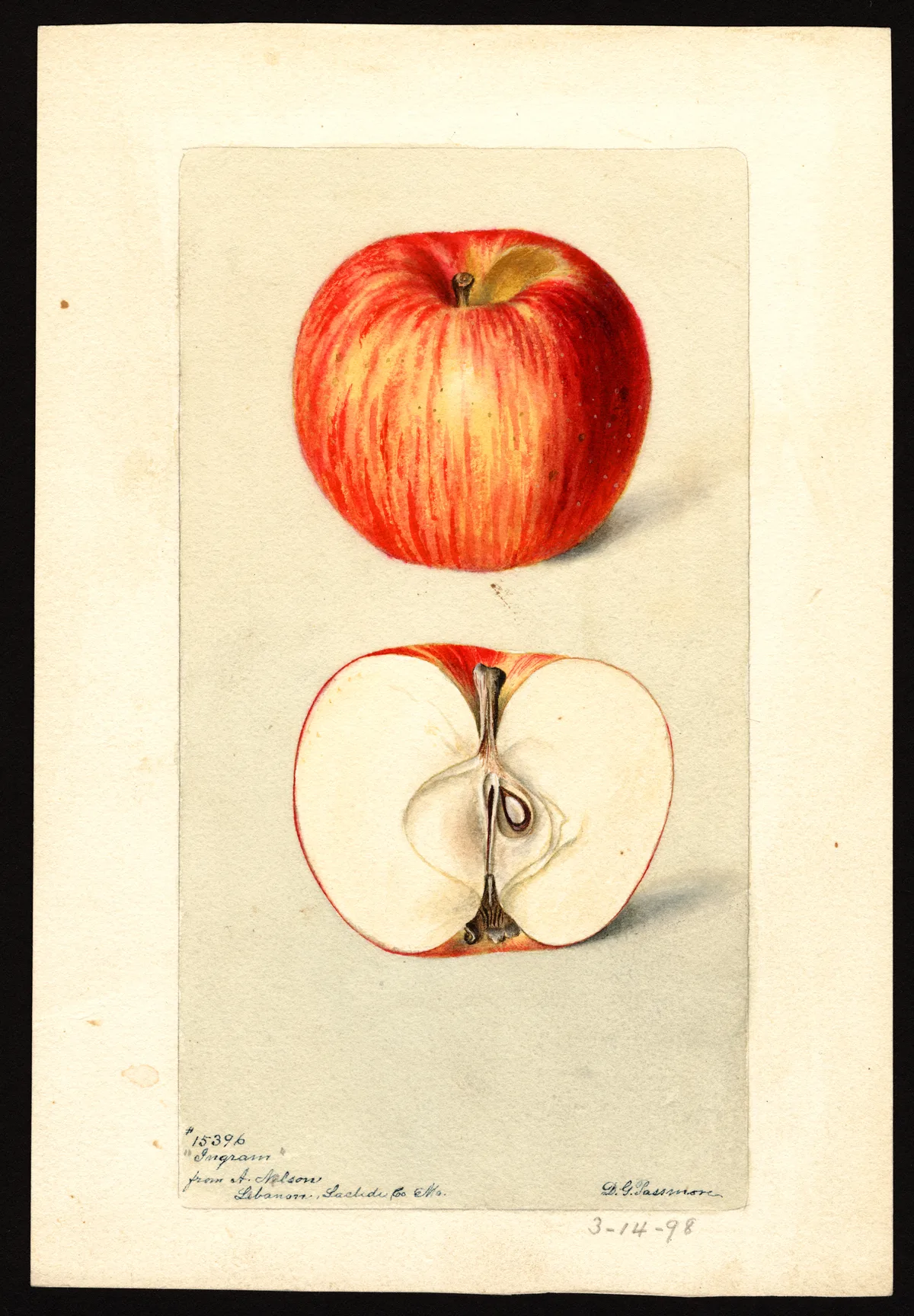
USDA Pomological Watercolor Collection
Ingram
Origin/History
Ingram originated as a seedling of Rawls Janet (also called Rails, Rails Genet, or Geniton), grown by Martin Ingram of Greene County, Missouri, near Springfield. Downing reports it simply as a new variety from this origin. Beach gives the dates of origin as between 1844 and 1855, while Budd-Hansen states more specifically that the seed was planted by "Jack Ingram" near Springfield, Mo., in 1844. Hedrick places the origination "about 1850." Thomas notes simply "Seedling of Ralls. Good South. Missouri."
The variety attracted attention in the Southwest, particularly in the Ozark region, for its excellent keeping qualities and was being largely planted there for commercial purposes (Beach). Budd-Hansen calls it "a heavy regular bearer and long keeper" that is "becoming very popular in southern Missouri." Hedrick judges it more critically: "The fruit is but mediocre, and the variety has small value except when a tree is wanted which blooms late or an apple which keeps long. This variety has attracted much attention in the Southwest, especially in the Ozarks, but promises little in other regions." Beach adds that it has not yet been sufficiently tested in New York to determine whether it is a desirable apple for that state, but since it is so much like its parent Rails, it probably is not so well adapted for that region as for more southern localities. In quality Beach ranks it "about with York Imperial." In flavor it is much like Rails but less juicy (Beach).
Tree
Tree vigorous (Beach, Hedrick; Central Experimental Farm calls it "a vigorous grower"), with long, moderately stout (Beach) to stout (Hedrick) branches. Form upright or roundish, rather dense (Beach); upright, dense (Hedrick). Twigs medium to long, straight, rather stout; internodes medium or below. Bark olive-green partly covered with clear brownish-red, lightly mottled with scarf-skin. Lenticels numerous, large, generally round, raised, very conspicuous. Buds medium, broad, flat, obtuse, appressed, pubescent, deeply set in the bark (Beach).
Tree productive (Downing); a heavy regular bearer (Budd-Hansen). Like Rails, Ingram blooms late in the season, and the older trees are apt to bear rather small fruit unless the fruit is thinned (Beach); "In common with its parent Ingram blooms later than other varieties" (Budd-Hansen).
Fruit
Size: Medium or below (Downing); medium (Thomas, Budd-Hansen); usually about medium, sometimes large (Beach, Hedrick); below medium size (Central Experimental Farm). Beach notes the fruit is of the Rails type but averages larger than Rails and is more highly colored, being nearly red.
Form: Roundish oblate (Downing); roundish conical (Thomas); regular, roundish conical, flattened, at ends truncated (Budd-Hansen); roundish conic to roundish oblate, symmetrical (Beach, Hedrick); roundish, conical (Central Experimental Farm).
Stem: Slender (Downing); short and stout (Thomas); short (Budd-Hansen); rather short, varying from thick and swollen to moderately slender (Beach); short, varying from thick and swollen to slender (Hedrick).
Cavity: Regular, medium depth (Thomas); deep, wavy, obtuse, trace of russet (Budd-Hansen); acuminate, varying from medium in depth and width to deep and broad, sometimes partly russeted, obscurely furrowed (Beach, Hedrick).
Calyx: Small (Downing); open (Budd-Hansen); large, open (Beach, Hedrick). Segments divergent (Budd-Hansen). Calyx tube conical or somewhat funnel-form (Beach); calyx-tube conical (Hedrick). Stamens basal (Beach, Budd-Hansen, Hedrick).
Basin: Medium (Thomas); shallow, regular, smooth, sometimes leather-cracked (Budd-Hansen); pretty regular, moderately deep, medium in width to rather narrow, moderately abrupt (Beach); regular, deep, narrow, abrupt (Hedrick). Thomas adds the fruit is "slightly leather cracked."
Skin: Orange yellow, mostly overspread with broken stripes of rich warm red, gray russet dots, and slight marblings (Downing). Yellow, splashed and striped crimson (Thomas). Surface smooth, rich orange yellow, mostly covered with marbled and mixed rich warm bright red with carmine splashes, in part thinly overlaid with whitish (Budd-Hansen). Rather thick and tough, smooth, bright greenish-yellow or pale yellow, washed, mottled and striped with two shades of red and clouded with whitish scarf-skin over the base; highly colored specimens are nearly overspread with rather dark red (Beach). Thick and tough, smooth, pale yellow, washed, mottled and striped with two shades of red and clouded with white scarf-skin over the base (Hedrick). Green, nearly covered with splashes of red, and sprinkled with whitish dots (Central Experimental Farm).
Dots: Gray russet dots (Downing); very large, numerous, large, yellow and russet (Budd-Hansen); numerous, whitish or areolar with russet center, rather conspicuous (Beach); numerous, white areolar with russet center, conspicuous (Hedrick); whitish dots (Central Experimental Farm).
Flesh/flavor: Yellowish white, moderately juicy, crisp, mild subacid (Downing). Yellowish, fine, tender and juicy when fully ripe, sub-acid, good (Thomas). Yellow, moderately juicy, firm, crisp, mild rich subacid with sweet after taste, very good (Budd-Hansen). Somewhat tinged with yellow, firm and hard but becoming crisp and tender, juicy, very mild subacid, somewhat aromatic, good to very good (Beach). Yellow, firm and hard but becoming crisp and tender, juicy, very mild subacid, aromatic, good to very good (Hedrick). Yellowish white, crisp, juicy, a pleasant sub-acid, quality good (Central Experimental Farm).
Core/seeds: Core above medium (Downing); seeds dark brown (Downing). Core closed, small, meeting; cells ovate, axile, widely slit; tube conical; seeds few, flattened, pointed, packed tight in cells, partially covered with cellular exudate (Budd-Hansen). Core medium to rather small, axile; cells symmetrical, closed or nearly so; core lines meeting or slightly clasping; carpels roundish, tufted; seeds medium in size, rather wide, acute, tufted (Beach). Core small, axile; cells symmetrical, closed; core-lines meeting; carpels round, tufted; seeds wide, acute, tufted (Hedrick).
Season
February to June (Downing, Beach, Budd-Hansen, Hedrick); Beach notes "February to June or later." Late winter (Thomas). Mid-winter (Central Experimental Farm). The fruit is especially valued for its long keeping (Downing); Beach, Budd-Hansen, and Hedrick all emphasize the late-keeping quality.
Uses
Largely planted for commercial purposes in the Ozark region (Beach). Beyond commercial planting in the Southwest, no specific use beyond dessert/keeping apple is detailed in the sources.
Subtypes/Variants
Not described in source.
Other
The Central Experimental Farm at Agassiz, BC noted their trees were planted Spring 1894. Beach reports the variety had not yet been sufficiently tested in New York at the time of his writing.
Book Sources
Described in 5 period pomological works
USDA Nomenclature (1905)
From W.H. Ragan, Nomenclature of the Apple, USDA Bulletin No. 56
A seedling of Ralls.
Nursery Catalog Sources
Found in 18 catalogs (1884–1918) from Alabama, California, Illinois, Kansas, Missouri, Nebraska
- Felix Gillet , Barren Hill Nursery, Nevada City , California — 1884
- Missouri Nursery Co. , Louisiana , Missouri — 1891
- Stark Bros. Nurseries & Orchards Co. , Louisiana , Missouri — 1896
- J.V. Cotta (Cotta Nursery) , Carroll County , Illinois — 1898
- Stark Bros. Nurseries & Orchards Co. , Louisiana , Missouri — 1898
- Alabama Nursery Co. , Huntsville , Alabama — 1900
- Central Experimental Farm , Dominion Department of Agriculture, Agassiz, British Columbia (under test; Bulletin No. 3, Second Series) — 1900
- Benjamin Buckman (personal inventory) , Farmingdale , Illinois — 1901
- Mountain Grove Nurseries (Tippin & Moore , Proprietors; Geo. T. Tippin, J. W. Tippin, J. C. Moore), Mountain Grove , Missouri — 1901
- Phoenix Nursery Company (W. E. Rossney , President; Sidney Tuttle, Vice-President), Bloomington , Illinois — 1904
- Stark Bros. Nurseries & Orchards Co. , Louisiana , Missouri — 1906
- Stark Bros. Nurseries & Orchards Co. , Louisiana , Missouri — 1910
- Galbraith Nursery Co. (DeWitt Hansen , Pres.-Mgr.), Fairbury , Nebraska — 1911
- Stark Bros. Nurseries & Orchards Co. , Louisiana , Missouri — 1911
- Stark Bros. Nurseries & Orchards Co. , Louisiana , Missouri — 1912
- Benjamin Buckman (personal inventory) , Farmingdale , Illinois — 1913
- Holsinger Bros. Nurseries (Holsinger Brothers Nursery) , Rosedale , Kansas — 1916
- Stark Bros. Nurseries & Orchards Co. , Louisiana , Missouri — 1918
View original book sources (6)
— A.J. Downing, The Fruits and Fruit Trees of America (1900)Ingram.
A new variety, grown from seed of Rawls Janet, by Martin Ingram, of Greene Co., Mo. Tree productive, and the fruit especially valued for its long keeping.
Fruit medium or below, roundish oblate, orange yellow, mostly overspread with broken stripes of rich warm red, gray russet dots, and slight marblings. Stalk slender. Calyx small. Flesh yellowish white, moderately juicy, crisp, mild subacid. Core above medium. Seeds dark brown. February to June. (Hort.)
— John J. Thomas, The American Fruit Culturist (1903)Ingram. (Ingram Seedling.) Medium, roundish conical; yellow, splashed and striped crimson; cavity regular, medium depth, stem short and stout, basin medium; slightly leather cracked; flesh yellowish, fine, tender and juicy when fully ripe, sub-acid, good. Late winter. Seedling of Ralls. Good South. Missouri.
— S.A. Beach, The Apples of New York, Vol. 1 (1905)INGRAM.
REFERENCES. 1. Horticulturist, 23:201. 1868 (cited by 5). 2. Downing, 1872:229. 3. Bailey, An. Hort., 1892:241. 4. Rural N. Y., 56:345. 1897. 5. Taylor, U. S. Dept. Agr. Yr. Bk., 1901:382. col. pl. 6. Stinson, Mo. Fr. Sta. Bul. 3:22. 1902. fig. 7. Thomas, 1903:328. 8. Budd-Hansen, 1903:103. 9. Powell and Fulton, U. S. B. P. I. Bul. 48:45. 1903.
SYNONYMS. Ingraham (5). INGRAM SEEDLING (1). Ingram Seedling (5, 7).
This variety has attracted attention in the Southwest within recent years on account of its excellent keeping qualities (4, 5, 6, 9). It is said to be exceptionally promising for the Ozark region (6) where it is being largely planted for commercial purposes. Like the Rails it blooms late in the season and the older trees are apt to bear rather small fruit unless the fruit is thinned. The fruit is of the Rails type but averages larger and is more highly colored, being nearly red. In quality it ranks about with York Imperial. In flavor it is much like Rails but less juicy. It has not yet been sufficiently tested in New York to determine whether it is a desirable apple for this state but since it is so much like its parent, Rails, it probably is not so well adapted for this region as it is for more southern localities.
Historical. Originated with Martin Ingram near Springfield, Mo., from seed of the Rails (Geniton) between 1844 and 1855 (5, 6).
TREE.
Tree vigorous, with long, moderately stout branches. Form upright or roundish, rather dense. Twigs medium to long, straight, rather stout; internodes medium or below. Bark olive-green partly covered with clear brownish-red, lightly mottled with scarf-skin. Lenticels numerous, large, generally round, raised, very conspicuous. Buds medium, broad, flat, obtuse, appressed, pubescent, deeply set in the bark.
FRUIT.
Fruit usually about medium, sometimes large. Form roundish conic, to roundish oblate, symmetrical. Stem rather short, varying from thick and swollen to moderately slender. Cavity acuminate, varying from medium in depth and width to deep and broad, sometimes partly russeted, obscurely furrowed. Calyx large, open. Basin pretty regular, moderately deep, medium in width to rather narrow, moderately abrupt. Skin rather thick and tough, smooth, bright greenish-yellow or pale yellow, washed, mottled and striped with two shades of red and clouded with whitish scarf-skin over the base. Highly colored specimens are nearly overspread with rather dark red. Dots numerous, whitish or areolar with russet center, rather conspicuous. Calyx tube conical or somewhat funnel-form. Stamens basal. Core medium to rather small, axile; cells symmetrical, closed or nearly so; core lines meeting or slightly clasping. Carpels roundish, tufted. Seeds medium in size, rather wide, acute, tufted. Flesh somewhat tinged with yellow, firm and hard but becoming crisp and tender, juicy, very mild subacid, somewhat aromatic, good to very good.
Season February to June or later.
— J.L. Budd & N.E. Hansen, American Horticultural Manual, Part II: Systematic Pomology (1914)Ingram. — Ingram is said to be a seedling of Rails Genet and resembles that variety, but more highly colored ; it is said that the seed was planted by Jack Ingram, near Springfield, Mo., in 1844. A heavy regular bearer and long keeper and is becoming very popular in southern Missouri. In common with its parent Ingram blooms later than other varieties. Fruit medium, regular, roundish conical, flattened; at ends truncated; surface smooth, rich orange yellow, mostly covered with marbled and mixed rich warm bright red with carmine splashes, in part thinly overlaid with whitish; dots very large, numerous, large, yellow and russet ; cavity deep, wavy, obtuse, trace of russet; stem short; basin shallow, regular, smooth, sometimes leather-cracked; calyx open; segments divergent. Core closed, small, meeting; cells ovate, axile, widely slit; tube conical, stamens basal; seeds few, flattened, pointed, packed tight in cells, partially covered with cellular exudate; flesh yellow, moderately juicy, firm, crisp, mild rich subacid with sweet after taste, very good. February to June.
— U.P. Hedrick, Cyclopedia of Hardy Fruits (1922)INGRAM. Ingram Seedling. Ingram is remarkable for two qualities—late-blooming, and late-keeping fruits. It is a seedling of Rails, which it much resembles except for larger and more brightly colored apples. The fruit is but mediocre, and the variety has small value except when a tree is wanted which blooms late or an apple which keeps long. This variety has attracted much attention in the Southwest, especially in the Ozarks, but promises little in other regions. Ingram originated in the orchard of Martin Ingram, Springfield, Missouri, about 1850. Tree vigorous, upright, dense, with long, stout branches. Fruit medium, sometimes large, round-conic to round-oblate, symmetrical; stem short, varying from thick and swollen to slender; cavity acuminate, from medium in depth and width to deep and broad, sometimes partly russeted, obscurely furrowed; calyx large, open; basin regular, deep, narrow, abrupt; skin thick and tough, smooth, pale yellow, washed, mottled and striped with two shades of red and clouded with white scarf-skin over the base; dots numerous, white areolar with russet center, conspicuous; calyx-tube conical; stamens basal; core small, axile; cells symmetrical, closed; core-lines meeting; carpels round, tufted; seeds wide, acute, tufted; flesh yellow, firm, and hard but becoming crisp and tender, juicy, very mild subacid, aromatic; good to very good; February to June.
— Central Experimental Farm, Central Experimental Farm, Agassiz BC — Catalogue of Fruit Trees under Test (Bulletin No. 3, 1900) (1900)Planted Spring 1894. Tree a vigorous grower. Fruit below medium size, roundish, conical. Skin green, nearly covered with splashes of red, and sprinkled with whitish dots. Flesh yellowish white, crisp, juicy, a pleasant sub-acid, quality good. Season mid-winter.