Walbridge
Apple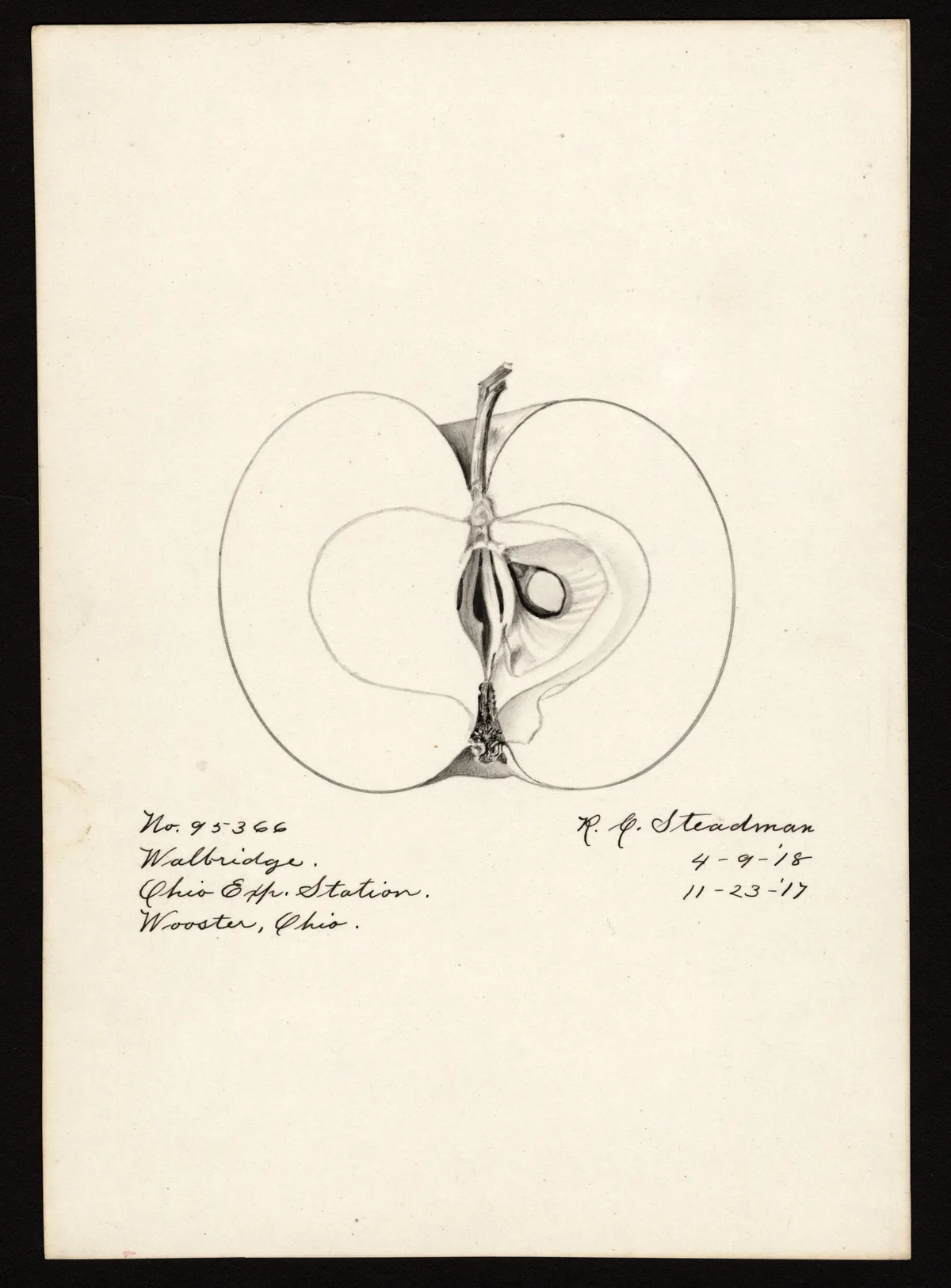
USDA Pomological Watercolor Collection
Walbridge
Origin / History
Originated with Joseph Curtis, Paris, Edgar County, Illinois, in 1818, and named Edgar Redstreak. Hansen writes that the shorter name Walbridge, "under which it was raised for many years before the true name became known, has the preference."
The first description Beach could find is "a very good one" in the Rural New Yorker for 1870, under the name Walbridge. The variety was disseminated from Wisconsin under the name Walbridge and long cultivated under it. The American Pomological Society listed it as Walbridge in 1873. At the Society's meeting in Chicago in 1875 it was decided that it was identical with Edgar Red Streak, and it was entered on the Catalogue under that name, with Walbridge as a synonym. It stood so until 1897, when the Society finally accepted the popular name Walbridge.
Beach reports it planted to a considerable extent in Wisconsin, Iowa and adjacent portions of the Mississippi valley, and "grown quite successfully in many localities in that region." He finds it "less well adapted to New York conditions" and "of comparatively little value for planting in this state." Hedrick writes that "several good characters have enabled Walbridge to gain a foothold in the states of the North Mississippi Valley." He finds its merits "chiefly in the trees." He credits some of its popularity to its very satisfactory growth in the nursery, "because of which it is a favorite with nurserymen."
At the Central Experimental Farm, Agassiz, British Columbia, it was planted in the spring of 1892.
Tree
[NOTE: Source text may be incorrect — Thomas's entry appears transposed ("flesh tender, juicy, sub-acid, vigorous, hardy. Tree prolific bearer, good."), with tree terms inside the flesh clause; only his "prolific bearer" is used here as a tree character.]
Tree vigorous, a fine tree in the nursery, where it makes a good growth. In the orchard Beach finds it moderately vigorous and medium in size. Upright at first, spreading with age; open, upright becoming roundish or spreading (Beach). Hardy and healthy (Hedrick).
Twigs medium to long, usually curved, moderately stout, with large terminal buds; internodes short to medium. Bark moderately dark reddish-brown mingled with olive-green, lightly streaked with scarf-skin, heavily pubescent. Lenticels scattering, small to medium, round to oblong, not raised. Buds prominent, medium to rather large, broad, plump, obtuse, free or nearly so, pubescent.
Beach finds that it comes into bearing rather young and yields full crops biennially. Thomas gives "Tree prolific bearer, good." Hansen reports that "in many parts of the west it has been a very tardy and shy bearer," and at Agassiz it was "not very productive." The fruit hangs well to the tree, with little loss from drops (Beach).
Fruit
Size: Medium, sometimes nearly large but usually medium or below (Beach). Thomas alone calls it large. Often a comparatively large amount of the crop is undersized, misshapen or otherwise unmarketable (Beach).
Form: Oblate conic to roundish conic, flattened at the base, varying to roundish or roundish oblate (Thomas). Hansen calls it regular; Beach finds it often one-sided.
Stem: Short to medium.
Cavity: Medium, acute to acuminate, deep to moderately deep, rather narrow to broad, symmetrical or regular, furrowed gently if at all. A trace of russet, or sometimes partly covered with fine russet.
Calyx: Small, closed or usually closed, pubescent. Calyx tube long, narrow, funnel-shaped, cone-shape to truncate funnel-form, with a fleshy pistil point projecting into the base (Beach). Stamens median to marginal.
Basin: Small, narrow, characteristically shallow, flat or scarcely at all depressed, which Hansen calls "a marked characteristic." Often oblique, somewhat furrowed, minutely wrinkled.
Skin: Moderately thin, tough, smooth, polished (Hansen). Ground pale greenish yellow, or green becoming clear pale yellow or whitish. Thinly shaded or washed with pale red, red-streaked, with narrow stripes and splashes of bright red on the sunny side. Conspicuously mottled and striped with bright carmine and overspread with thin bloom (Beach). Prevailing effect in well-colored specimens striped red. Beach calls it "rather attractive when well colored." Hedrick finds the apples "not remarkable in appearance" but "attractive when well grown."
Dots: Whitish, a few russet. Hansen finds them very obscure and few. Beach finds them numerous, often submerged, sometimes whitish and rather conspicuous.
Flesh and flavor: Flesh white or whitish, with green veinings (Hansen), or a little tinged with yellow (Beach). Firm, moderately fine to a little coarse, crisp, moderately tender to tender, juicy, sprightly, rather mild subacid, slightly aromatic (Beach). Quality ranges from "fair" (Hansen) to "good" (Agassiz), with Beach placing it "fair to good in flavor and quality."
Core and seeds: Core small to medium, abaxile with a wide, hollow cylinder in the axis, or sometimes axile (Beach). Hansen calls it open. Cells symmetrical, closed or sometimes partly open (Beach). Core lines clasping the funnel cylinder. Carpels broadly roundish, emarginate, mucronate. Seeds few, dark, below medium to rather large, moderately wide, obtuse to somewhat acute.
Season
Winter. The recorded season runs from November to February or March, and Hansen gives "all winter." Beach gives a commercial limit of February in ordinary storage and April or May in cold storage. At Agassiz the season was January and February.
Uses
A culinary fruit. Beach finds it "good for culinary purposes, but not equal to standard varieties of its season for dessert use."
Subtypes / Variants
Not described in source.
Other
Beach's Apples of New York carries a colored plate of the whole fruit of Walbridge. The section is shown on the same plate as the whole fruit of Rambo.
Book Sources
Described in 5 period pomological works
Nursery Catalog Sources
Found in 19 catalogs (1884–1913) from Alabama, California, Illinois, Oregon, Washington
- Felix Gillet , Barren Hill Nursery, Nevada City , California — 1884
- Palouse Nursery and Pleasant Dale Fruit Farm , Colfax, Washington Territory (situated two miles northeast of Colfax) - undated (single-page broadside flyer; "Washington Territory" suggests pre — 1889
- California Nursery Co. , Niles , California — 1889
- Sherwood Hall Nursery Co. , Timothy Hopkins (Menlo Park Nurseries), San Francisco / Menlo Park , California — 1893
- Milwaukie-Canby Nurseries , Canby, OR (and Milwaukie, OR) — 1893
- The Vineland Nurseries (Kelsey & Co. , Proprietors), St. Joseph, Missouri (Office: 13th and Atchison Sts., 2 Blocks East of the Citizens St. Car Line) — 1894
- Woodburn Nurseries , Woodburn, Marion Co. , Oregon — 1894
- Alabama Nursery Co. , Huntsville , Alabama — 1900
- Central Experimental Farm , Dominion Department of Agriculture, Agassiz, British Columbia (under test; Bulletin No. 3, Second Series) — 1900
- The Dalles Nurseries , The Dalles , Oregon — 1901
- Washington Nursery Co. , Toppenish , Washington — 1901
- Benjamin Buckman (personal inventory) , Farmingdale , Illinois — 1901
- Pacific Nursery Company (W. O. Hudson & A. D. Hudson) , Tangent , Oregon — 1903
- Phoenix Nursery Company (W. E. Rossney , President; Sidney Tuttle, Vice-President), Bloomington , Illinois — 1904
- Washington Nursery Company , Toppenish , Washington — 1909
- Pacific Nursery Company , Portland , Oregon — 1912
- Vineland Nurseries Company , Clarkston , Washington — 1912
- Washington Nursery Company , Toppenish , Washington — 1912
- Benjamin Buckman (personal inventory) , Farmingdale , Illinois — 1913
View original book sources (6)
— N.E. Hansen, A Study of Northwestern Apples (1902)Walbridge. (Edgar Redstreak)
Walbridge (Edgar Redstreak)—Originated by Joseph Curtis, Paris, Edgar Co., Illinois, and named Edgar Redstreak, but the shorter name, under which it was raised for many years before the true name became known, has the preference. Tree vigorous, at first upright, but spreading with age, a fine tree in nursery. In many parts of the west it has been a very tardy and shy bearer—Fruit medium, oblate, conical, regular; surface smooth, polished, pale greenish yellow, thinly shaded with pale red, with narrow stripes and splashes of bright red on sunny side; dots whitish, very obscure, few; cavity acute, regular, trace of russet; stem short to medium; basin narrow, flat or nearly so (this is a marked characteristic), minutely wrinkled; calyx closed; small. Core open, clasping; tube funnel-shaped; stamens marginal; flesh white with green veinings, crisp, tender, juicy, mild subacid, fair. All winter.
— John J. Thomas, The American Fruit Culturist (1903)Walbridge. Large, roundish, oblate; red streaked; flesh tender, juicy, sub-acid, vigorous, hardy. Tree prolific bearer, good. Winter.
— S.A. Beach, The Apples of New York, Vol. 1 (1905)WALBRIDGE.
REFERENCES. 1. Rural N. Y., 1870:204, 205. fig. 2. Am. Pom. Soc. Cat., 1873. 3. Am. Pom. Soc. Rpt., 1875:136, 68, 124; Cat.: 8. 4. Downing, 1876:150 app. fig. 5. Ill. Hort. Soc. Rpt., 1877:213. 6. Burrill, Ib., 1878:226. 7. Ia. Hort. Soc. Rpt., 1882:343. 8. Gibb, Am. Pom. Soc. Rpt., 1883:124. 9. Thomas, 1885:527. 10. Bailey, An. Hort., 1892:252. 11. Ib., 1892:238. 12. Craig, Can. Dept. Agr. Rpt., 1894:126. 13. Can. Hort., 17:69, 70. 1894. 14. Beach, N. Y. Sta. An. Rpt., 13:592. 1894. 15. Maynard, Putnam and Fletcher, Mass. Sta. Bul., 44:4. 1897. 16. Am. Pom. Soc. Cat., 1897:15. 17. Waugh, Vt. Sta. An. Rpt., 14:311. 1901. 18. Craig, Can. Hort., 24:76. 1901. fig. 19. Munson, Me. Sta. Rpt., 1902:96. 20. Dickens and Greene, Kan. Sta. Bul., 106:56. 1902. 21. Hansen, S. D. Sta. Bul., 76:112. 1902. fig. 22. Budd-Hansen, 1903:196. fig. 23. Powell and Fulton, U. S. B. P. I. Bul., 48:59. 1903. 24. Beach and Clark, N. Y. Sta. Bul., 248:149. 1904.
SYNONYMS. Edgar County Red Streak (7, 8). EDGAR REDSTREAK (2, 11). Edgar Redstreak (9, 17, 21, 22). EDGAR RED STREAK (4). Edgar Red Streak (16). Kentucky Red Streak (7). Walbridge (4). WALLBRIDGE (13, 20).
The accompanying colored plate shows the whole fruit of Walbridge. The section is shown on the same plate as that which shows the whole fruit of Rambo. Fruit red-striped, rather attractive when well colored, good for culinary purposes, but not equal to standard varieties of its season for dessert use. Season, November to February or March. Commercial limit, in ordinary storage, February; in cold storage, April or May (23, 24). The fruit hangs well to the tree so that there is little loss from drops, but often a comparatively large amount of it is undersized, misshapen or otherwise unmarketable. This variety has been planted to a considerable extent in Wisconsin, Iowa and adjacent portions of the Mississippi valley and has been grown quite successfully in many localities in that region. It appears to be less well adapted to New York conditions and is of comparatively little value for planting in this state. The tree makes a good growth in the nursery. In the orchard it is moderately vigorous, comes into bearing rather young and yields full crops biennially.
Historical. The first description of this variety which we have been able to find is a very good one which appeared in the Rural New Yorker for 1870 under the name Walbridge (1). It was disseminated from Wisconsin under the name Walbridge and has long been in cultivation under this name (4, 6). The American Pomological Society listed it as Walbridge in 1873 (2), but at the following meeting of the Society in Chicago, in 1875, it was decided that it was identical with Edgar Red Streak which originated with Joseph Curtis, Paris, Edgar county, Ill., in 1818 (3), and accordingly it was entered on the Society's Catalogue as Edgar Red Streak with Walbridge as a synonym. It continued to be thus listed until 1897 when the popular name Walbridge was finally accepted by the Society (16).
TREE. Tree medium in size, moderately vigorous. Form upright becoming roundish or spreading, open. Twigs medium to long, usually curved, moderately stout, with large terminal buds; internodes short to medium. Bark moderately dark reddish-brown, mingled with olive-green, lightly streaked with scarf-skin; heavily pubescent. Lenticels scattering, small to medium, round to oblong, not raised. Buds prominent, medium to rather large, broad, plump, obtuse, free or nearly so, pubescent.
FRUIT. Fruit sometimes nearly large but usually medium or below. Form roundish conic, flattened at the base, varying to roundish or to oblate conic, often onesided. Stem short to medium. Cavity medium, acute to acuminate, deep to moderately deep, rather narrow to broad, symmetrical, furrowed gently if at all, sometimes partly covered with fine russet. Calyx small, usually closed, pubescent. Basin small, characteristically shallow or scarcely at all depressed, often oblique, somewhat furrowed and wrinkled. Skin moderately thin, tough, smooth, green becoming clear pale yellow or whitish, washed with red, conspicuously mottled and striped with bright carmine and overspread with thin bloom. Dots numerous, often submerged, sometimes whitish and rather conspicuous; a few are russet. Prevailing effect in well-colored specimens, striped red. Calyx tube long, narrow, cone-shape to truncate funnel-form with fleshy pistil point projecting into base. Stamens median to marginal. Core small to medium, abaxile with a wide, hollow cylinder in the axis, or sometimes axile; cells symmetrical, closed or sometimes partly open; core lines clasping the funnel cylinder. Carpels broadly roundish, emarginate, mucronate. Seeds few, dark, below medium to rather large, moderately wide, obtuse to somewhat acute. Flesh whitish a little tinged with yellow, firm, moderately fine to a little coarse, crisp, moderately tender, juicy, sprightly, rather mild subacid, slightly aromatic, fair to good in flavor and quality.
— J.L. Budd & N.E. Hansen, American Horticultural Manual, Part II: Systematic Pomology (1914)Walbridge (Edgar Redstreak).— Originated by Joseph Curtis, Paris, Edgar Co., Ill., and named Edgar Redstreak, but the shorter name, under which it was raised for many years before the true name became known, has the preference; tree vigorous, at first upright, but spreading with age, a fine tree in nursery. In many parts of the West it has been a very tardy and shy bearer.
Fruit medium, oblate, conical, regular; surface smooth, polished, pale greenish yellow, thinly shaded with pale red, with narrow stripes and splashes of bright red on sunny side; dots whitish, very obscure, few; cavity acute, regular, trace of russet; stem short to medium; basin narrow, flat, or nearly so (this is a marked characteristic), minutely wrinkled; calyx closed, small. Core open, clasping; tube funnel-shaped; stamens marginal; flesh white with green veinings, crisp, tender, juicy, mild subacid, fair. All winter.
— U.P. Hedrick, Cyclopedia of Hardy Fruits (1922)WALBRIDGE. Edgar. Red Streak. Kentucky Red Streak. Several good characters have enabled Walbridge to gain a foothold in the states of the North Mississippi Valley. Its merits are chiefly in the trees, which are hardy, healthy, vigorous, come into bearing young, and yield full crops biennially. Some of the popularity of Walbridge is due to its very satisfactory growth in the nursery, because of which it is a favorite with nurserymen. The apples, while not remarkable in appearance, are attractive when well grown, but often much of the crop is undersized and malformed. It is a culinary fruit which keeps in ordinary storage until February. The variety originated with Joseph Curtis, Paris, Illinois, in 1818.
Tree medium in size, vigorous, upright-spreading, open. Fruit medium in size, round-conic, flattened at the base, or round to oblate-conic, often one-sided; stem short; cavity acute, deep, narrow, symmetrical, furrowed gently, sometimes partly covered with fine russet; calyx small, usually closed, pubescent; basin small, shallow or scarcely depressed, often oblique, furrowed and wrinkled; skin thin, tough, smooth, pale yellow washed with red, conspicuously mottled and striped with carmine and overspread with thin bloom; dots numerous, often submerged, conspicuous, white or a few russet; prevailing effect striped-red; calyx-tube long, narrow, cone-shape with fleshy pistil point projecting into base; stamens median; core small, abaxile, with a wide, hollow cylinder in the axis, sometimes axile; cells symmetrical, closed or partly open; core-lines clasping; carpels broadly round, emarginate, mucronate; seeds few, dark, small, wide, obtuse; flesh tinged with yellow, firm, fine to coarse, crisp, tender, juicy, sprightly, mild subacid, aromatic; fair to good; November to February.
— Central Experimental Farm, Central Experimental Farm, Agassiz BC — Catalogue of Fruit Trees under Test (Bulletin No. 3, 1900) (1900)Planted Spring 1892. Tree a vigorous grower, but not very productive. Fruit of medium size, oblate, conical. Skin pale yellow, shaded with red. Flesh firm, juicy, white, sprightly, quality good. Season January and February.