Green Newtown And Yellow Newtown
Apple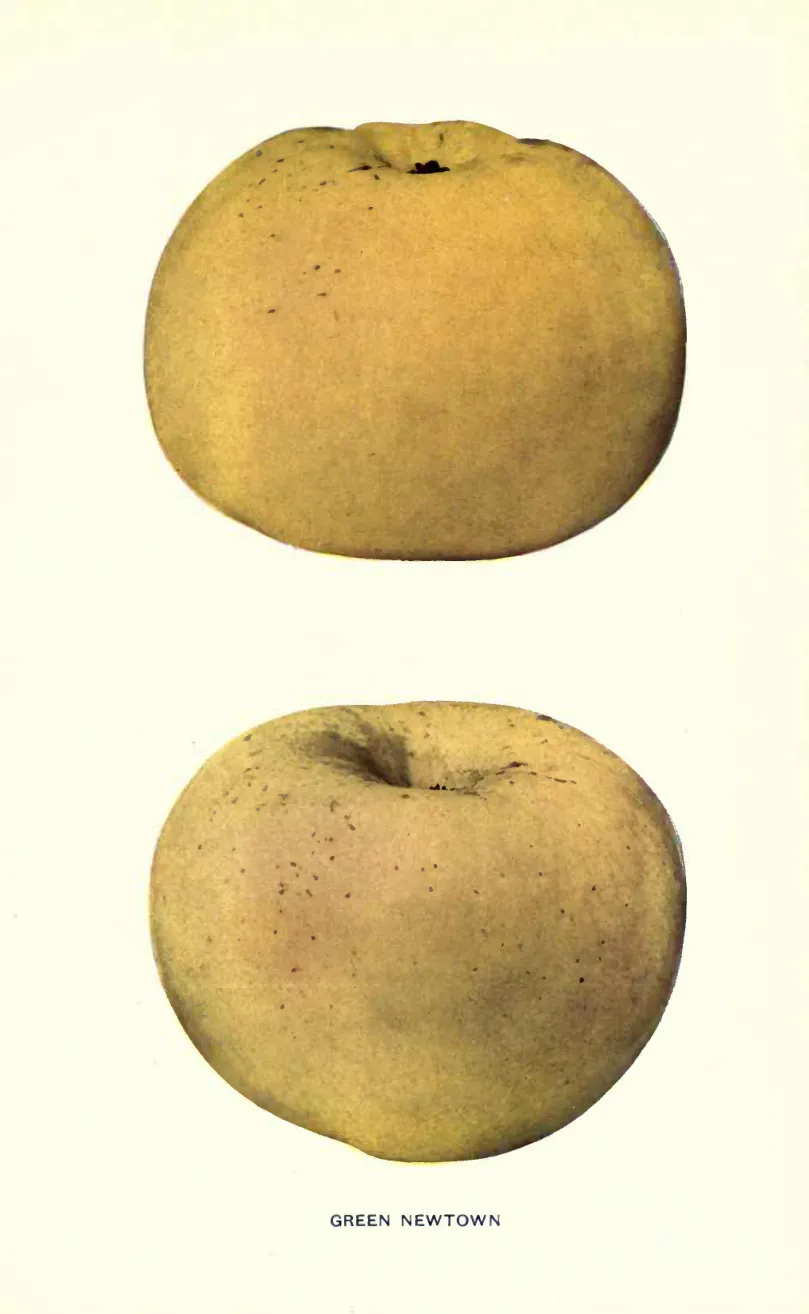
Green Newtown and Yellow Newtown
Origin and History
The Newtown Pippin was the first American apple to attract attention in Europe. After Benjamin Franklin received specimens while in London in 1759, and John Bartram subsequently sent grafts to Collinson, numerous attempts were made to cultivate the variety in England. By 1768 it was being grown in the Brompton Park nursery under the name "Newtown Pippin of New York."
The variety was widely distributed through apple-growing districts of the Atlantic slope by 1773. Thomas Jefferson recorded in his "Garden Book" that in March 1773, he received grafts of "Newtown Pippin" from Mordecai Debnam at Sandy Point, which were grafted by P. Morton. In March 1778, he noted that these grafted trees were planted out at Monticello.
The original seedling tree is alleged to have stood near a swamp on the estate of Gershom Moore in Newtown, Long Island, until approximately 1805, when it died from excessive cutting of cions and exhaustion. Its origin is credited to the early part of the eighteenth century. It is not clear whether the original tree was of the green or yellow type, nor has any record of a distinct origin of the two types been discovered.
Prior to 1817, only one type of Newtown was recognized in the American pomological record. However, Coxe's work of that year described as distinct varieties the "Large Yellow Newtown Pippin" and the "Green Newtown Pippin," characterizing the latter as "a variety of the preceding kind." Since Coxe's time, the two types have been recognized as distinct by leading American pomologists, though fruit growers have not been unanimous on this point. The Green Newtown and Yellow Newtown are so similar that it is highly probable that one is but a sport or strain of the other, and it is now impossible to determine which was the original Newtown Pippin.
Both sorts are exceedingly variable and susceptible to the influence of soil, climate, and elevation above sea level. The excellent quality of the fruit from some of the Patowmack counties of Virginia was noted as early as the time of Coxe. In Albemarle county, Virginia, where it reached a high degree of perfection, it became known as the "Albemarle Pippin" at an early day and was for many years considered a distinct variety of local origin.
Albemarle Pippin Origins: Two accounts exist regarding the introduction to Albemarle county. One tradition holds that as far back as 1765 there was a noted tree standing in a mountain hollow on what is now William Sutherland's land in the North Garden neighborhood, reputed to be a seedling from which all Albemarle Pippins descended. The more authentic account fixes the earliest introduction to the time of Braddock's defeat (1755). Dr. Thomas Walker of Castle Hill, Albemarle county, was commissary officer of the Virginia troops under Braddock. After the disastrous defeat, when troops went into winter quarters in Philadelphia, he returned home carrying in his saddle-bags cuttings of apple trees. These were grafted at Castle Hill and became the famous Albemarle Pippin. The land on which the North Garden tree stood was entered in the land office in 1741 in the name of Mildred Meriwether, who was the stepdaughter of Dr. Thomas Walker, suggesting the old tree on her land was likely one of Walker's grafts.
The identity of Albemarle and Yellow Newtown was first recorded by Franklin Davis in a letter from Staunton, Virginia, published in the Horticulturist in 1857. Since that time most pomologists have accepted their identity, ascribing slight variations to local soil or climatic conditions. Recent investigation by H. L. Lyman and Samuel B. Woods of Charlottesville, Virginia, has established a clear connection between the supposed original Albemarle tree and the older variety.
An export trade in Albemarle Pippin fruit was inaugurated in the first year of Queen Victoria's reign. Andrew Stevenson, whose home was in Albemarle, was minister to the Court of St. James. He had Albemarle Pippins sent for his own use and presented the Queen with several barrels. She was delighted with their perfect flavor and excellence, and as a graceful acknowledgment of Stevenson's courtesy, removed a small tax which then existed for the benefit of the Crown on all imported apples. From that time the Albemarle Pippin grew steadily in favor in English markets. They were known to sell in wholesale markets at Liverpool for two or three times the price other American apples commanded. A neighbor sold his entire crop for $10 per barrel, and Albemarle Pippins have been seen retailing at 36 cents a pound in England.
Tree
Under favorable conditions the trees come into bearing young and are reliable croppers, yielding good crops biennially or sometimes more frequently. The fruit hangs well to the tree.
The trees are quite susceptible to scab and require thorough treatment to hold this disease in check, particularly when grown on heavy clay soils. Unless grown on fertile soils and under good cultivation with insect pests and fungous diseases kept well under control, there is often a comparatively high percentage of ill-shaped, uneven, and low-grade fruit.
The variety is highly variable and susceptible to the influence of soil, climate, and elevation above sea level. Both types are successfully grown in but few portions of the apple-producing area of the United States. The principal localities are the lower portion of the Hudson River valley in New York, the Piedmont and mountain regions of Virginia and North Carolina, and portions of California, Oregon, and Washington. They are successfully and extensively grown in certain localities in the Hudson Valley and along the north shore of Long Island, but usually neither is regarded as desirable for commercial planting west of the Hudson Valley. Their successful cultivation is probably more limited by local conditions than is the case with any other standard commercial variety grown in this state.
Fruit
Size and Form: Under favorable conditions the fruit grows large or sometimes very large and is fairly uniform in size, although somewhat variable in form and coloring.
Skin: Not described in detail in source. The Yellow Newtown has a brighter color than the Green Newtown. Both types are variable in coloring depending on growing conditions.
Cavity: Not described in source.
Calyx: Not described in source.
Basin: Not described in source.
Flesh and Flavor: The fruit is of the highest quality for dessert and excellent for culinary uses. It is firm and keeps very late. The fruit ships well. Cider made from it is very clear and of high quality.
Core and Seeds: Not described in source.
Season and Storage
In ordinary storage, the commercial season is February to March; in cold storage, March to May. The fruit has a long established reputation in Europe and commands the best prices paid there for American apples.
Uses
The fruit is of the highest quality for dessert purposes and excellent for culinary uses. Cider made from it is very clear and of high quality. In the early days, large quantities of the fruit were used for cider production. The crop is largely exported.
Subtypes and Variants
Green Newtown vs. Yellow Newtown: The Green Newtown and Yellow Newtown are so similar that one is highly probable to be a sport or strain of the other. Since the time of Coxe (1817), the two types have been recognized as distinct by leading American pomologists, though fruit growers have not been unanimous on this point. The Yellow Newtown has for many years been considered the better apple for exportation and in commercial orchards has almost superseded the Green Newtown on account of its larger size, brighter color, and better keeping quality.
Albemarle Pippin: The Yellow Newtown variety in Albemarle county, Virginia, where it reached a high degree of perfection, became known as the "Albemarle Pippin" at an early day and was for many years considered a distinct variety of local origin and was so propagated. The identity of Albemarle and Yellow Newtown is now accepted by most pomologists, with variations attributed to local soil or climatic conditions.
Other
The variety has a long and well-documented history in European and American horticultural literature, with references dating from 1803 onward. In pomological literature the name "Newtown Pippin" has often been used in such a way that it is uncertain whether writers referred to the Yellow Newtown or the Green Newtown, and correct synonymy cannot be accurately determined in all cases. It is now believed that Albemarle is Yellow Newtown and Brooke Pippin is possibly identical with Green Newtown.
Book Sources
Described in 1 period pomological work
View original book sources (1)
— S.A. Beach, The Apples of New York, Vol. 1 (1905)GREEN NEWTOWN AND YELLOW NEWTOWN.
References. 1. Forsyth, 1803:53. 2. Coxe, 1817:142, 143. figs. 3. Thacher, 1822:125. 4. N. Y. Bd. Agr. Mem., 1826:477. 5. Wilson, 1828:136. 6. Ronalds, 1831:33. 7. Cat. Hort. Soc. London, 1831:22. 8. Kenrick, 1832:45, 55. 9. Floy-Lindley, 1833:37, 40. 10. Downing, 1845:118, 119. fig. 11. Barrett, Horticulturist, 3:240. 1848. 12. Cole, 1849:133. fig. 13. Thomas, 1849:172, 177, 182, 187. fig. 14. Emmons, Nat. Hist. N. Y., 3:83. 1851. col. pls. Nos. 23 and 53. 15. Am. Pom. Soc. Cat., 1852. 16. Mag. Hort., 19:171. 1853. 17. Hooper, 1857:64, 102. 18. Elliott, 1858:93, 118, 120. figs. 19. Oberdieck, Ill. Handb. der Obstk., 4:99. 20. Am. Pom. Soc. Cat., 1862. 21. Warder, 1867:637, 649, 711, 720. fig. 22. Regel, 1868:463, 464. 23. Downing, 1872:201. fig. 24. Leroy, 1873:486, 871. figs. 25. Barry, 1883:350, 358. 26. Hogg, 1884:155, 252. 27. Lyon, Mich. Hort. Soc. Rpt., 1890:292, 300. 28. Wickson, 1891:249. 29. Bailey, An. Hort., 1892:240, 253. 30. Massey, Rural N. Y., 51:462. 1892. 31. Hicks, Ib., 53:205. 1894. 32. Taylor, U. S. Pom. Bul., 7:358. 1898. 33. Alwood, Va. Sta. Bul., 130:126, 140. 1901. figs. of trees. 34. Eneroth-Smirnoff, 1901:392. 35. Budd-Hansen, 1903:94, 211. figs. 36. Powell and Fulton, U. S. B. P. I. Bul., 48:43, 62. 1903. 37. Beach and Clark, N. Y. Sta. Bul., 248:123, 152. 1904. 38. Ragan, U. S. B. P. I. Bul., 56:23, 55, 129, 210, 346. 1905.
Nomenclature. Albemarle (21, 38). Albemarle (36, 38). Albemarle Pippin (13, 18, 33). Albemarle Pippin (30, 32, 35, 37, 38). American Newtown Pippin (9, 10, 18, 23, 24, 26, 38). Back Creek (38). Brooke Pippin (38). Brooke Pippin (20). Brookes Pippin (16, 21). Brooke's Pippin (?23, 38). Green Newton Pippin (2, 3, 4). Green Newtown (27, 35, 36, 37). Green Newtown Pippin (8, 14, 17, 21, 23, 28, 29, probably incorrectly 9). Green Newtown Pippin (10, 13, 18, 24, 25, 26, 37, 38). Green Winter Pippin (10, 18, 23, 24, 26, 38). Hunt's Fine Green Pippin (23, 38). Hunt's Green Newtown Pippin (?23, 38). Large Newtown Pippin (24, 38). Large Yellow Newton Pippin (2). Large Yellow Newton Pippin (26). Large Yellow Newtown Pippin (8, 26, 38). Mountain Pippin (38). Neustadt's Gelber Pepping (19). Newton's Pippin (22). Newton Yellow Pippin (34). Newtown Pippin (1, 5, 6, 7, 9, 10, 11, 12, 13, 15, 18, 23, 24, 25, 26, 30, 31). Newtown Pippin (36, 37, 38). New York Greening (38). New York Pippin (38). Petersburgh Pippin (10, 18, 23, 24, 26, 38). Pippin (13). Reinette de New-York (24). Virginia Pippin (38). Yellow Newton's Pippin (22). Yellow Newtown (21, 27, 32, 35, 36, 37). Yellow Newtown Pippin (4, 7, 8, 10, 13, 14, 17, 18, 20, 25, 26, 28, 29). Yellow Newtown Pippin (24, 36, 38). Yopp's Favorite (24), but incorrectly.
The Green Newtown and the Yellow Newtown are here discussed together because they are so much alike that it is highly probable that one is but a sport or strain of the other. At this time it is impossible to determine which of the two was the original Newtown Pippin. It is now believed that Albemarle is Yellow Newtown and Brooke Pippin is possibly identical with Green Newtown. In pomological literature the name Newtown Pippin has often been used in such a way that it is uncertain whether the writer had in mind the Yellow Newtown or the Green Newtown, and the correct synonymy cannot be accurately determined in all cases. On this account, the names as given by the different writers are stated in the above nomenclatural list without indicating whether or not they are used correctly except in the case of Leroy (24). Both the Green Newtown and the Yellow Newtown differ markedly in size, color and quality in different locations and their successful cultivation is probably more limited by local conditions than is the case with any other standard commercial variety grown in this state. They are successfully and extensively grown in certain localities in the Hudson valley and along the north shore of Long Island, but usually neither of them is regarded as desirable for commercial planting west of the Hudson valley.
Under favorable conditions the trees come into bearing young and are reliable croppers yielding good crops biennially or sometimes oftener. The fruit hangs well to the tree. It is quite susceptible to the scab and requires thorough treatment to hold this disease in check particularly when grown on heavy clay soils. Unless grown on fertile soils and under good cultivation with insect pests and fungous diseases kept well under control there is often a comparatively high percentage of ill-shaped, uneven and low-grade fruit. Under favorable conditions the fruit grows large or sometimes very large and is fairly uniform in size although somewhat variable in form and coloring. It has a long established reputation in Europe and commands the best prices paid there for American apples. It is firm, keeps very late and ships well. The crop is largely exported. In ordinary storage its commercial season is February to March; in cold storage March to May. The fruit is of the highest quality for dessert and excellent for culinary uses. Cider made from it is very clear and of high quality, and in the early days large quantities of the fruit were used for this purpose.
Historical. The excellent historical account of the Yellow Newtown and the Green Newtown given by Taylor (32) is reproduced here:
The "Newtown Pippin" was the first American apple which attracted attention in Europe. After the receipt of specimens by Franklin while in London in 1759, and the subsequent sending of grafts to Collinson by John Bartram, numerous attempts were made to grow the variety in England. As early as 1768 it was cultivated in the Brompton Park nursery under the name "Newtown Pippin of New York."
It is probable that the large apple exports of 1773 included considerable quantities of the Newtown, for it was at that time quite generally distributed through the apple-growing districts of the Atlantic slope. Thomas Jefferson recorded in his "Garden Book" that in March, 1773, grafts of "Newtown Pippin," received from Mordecai Debnam, at Sandy Point, were "ingrafted by P. Morton," and in March, 1778, he noted that the grafted trees were planted out at Monticello.
Prior to 1803 Forsyth said of the variety in England, "The New-Town Pippin is a fine apple in good season, but seldom ripens with us. It is held in great esteem in America." McMahon, in 1806 included Newtown Pippin in his select list of "Long-keeping apples" and also in a list of "Cyder apples."
Previous to 1817 we have no record that more than one type of the Newtown was recognized, but Coxe, whose work appeared in that year, described as distinct varieties the "Large Yellow Newtown Pippin" and the "Green Newtown Pippin," characterizing the latter as "a variety of the preceding kind." Since the time of Coxe the two types have been recognized as distinct by our leading American pomologists, though fruit growers are by no means unanimous on this point.
The original seedling tree of Newtown Pippin is alleged to have stood near a swamp on the estate of Gershom Moore, in Newtown, Long Island, until about 1805, when it died from excessive cutting of cions and exhaustion. Its origin is credited to the early part of the eighteenth century. It is not clear at this time whether the original tree was of the "green" or the "yellow" type, nor has any record of a distinct origin of the two been discovered.
The Yellow Newtown has for many years been considered the better apple for exportation, however, and in commercial orchards has almost superseded the Green Newtown on account of its larger size, brighter color, and better keeping quality.
Both sorts are exceedingly variable and susceptible to the influence of soil, climate, elevation above sea level, etc. They are successfully grown in but few portions of the apple-producing area of the United States at the present time, the principal localities being the lower portion of the Hudson River valley in New York, the Piedmont and mountain regions of Virginia and North Carolina, and portions of California, Oregon and Washington.
Though first grown in commercial orchards in New York, New Jersey and Pennsylvania, the excellent quality of the fruit from "some of the Patowmack counties of Virginia" was noted as early as the time of Coxe.
In Albemarle county, Va., where it reached a high degree of perfection, it became known as the "Albemarle Pippin" at an early day, and was for many years considered a distinct variety, of local origin, and was so propagated.
An export trade in the fruit from Albemarle county was inaugurated under favorable auspices by a happy circumstance which occurred in the first year of the reign of Queen Victoria. The account below is kindly furnished by Mr. Samuel B. Woods, president of the Virginia Horticultural Society.
The true history of the matter is that in the first year of Queen Victoria's reign Andrew Stevenson, whose home was on a mountain side in Albemarle, was minister to the Court of St. James. He had Albemarle Pippins sent over for his own use and presented the Queen with several barrels. She was delighted with the perfect flavor and excellence of the fruit, and, as a graceful acknowledgment of the courtesy of Mr. Stevenson, removed from Albemarle Pippins a small tax which then existed for the benefit of the Crown on all imported apples. From this time the Albemarle Pippin has grown steadily in favor in the English markets. It is not unusual to see them selling in the wholesale markets at Liverpool for two or three times the price other American apples are bringing. A neighbor last fall sold his entire crop for $10 per barrel, and Mr. Whately, an English gentleman who recently returned from abroad, told me that he saw Albemarle Pippins retailing at 36 cents a pound.
As far back as 1765 there was a tree noted for its fine fruit standing in a mountain hollow on what is now Mr. William Sutherland's land, in the North Garden neighborhood. How this tree came here no one knows, but tradition has it that it was a seedling, and from its stock came all Albemarle Pippins. The other account, and the most authentic one, is that which fixes the earliest introduction at the time of Braddock's defeat. Dr. Thomas Walker, of Castle Hill, Albemarle county, was the commissary officer of the Virginia troops with Braddock, and after the disastrous defeat, when the remnant of the troops went into winter quarters in Philadelphia, he returned home, carrying in his saddle-bags cuttings of apple trees. These were grafted at Castle Hill and became the famous Albemarle Pippin.
These two accounts I find connected in this rather curious way. The land on which the tree in the North Garden neighborhood stood was entered in the land office in 1741 in the name of Mildred Meriwether, in whose lifetime parts of the tract were improved. Mildred Meriwether was the stepdaughter of Dr. Thomas Walker, and what is more natural than that the old tree on her land, supposed to be a seedling, was one of the Walker grafts? There is little doubt that the first appearance of the Albemarle Pippin was at Castle Hill from the grafts brought home from Pennsylvania by Dr. Walker after Braddock's defeat in 1755.
The identity of Albemarle and Yellow Newtown seems to have been recorded first by the late Franklin Davis in a letter from Staunton, Va., which was published in the Horticulturist in 1857. Since that time most pomologists have accepted their identity, ascribing the slight variations which are observable to local soil or climatic conditions. But in the absence of an authentic record of the introduction of Yellow Newtown to Albemarle county, many orchardists in the Piedmont and mountain regions have continued to believe the Albemarle a distinct variety of local origin. Recent investigation by Messrs. H. L. Lyman and Samuel B. Woods, prominent citizens and fruit growers of Charlottesville, Va., have resulted in an apparent clearing up of the historical uncertainty and establishing a clear connection between the supposed original Albemarle tree and the older variety.