Canada Reinette
Apple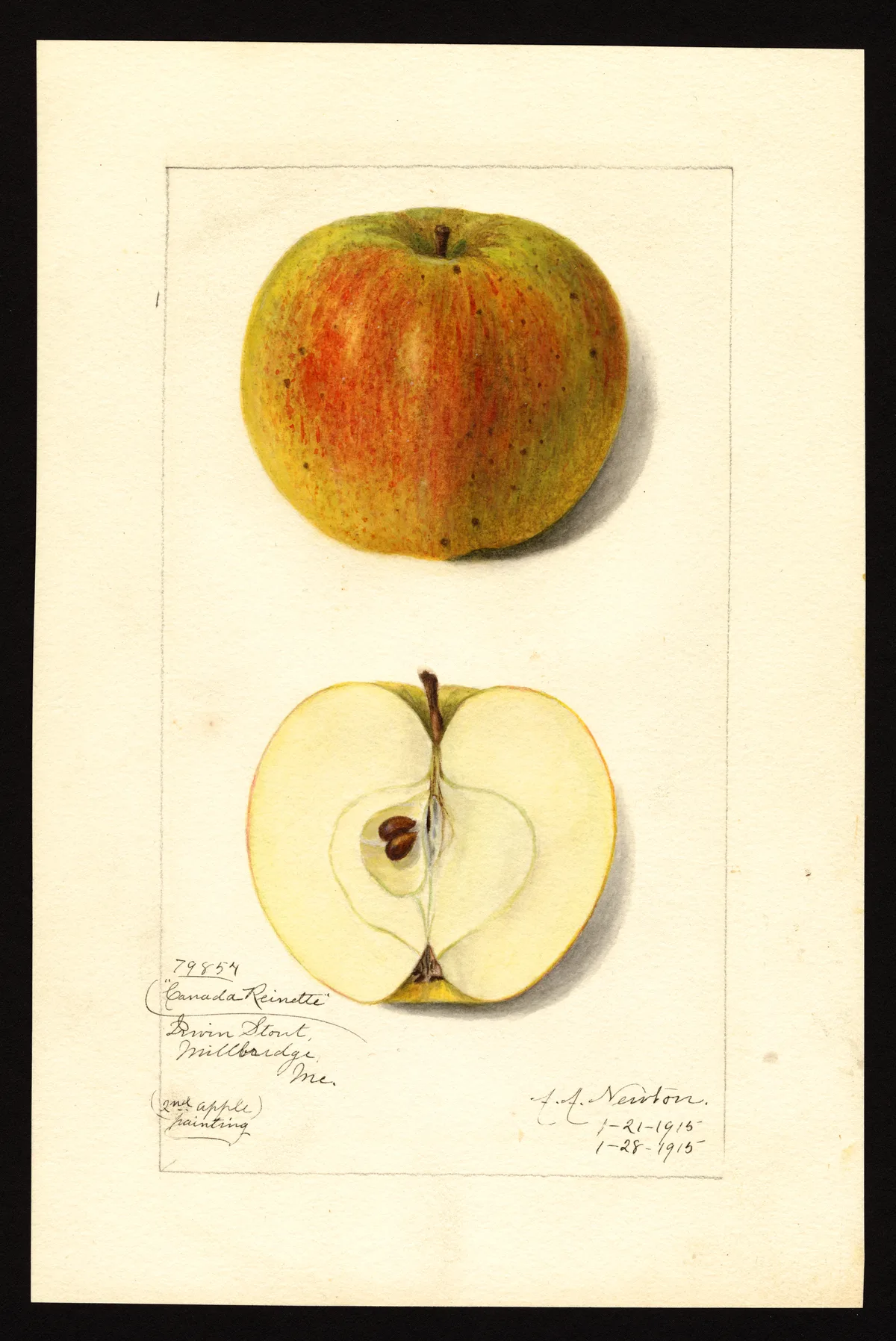
USDA Pomological Watercolor Collection
Canada Reinette
Origin / History
The origin of Canada Reinette is uncertain. Despite its name, it is doubtful whether the variety is truly of Canadian origin. Merlet, a French writer, described the same fruit in the 17th century, and some authors think it was first brought to this continent from Normandy and carried back under its new name (Downing). Warder likewise notes the origin is uncertain, probably European. Budd-Hansen state the origin is doubtful, by some supposed to have originated in France. Bunyard records it as known in France before 1771. Beach states the origin is unknown but that it was listed in France as the Canada Reinette at least as early as 1771. Hedrick says it was first described in France in 1786 and notes it is "supposed to have originated in Canada."
The variety is a popular and highly esteemed sort in Europe, evidenced by the great number of synonyms under which it is known (Downing, Beach). Wherever grown in this country it has historically sustained its foreign reputation (Downing). However, Beach notes it is not much in demand in America because it is easily excelled by other varieties, both for home use and for market. Hedrick echoes this, stating that in America the apples lack in quality and the trees are unproductive, but it is highly esteemed in Europe. Warder observes the fruit does not appear to be well known to American orchardists, and notes that some writers have given the White Pippin among its synonyms and suggested they might be the same — Warder states this is not so; they are very distinct.
Beach's specific description was made from a specimen presented by Irvin Jessup, of Laporte, Indiana, drawn up by Geo. M. Beeler shortly before his death (this attribution actually appears in Warder, not Beach — Warder reproduces the Beeler outline).
Tree
Tree strong, vigorous, upright, spreading, productive, very hardy (Elliott). Vigorous, robust, tall, spreading, productive (Warder). Of vigorous habit, spreading, open, and productive; young shoots clear reddish-brown, slightly downy (Downing; Budd-Hansen repeat this characterization). Bunyard describes growth as vigorous, rather spreading, with fertility moderate, and notes the variety is very subject to canker.
Beach gives the most detailed tree description: moderately vigorous; branches long, stout, crooked; form spreading and drooping. Twigs medium to long, straight, rather stout; internodes medium or below. Bark dull brown, tinged with dark olive-green, irregularly mottled with scarf-skin; very pubescent. Lenticels rather numerous, conspicuous, large, roundish to oblong, raised. Buds large, broad, plump, obtuse, appressed, rather deeply set, pubescent. Leaves large, broad. Hedrick repeats: tree vigorous, spreading and drooping; branches long, stout, crooked; leaves broad.
Bunyard adds further leaf detail: leaf rather large, dark, upfolded, undulated, oval, sharply pointed, very deeply curved serrate.
Beach characterizes the bearing habit as irregular — in some years very productive, but more often only moderately productive or unproductive. This contrasts with the older sources (Elliott, Warder, Downing) which simply call it productive.
Fruit
Size. Large (Elliott). Large (Warder). Of the largest size, four inches in diameter and three deep (Downing). Quite large (Thomas). Very large (Budd-Hansen). Large in size (Lowther). Large, 3½ by 3 (Bunyard). Beach: variable in size, averages above medium and is frequently very large. Hedrick: variable in size, frequently very large. The fruit is sometimes produced in considerable size (Veitch).
Form. Roundish, flattened, irregularly angular, much ribbed, sometimes almost oblong and smooth (Elliott). Oblate, angular; surface not smooth (Warder). Oblate conical, flattened, rather irregular, with projecting ribs; broad at the base, narrowing towards the eye (Downing). Somewhat conical and flattened; rather irregular, ribbed, apex obtuse (Thomas). Oblate conical, flattened, with prominent ribs originating at calyx and diminishing toward the stem (Budd-Hansen). "Re" in form (Lowther). Round conical, slightly angular (Bunyard). Beach: oblate or roundish, inclined to conic, often irregular, broadly angular, sometimes with furrows extending from base to apex; not uniform in shape. Hedrick repeats Beach: oblate or roundish, inclined to conic, often irregularly broadly angular, sometimes with furrows extending from base to apex, not uniform in shape. Veitch (a brief catalog notice) describes it as large, roundish.
Stem / Stalk. Short (Elliott, Downing, Thomas, Beach, Hedrick). Medium, inclined (Warder). Short, slender (Budd-Hansen). Short and thick, not protruding from a very wide cavity (Bunyard). Beach adds: short to very short, moderately thick, not exserted (in his Magenta entry, which he considers identical to Canada Reinette).
Cavity. Narrow, slightly russeted (Elliott). Medium, acute (Warder). Inserted in a wide hollow (Downing). Wide (Thomas). Wide, deep, generally smooth (Budd-Hansen). Very wide (Bunyard). Beach: rather acute, moderately broad, wavy, sometimes russeted. Hedrick: acute, broad, wavy, sometimes russeted. Note the disagreement between Elliott (narrow) and the consensus of later sources (wide/broad). For the Magenta strain Beach considers identical, the cavity is described as large, moderately deep to deep, rather broad, acute or approaching acuminate, usually with outspreading russet.
Calyx. Large (Elliott). Eye small, nearly closed (Warder). Short and large (Downing). Large (Thomas). Open or closed; segments short (Budd-Hansen). Eye open, very large, in a very wide ribbed basin (Bunyard). Beach: medium to large, closed or partly open. Hedrick: large, closed or partly open. Calyx tube medium, rather wide, cone-shaped (Beach); wide, cone-shape (Hedrick); conical (Budd-Hansen). Note: Warder's "eye small, nearly closed" disagrees with the consensus characterization of large/open. Stamens median or approaching basal (Beach); median or basal (Hedrick); basal (Budd-Hansen).
Basin. Deep, angular, with prominent ribs (Elliott). Abrupt, deep, angular (Warder). Rather deep, irregular (Downing, Budd-Hansen). Rather deep, irregular (Thomas). Very wide, ribbed (Bunyard). Beach: abrupt, usually rather deep, moderately wide, furrowed and wrinkled. Hedrick: abrupt, deep, wide, furrowed and wrinkled. For Magenta (considered identical by Beach): often irregular, rather abrupt, medium in width and depth, compressed or furrowed.
Skin. Light greenish-yellow, a blush in sun, and small dark green specks, surrounded with light green, suffused beneath the skin (Elliott). Yellow, blushed and spotted red; dots numerous, small, gray (Warder). Greenish-yellow, slightly washed with brown on the sunny side, sprinkled with dots and russet patches (Downing). Greenish yellow, sometimes a brown cheek (Thomas). Greenish yellow, with brown blush on sunny side, with numerous russet patches; dots numerous, brown russety (Budd-Hansen). Greenish yellow (Lowther). Greenish-yellow with thin russet and slight brown flush (Bunyard). Beach: yellow, sometimes with decided blush but not striped, marked more or less with dots, flecks or irregular patches of russet. Hedrick repeats: yellow, sometimes with a blush, not striped, marked with dots, flecks or irregular patches of russet. Veitch's brief notice — diverging from the other sources — describes the skin as lemon-colored, shaded and striped with red. For the Magenta strain Beach considers identical: yellow or greenish with a bronze blush and roughened with very large stellar or irregular russet dots or patches.
Flesh / Flavor. Yellowish white, crisp, tender, juicy, sub-acid, sprightly (Elliott). Breaking, fine grained, very juicy; flavor acid to sub-acid, aromatic, rich; quality very good (Warder). Nearly white, rather firm, juicy, with a rich, lively, subacid flavor; very good to best (Downing). Nearly white, rather firm, becoming quite tender, juicy, with a good, lively sub-acid flavor (Thomas). Yellowish white, firm, juicy, rich, brisk subacid, very good to best (Budd-Hansen). Very good in quality (Lowther). Firm, pale yellow, of rich flavour (Bunyard). Beach: has a decided yellow tinge and is firm, moderately tender, coarse, breaking, not crisp, juicy, subacid, very good. Hedrick: yellow, firm, tender, coarse, breaking, juicy, subacid; very good. Veitch — diverging from the other sources — describes flesh as tender, juicy, and sweet. For the Magenta strain Beach considers identical: yellowish, firm, moderately coarse, crisp, moderately tender, juicy, rich agreeable subacid, good to very good.
Note that sources disagree on flesh color (white/yellowish white vs. yellow/yellowish), texture (crisp vs. not crisp; tender vs. firm — with several noting it becomes tender over time), and acidity character (Veitch's "sweet" is the outlier).
Core / Seeds. Core small, compact; seeds dark, almost black (Elliott). Core wide, regular, closed, clasping; seeds plump, angular, dark (Warder). Cells obovate, axile, slit; tube conical (Budd-Hansen). Beach: core medium or below, abaxile to nearly axile, open or partly open; core lines meeting. Carpels roundish inclined to obovate, somewhat tufted. Seeds few, large, long, tufted, dark. Hedrick: core medium, abaxile to axile, open or partly so; core-lines meeting; carpels round, inclined to obovate, tufted; seeds few, large, long, tufted, dark. For Magenta (considered identical by Beach): core somewhat abaxile, below medium to rather small; cells usually symmetrical, closed or partly open; core lines clasping; carpels roundish ovate, emarginate, somewhat tufted; seeds medium or above, moderately wide, plump, obtuse, somewhat tufted.
Note Warder calls the core "wide," while Beach and Hedrick call it "medium or below" / "medium." Warder describes the core as closed and clasping; Beach and Hedrick describe it as open or partly open with core-lines meeting.
Season
January to May (Elliott). December to February, in northern Indiana (Warder). Ripe in December, and, if picked early in autumn, it will keep till April (Downing). Early and mid-winter (Thomas). December to April (Budd-Hansen). Dessert, till April (Bunyard). Early winter till March or April or perhaps later — late in the season the fruit begins to lose in flavor although it may apparently be still in good condition (Beach). Early winter until March or April (Hedrick). Veitch: Oct. & Dec. Lowther: season not recorded. Bunyard adds that the variety is excellent in warm seasons.
Uses
Table and cooking (Warder). Suited for both kitchen and market use (Lowther). Dessert (Bunyard). A good variety for a cool locality, being particularly suited to the south of England (Veitch).
Subtypes / Variants
Downing notes: "The Canada Reinette Grise is very much like the above, and may prove identical."
Beach treats Magenta as identical to Canada Reinette. Magenta was brought to notice in France in 1861 (Leroy, 1873). It had been but little grown in New York state under that name. The Magenta fruit is described as above medium to large; oblate conic, broadly angular, irregular; stem short to very short, moderately thick, not exserted; cavity large, moderately deep to deep, rather broad, acute or approaching acuminate, usually with outspreading russet; calyx medium, closed or partly open; basin often irregular, rather abrupt, medium in width and depth, compressed or furrowed; skin yellow or greenish with a bronze blush and roughened with very large stellar or irregular russet dots or patches; calyx tube conical or somewhat funnel-form; stamens median or below; core somewhat abaxile, below medium to rather small; cells usually symmetrical, closed or partly open; core lines clasping; carpels roundish ovate, emarginate, somewhat tufted; seeds medium or above, moderately wide, plump, obtuse, somewhat tufted; flesh yellowish, firm, moderately coarse, crisp, moderately tender, juicy, rich agreeable subacid, good to very good; season November to March.
Other
Lowther (Encyclopedia of Practical Horticulture, 1914) reports station distribution data: Canada Reinette was reported by 7 stations in the Northern Division, 2 stations in the Central Division, and 1 station in the Southern Division, with the asterisk on each division count indicating the variety is reported as adapted to more than one of the three divisions.
Warder explicitly cautions against confusing Canada Reinette with the White Pippin: "some of our writers have given the White Pippin among its numerous synonims, and have suggested that they might be the same, which is not so; they are very distinct." Elliott and Beach both note that Yellow Newtown Pippin has been listed under this variety erroneously.
Bunyard notes the variety is very subject to canker.
Book Sources
Described in 9 period pomological works
- Beach, The Apples of New York Vol. 1 (1905)
- Warder, American Pomology: Apples (1867)
- Budd & Hansen, Systematic Pomology (1914)
- Downing, Fruits and Fruit Trees of America (1900)
- Bunyard, A Handbook of Hardy Fruits (1920) — listed as REINETTE DU CANADA
- Elliott, The Western Fruit Book (1865)
- Lowther (ed.), Encyclopedia of Practical Horticulture (1914)
- Hedrick, Cyclopedia of Hardy Fruits (1922)
- Thomas, The American Fruit Culturist (1903)
Nursery Catalog Sources
Found in 20 catalogs (1884–1913) from California, England, Illinois, Oregon, Washington
- Felix Gillet , Barren Hill Nursery, Nevada City , California — 1884
- Felix Gillet , Barren Hill Nursery, Nevada City , California — 1888
- California Nursery Co. , Niles , California — 1889
- Felix Gillet , Barren Hill Nursery, Nevada City , California — 1889
- Felix Gillet , Barren Hill Nursery, Nevada City , California — 1890
- Felix Gillet , Barren Hill Nursery, Nevada City , California — 1891
- Sherwood Hall Nursery Co. , Timothy Hopkins (Menlo Park Nurseries), San Francisco / Menlo Park , California — 1893
- Woodburn Nurseries , Woodburn, Marion Co. , Oregon — 1894
- Felix Gillet , Barren Hill Nursery, Nevada City , California — 1895
- Felix Gillet , Barren Hill Nursery, Nevada City , California — 1897
- Central Experimental Farm , Dominion Department of Agriculture, Agassiz, British Columbia (under test; Bulletin No. 3, Second Series) — 1900 — listed as Canada Pippin
- George Bunyard & Co. , Royal Nurseries, Maidstone, Kent , England — 1900
- Washington Nursery Co. , Toppenish , Washington — 1901
- OSU Bulletin 81 — 1904
- Washington Nursery Company , Toppenish , Washington — 1909
- James Veitch & Sons , Ltd., Royal Exotic Nursery, Chelsea, London (also Coombe Wood, Langley, and Feltham) , England — 1911
- Vineland Nurseries Company , Clarkston , Washington — 1912 — listed as Canada Pippin
- Pacific Nursery Company , Portland , Oregon — 1912
- Washington Nursery Company , Toppenish , Washington — 1912
- Benjamin Buckman (personal inventory) , Farmingdale , Illinois — 1913 — listed as Canada Pippin
View original book sources (10)
— F.R. Elliott, The Western Fruit Book (1865)CANADA REINETTE.
Canadian Reinette, Januarea, Reinette du Canada Blanche, Pomme de Caen, German Green, Reinette du Canada à Portea, Reinette Grosse du Canada, Reinette du Canada, Portugal, De Bretagne, Grosse Reinette d'Angleterre, Wahr Reinette, Yellow Newtown Pippin, erroneously. Foreign.
Tree, strong, vigorous, upright, spreading, productive, very hardy. Size, large ; form, roundish, flattened, irregularly angular, much ribbed, sometimes almost oblong and smooth ; color, light greenish-yellow, a blush in sun, and small dark green specks, surrounded with light green, suffused beneath the skin ; stem, short ; cavity, narrow, slightly russeted ; calyx, large ; basin, deep, angular, with prominent ribs ; flesh, yellowish white, crisp, tender, juicy, sub-acid, sprightly ; core, small, compact ; seeds, dark, almost black. January to May.
— John A. Warder, American Pomology: Apples (1867)Canada Reinette.
This fine fruit does not appear to be well known to our orchardists, and some of our writers have given the White Pippin among its numerous synonims, and have suggested that they might be the same, which is not so; they are very distinct. I have omitted the synonims, as they can be of little interest to our planters; they are not used in this country. The origin of this variety is uncertain, probably European. Downing says that Merlet, a French writer, described the fruit in the 17th century.
Tree vigorous, robust, tall spreading, productive.
The following outline and description of a specimen presented by Irvin Jessup, of Laporte, Indiana, was kindly made for me by my lamented friend, Geo. M. Beeler, a short time before his death.
Fruit large, oblate, angular; Surface not smooth, yellow, blushed and spotted red; Dots numerous, small, gray.
Basin abrupt, deep, angular; Eye small, nearly closed. Cavity medium, acute; Stem medium, inclined.
Core wide, regular, closed, clasping; Seeds plump, angular, dark; Flesh breaking, fine grained, very juicy; Flavor acid to sub-acid, aromatic, rich; Quality very good; Use, table and cooking; Season, December to February, in northern Indiana.
— A.J. Downing, The Fruits and Fruit Trees of America (1900)Canada Reinette.
Canadian Reinette. De Bretagne. Grosse Reinette d'Angleterre. Portugal. Pomme du Caen. Januarea. Reinette du Canada Blanche. Wahr Reinette. Reinette Grosse du Canada. Praire Rambour Reinette. Reinette du Canada a Cortes.
It is easy to see that the Canada Reinette is a popular and highly esteemed variety in Europe, by the great number of synonyms under which it is known. It is doubtful, notwithstanding its name, whether it is truly of Canadian origin, as Merlet, a French writer, describes the same fruit in the 17th century, and some authors think it was first brought to this continent from Normandy, and carried back under its new name. At any rate, it is a very large and handsome fruit, a good bearer, and of excellent quality in all respects. Wherever grown in this country it sustains its foreign reputation, the tree being of vigorous habit, spreading, open, and productive. Young shoots clear reddish-brown, slightly downy.
Fruit of the largest size, oblate conical, flattened ; rather irregular, with projecting ribs ; broad at the base, narrowing towards the eye, four inches in diameter, and three deep. Skin greenish-yellow, slightly washed with brown on the sunny side, sprinkled with dots and russet patches. Stalk short, inserted in a wide hollow. Calyx short and large, set in a rather deep, irregular basin. Flesh nearly white, rather firm, juicy, with a rich, lively, subacid flavor. Very good to best. Ripe in December, and, if picked early in autumn, it will keep till April.
The Canada Reinette Grise is very much like the above, and may prove identical.
— John J. Thomas, The American Fruit Culturist (1903)Canada Reinette. (Reinette du Canada, Canadian Reinette.) Quite large, somewhat conical and flattened; rather irregular, ribbed, apex obtuse; greenish yellow, sometimes a brown cheek; stalk short, cavity wide; calyx large; basin rather deep, irregular; flesh nearly white, rather firm, becoming quite tender, juicy, with a good, lively sub-acid flavor. Early and mid-winter.
— S.A. Beach, The Apples of New York, Vol. 1 (1905)CANADA REINETTE.
REFERENCES. 1. Duhamel, 2:299. 1768. 2. Andrieux, Catalogue raisonnee des meilleures sortes d'arbres fruitiers, 1771:56. 3. Diel, 1:133. 1799. 4. Ib., 1800:64. 5. Ib., 9:81. 1807. 6. Ib., 10:86. 1809. 7. Lindley, 1841:40. 8. Cat. Hort. Soc. London, 1831:30. 9. Ronalds, 1831:21. fig. 10. Kenrick, 1833:73. 11. Pom. Mag. 2:77. 1841. col. pl. 12. Mag. Hort., 7:44. 1841. 13. Downing, 1845:129. 14. Cole, 1849:134. 15. Thomas, 1849:178. 16. Emmons, Nat. Hist. N. Y., 3:82. 1851. 17. Biedenfeld, 1854:193. 18. Elliott, 1858:72. fig. 19. Ib., 1859:69. 20. Lucas, 1:119. 21. Am. Pom. Soc. Cat., 1852. 22. Warder, 1867:479. fig. 23. Regel, 1868:470. 24. Mas, Le Verger, 4:31. 25. Leroy, 1873:637. 26. Lauche, 1882:260. col. pl. 27. Barry, 1883:344. 28. Hogg, 1884:191. 29. Cat. Cong. Pom. France, 1887:329. 30. Lyon, Mich. Hort. Soc. Rpt., 1890:290. 31. Bailey, An. Hort., 1892:236. 32. Can. Hort., 16:17, 115. 1893. 33. Bredsted, 1893:86. 34. Gaucher, Pomologie, 1894: col. pl. No. 15. 35. Taft, Mich. Sta. Bul., 105:108. 1894. 36. Eneroth-Smirnoff, 1901:231. 37. Budd-Hansen, 1903:59. fig. 38. Powell and Fulton, U. S. B. P. I. Bul., 48:39. 1903. 39. Beach and Clark, N. Y. Sta. Bul., 248:114. 1904.
SYNONYMS. CANADA PIPPIN (18). CANADIAN REINETTE (7, 10, 11, 12, 32). Canadian Reinette (13, 15, 18). CANADISK REINET (33). Canada Reinette (18, 28). De Bretagne (13, 18). DIE HAARLEMER REINETTE (4). DIE WEIBERREINETTE (3). German Green (18). GROSSE REINETTE D'ANGLETERRE (1). Grosse Reinette d'Angleterre (10, 13, 18). Januarea (13, 18). KANADA-RENETT (36). KANADA REINETTE (34). Mela Januera (10). PARISER RAMBOUR REINETTE (6, 20, 26). PARISER RAMBOUR REINET (33). PARISER RAMBOURRENETT (36). Pomme de Caen (13, 18). Portugal (10, 13, 18, 28). REINETTE DE CANADA (9, 28). REINETTE GROSSE DE ANGLETERRE (17). REINETTE MONSTREUSE DE CANADA (2). REINETTE DU CANADA (8, 24, 25, 29). REINETTE VON CANADA (23). Reinette du Canada (10, 15, 18). Reinette Grosse du Canada (10, 13, 18). Reinette du Canada Blanche (10, 13, 18). Reinette du Canada a Cotes (13, 18). Reinette Canada (27). Reinette de Caen (10). Reinette de Canada a Cotes (10). St. Helena Russet (28). Wahr Reinette (13, 18). WEISSE ANTILLISCHE WINTERREINETTE (5). White Pippin (18). Yellow Newtown Pippin (18), erroneously.
An irregular bearer, in some years very productive, but more often only moderately productive or unproductive. It appears to be much esteemed in Europe, where it has been grown under numerous synonyms. It is not much in demand in America because it is easily excelled by other varieties, both for home use and for market.
Historical. Origin unknown. It was listed in France as the Canada Reinette at least as early as 1771 (2).
TREE.
Tree moderately vigorous; branches long, stout, crooked. Form spreading and drooping. Twigs medium to long, straight, rather stout; internodes medium or below. Bark dull brown, tinged with dark olive-green, irregularly mottled with scarf-skin; very pubescent. Lenticels rather numerous, conspicuous, large, roundish to oblong, raised. Buds large, broad, plump, obtuse, appressed, rather deeply set, pubescent. Leaves large, broad.
FRUIT.
Fruit variable in size, averages above medium and is frequently very large. Form oblate or roundish, inclined to conic, often irregular, broadly angular, sometimes with furrows extending from base to apex; not uniform in shape. Stem short. Cavity rather acute, moderately broad, wavy, sometimes russeted. Calyx medium to large, closed or partly open. Basin abrupt, usually rather deep, moderately wide, furrowed and wrinkled. Skin yellow, sometimes with decided blush but not striped, marked more or less with dots, flecks or irregular patches of russet. Calyx tube medium, rather wide, cone-shaped. Stamens median or approaching basal. Core medium or below, abaxile to nearly axile, open or partly open; core lines meeting. Carpels roundish inclined to obovate, somewhat tufted. Seeds few, large, long, tufted, dark. Flesh has a decided yellow tinge and is firm, moderately tender, coarse, breaking, not crisp, juicy, subacid, very good.
Season. Early winter till March or April or perhaps later (39). Late in the season the fruit begins to lose in flavor although it may apparently be still in good condition.
[Additional entry in this volume: "MAGENTA", pp. 333–333]
MAGENTA.
REFERENCE. 1. Leroy, 1873:447. fig.
This is a variety which was brought to notice in France in 1861. It has been but little grown as yet in New York state, at least not under this name. It appears to be identical with Canada Reinette.
FRUIT.
Fruit above medium to large. Form oblate conic, broadly angular, irregular. Stem short to very short, moderately thick, not exserted. Cavity large, moderately deep to deep, rather broad, acute or approaching acuminate, usually with outspreading russet. Calyx medium, closed or partly open. Basin often irregular, rather abrupt, medium in width and depth, compressed or furrowed. Skin yellow or greenish with a bronze blush and roughened with very large stellar or irregular russet dots or patches. Calyx tube conical or somewhat funnel-form. Stamens median or below. Core somewhat abaxile, below medium to rather small; cells usually symmetrical, closed or partly open; core lines clasping. Carpels roundish ovate, emarginate, somewhat tufted. Seeds medium or above, moderately wide, plump, obtuse, somewhat tufted. Flesh yellowish, firm, moderately coarse, crisp, moderately tender, juicy, rich agreeable subacid, good to very good. Season November to March.
— J.L. Budd & N.E. Hansen, American Horticultural Manual, Part II: Systematic Pomology (1914)Canada Reinette. — Origin doubtful, by some supposed to have originated in France; highly esteemed in Europe. Tree a strong vigorous grower, spreading, open, productive, young shoots clear reddish brown, slightly downy.
Fruit very large, oblate conical, flattened, with prominent ribs originating at calyx and diminishing toward the stem; surface greenish yellow, with brown blush on sunny side, with numerous russet patches; dots numerous, brown russety; cavity wide, deep, generally smooth; stem short, slender; basin rather deep, irregular; calyx open or closed; segments short. Cells obovate, axile, slit; tube conical; stamen basal; flesh yellowish white, firm, juicy, rich, brisk subacid, very good to best. December to April.
— Granville Lowther (ed.), Encyclopedia of Practical Horticulture (1914)Canada Reinette is large in size, "re" in form, greenish yellow in skin color, very good in quality, suited for both kitchen and market use, with season not recorded. It is reported by 7 stations in the Northern Division, 2 stations in the Central Division, and 1 station in the Southern Division; the asterisk on each division count indicates the variety is reported as adapted to more than one of the three divisions.
— E.A. Bunyard, A Handbook of Hardy Fruits (1920)REINETTE DU CANADA. Ronalds, P. 11. F., Reinette du Canada; G., Pariser Rambour Reinette. (Some forty-eight synonyms exist; Gold Reinette, Mela Januria, Portugal, Reinette Grandville.) Dessert, till April, large, 3½ by 3, round conical, slightly angular. Colour, greenish-yellow with thin russet and slight brown flush. Flesh, firm, pale yellow, of rich flavour. Eye, open, very large, in a very wide ribbed basin. Stem, short and thick, not protruding from a very wide cavity. Growth, vigorous, rather spreading; fertility, moderate. Leaf, rather large, dark, upfolded, undulated, oval, sharply pointed, very deeply curved serrate. Origin, uncertain; known in France before 1771. Excellent in warm seasons. Very subject to canker.
— U.P. Hedrick, Cyclopedia of Hardy Fruits (1922)CANADA REINETTE. Canada Pippin. White Pippin. This variety, supposed to have originated in Canada, is not well thought of on this side of the Atlantic, being excelled by many similar sorts, but is highly esteemed in Europe. In America, the apples lack in quality and the trees are unproductive. The origin of the variety is not definitely known; it was first described in France in 1786. Tree vigorous, spreading and drooping; branches long, stout, crooked. Leaves broad. Fruit variable in size, frequently very large, oblate or roundish, inclined to conic, often irregularly, broadly angular, sometimes with furrows extending from base to apex, not uniform in shape; stem short; cavity acute, broad, wavy, sometimes russeted; calyx large, closed or partly open; basin abrupt, deep, wide, furrowed and wrinkled; skin yellow, sometimes with a blush, not striped, marked with dots, flecks or irregular patches of russet; calyx-tube wide, cone-shape; stamens median or basal; core medium, abaxile to axile, open or partly so; core-lines meeting; carpels round, inclined to obovate, tufted; seeds few, large, long, tufted, dark; flesh yellow, firm, tender, coarse, breaking, juicy, subacid; very good; early winter until March or April.
— James Veitch & Sons, Veitch's Fruit Trees (1911) (1911)large, roundish, with lemon-colored skin, shaded and striped with red, flesh tender, juicy and sweet. The fruit is sometimes produced in a considerable size. A good variety for a cool locality, being particularly suited to the south of England. Oct. & Dec.