White Pippin
Apple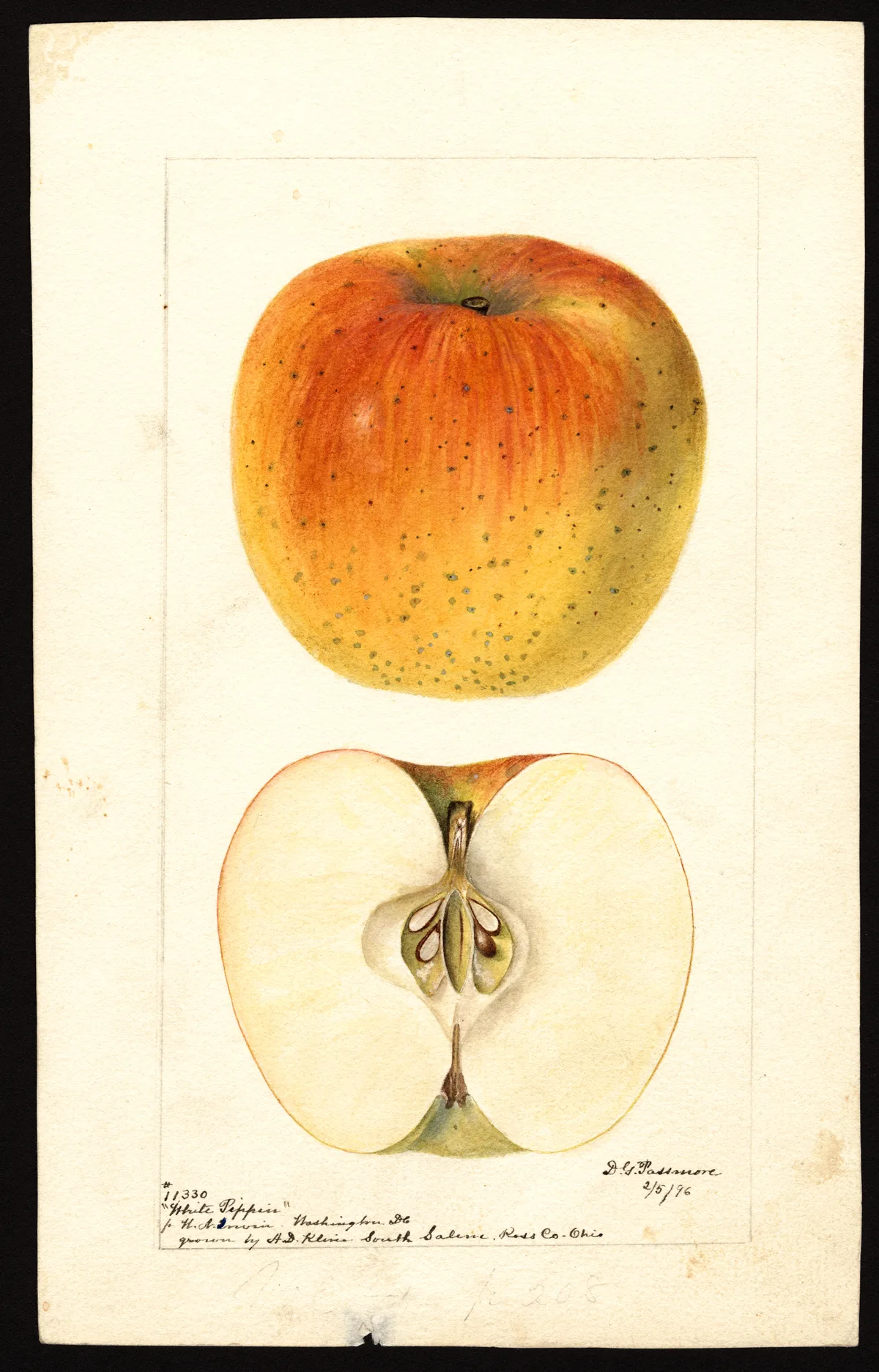
USDA Pomological Watercolor Collection
White Pippin
[NOTE: Source text may be incorrect — the Hedrick (1922) source opens with a fragment ("of Ohio and Indiana, having been brought to these states as grafts in the days of saddle-bag transportation…") and a technical description placed before the WHITE PIPPIN heading. These appear to be the end of a different variety's entry. Their details are excluded here: cavity small; stem medium to long; calyx large; basin oblique and obtuse; dots large and much elongated about the cavity; carpels mucronate; seeds large, wide and obtuse; fruit "not particularly attractive in appearance"; "a little too mild for culinary uses". Hedrick's White Pippin entry proper, beginning at the heading, is used.]
Origin / History
Origin unknown. Warder heads his description "[Of Kentucky.]" Beach quotes him: "the origin of this valuable fruit is entirely unknown, and its history can only be traced to the nursery of Silas Wharton, who may have brought it with him from the East. For a time some of our leading pomologists thought it was the Canada Reinette, but this idea has long since been relinquished, and all agree that it is sui generis, though it may have had a different name."
Elliott, having heretofore considered White Pippin identical with Canada Reinette, judged it "probably" distinct. Downing places it in the Newtown Pippin class, distinct from Canada Reinette.
The earliest of Beach's references is the Magazine of Horticulture, 1848. Hedrick says the fruits were described from old trees in 1848, so the variety "must be more than a century old."
Much grown in the Southwestern sections (Elliott) and much cultivated at the West (Downing). Thomas calls it valued at the West and Southwest, and Budd and Hansen call it popular there. Beach says it "has long been highly esteemed in some sections of Ohio and other portions of the Middle West." He adds that in Central and Western New York it generally succeeds better than either the Yellow Newtown or the Green Newtown. It has been grown to a limited extent in some portions of New York, but, "so far as we can learn," its planting there is not being extended. Beach does not recommend it for general planting in New York. Hedrick calls it most commonly grown in New York and New England. He says it is gradually passing out of cultivation, "though it would seem to be too good to be wholly lost."
Tree
Large, vigorous, strong, thrifty. Upright to upright spreading or roundish, rather dense. Hardy (Elliott); Hedrick adds healthy, and in tree character usually better than Green Newtown Pippin.
Young shoots dark clear reddish brown, downy (Downing). Beach gives the following wood characters. Twigs long to rather short, straight, moderately slender to rather stout and often very blunt; internodes short. Bark very dark brown, lightly streaked with scarf-skin, heavily pubescent. Lenticels numerous, large to medium, oval or irregular, raised, conspicuous. Buds deeply set in bark, medium to short, flat, obtuse, more or less appressed or sometimes free, pubescent.
Comes into bearing young. Productive, a regular and good bearer, cropping annually or nearly annually. Beach calls it a reliable cropper yielding moderate to good crops; Hedrick says it yields large crops almost annually. Thomas calls it "fair and productive."
Fruit
Size: Large in most accounts. Beach gives medium to large, often averaging rather large, pretty uniform in size and shape.
Form: Variable, roundish oblate to roundish oblong, flattened at the ends, slightly oblique, angular. Warder calls it globular, somewhat oblate, regular. Beach gives roundish or roundish oblate, inclined to conic, irregular or somewhat angular, sometimes symmetrical.
Stem: Short. Warder gives medium, regular, knobby; Elliott calls it varying.
Cavity: Large (Beach: medium or above), acute or approaching acuminate, deep. Moderately narrow to wide. Often wavy, sometimes lipped; Warder calls it regular. Green, surrounded or lined with green russet, partly russeted and often with a strip of russet extending out on one side.
Calyx: Small to medium, closed or nearly closed to partly open. Warder calls the eye very small, long, slender, closed. Lobes long, narrow, acuminate. Calyx tube long, narrow, elongated conical to somewhat funnel-form; stamens median to nearly basal (Beach).
Basin: Small to medium, abrupt or rather abrupt, rather narrow to moderately wide. Usually somewhat furrowed and slightly wrinkled; Warder calls it regular. Depth moderately shallow to medium in Beach, deep in Budd and Hansen.
Skin: Smooth, waxen. Green or greenish white to greenish yellow, becoming pale yellow at maturity; prevailing color yellow or green. Elliott describes light green surrounding the specks and suffused beneath the skin, yellowish green when fully ripe. Sometimes faintly or dully blushed. Beach describes it as mottled and striped with thin brownish-red or brownish-pink. Before maturity the surface toward the base is often shaded with pink or purple, with obscure wavy streaks or stripes of white (Budd and Hansen). Beach calls the general appearance good for a yellow apple.
Dots: Small, green, or characteristically whitish and submerged, or green with a fine russet point. Toward the cavity they are more scattering, larger, irregular and more often russet (Beach). Elliott calls them dark green specks. Downing adds that the ripe fruit sometimes has a few brown dots. Warder calls the dots numerous, white, rather large; Budd and Hansen call them very minute, few, brown, with green bases.
Flesh and flavor: White to yellowish white or slightly tinged with yellow. Firm, fine-grained (Beach: moderately fine-grained to a little coarse), tender, crisp, breaking (Warder), juicy.
Sprightly subacid to acid. Downing calls it rich subacid, Thomas "not very rich," and Warder simply acid. Warder, quoted by Beach, writes that "in some of its external characters it more nearly resembles the Yellow Newtown Pippin than any other fruit; but, while it lacks the high, spicy flavor of that apple, it is found to be much more profitable in the orchard." Hedrick calls Green Newtown Pippin much superior in flesh and flavor.
Quality "good" to "very good to best." Downing gives the top verdict, "very good to best," and Budd and Hansen, Hedrick, and Lowther's table give "very good." Beach rates it "good or sometimes very good," Warder "good," and Thomas "Good, but not very rich."
Core and seeds: Core small, compact (Elliott), to medium. Round, regular, closed, clasping (Warder). Beach gives it as somewhat abaxile with a hollow cylinder in the axis; cells not uniformly developed but usually symmetrical, closed or sometimes open; core lines clasping. Carpels roundish to somewhat ovate, varying to elongated and narrow, sometimes emarginate, slightly tufted (Beach).
Seeds numerous, long, pointed, angular (Warder). Beach gives small to above medium, plump, rather narrow, elongated, acuminate. Light brown through brown and medium brown to rather dark brown or dark.
Season
Winter. The recorded season runs from November into May. The most common span is December or January to March. Warder gives only December and January. Elliott gives January to May, but December to March at the South, and calls it a good keeper.
Beach gives November to May in ordinary storage, with February as the ordinary commercial limit, and says keeping quality varies considerably in different seasons. Hedrick says it keeps until February in ordinary storage, not so long as Green Newtown Pippin.
Uses
Kitchen and market; suitable for home use or general market purposes. Some New York fruit growers, Beach reports, consider it a profitable commercial variety because the fruit is large, pretty uniform, rather attractive and generally keeps pretty well.
Subtypes / Variants
Not described in source.
Other
Because of similarity in color and an oblique axis, White Pippin is often confounded with Green Newtown Pippin. Hedrick distinguishes it by its larger fruit and a blush not so well marked. Thomas illustrates it (Fig. 473). Lowther's station table gives "N. Div.: 1," "C. Div.: 8," and "S. Div.: 9," each also reported in another division.
Book Sources
Described in 8 period pomological works
- Beach, The Apples of New York Vol. 1 (1905)
- Budd & Hansen, Systematic Pomology (1914)
- Downing, Fruits and Fruit Trees of America (1900)
- Warder, American Pomology: Apples (1867)
- Elliott, The Western Fruit Book (1865)
- Lowther (ed.), Encyclopedia of Practical Horticulture (1914)
- Hedrick, Cyclopedia of Hardy Fruits (1922)
- Thomas, The American Fruit Culturist (1903)
Nursery Catalog Sources
Found in 14 catalogs (1891–1918) from Alabama, Illinois, Missouri, Oregon, Washington
- Missouri Nursery Co. , Louisiana , Missouri — 1891
- The Vineland Nurseries (Kelsey & Co. , Proprietors), St. Joseph, Missouri (Office: 13th and Atchison Sts., 2 Blocks East of the Citizens St. Car Line) — 1894
- Woodburn Nurseries , Woodburn, Marion Co. , Oregon — 1894
- J.V. Cotta (Cotta Nursery) , Carroll County , Illinois — 1898
- Central Experimental Farm , Dominion Department of Agriculture, Agassiz, British Columbia (under test; Bulletin No. 3, Second Series) — 1900 — listed as Canada Pippin
- Alabama Nursery Co. , Huntsville , Alabama — 1900
- Benjamin Buckman (personal inventory) , Farmingdale , Illinois — 1901
- Mountain Grove Nurseries (Tippin & Moore , Proprietors; Geo. T. Tippin, J. W. Tippin, J. C. Moore), Mountain Grove , Missouri — 1901
- Phoenix Nursery Company (W. E. Rossney , President; Sidney Tuttle, Vice-President), Bloomington , Illinois — 1904
- Vineland Nurseries Company , Clarkston , Washington — 1912 — listed as Canada Pippin
- Ballygreen Nurseries , Hanford , Washington — 1912
- Benjamin Buckman (personal inventory) , Farmingdale , Illinois — 1913 — listed as Canada Pippin
- Benjamin Buckman (personal inventory) , Farmingdale , Illinois — 1913
- Stark Bros. Nurseries & Orchards Co. , Louisiana , Missouri — 1918
View original book sources (8)
— F.R. Elliott, The Western Fruit Book (1865)White Pippin.
This variety we have heretofore considered identical with Canada Reinette; probably it is distinct. It is much grown in the Southwestern sections; proves hardy as a tree, productive, and is a good keeper. Tree strong, upright, vigorous grower. Fruit, large; form, roundish oblong, smooth; color, greenish yellow, with dark green specks and light green surrounding and suffused beneath skin, when fully ripe, yellowish green; stem, varying; calyx, medium; segments, long; flesh, yellowish white, crisp, tender, juicy, sprightly, sub-acid; core, small, compact; seeds, dark. January to May; December to March, at South.
— John A. Warder, American Pomology: Apples (1867)White Pippin— [Of Kentucky.]
Fruit large, globular, somewhat oblate, regular; Surface smooth, green, becoming pale yellow, sometimes faintly blushed; Dots numerous, white, rather large.
Basin small, abrupt, regular; Eye very small, long, slender, closed.
Cavity acute, regular, green; Stem medium, regular, knobby.
Core round, regular, closed, clasping; Seeds numerous, long, pointed, angular, brown; Flesh white, breaking, fine-grained, juicy; Flavor acid; Quality good; Use, market and kitchen; Season, December, January.
— A.J. Downing, The Fruits and Fruit Trees of America (1900)White Pippin.
Canada Pippin.
This Apple is much cultivated at the West, but of unknown origin. It is of the Newtown Pippin class, distinct from Canada Reinette. Tree thrifty, upright, a regular and good bearer. Young shoots dark clear reddish brown, downy.
Fruit large, form variable, roundish oblate, slightly oblique, greenish white, waxen, sprinkled with green dots, and becoming pale yellow at maturity, sometimes having a dull blush and a few brown dots. Stalk short, inserted in a large cavity, surrounded by green russet. Calyx small, nearly closed, set in an abrupt furrowed basin. Flesh white, tender, crisp, juicy, fine, rich subacid. Very good to best. Core small. January to March.
— John J. Thomas, The American Fruit Culturist (1903)White Pippin.* (Canada Pippin.) Large, roundish, oblong, flattened at ends; light greenish yellow; cavity large; basin abrupt, furrowed; flesh yellowish white, sub-acid. Good, but not very rich. Winter. Fair and productive, valued at the West and Southwest. Fig. 473.
— S.A. Beach, The Apples of New York, Vol. 1 (1905)WHITE PIPPIN.
References. 1. Mag. Hort., 14:113. 1848. 2. Emmons, Nat. Hist. N. Y., 3:85. 1851. 3. Downing, 1857:203. 4. Am. Pom. Soc. Cat., 1860. 5. Mag. Hort., 27:100. 1861. 6. Warder, 1867:647. fig. 7. Ia. Hort. Soc. Rpt., 1880:277. 8. Barry, 1883:356. 9. Lyon, Mich. Hort. Soc. Rpt., 1890:300. 10. Bailey, An. Hort., 1892:252. 11. Beach, N. Y. Sta. An. Rpt., 11:589, 596. 1892. 12. Ib., E. N. Y. Hort. Soc. Rpt., 1900:44. 13. Ib., W. N. Y. Hort. Soc. Rpt., 1900:37. 14. Brackett, Amer. Gard., 22:191. 1901. 15. Budd-Hansen, 1903:202. fig. 16. Bruner, N. C. Sta. Bul., 182:23. 1903. 17. Powell and Fulton, U. S. B. P. I. Bul., 48:60. 1903. 18. Beach and Clark, N. Y. Sta. Bul., 248:150. 1904.
Synonym. Canada Pippin (3).
Fruit medium to large, often averaging rather large. The general appearance is good for a yellow apple. It is suitable for home use or for general market purposes. In ordinary storage it is in season from November to May with February as the ordinary commercial limit. It varies considerably in keeping qualities in different seasons (18). Warder (6) observes that "in some of its external characters it more nearly resembles the Yellow Newtown Pippin than any other fruit; but, while it lacks the high, spicy flavor of that apple, it is found to be much more profitable in the orchard." It has long been highly esteemed in some sections of Ohio and other portions of the Middle West. In Central and Western New York it generally succeeds better than does either the Yellow Newtown or the Green Newtown. The tree is a good thrifty grower, comes into bearing young and is a reliable cropper, yielding moderate to good crops annually or nearly annually. Some New York fruit growers consider it a profitable commercial variety because the fruit is large, pretty uniform, rather attractive and generally keeps pretty well. It is not recommended for general planting in New York.
Historical. Warder remarks that "the origin of this valuable fruit is entirely unknown, and its history can only be traced to the nursery of Silas Wharton, who may have brought it with him from the East. For a time some of our leading pomologists thought it was the Canada Reinette, but this idea has long since been relinquished, and all agree that it is sui generis, though it may have had a different name." It has been grown to a limited extent in some portions of New York, but, so far as we can learn, its planting is not being extended.
Tree.
Tree large, vigorous. Form upright spreading to roundish, rather dense. Twigs long to rather short, straight, moderately slender to rather stout and often very blunt; internodes short. Bark very dark brown, lightly streaked with scarf-skin, heavily pubescent. Lenticels numerous, large to medium, oval or irregular, raised, conspicuous. Buds deeply set in bark, medium to short, flat, obtuse, more or less appressed or sometimes free, pubescent.
Fruit.
Fruit medium to large, often averaging rather large, pretty uniform in size and shape. Form roundish or roundish oblate, inclined to conic, irregular or somewhat angular, sometimes symmetrical. Stem short. Cavity medium or above, acute or approaching acuminate, deep, moderately narrow to rather wide, often wavy, sometimes lipped, partly russeted and often with a strip of russet extending out on one side. Calyx small to medium, closed or partly open; lobes long, narrow, acuminate. Basin small to medium, moderately shallow to medium in depth, rather narrow to moderately wide, rather abrupt, usually somewhat furrowed and slightly wrinkled.
Skin pale yellow or greenish, sometimes blushed, mottled and striped with thin brownish-red or brownish-pink. Dots small, characteristically whitish and submerged, or green with fine russet point. They are more scattering, larger, irregular and more often russet toward the cavity. Prevailing color yellow or green.
Calyx tube long, narrow, elongated conical to somewhat funnel-form. Stamens median to nearly basal.
Core small to medium, somewhat abaxile with hollow cylinder in the axis; cells not uniformly developed but usually symmetrical, closed or sometimes open; core lines clasping. Carpels roundish to somewhat ovate varying to elongated and narrow, sometimes emarginate, slightly tufted. Seeds small to above medium, plump, rather narrow, elongated, acuminate, medium brown to rather dark brown.
Flesh slightly tinged with yellow, firm, moderately fine-grained to a little coarse, tender, crisp, juicy, sprightly subacid, good or sometimes very good.
— J.L. Budd & N.E. Hansen, American Horticultural Manual, Part II: Systematic Pomology (1914)White Pippin. — Of unknown origin, popular at the West and Southwest. Of the Newtown Pippin class, and distinct from the Canada Reinette. Tree vigorous, upright, productive.
Fruit large, variable in form, roundish oblate, angular, slightly oblique, sometimes roundish oblong, flattened at ends; surface greenish white to pale yellow when ripe, waxen, sometimes with dull blush, before maturity the surface toward the base often shaded with pink or purple, with obscure wavy streaks or stripes of white; dots very minute, few, brown, with green bases; cavity wide, deep, wavy, lined with green and russet; stem short; basin deep, abrupt, furrowed; calyx small, nearly closed. Core small, closed, clasping; seeds many, angular, light brown, pointed; flesh yellowish white, tender, crisp, juicy, rich subacid to acid, very good. December to March.
— Granville Lowther (ed.), Encyclopedia of Practical Horticulture (1914)White Pippin. Size: large. Form: roundish (oblate). Color: greenish yellow. Quality: very good. Use: both kitchen and market. Season: winter. N. Div.: 1 (also reported in another division). C. Div.: 8 (also reported in another division). S. Div.: 9 (also reported in another division).
— U.P. Hedrick, Cyclopedia of Hardy Fruits (1922)of Ohio and Indiana, having been brought to these states as grafts in the days of saddle-bag transportation. It is thought to be an old sort renamed, but what it is no one knows. The apples are very good to best in quality, a little too mild for culinary uses, not particularly attractive in appearance, neither shape nor color appealing to the eye. Its cultivation is largely confined to the states mentioned, though it has been somewhat planted in the Far West.
Tree vigorous, spreading. Fruit medium to large, uniform in size, round-oblate, round or oblong-conic, ribbed, symmetrical; stem medium to long; cavity small, acute, deep, narrow, furrowed, sometimes russeted; calyx large, usually closed; lobes long, acute; basin small, oblique, shallow, obtuse, often distinctly furrowed, wrinkled, pubescent; skin tough, smooth, waxen, pale yellow, with a shade of brownish-red; dots numerous, pale or russet, often submerged, usually large and much elongated about the cavity; calyx-tube long, conical; core medium to large; cells closed or partly open; core-lines clasping; carpels flat, broad or round-cordate, emarginate, mucronate, tufted; seeds light brown, large, wide, plump, obtuse, tufted; flesh yellow, firm, fine-grained, crisp, tender, juicy, mild subacid, sprightly, pleasantly aromatic; good to best; December to March.
WHITE PIPPIN. Canada Pippin. Because of similarity in color and in having an oblique axis, fruits of this variety are often confounded with those of Green Newtown Pippin, but here the similarities end; for, in flesh and flavor, the last-named apple is much superior, while in tree-character White Pippin is usually the better. The fruits of White Pippin are larger, and the blush is not so well marked, nor do they keep so long. The apples are yellow with a sprightly, subacid, very good flavor, keeping until February in ordinary storage. The trees are thrifty, bear young, are hardy and healthy, and yield large crops almost annually. The variety is gradually passing out of cultivation, though it would seem to be too good to be wholly lost. Its origin is not known, but since the fruits were described from old trees in 1848, it must be more than a century old. It is most commonly grown in New York and New England.
Tree large, vigorous, upright-spreading, dense. Fruit medium to large, uniform in size and shape, round or round-oblate, irregular or angular, sometimes symmetrical; stem short; cavity large, acute, deep, narrow, often wavy, sometimes lipped, partly russeted and often with a strip of russet extending out on one side; calyx small, closed or partly open; lobes long, narrow, acuminate; basin small, shallow, narrow, abrupt, usually furrowed and wrinkled; skin pale yellow, sometimes blushed, mottled and striped with thin brownish-red; dots small, characteristically white and submerged, or green with fine russet point, scattering, large, irregular and russeted toward the cavity; prevailing effect yellow; calyx-tube long, narrow, elongated conical; stamens median; core small, abaxile with hollow cylinder in the axis; cells not uniformly developed but usually symmetrical, closed or open; core-lines clasping; carpels round to ovate or elongated and narrow, sometimes emarginate, tufted; seeds small, plump, narrow, elongated, acuminate, brown to dark brown; flesh yellow, firm, fine-grained, tender, crisp, juicy, sprightly subacid; good or very good; November to April.