Jersey Black
Apple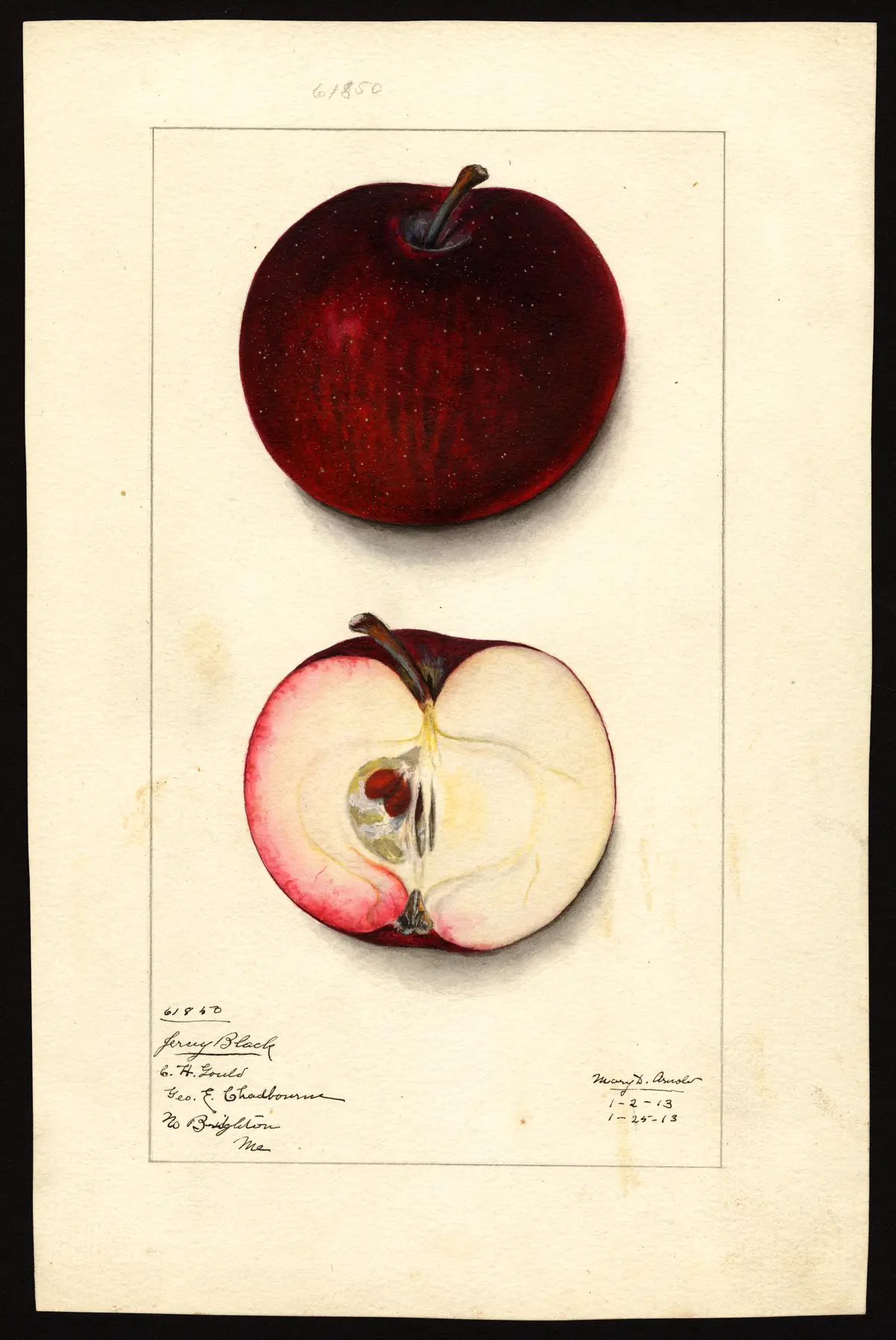
USDA Pomological Watercolor Collection
Jersey Black
Origin/History
Origin unknown. Warder (1867) supposes the variety was introduced into the West by Silas Wharton of Warren County, Ohio, as it is found growing alongside the White Pippin and other sorts of his introduction, and appears in his published list. Warder notes the variety "has extended its way quietly through the country, along the parallels 40° to 42°, without ever having had any extra puffing, such as has given notoriety to some of its competitors for places in the orchard. Nobody speaks about this apple, nor writes about it, and yet it is everywhere to be found." Warder questions whether this is the same as the Black Apple described by Coxe and Downing, noting it is "quite different in some of its strong characters."
Tree
Sufficiently vigorous but does not grow large. Spreading habit; older trees often drooping. Branches open. Always fruitful, bearing either a well-distributed light crop or a crowded full one (Warder). Thomas confirms: vigorous but not large; spreading and productive.
Fruit
Size and Form: Full medium in size, round, angular and irregular, sometimes ribbed (Warder). Thomas describes it as medium, round, and somewhat irregular.
Stem: Short to long, usually stout, sometimes knobbed (Warder). Thomas notes the stalk as variable.
Cavity: Deep, acute, brown, often wavy or folded (Warder). Thomas confirms the cavity as deep.
Calyx: Eye small to medium, closed (Warder). Not described by Thomas.
Basin: Mostly shallow, folded and plaited (Warder; confirmed by Thomas).
Skin: Surface smooth, completely covered with deep red, striped darker, giving a purple, almost black hue to the fruit; often covered with a thin bloom (Warder). Thomas describes the coloring as striped blackish red on lighter red.
Dots: Numerous, minute, indented, purple (Warder). Thomas notes numerous small dots.
Flesh and Flavor: Flesh yellow, crisp, fine-grained, juicy; often stained pink or reddish (Warder). Thomas confirms yellow, crisp, juicy flesh, often stained. Flavor rich, mild sub-acid, aromatic, not spicy, satisfying (Warder); Thomas describes it as mild sub-acid and agreeable. Quality good.
Core and Seeds: Core medium, regular, generally closed, clasping the eye. Seeds numerous, short, plump, pointed, dark (Warder). Not described by Thomas.
Season
December and January; keeps sound (Warder). Thomas places it in early winter.
Uses
Table, kitchen, cider, and for stock (Warder). A good market apple (Warder); Thomas calls it "a valuable market apple at the West."
Subtypes/Variants
Warder distinguishes one variant strain: "one variety is always lighter, stripes more distinct, and the flesh more stained."
Other
The Encyclopedia of Practical Horticulture (Lowther, 1914) lists Jersey Black in a variety-characteristic table without prose description:
Jersey Black.... M fl dr G f
Book Sources
Described in 3 period pomological works
USDA Nomenclature (1905)
From W.H. Ragan, Nomenclature of the Apple, USDA Bulletin No. 56
Possibly identical with: Black
View original book sources (3)
— John A. Warder, American Pomology: Apples (1867)Jersey Black.
BLACK APPLE of Coxe ?
This admirable but unpretending fruit has extended its way quietly through the country, along the parallels 40° to 42°, without ever having had any extra puffing, such as has given notoriety to some of its competitors for places in the orchard. Nobody speaks about this apple, nor writes about it, and yet it is everywhere to be found. This cannot be the Black Apple of Coxe and Downing, being quite different in some of its strong characters. Origin unknown, supposed to have been introduced into the West by Silas Wharton, of Warren County, Ohio, as it is found with the White Pippin and other favorite sorts of his introduction, and is in his published list.
Tree sufficiently vigorous, but does not grow large, spreading, often drooping when old, branches open, always fruitful, either well distributed in a light crop, or crowded in a full one.
Fruit full medium, round, angular and irregular, sometimes ribbed; Surface smooth, completely covered with deep red, striped darker, giving a purple, almost black hue to the fruit, often covered with a thin bloom; one variety is always lighter, stripes more distinct, and the flesh more stained; Dots numerous, minute, indented, purple.
Basin mostly shallow, folded and plaited; Eye small to medium, closed.
Cavity deep, acute, brown, often wavy or folded; Stem short, medium or long, usually stout, sometimes knobbed.
Core medium, regular, generally closed, clasping the eye; Seeds numerous, short, plump, pointed, dark; Flesh yellow, crisp, fine-grained, juicy, often stained pink or reddish; Flavor rich, mild sub-acid, aromatic, not spicy, satisfying; Quality good; Use, table, kitchen, cider and for stock; Season, December, January; keeps sound. A good market apple.
— Granville Lowther (ed.), Encyclopedia of Practical Horticulture (1914)Jersey Black.... M fl dr G f
— John J. Thomas, The American Fruit Culturist (1903)Jersey Black. Size medium, round, somewhat irregular; striped blackish red on lighter red, with numerous small dots; flesh often stained; stalk variable, cavity deep; basin shallow, plaited; flesh yellow, crisp, juicy, mild sub-acid, agreeable. Early winter. Tree vigorous, but does not grow large; spreading, productive. A valuable market apple at the West.