Black Apple
Apple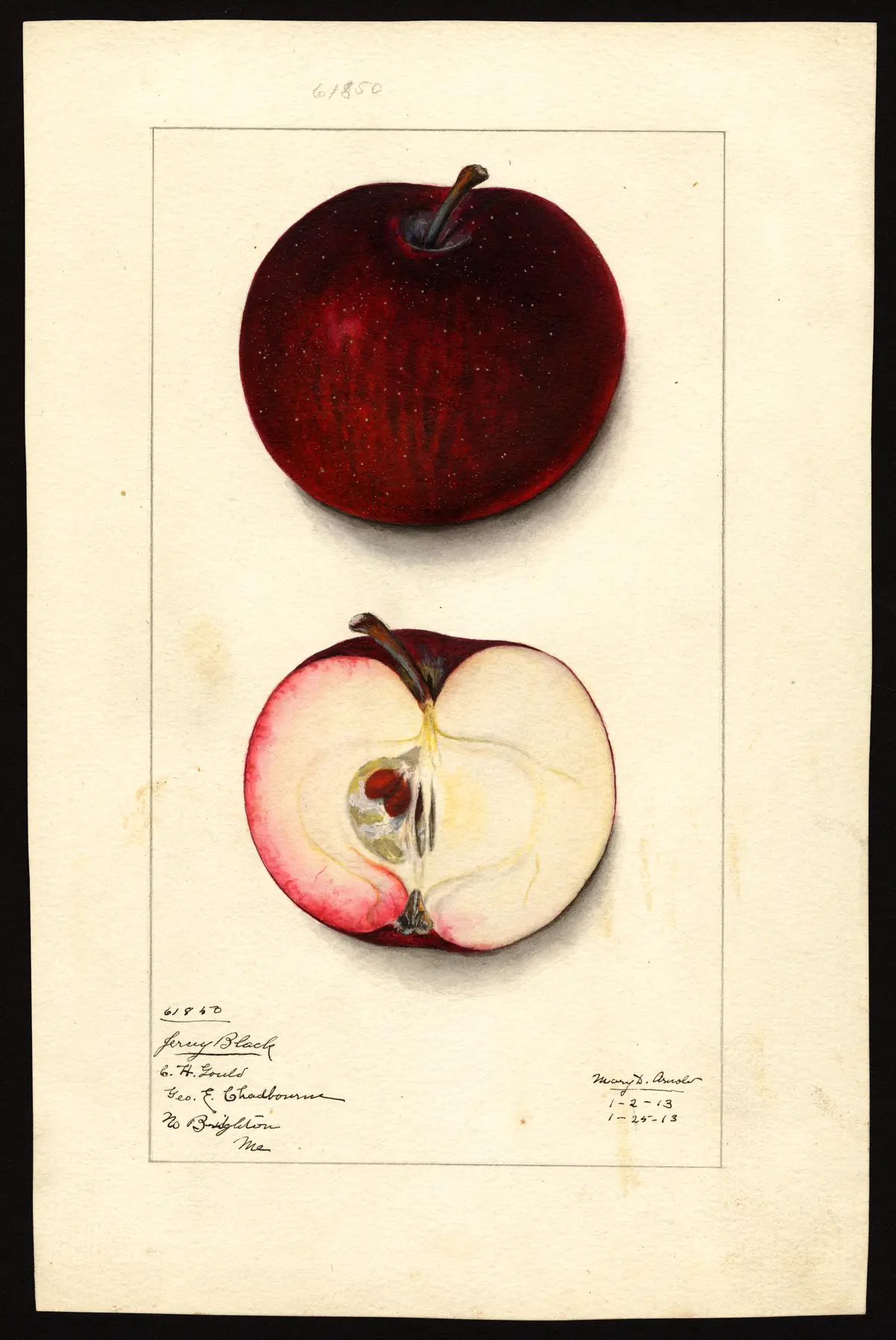
USDA Pomological Watercolor Collection
Black Apple
Origin/History
Black Apple is an old American variety, first described and put out by Coxe (1817) as variety No. 67. By the time of Downing's account it was found in many sections of the country. Warder notes that it is found in many collections where the Jersey Black is cultivated, but considers it quite distinct from that variety. Origin is unknown.
Tree
The tree is of moderate size, healthy, a moderate grower, forming a medium-sized, spreading round head with drooping limbs. Coxe describes it as a great and constant bearer.
Fruit
Size
Sources differ slightly: Coxe describes the size as below middling; Warder gives medium to small; Downing gives medium.
Form
Coxe describes the form as round but flat at the ends. Warder gives globular, sometimes nearly oblate, regular. Downing gives roundish oblate.
Stem
Half an inch long (Coxe), or long and inclined, red or green (Warder). Planted deep in the cavity.
Cavity
Acute, sometimes lipped, brown (Warder). Coxe's description of the stem as "planted deep" is consistent with an acute cavity.
Calyx / Eye
The crown is not much hollowed (Coxe). Eye small to medium, closed; segments reflexed (Warder).
Basin
Shallow, abrupt, regular or folded (Warder). Coxe's "crown not much hollowed" is consistent.
Skin
Smooth, of a deep red approaching to blackness, with a down or bloom that obscures its brightness until rubbed off (Coxe, corroborated by Downing's "deep red, with a bloom"). Warder describes the surface as smooth, deep red, sometimes purplish, with striping indistinct; dots numerous, indented, minute, pink or purple.
Flesh / Flavor
Sources disagree on flesh color and richness. Coxe describes the flesh as yellow, rich, juicy, crisp, and well tasted. Warder gives the flesh as yellowish, often pink, tender, and fine-grained, with flavor sub-acid and agreeable, quality good. Downing gives the flesh as white, sometimes slightly stained with pinkish red, and characterizes the fruit as a pleasant table fruit, though "not of high or rich flavor" — a direct contrast to Coxe's assessment of richness.
Core / Seeds
Core regular, round, slightly open, clasping the eye. Seeds numerous, plump and angular (Warder).
Season
Ripens in November (Coxe). Season November to January (Warder) or November to February (Downing). Coxe notes it keeps well.
Uses
Dessert and table fruit. Coxe considers it "much admired as a fine table fruit." Downing calls it "a pleasant table fruit, although not of high or rich flavor."
Subtypes / Variants
Not described in source.
Other
Warder notes that Black Apple is found in many collections alongside the Jersey Black but "seems to be quite distinct" from it, despite the shared cultivar context and overlapping synonymy in Downing's listing.
Book Sources
Described in 3 period pomological works
View original book sources (3)
— William Coxe, A View of the Cultivation of Fruit Trees (1817)NO. 67. BLACK APPLE.
The size is below middling; the form round, but flat at the ends, the stem half an inch long, planted deep, the crown not much hollowed; the skin smooth, of a deep red—approaching to blackness, with a down which obscures its brightness till rubbed off: the flesh is yellow, rich, juicy, crisp, and well tasted—it ripens in November, and is much admired as a fine table fruit, which keeps well—the tree is of moderate size, the growth spreading, with drooping limbs—it is a great and constant bearer.
— John A. Warder, American Pomology: Apples (1867)SMALL BLACK.
BLACK APPLE of Coxe and Downing— American black.
This useful little apple is found in many collections where the Jersey Black is cultivated, but it seems to be quite distinct. Origin unknown.
Fruit medium to small, globular, sometimes nearly oblate, regular; Surface smooth, deep red, sometimes purplish, striping indistinct; Dots numerous, indented, minute, pink or purple.
Basin shallow, abrupt, regular or folded; Eye small to medium, closed; Segments reflexed.
Cavity acute, sometimes lipped, brown; Stem long, inclined, red or green.
Core regular, round, slightly open, clasping the eye; Seeds numerous, plump and angular; Flesh yellowish, often pink, tender, fine grained; Flavor sub-acid, agreeable; Quality good; Use, dessert; Season, November to January.
— A.J. Downing, The Fruits and Fruit Trees of America (1900)Black Apple.
Small Black. Jersey Black. Black American.
An old variety, described and put out by Coxe, and now found in many sections. The trees are healthy, moderate growers, forming medium-sized, spreading round heads, with drooping limbs. It is a pleasant table fruit, although not of high or rich flavor.
Fruit medium. Form roundish oblate, deep red, with a bloom. Flesh white, sometimes slightly stained with pinkish red. Good. November to February.