Cheeseboro
Apple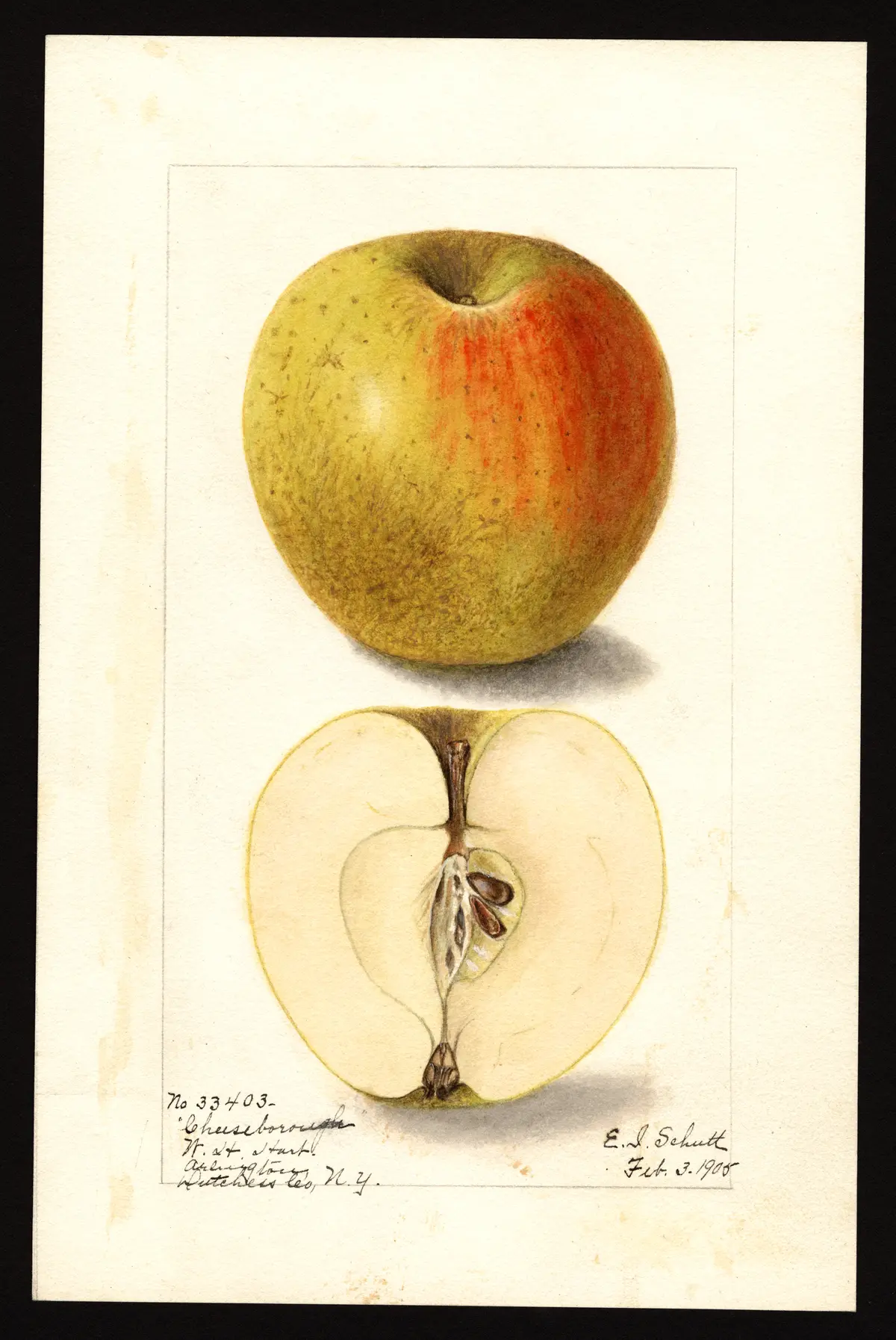
USDA Pomological Watercolor Collection
Cheeseboro
Origin / History
Cheeseboro is an old variety of unknown origin (Beach). Beach describes it as fast becoming obsolete; Warder records it expressly "to be avoided." Elliott calls it American. It appears in pomological literature from at least 1851 (Magazine of Horticulture; Emmons, Natural History of New York). Both Warder and Downing characterize it as an old fruit of little value.
Tree
Beach: tree large to very large, very vigorous, long-lived; a reliable cropper yielding good to heavy crops biennially or almost annually; form upright spreading or roundish. Bark, twigs, lenticels, buds, and leaves not described in source.
Fruit
Size: Large (Warder, Downing, Elliott, Thomas); large to very large (Beach). Warder describes it as one of the largest of the russet apples.
Form: Conical and regular (Warder); conical (Downing, Beach, Elliott, Thomas).
Stem: Short (Warder).
Cavity: Pointed and regular (Warder).
Calyx (Eye): Large, closed (Warder).
Basin: Irregular, green (Warder).
Skin: Surface dull green, overspread with thin russet (Warder); Warder adds the russet is "more" southward (i.e., more developed in southern growing conditions). Downing: green russet. Beach: dull green overspread with thin russet. Elliott: thin russet on greenish yellow. Thomas: greenish russet. Warder notes the fruit is fair (free of blemish).
Flesh / Flavor: Flesh green, breaking, coarse, often dry (Warder); coarse, rather dry (Beach); greenish white, coarse, dry (Elliott); coarse, dry (Downing). Flavor acid or sub-acid, not rich (Warder); subacid or becoming almost sweet (Beach); mild, subacid, almost sweet (Downing); sub-acid (Elliott, Thomas). Quality poor and inferior — Warder rates the quality poor and calls it one of the poorest of the russet apples; Beach calls it inferior in flavor and quality; Downing rates it poor; Thomas calls it of little value.
Core / Seeds: Core large, closed, clasping; seeds long, pointed, angular (Warder).
Season
October and November (Downing, Elliott); November and December (Warder); October to early winter (Beach); autumn (Thomas).
Uses
Suitable for kitchen use only (Warder, Beach). Warder considers it unworthy of cultivation.
Subtypes / Variants
Not described in source.
Other
Not described in source.
Book Sources
Described in 5 period pomological works
- Beach, The Apples of New York Vol. 2 (1905)
- Warder, American Pomology: Apples (1867) — listed as Cheesborough
- Downing, Fruits and Fruit Trees of America (1900) — listed as Cheeseborough Russet
- Elliott, The Western Fruit Book (1865) — listed as Cheesborough Russet
- Thomas, The American Fruit Culturist (1903) — listed as Cheeseborough Russet
Nursery Catalog Sources
Found in 4 catalogs (1850–1913) from Illinois, Massachusetts
- Azell Bowditch (Nursery / Fruit Catalog) , Boston , Massachusetts — 1850 — listed as Cathead
- Central Experimental Farm , Dominion Department of Agriculture, Agassiz, British Columbia (under test; Bulletin No. 3, Second Series) — 1900 — listed as Cathead
- Benjamin Buckman (personal inventory) , Farmingdale , Illinois — 1901 — listed as Cathead
- Benjamin Buckman (personal inventory) , Farmingdale , Illinois — 1913 — listed as Cathead
View original book sources (5)
— John A. Warder, American Pomology: Apples (1867)Cheesborough.
This is one of the largest and one of the poorest of the Russet apples, and unworthy of cultivation; on that account put upon record to be avoided.
Fruit large and fair, conical, regular; Surface dull green, overspread with thin russet, or more southward.
Basin irregular, green; Eye large, closed.
Cavity pointed, regular; Stem short.
Core large, closed, clasping; Seeds long, pointed, angular; Flesh green, breaking, coarse, often dry; Flavor acid or sub-acid, not rich; Quality poor; Use, kitchen only; Season, November and December.
— A.J. Downing, The Fruits and Fruit Trees of America (1900)Cheeseborough Russet.
Pumpkin Sweet of some. Kingsbury Russet. Forever Pippin. Cheeseboro. Howard Russet. York Russet. Sweet Russet.
An old fruit of little value, large, conical, green russet. Flesh coarse, dry, mild, subacid, almost sweet. Poor. October, November.
— S.A. Beach, The Apples of New York, Vol. 2 (1905)CHEESEBORO
REFERENCES. 1. Mag. Hort., 17:263. 1851. 2. Emmons, Nat. Hist. N. Y., 3: col. pl. No. 20. 1851. 3. Elliott, 1854:168. 4. Downing, 1857:211. 5. Hooper, 1857:25. 6. Am. Pom. Soc. Rpt., 1860:243. 7. Warder, 1867:522. 8. Thomas, 1875:496. 9. Waugh, Vt. Sta. An. Rpt., 14:291. 1901. 10. Ragan, U. S. B. P. I. Bul. 56:70. 1905.
SYNONYMS. Canada Reinette (9). Cathead (9). CHEESEBORO (10). CHEESEBORO'S RUSSET (6). CHEESBOROUGH (7). CHEESEBOROUGH (2, 9). CHEESEBOROUGH RUSSET (1, 3, 4, 5, 8). Cheeseborough Russet (9, 10). Forever Pippin (10, of some 3, 5). Howard Russet (3, 4, 5, 10). Kingsbury Russet (3, 4, 5, 10). Oxheart (9). Pumpkin Sweet of some (10). Sweet Russet (10). York Russet (10, of some 3, 5). York Russeting (10).
This is an old variety of unknown origin which is fast becoming obsolete. Tree large to very large, very vigorous, long-lived, a reliable cropper yielding good to heavy crops biennially or almost annually; form upright spreading or roundish. Fruit large to very large, conical, dull green overspread with thin russet, coarse, rather dry, subacid or becoming almost sweet, inferior in flavor and quality, suitable for kitchen use only; season October to early winter.
— F.R. Elliott, The Western Fruit Book (1865)Cheesborough Russet. Howard Russet, | York Russet, of some, Kingsbury Russet, | Forever Pippin, of some. West. American. Large, conical, thin russet on greenish yellow; flesh, greenish white, coarse, dry, sub-acid. October, November.
— John J. Thomas, The American Fruit Culturist (1903)Cheeseborough Russet. Large, conical, greenish russet; sub-acid. Of little value. Autumn.