Priestly
Apple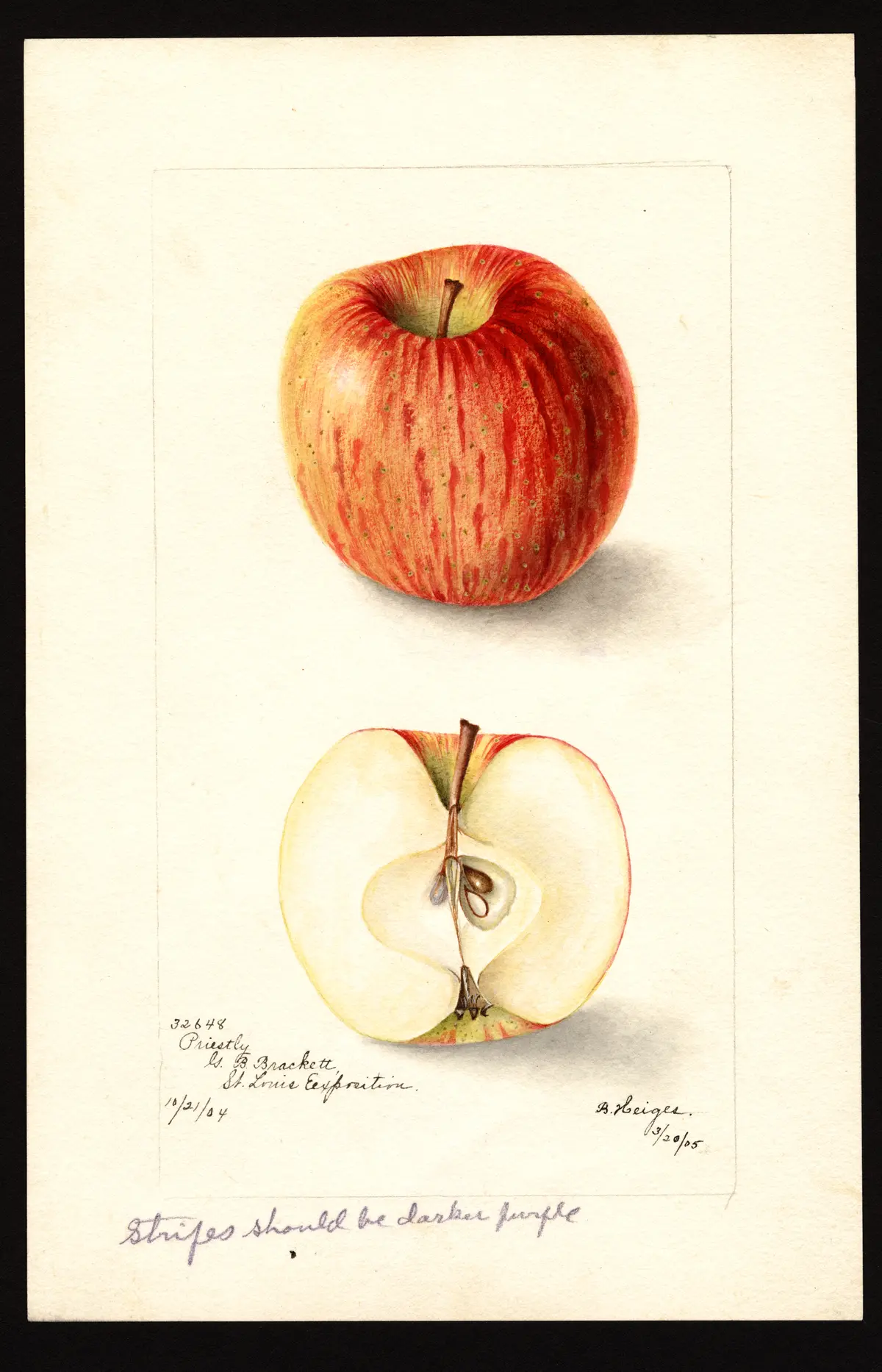
USDA Pomological Watercolor Collection
Priestly
Origin / History
Priestly is a native of Bucks County, Pennsylvania, where it was first cultivated by a person from whom it has obtained its name (Coxe, 1817; Downing, 1900; Thomas, 1903). Beach (1905) cites references going back to Coxe in 1817, including Thacher (1822), Buel (1826), Wilson (1828), Kenrick (1832), Downing (1845), the Horticulturist (1848), Emmons (1851), Elliott (1854), Hooper (1857), and Warder (1867).
Tree
The tree has a handsome, upright form, with vigorous growth and large leaves; it is well suited to light soils (Coxe, 1817). Downing (1900) likewise describes the tree as vigorous, upright, and productive. Beach (1905) characterizes it as a pretty vigorous grower, hardy, healthy, long-lived, and one that commonly bears good crops annually. The fruit hangs well to the tree (Beach, 1905), or, as Coxe puts it, hangs late on the tree, and the tree is an abundant bearer (Coxe, 1817).
Fruit
Size
Sources vary slightly: Coxe (1817), Elliott (1865), and Downing (1900) describe the fruit as large; Thomas (1903) calls it medium; Beach (1905) gives it as large to medium, also describing it as medium to large.
Form
Roundish oblong (Elliott, 1865; Downing, 1900; Thomas, 1903), or oblong (Coxe, 1817). Beach (1905) specifies the form as roundish oblate to roundish oblong, usually quite regular and symmetrical.
Stem
Long, usually rather slender (Beach, 1905).
Cavity
Acute to acuminate, moderately deep to very deep, broad, russeted and with outspreading russet rays, sometimes faintly furrowed (Beach, 1905).
Calyx
Large, usually closed, sometimes partly open; lobes connivent, erect or reflexed, broad, acute (Beach, 1905).
Basin
Very shallow to moderately deep, wide, obtuse or somewhat abrupt, distinctly furrowed and wrinkled (Beach, 1905).
Skin
Smooth (Coxe, 1817; Downing, 1900), the color usually a dull red, streaked faintly with green, with spots of the same color (Coxe, 1817). Downing (1900) describes it as smooth, dull red, with small streaks of yellowish green. Elliott (1865) gives dull red with streaks of yellowish green. Thomas (1903) calls it striped dull red. Beach (1905) describes the skin as tough, smooth, green or yellow washed and blushed with red and inconspicuously striped with dark carmine; highly colored specimens are nearly covered with deep red. Beach also notes more generally that the fruit is blushed or faintly striped with red.
Dots
Rather numerous toward the basin, larger and more scattering toward the cavity, gray or russet (Beach, 1905).
Flesh and Flavor
The flesh is white (Coxe, 1817; Downing, 1900), with Elliott (1865) giving greenish white, and Beach (1905) yellowish. Beach further describes it as firm, rather coarse, crisp, juicy, agreeably mild subacid, somewhat aromatic, medium to good in quality. Downing (1900) calls the flesh moderately juicy, with a spicy, agreeable flavor, but rates the quality as "hardly good." Coxe (1817) notes a pleasant spicy taste and considers it an excellent table and kitchen apple. Thomas (1903) describes it as spicy, good. Elliott (1865) terms the flesh inferior. Beach (1905) summarizes that although it ranks only fair to good in quality, it is an agreeable dessert apple — especially in the spring, when it is fresh, juicy, and mildly subacid — and is less desirable for culinary uses because it lacks acidity.
Core and Seeds
Calyx tube rather wide, conical. Stamens median or below. Core medium to small, axile; cells symmetrical, closed; core lines meeting or clasping. Carpels roundish, emarginate. Seeds large, wide, flat, obtuse to somewhat acute, very dark brown (Beach, 1905).
Season
December to March (Elliott, 1865; Downing, 1900). Winter (Thomas, 1903). December to April (Beach, 1905).
Uses
An excellent table and kitchen apple; also makes good cider late in the season, but not of the first quality (Coxe, 1817). Beach (1905) considers it an agreeable dessert apple, particularly in the spring, but less desirable for culinary uses because it lacks acidity. Beach concludes that it is surpassed by standard varieties of its season and is not recommended for planting.
Subtypes / Variants
Not described in source.
Other
Not described in source.
Book Sources
Described in 5 period pomological works
View original book sources (5)
— William Coxe, A View of the Cultivation of Fruit Trees (1817)NO. 79. PRIESTLY.
This apple is said to be a native of the county of Bucks in Pennsylvania, where it was first cultivated by a person from whom it has obtained its name. The tree has a handsome, upright form, vigorous growth, and large leaves; it is well suited to light soils: the fruit is large, of an oblong form; the skin smooth, the colour usually a dull red, streaked faintly with green, with spots of the same colour: the flesh is white, has a pleasant spicy taste; it is an excellent table and kitchen apple; hangs late on the tree; is an abundant bearer, and makes good cider late in the season, but not of the first quality.
— F.R. Elliott, The Western Fruit Book (1865)Priestley. Priestley's American, | Red Cathead. Large, roundish oblong, dull red, streaks of yellowish green; flesh, greenish white, inferior. December to March.
[Additional entry in this volume: "Priestly", pp. 196–196]
Priestley. Priestley's American, | Red Cathead. Large, roundish oblong, dull red, streaks of yellowish green; flesh, greenish white, inferior. December to March.
— A.J. Downing, The Fruits and Fruit Trees of America (1900)Priestly. Priestley's American. Origin, Pennsylvania. Tree vigorous, upright, and productive. Fruit large, roundish oblong, smooth, dull red, with small streaks of yellowish green. Flesh white, moderately juicy, with a spicy, agreeable flavor. Hardly good. December to March.
— John J. Thomas, The American Fruit Culturist (1903)Priestley. Medium, roundish oblong, striped dull red; spicy, good. Winter. Pa.
[Additional entry in this volume: "Priestly", pp. 738–738]
Priestley. Medium, roundish oblong, striped dull red; spicy, good. Winter. Pa.
— S.A. Beach, The Apples of New York, Vol. 1 (1905)PRIESTLY.
REFERENCES. 1. Coxe, 1817:146. fig. 2. Thacher, 1822:132. 3. Buel, N. Y. Bd. Agr. Mem., 1826:476. 4. Wilson, 1828:136. 5. Kenrick, 1832:51. 6. Downing, 1845:126. 7. Horticulturist, 2:483. 1848. 8. Emmons, Nat. Hist. N. Y., 3:72. 1851. 9. Elliott, 1854:176. 10. Hooper, 1857:72. 11. Warder, 1867:729.
SYNONYMS. PRIESTLEY (3, 5, 10). Priestley's American (6, 9). Red Cathead (9).
Fruit medium to large, blushed or faintly striped with red. Although it ranks only fair to good in quality it is an agreeable dessert apple especially in the spring when it is fresh, juicy and mildly subacid. It is less desirable for culinary uses because it lacks acidity. The tree is a pretty vigorous grower, hardy, healthy, long-lived and commonly bears good crops annually. The fruit hangs well to the tree. It is surpassed by standard varieties of its season and is not recommended for planting.
The following is Coxe's description of this variety: "This apple is said to be a native of the county of Bucks in Pennsylvania, where it was first cultivated by a person from whom it has obtained its name. The tree has a handsome, upright form, vigorous growth, and large leaves; it is well suited to light soils—the fruit is large, of an oblong form—the skin smooth, the colour usually a dull red, streaked faintly with green, with spots of the same colour; the flesh is white, has a pleasant spicy taste—it is an excellent table and kitchen apple; hangs late on the tree; is an abundant bearer, and makes good cider late in the season, but not of the first quality."
FRUIT.
Fruit large to medium. Form roundish oblate to roundish oblong, usually quite regular and symmetrical. Stem long, usually rather slender. Cavity acute to acuminate, moderately deep to very deep, broad, russeted and with outspreading russet rays, sometimes faintly furrowed. Calyx large, usually closed, sometimes partly open; lobes connivent, erect or reflexed, broad, acute. Basin very shallow to moderately deep, wide, obtuse or somewhat abrupt, distinctly furrowed and wrinkled. Skin tough, smooth, green or yellow washed and blushed with red and inconspicuously striped with dark carmine; highly colored specimens are nearly covered with deep red. Dots rather numerous toward basin, larger and more scattering toward cavity, gray or russet. Calyx tube rather wide, conical. Stamens median or below. Core medium to small, axile; cells symmetrical, closed; core lines meeting or clasping. Carpels roundish, emarginate. Seeds large, wide, flat, obtuse to somewhat acute, very dark brown.
Flesh yellowish, firm, rather coarse, crisp, juicy, agreeable mild subacid, somewhat aromatic, medium to good in quality.
Season December to April.