Catshead
Apple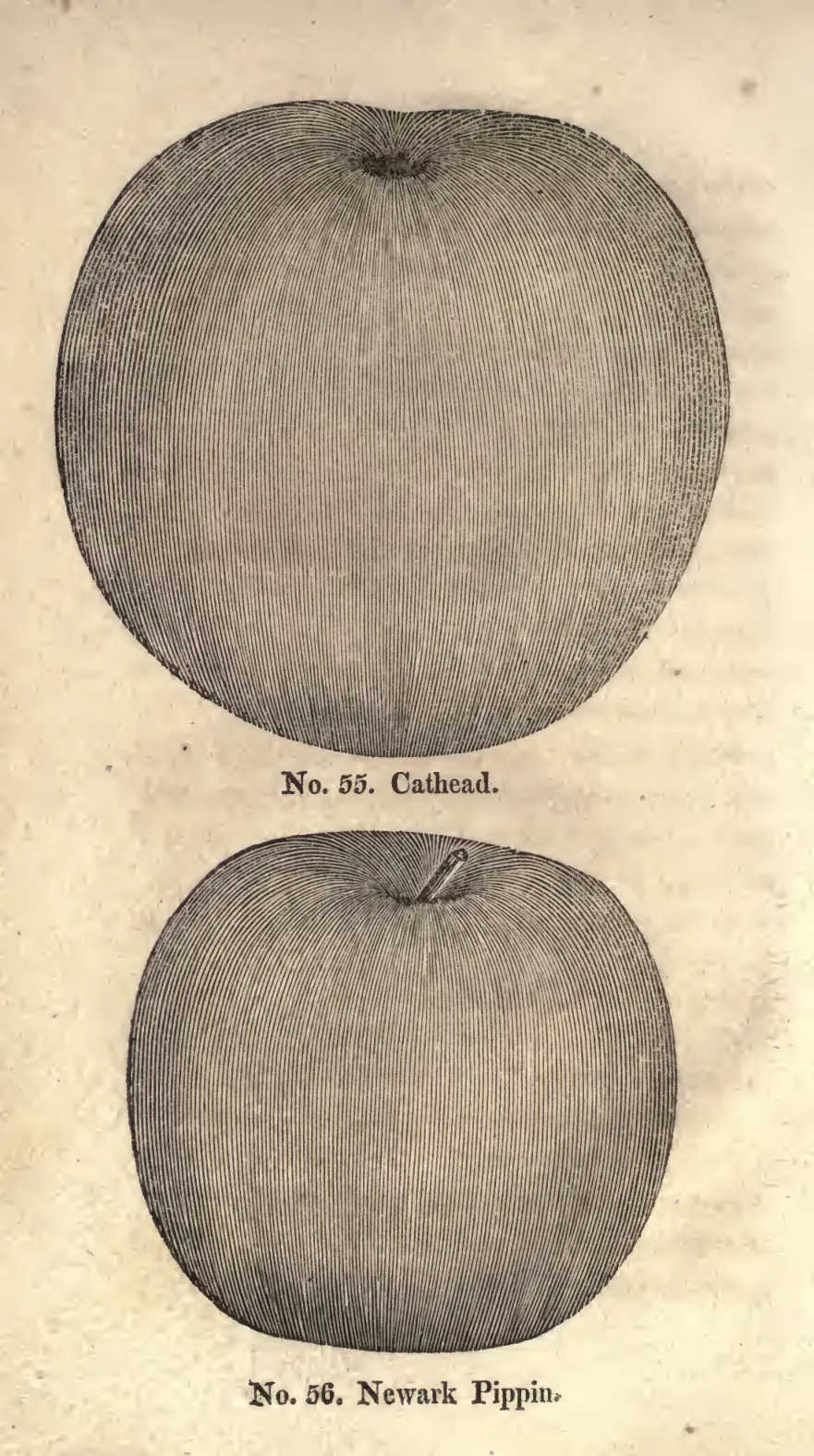
Catshead
Origin / History
Catshead is an old English variety (Beach, Bunyard), known from the seventeenth century (Bunyard). Beach records that Ray described it as long ago as 1688. Thomas marks it "Foreign." Beach's references run from Forsyth (1803) through Hogg (1884). Coxe (1817), Elliott (1865), and Beach (1905) entered it under the name Cathead, and Thomas under Cat-head.
Downing found it cultivated for drying in some parts of the country. Beach reports it formerly grown in some of the home orchards of New York but by 1905 practically obsolete. Elliott, describing a second apple of the name as "equally worthless," holds Catshead itself worthless. Bunyard judges it "Not worthy of cultivation," superseded by others such as Lord Derby.
Tree
Growth strong, fertile when aged; leaf large, round, pale, flat, curved serrate (Bunyard). Coxe says the fruit is apt to drop from the tree from its great weight.
Fruit
Size: Large to of the largest size, most authors calling it very large. Bunyard measures it 3¼ by 3½.
Form: Round or roundish; Coxe describes it as flattened at the ends and deeply hollowed. Bunyard alone calls it long oblong, conical, irregular.
Stem: Short and thick (Coxe).
Cavity: Deep, the stem so deeply sunk as to be almost imperceptible (Coxe).
Calyx: Not described in source.
Basin: Not described in source.
Skin: Quite smooth (Downing). Pale green to greenish yellow or yellowish green. Bunyard gives pale yellowish green with a faint brown flush.
Dots: Not described in source.
Flesh and flavor: Flesh white and tender, with a subacid juice. Elliott alone calls the flesh coarse and the flavor sharp acid. Coxe finds it "deficient in point of richness and flavour"; Downing rates it "Good."
Core and seeds: Not described in source.
Season
The recorded season runs from October into January. Most authors give autumn, October and November; Bunyard extends it to January.
Uses
Culinary: used for cooking, drying, and evaporating. Coxe calls it "a good apple for cooking and drying." Downing finds it "of little other value except as a cooking apple," and Thomas "Valueless except for cooking."
Subtypes / Variants
Elliott records another apple of this name, "equally worthless," of the same shape but striped yellow and red.
Other
Not described in source.
Book Sources
Described in 6 period pomological works
- Coxe, A View of the Cultivation of Fruit Trees (1817) — listed as Cathead
- Bunyard, A Handbook of Hardy Fruits (1920)
- Downing, Fruits and Fruit Trees of America (1900)
- Beach, The Apples of New York Vol. 2 (1905) — listed as Cathead
- Elliott, The Western Fruit Book (1865) — listed as Cathead
- Thomas, The American Fruit Culturist (1903) — listed as Cat-head
Nursery Catalog Sources
Found in 4 catalogs (1850–1913) from Illinois, Massachusetts
- Azell Bowditch (Nursery / Fruit Catalog) , Boston , Massachusetts — 1850 — listed as Cathead
- Central Experimental Farm , Dominion Department of Agriculture, Agassiz, British Columbia (under test; Bulletin No. 3, Second Series) — 1900 — listed as Cathead
- Benjamin Buckman (personal inventory) , Farmingdale , Illinois — 1901 — listed as Cathead
- Benjamin Buckman (personal inventory) , Farmingdale , Illinois — 1913 — listed as Cathead
View original book sources (6)
— William Coxe, A View of the Cultivation of Fruit Trees (1817)NO. 55. CATHEAD.
This is a very large round apple ; flattened at the ends, and deeply hollowed: the stalk is short and thick, so deeply sunk as to be almost imperceptible the colour a greenish yellow, the flesh white: a good apple for cooking and drying, but apt to drop from the tree from its great weight, and deficient in point of richness and flavour.
— F.R. Elliott, The Western Fruit Book (1865)Cathead. Cathead Greening, | Round Catshead. Large, roundish, yellowish green; flesh, white, coarse, sharp acid. October, November. There is another one of this name, equally worthless, same shape, but striped yellow and red.
— A.J. Downing, The Fruits and Fruit Trees of America (1900)Catshead. Round Catshead. Cathead Greening. A very large Apple, cultivated for drying in some parts of the country, but of little other value except as a cooking apple. Fruit of the largest size, round, quite smooth, pale green. Flesh tender, with a subacid juice. Good. October and November.
— John J. Thomas, The American Fruit Culturist (1903)Cat-head. Very large, round, pale green, sub-acid. Valueless except for cooking. Autumn. Foreign.
[Additional entry in this volume: "Cat-head Greening", pp. 720–720]
Cat-head Greening. See Cat-head.
— S.A. Beach, The Apples of New York, Vol. 2 (1905)CATHEAD.
REFERENCES. 1. Forsyth, 1803:56. 2. Coxe, 1817:133. fig. 3. Thacher, 1822:122. 4. Floy-Lindley, 1833:48. 5. Downing, 1845:103. 6. Thomas, 1849:179. 7. Emmons, Nat. Hist. N. Y., 3:86. 1851. 8. Elliott, 1854:168. 9. Warder, 1867:715. 10. Leroy, 1873:842. fig. 11. Hogg, 1884:41.
SYNONYMS. CATHEAD (2, 3, 8). Cathead Greening (5, 6, 8). CATSHEAD (1, 4, 5, 6, 7, 9, 11). Catshead (4, 10). Catshead Greening (10). Costard (4). Costard Ray (7). Coustard (4). De Seigneur d'Automne (10). Grosse-Schafnase (10). Round Catshead (5, 8, 10). Schafnase (10). Tete d'Ange (10). TETE DE CHAT (10).
Formerly grown in some of the home orchards of the state but now practically obsolete. Fruit very large, pale green, subacid. Used for cooking and evaporating. An old English variety. Ray described it as long ago as 1688 (4).
— E.A. Bunyard, A Handbook of Hardy Fruits (1920)CATSHEAD. Her. Pom., L. F., Tête du Chat; G., Schafsnase. (Katzenkopf, Catshead Greening.) Culinary, October to January, large, 3¼ by 3½, long oblong, conical, irregular. Colour, pale yellowish-green, faint brown flush. Flesh, tender, white, sub-acid. Growth, strong; fertile when aged. Leaf, large, round, pale, flat, curved serrate. Origin, Old English sort, known from seventeenth century. Not worthy of cultivation. Superseded by others such as Lord Derby.