Fall Pippin
Apple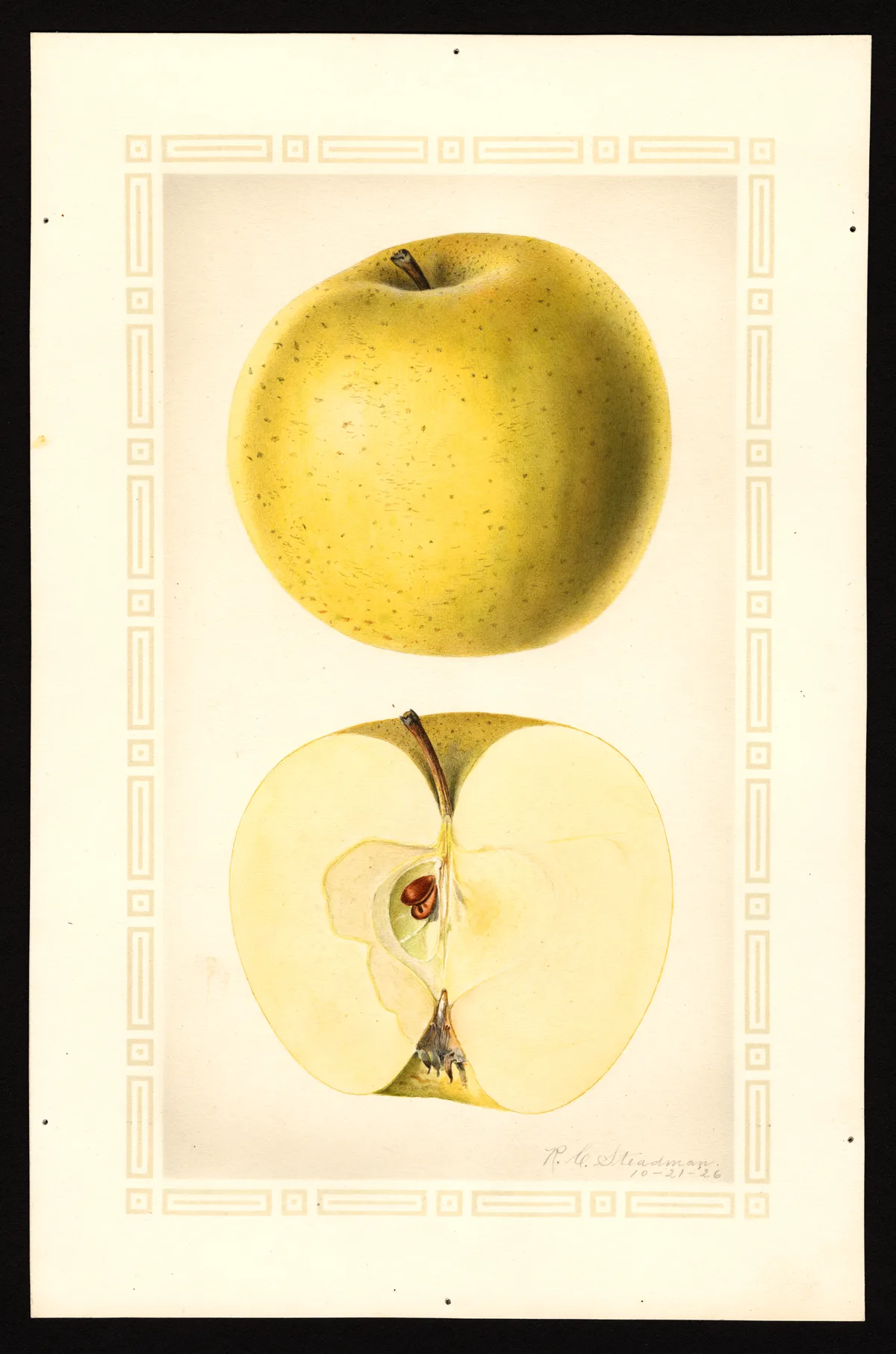
USDA Pomological Watercolor Collection
Fall Pippin
Origin / History
Fall Pippin is an American variety of uncertain parentage. Elliott calls it "unquestionably, an American seedling, and probably from the 'White Spanish Reinette,'" which it closely resembles in all but its period of ripening. Downing thought it "decidedly an American variety," very probably raised in this country from either the White Spanish Reinette or the Holland Pippin, both of which it much resembles and from which it differs most strongly in season of maturity. Budd and Hansen also give it as of American origin. Beach records the origin as unknown, cites Downing's opinion of 1845, and is unable to determine how long the variety has been in cultivation. His references under the name Fall Pippin begin in 1806 ("Amer. Gard. Cal.") and with Coxe in 1817. In some New York orchards Beach found trees more than one hundred years old. Hedrick calls it "one of the oldest American apples" and places its habitat in New England, "where it has been grown for at least a century and a half."
The variety has long been confused with the Holland Pippin. Beach says some have called it Holland Pippin since Coxe's time, and Lowther gives the confusion as the work of "a considerable number of persons." Elliott writes that "great confusion exists among growers respecting it," as the Holland Pippin is often grown under this name, as well as its parent. Warder calls it "unfortunate that since the days of Coxe there should have been a confounding of this noble and delicious American apple with the inferior foreign kitchen variety: the Holland Pippin."
Elliott found it extensively grown in the West and in the Eastern States, where it "universally succeeds well," though it does not answer as well on clayey soils, alluvial bottoms, and deep prairies. Downing calls it "a noble fruit," "considered the first of autumn apples in the Middle States, where its beauty, large size, and its delicious flavor for the table or for cooking, render it very popular." Thomas calls it "fine in nearly all localities." Beach says it has been widely disseminated "from the Atlantic to the Pacific" in most of the important apple-growing regions of the continent, and that many nurserymen still list it. He found it quite generally grown for home use throughout New York and to a limited extent for market, but "now seldom planted." Hedrick doubts "whether Fall Pippin is properly appreciated." He attributes the neglect into which it fell a generation earlier to apple scab, and holds that with means of controlling the scab "its culture should be renewed." The Agassiz station planted it for trial in spring 1894.
Tree
Tree large to very large, a strong grower, moderately vigorous to exceedingly vigorous; most authors call it vigorous to very vigorous. Habit spreading, the shoots diverging and becoming spreading; Downing calls it upright spreading. The large, long branches eventually become somewhat drooping (Beach). Warder describes a wide-branching, open head, while Beach calls the form spreading or roundish and rather dense. Hedrick says "few trees carry a more majestic port at maturity."
Shoots stout, dark or rather dark; Downing gives the young shoots as reddish brown. Twigs moderately long, curved, stout, with large terminal buds; internodes medium. Bark dark reddish-brown, somewhat tinged with green, heavily coated with gray scarf-skin, much pubescent. Lenticels scattering, medium size, oval, raised. Buds medium size, broad, plump, obtuse, free, pubescent (Beach). Leaves large, broad (Warder), sharply serrate (Thomas).
Beach calls the tree hardy and very long-lived, and Hedrick calls it hardy, healthy, and long-lived. Elliott, however, says it "proves tender on prairie soils." Foliage and fruit are both quite subject to apple scab. Beach holds thorough preventive treatment necessary to grow the variety commercially, and Hedrick calls tree and fruit "most inviting prey to the apple-scab fungus."
Bearing moderate. Elliott calls it "not always productive," Warder "not early bearer, moderately productive when old," and Thomas "mostly a moderate bearer."
Fruit
Size: Large to very large; Agassiz alone gives it as above medium. Pretty uniform in size and shape (Beach).
Form: Roundish or round to roundish oblate, generally or usually a little flattened (Downing, Budd and Hansen), flattened at the ends (Elliott, Thomas), regular to pretty regular or nearly regular. Sometimes a little inclined to conic, or sometimes slightly oblong and truncate. Elliott calls it conical, Thomas obtuse and somewhat oblong-conical, and Warder globular and "truncated, making it cylindrical." Obscure ribs at the eye or calyx are sometimes present, and often present according to Beach; Thomas gives them as sometimes large and obtuse.
Stem: Long or rather long, three-fourths of an inch (Downing), projecting considerably beyond the fruit; Beach gives medium to rather long. Moderately stout to thick or large; Budd and Hansen alone call it slender.
Cavity: Acute to acuminate, round, regular or symmetrical, sometimes compressed, russeted; Budd and Hansen give only a slight trace of russet. Narrow to wide. Most authors give it as moderately deep to deep; Downing alone calls it rather small and shallow.
Calyx: Medium to large, open in most accounts. Elliott gives it as above medium, and Downing as "not very large." Warder gives the eye as large and open. Budd and Hansen alone call it closed. Lobes separated at the base, rather narrow, acuminate. Beach gives the lobes as moderately long, while Warder calls the segments short. Elliott describes the segments as "in divisions." Calyx tube large, wide, long, conical to nearly funnel-form (Beach); Budd and Hansen give it as funnel-shaped, very long, wide, and open to the core. Stamens median to basal (Beach); Budd and Hansen give them as marginal.
Basin: Abrupt, narrow to wide, medium in depth to deep. Most authors call it deep, and Downing has the calyx rather deeply sunk; Budd and Hansen alone call it shallow. Elliott calls it open, and Downing round and narrow. Beach describes it as wavy and slightly wrinkled, while Warder and Budd and Hansen call it regular, and Budd and Hansen also smooth. Warder notes concentric rings "which often crack open in large southern specimens."
Skin: Thin, smooth. Greenish, greenish yellow, or yellowish green at first, becoming clear, rich, fine, or high rich yellow when ripe; Hedrick calls it "a beautiful golden yellow." Before full ripeness, some large shades of green appear about the crown (Thomas). Budd and Hansen describe the surface as covered with whitish veinings. Warder's text adds "with skin liner."
Blush faint to considerable, sometimes absent: faint (Elliott, Beach), a tinge of brownish blush on one side, often present (Downing), reddish (Agassiz). Elliott gives the faint blush when grown in good soil and exposed to sun. Warder says it is "rarely blushed South, frequently so North." Lowther says "in the arid regions of bright sunshine" the fruit has "a considerable blush of red." Handsome, of an attractive yellow color when fully ripe.
Dots: Minute to small, pale, white or gray to grayish, submerged or russet; Budd and Hansen call them obscure and suffused. Numerous (Beach, Budd and Hansen); Downing gives a few scattered dots, and Agassiz a few.
Flesh and flavor: Flesh white or whitish to yellowish white, yellowish, or yellow; Budd and Hansen note yellow veinings. Rather fine to very fine-grained, compact, moderately firm to rather firm, becoming tender; very tender (Downing), mellow (Downing, Agassiz). Warder calls it breaking, and Hedrick and Agassiz call it crisp. Juicy to very juicy.
Flavor rich, aromatic, subacid, agreeable or pleasant. Warder calls it acid at first, "becoming sub-acid, aromatic, delicious." Budd and Hansen call it spicy, and Beach "somewhat aromatic."
Quality "very good" in most accounts. Downing gives "very good to best," Warder "best," and Thomas "excellent." Hedrick calls it "of first rate quality to the very last" and "of delectable quality."
Core and seeds: Core medium for the size of the fruit, somewhat abaxile; Warder calls it large and regular, meeting the eye. Warder calls the core closed, Beach the cells closed or partly open, and Budd and Hansen the core half open. Cells symmetrical, round, slit. Core lines meeting or clasping. Carpels roundish, emarginate, tufted (Beach). Seeds rather dark brown, medium size, plump to very plump; somewhat acute or pointed, ovate (Elliott), or short (Budd and Hansen). Warder calls the seeds often imperfect. Thomas says the fruit is sometimes water-cored.
Season
The recorded season runs from September to January, extending to February in cold storage. Most authors begin it in September or October and close it in December; the station at Agassiz gives October alone, while others carry it to late autumn keeping into midwinter, or to January.
The crop does not ripen uniformly. Some fruit is ripe, well colored, and ready for immediate use in September while a considerable portion is still hard and green. Beach gives late September to January. Under favorable conditions, with proper handling, some of the crop may keep till midwinter or later, but even carefully selected fruit cannot be relied on to hold in common storage till December 1st without considerable loss. In cold storage it may be held till January or February. Lowther gives ripening from the middle of September to about the first of November, and says that in northern latitudes, especially at the higher altitudes, the fruit keeps nicely until January. Hedrick calls the name "inapt," since in the North the fruit "keeps well into mid-winter."
Uses
Dessert and culinary, prized for cooking. Beach calls it excellent for dessert "but especially desirable for culinary uses," and Warder rates it "best for dessert, kitchen, market and drying."
Generally in pretty good demand in local markets; in portions of Eastern New York used to a limited extent for the early export trade. Beach calls it one of the most desirable varieties of its season for the home orchard.
Subtypes / Variants
Not described in source.
Other
Beach distinguishes the Holland Pippin as in season from mid-August to midautumn, more roundish and less flattened, with a short, thick stem that is not exserted. Lowther gives the Holland Pippin as ripening almost a month earlier. Downing says the long stalk of Fall Pippin, projecting beyond the fruit, distinguishes it from the Holland Pippin. Budd and Hansen give the Holland Pippin a very short stem and an obtuse cavity.
Book Sources
Described in 8 period pomological works
- Beach, The Apples of New York Vol. 2 (1905)
- Warder, American Pomology: Apples (1867)
- Budd & Hansen, Systematic Pomology (1914)
- Elliott, The Western Fruit Book (1865)
- Downing, Fruits and Fruit Trees of America (1900)
- Lowther (ed.), Encyclopedia of Practical Horticulture (1914)
- Hedrick, Cyclopedia of Hardy Fruits (1922)
- Thomas, The American Fruit Culturist (1903)
Nursery Catalog Sources
Found in 51 catalogs (1845–1936) from Arkansas, California, Illinois, Maryland, Massachusetts, Missouri, New Jersey, Oregon, Pennsylvania, Virginia, Washington
- Winship's Nursery (Brighton Nurseries , operated by the Winship family), Brighton (Boston) , Massachusetts — 1845
- Azell Bowditch (Nursery / Fruit Catalog) , Boston , Massachusetts — 1850 — listed as Cathead
- Azell Bowditch (Nursery / Fruit Catalog) , Boston , Massachusetts — 1850
- St. Helena Nursery , Howell Prairie, Marion County, OR (Marion Co., Ogn.) — 1864
- Hutchison Nursery , James Hutchison, Oakland , California — 1881
- Fancher Creek Nursery , Fresno , California — 1886
- California Nursery Co. , Niles , California — 1889
- William H. Moon Co. , Morrisville, Bucks County , Pennsylvania — 1890
- Puyallup & Yakima Nurseries , Puyallup, Washington (Lock Box 191) and North Yakima , Washington — 1892
- Rogers Nursery Co. , Moorestown , New Jersey — 1893
- Milwaukie-Canby Nurseries , Canby, OR (and Milwaukie, OR) — 1893
- Sherwood Hall Nursery Co. , Timothy Hopkins (Menlo Park Nurseries), San Francisco / Menlo Park , California — 1893
- Multnomah Nurseries , Russellville , Oregon — 1894
- Woodburn Nurseries , Woodburn, Marion Co. , Oregon — 1894
- The Lovett Company , Little Silver , New Jersey — 1896
- The Salem Nursery (John A. Francis , Proprietor), Salem , Virginia — 1897
- Reading Nursery , Jacob W. Manning, Proprietor, Reading , Massachusetts — 1898
- Arthur J. Collins & Sons , Moorestown , New Jersey — 1898
- Brown Brothers Co. , Continental Nurseries, Rochester, NY (also operated from Toronto, Canada) — 1899
- Central Experimental Farm , Dominion Department of Agriculture, Agassiz, British Columbia (under test; Bulletin No. 3, Second Series) — 1900 — listed as Cathead
- Central Experimental Farm , Dominion Department of Agriculture, Agassiz, British Columbia (under test; Bulletin No. 3, Second Series) — 1900
- Benjamin Buckman (personal inventory) , Farmingdale , Illinois — 1901 — listed as Cathead
- Washington Nursery Co. , Toppenish , Washington — 1901
- Brown Brothers Co. , Continental Nurseries, Rochester, NY (also operated from Toronto, Canada) — 1901
- Mountain Grove Nurseries (Tippin & Moore , Proprietors; Geo. T. Tippin, J. W. Tippin, J. C. Moore), Mountain Grove , Missouri — 1901
- S.L. Watkins , Grizzly Flats, El Dorado County , California — 1901
- Yarbrough Bros. , Stephens , Arkansas — 1901
- Benjamin Buckman (personal inventory) , Farmingdale , Illinois — 1901
- Pacific Nursery Company (W. O. Hudson & A. D. Hudson) , Tangent , Oregon — 1903
- Russellville Nursery Co. , Russellville, OR (three miles east of Portland, one mile from Montavilla car line) — 1903
- Henderson Luelling / Traveling Nursery (historical recall) , Oregon — 1904
- Phoenix Nursery Company (W. E. Rossney , President; Sidney Tuttle, Vice-President), Bloomington , Illinois — 1904
- The Dalles Nurseries , The Dalles , Oregon — 1906
- Russellville Nursery Co. , Montavilla Station, Portland, OR (three miles east of Portland, one mile from Montavilla car line) — 1907
- Carlton Nursery Co. , Carlton , Oregon — 1909
- Wm. J. Corse (successor to Robert Sinclair / Sinclair Nurseries) , Baltimore , Maryland — 1909
- Washington Nursery Company , Toppenish , Washington — 1909
- Stark Bros. Nurseries & Orchards Co. , Louisiana , Missouri — 1910
- Stark Bros. Nurseries & Orchards Co. , Louisiana , Missouri — 1911
- Pacific Nursery Company , Portland , Oregon — 1912
- Stark Bros. Nurseries & Orchards Co. , Louisiana , Missouri — 1912
- Washington Nursery Company , Toppenish , Washington — 1912
- Benjamin Buckman (personal inventory) , Farmingdale , Illinois — 1913 — listed as Cathead
- Benjamin Buckman (personal inventory) , Farmingdale , Illinois — 1913
- Union Nurseries , J.B. Weaver & Sons, Union , Oregon — 1915
- Manalapan Nurseries , Englishtown , New Jersey — 1916
- Stark Bros. Nurseries & Orchards Co. , Louisiana , Missouri — 1918
- Oregon Nursery Co. , Orenco , Oregon — 1920
- Benedict Nursery Co. , Portland , Oregon — 1921
- Fresno Nursery Co. , Fresno , California — 1924
- Hudson's Wholesale Nurseries , Tangent , Oregon — 1936
View original book sources (9)
— F.R. Elliott, The Western Fruit Book (1865)FALL PIPPIN. Philadelphia Pippin.
This is, unquestionably, an American seedling, and probably from the "White Spanish Reinette," which it closely resembles in all but its period of ripening. Great confusion exists among growers respecting it, as the Holland Pippin is often grown under this name, as well as its parent. It is extensively grown at the West and in the Eastern States, and universally succeeds well; but, where the soil is of a clayey nature, on the alluvial bottoms and deep prairies, it does not answer as well. Tree, of growth vigorous; shoots, dark; diverging or spreading; becomes large; not always productive; proves tender on prairie soils.
Size, large; form, roundish, conical, flattened at ends; color, greenish yellow until fully ripe, then rich yellow with a faint blush, when grown in good soil and exposed to sun; stem, long, moderately stout; cavity, deep, round; calyx, above medium, with segments in divisions; basin, deep, wide, and open; flesh, yellowish white, tender, sub-acid, aromatic; core, medium, for size of fruit; seeds, ovate. October to December
— John A. Warder, American Pomology: Apples (1867)Fall Pippin.
It is unfortunate that since the days of Coxe there should have been a confounding of this noble and delicious American apple with the inferior foreign kitchen variety: the Holland Pippin.
Tree exceedingly vigorous, large, wide-branching, open head, not early bearer, moderately productive when old; Shoots stout, dark; Leaves large, broad.
Fruit large to very large, handsome, globular, truncated, making it cylindrical, regular; Surface smooth, rich yellow, rarely blushed South, frequently so North, with skin liner; Dots minute, gray.
Basin deep, abrupt, regular, marked with concentric rings which often crack open in large southern specimens; Eye large, open; Segments short.
Cavity wide, regular, or narrow, deep; Stem long.
Core large, regular, closed, meeting the eye; Seeds pointed, often imperfect; Flesh yellow, breaking, compact, very fine-grained; Flavor acid, becoming sub-acid, aromatic, delicious; Quality best for dessert, kitchen, market and drying; Season September to December.
— A.J. Downing, The Fruits and Fruit Trees of America (1900)Fall Pippin. York Pippin. Episcopal. Philadelphia Pippin. Pound Pippin. Golden Pippin, erroneously. Pound Royal of some. Cathead, incorrectly. The Fall Pippin is, we think, decidedly an American variety. It is very probably a seedling raised in this country from the White Spanish Reinette, or the Holland pippin, both of which it so much resembles, and from which it, in fact, differs most strongly in the season of maturity. The Fall Pippin is a noble fruit, and is considered the first of autumn apples in the Middle States, where its beauty, large size, and its delicious flavor for the table or for cooking, render it very popular. The tree is a very vigorous, strong grower, upright spreading. Young shoots reddish brown. Fruit very large, roundish, generally a little flattened, pretty regular, sometimes with obscure ribs at the eye. Stalk rather long, three-fourths of an inch, projecting considerably beyond the fruit (which distinguishes it from the Holland Pippin), set in a rather small, shallow, round cavity. Calyx open, not very large, rather deeply sunk in a round, narrow basin. Skin smooth, yellowish green, becoming a fine yellow, with often a tinge of brownish blush on one side, and with a few scattered dots. Flesh white, very tender and mellow, with a rich, aromatic flavor. Very good to best. October to December.
— John J. Thomas, The American Fruit Culturist (1903)Fall Pippin.* (Holland Pippin, erroneously.) Very large, roundish, obtuse, somewhat oblong-conical, a little flattened at the ends, sometimes with large obtuse ribs; color greenish, becoming a high rich yellow when ripe, with some large shades of green about the crown before fully ripe; stalk large, in an acuminate cavity, basin deep; flesh yellowish, rather firm, becoming tender, rich, aromatic, excellent. Leaves sharply serrate, shoots vigorous, rather dark, diverging, becoming spreading; tree large. Late autumn, keeping into mid-winter. Mostly a moderate bearer—fruit sometimes water-cored. Excellent for cooking. Fine in nearly all localities. Fig. 368.
— S.A. Beach, The Apples of New York, Vol. 2 (1905)FALL PIPPIN.
REFERENCES. 1. Amer. Gard. Cal., 1806:585. 2. Coxe, 1817:109. fig. 3. Cobbett, 1821:par. 300. 4. Thacher, 1822:120. 5. Buel, N. Y. Bd. Agr. Mem., 1826:476. 6. Fessenden, 1828:131. 7. Kenrick, 1832:32. 8. Floy-Lindley, 1833:85. 9. Mag. Hort., 1:326, 364. 1835. 10. Downing, 1845:84. 11. Floy-Lindley, 1846:412 app. 12. Phoenix, Horticulturist, 1:361. 1847. 13. Downing, Ib., 3:345. 1849. 14. Cole, 1849:117. fig. 15. Thomas, 1849:155. fig. 16. Phoenix, Horticulturist, 4:472. 1850. 17. Barry, 1851:283. 18. Emmons, Nat. Hist. N. Y., 3:44. 1851. fig., col. pl. No. 18. 19. Am. Pom. Soc. Cat., 1852. 20. Elliott, 1854:78. fig. 21. Gregg, 1857:42. 22. Hooper, 1857:34, 106, 110. 23. Warder, 1867:571. fig. 24. Downing, 1869:169. fig. 25. Todd, 1871:311. fig. 26. Fitz, 1872:143, 149, 162. 27. Hogg, 1884:74. 28. Wickson, 1889:244. 29. Lyon, Mich. Hort. Soc. Rpt., 1890:290. 30. Bailey, An. Hort., 1892:239. 31. Woolverton, Ont. Fr. Stas. An. Rpt., 8:7. 1901. figs. 32. Budd-Hansen, 1903:80. fig. 33. Beach and Clark, N. Y. Sta. Bul., 248:119. 1904.
SYNONYMS. American Fall (7). AUTUMN PIPPIN (4). Cathead incorrectly (24). Cat Head (25). Cobbett's Fall (7). Cobbett's Fall Pippin (27). Concombre Ancien (7). De Rateau (7). D'Espagne (7). Episcopal (24, 25). FALL PIPPIN (1, 2, 3, 5, 6, 7, 8, 9, 10, 11, 12, 13, 14, 15, 16, 17, 18, 19, 20, 21, 22, 23, 24, 25, 26, 27, 28, 29, 30, 31, 32, 33). Fall Pippin (4). Golden Pippin (22, 25, erroneously 2, 24). Holland Pippin (2, 5, err. 15). Philadelphia Pippin (20, 24, 25). Pound Pippin (24, 25). Pound Royal (25, of some 24). Prince's large Pippin of N. Y. (2). Reinette Blanche d'Espagne (7). Summer Pippin (2). Van Duym's Pippin (2). Van Dyn's Pippin (5). York Pippin (24, 25).
Fruit large, and, when fully ripe, of an attractive yellow color. The flesh is tender, rich and very good in quality, being excellent for dessert but especially desirable for culinary uses. The tree is a strong grower, hardy and very long-lived, eventually becoming large or very large. Since the foliage and fruit are both quite subject to the attacks of the apple-scab fungus, thorough preventive treatment for this disease is necessary in order to grow Fall Pippin successfully for commercial purposes.¹ The crop does not ripen uniformly, some of the fruit being ripe, well colored and ready for immediate use in September, while at the same time a considerable portion of the crop is still hard and green. When grown under favorable conditions and properly handled some portion of the crop may keep till midwinter or later, but even carefully selected fruit cannot be relied upon to hold in common storage till December 1st without considerable loss. In cold storage it may be held till January or February (33). Fall Pippin is generally in pretty good demand in local markets, and in portions of Eastern New York it is being used to a limited extent for the early export trade. It is one of the most desirable varieties of its season for the home orchard.
HOLLAND PIPPIN AND FALL PIPPIN COMPARED.
From the time of Coxe (2), Fall Pippin has by some been called Holland Pippin. The Holland Pippin indeed much resembles Fall Pippin, but it differs from it in being in season from mid-August to midautumn and in being more roundish and less flattened, and in having a short, thick stem which is not exserted.
Historical. Origin unknown. Downing (10) held the opinion that Fall Pippin is an American variety and probably a seedling raised in this country from either the White Spanish Reinette or the Holland Pippin, both of which it resembles. It has been widely disseminated from the Atlantic to the Pacific in most of the important apple-growing regions of the continent and is still listed by many nurserymen (30). We are unable to determine how long this variety has been in cultivation. In some New York orchards trees of it are found which are more than one hundred years old. It is quite generally grown for home use throughout New York, and also to a limited extent for market, but it is now seldom planted.
TREE.
Tree large, moderately vigorous to very vigorous, with large, long branches which eventually become somewhat drooping. Form spreading or roundish and rather dense. Twigs moderately long, curved, stout and with large terminal buds; internodes medium. Bark dark reddish-brown, somewhat tinged with green, heavily coated with gray scarf-skin; much pubescent. Lenticels scattering, medium size, oval, raised. Buds medium size, broad, plump, obtuse, free, pubescent.
FRUIT.
Fruit large or very large, pretty uniform in size and shape. Form roundish to roundish oblate, sometimes a little inclined to conic, or sometimes slightly oblong and truncate, often obscurely ribbed. Stem medium to rather long, thick. Cavity acute or approaching acuminate, moderately deep, moderately narrow to rather wide, symmetrical or sometimes compressed, russeted. Calyx medium to large, open; lobes separated at the base, moderately long, rather narrow, acuminate. Basin medium in depth to deep, moderately narrow to rather wide, abrupt, wavy, slightly wrinkled. Skin thin, smooth, at first greenish-yellow but becoming clear yellow, sometimes faintly blushed. Dots numerous, small, pale and submerged or russet. Calyx tube large, wide, long, conical to nearly funnel-form. Stamens median to basal. Core medium size, somewhat abaxile; cells symmetrical, closed or partly open; core lines meeting or clasping. Carpels roundish, emarginate, tufted. Seeds rather dark brown, medium size, somewhat acute, plump. Flesh whitish or tinged with yellow, moderately firm, rather fine, tender, very juicy, agreeable subacid, somewhat aromatic, very good. Season late September to January.
¹ Directions for treating apple scab are given in the reports of this Station for 1899:399-418, and for 1903:321-386.
— J.L. Budd & N.E. Hansen, American Horticultural Manual, Part II: Systematic Pomology (1914)Fall Pippin. — Of American origin; the fruit much resembles Holland Pippin, but the latter has a very short stem and obtuse cavity.
Fruit large, round, nearly regular, usually a little flattened, sometimes obscurely ribbed at calyx; surface greenish yellow covered with whitish veinings; dots obscure, numerous, suffused, white; cavity acuminate, wide, deep, slight trace of russet; stem slender, rather long, projecting beyond the fruit; basin shallow, narrow, smooth, regular; calyx closed. Core half open; cells round, slit; tube funnel-shaped, very long, wide, open to core; stamens marginal; seeds short, very plump; flesh juicy, yellow with yellow veinings, pleasant subacid, spicy, very good. October to December.
— Granville Lowther (ed.), Encyclopedia of Practical Horticulture (1914)Fall Pippin
The Fall Pippin has, by a considerable number of persons, been called the Holland Pippin, which it very much resembles, but from which it differs mainly in the fact that its fruit ripens from the middle of September until about the first of November, while the fruit of the Holland Pippin ripens almost a month earlier.
The fruit of the Fall Pippin is large, tender, rich, very good in quality desirable for culinary purposes, and when fully ripe is an attractive yellow color.
The tree is a strong grower, hardy and long lived, eventually becoming very large. It is spreading or roundish, with long branches, twigs moderately long, curved, stout and with large terminal buds. Bark dark reddish brown, somewhat tinged with green, heavily coated with gray scarf skin.
The flesh of the fruit is whitish, tinged with yellow, moderately firm, rather fine, tender, very juicy, agreeable subacid, somewhat aromatic, very good. The skin is thin, smooth, at first greenish yellow but becoming a clear yellow, and in the arid regions of bright sunshine, having a considerable blush of red.
In the northern latitudes, especially in the higher altitudes, the fruit will keep nicely until January.
— U.P. Hedrick, Cyclopedia of Hardy Fruits (1922)FALL PIPPIN. Fig. 19. Autumn Pippin. Pound Pippin. Summer Pippin. York Pippin.
Though one of the oldest American apples, it is doubtful whether Fall Pippin is properly appreciated. The name is inapt, as in the North the fruit keeps well into mid-winter, and is of first rate quality to the very last. The color is a beautiful golden yellow, and the flesh is tender, rich, crisp, aromatic, and of delectable quality either for dessert or for culinary uses. The trees are hardy, healthy, long-lived, and very large; few trees carry a more majestic port at maturity. Unfortunately, tree and fruit are most inviting prey to the apple-scab fungus; this accounts for the neglect into which the variety fell a generation ago, but, with means of controlling the scab, its culture should be renewed. The habitat of the variety is New England, where it has been grown for at least a century and a half.
Tree large, very vigorous, spreading, with long branches which become drooping. Fruit large or very large, uniform in size and shape, round to round-oblate, inclined to conic, sometimes oblong and truncate, often obscurely ribbed; stem long, thick; cavity acute, wide, symmetrical or compressed, russeted; calyx large, open; lobes separated at the base, long, narrow, acuminate; basin wide, abrupt, wavy, wrinkled; skin thin, smooth, clear yellow, sometimes faintly blushed; dots numerous, small, pale and submerged or russet; calyx-tube large, wide, long, conical; stamens median; core medium size, abaxile; cells symmetrical, closed or partly open; core-lines meeting or clasping; carpels round, emarginate, tufted; seeds dark brown, acute, plump; flesh yellow, firm, fine, tender, very juicy, agreeably subacid, aromatic; very good; late September to January.
— Central Experimental Farm, Central Experimental Farm, Agassiz BC — Catalogue of Fruit Trees under Test (Bulletin No. 3, 1900) (1900)Planted Spring 1894. Tree a strong grower. Fruit above medium size, roundish, flattened. Skin yellowish green with a reddish blush, and a few grayish dots. Flesh white, crisp, mellow, with a rich aromatic flavour, quality very good. Season October.