Orange Pippin
Apple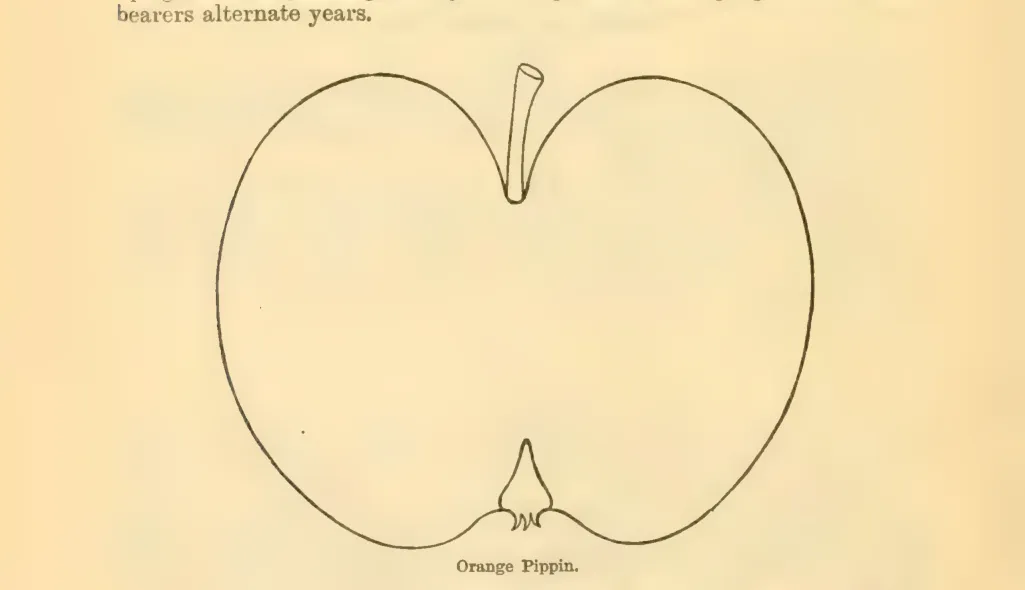
Orange Pippin
[NOTE: Source text may be incorrect. Beach says at least two varieties have been known in this country as Orange Pippin: an old apple associated with Normandy and the Isle of Wight, and a New Jersey summer market apple. Bunyard says "there seem to be two varieties under this name," his own and "a large fruit of the Blenheim style." Downing describes an Isle of Wight Pippin in a separate entry that carries Orange Pippin among its names; it is merged here.]
Origin / History
Orange Pippin is an old apple. Downing says it originated in Normandy. Beach says the apple was disseminated from the Isle of Wight, where, "as some have supposed," it was brought from Normandy; it has accordingly also been called the Isle of Wight Pippin. Downing gives the Isle of Wight Pippin a separate entry as "a very old Apple." Bunyard (1920), citing Ronalds, p. 16, gives the origin as unknown. He says Orange Pippin "has been grown in England at least 200 years" and is now little cultivated.
Beach's references run from Forsyth (1803) onward. He warns that they "are not all to the same variety," because in many cases it is uncertain which variety a writer had in mind. His own description of the Isle of Wight apple is drawn from Lindley (1833) and Downing (1872). Beach says at least two varieties have been known "in this country" under the name Orange Pippin. Neither is "now considered of superior value by fruit growers," and both are going out of cultivation. The Isle of Wight apple was entered on the list of the American Pomological Society in 1869, dropped in 1871, and re-entered in 1873.
Lowther (1914) records Orange Pippin as reported by 2 stations in the Northern Division, 7 in the Central Division, and 1 in the Southern Division; in each case the variety is also reported in another division.
Tree
Growth good; fertile (Bunyard).
Fruit
Size: Small to very large. Downing, Lowther, and Bunyard give medium, and Bunyard measures it 3 by 2. Downing's Isle of Wight Pippin is small, as is the apple of George Bunyard & Co.'s catalog (1901). Rivers' catalog (1914) alone calls it "very large."
Form: Roundish (Downing, for both his Orange Pippin and his Isle of Wight Pippin) to oblate (Lowther) or flattened round and regular (Bunyard).
Stem: Slender (Bunyard).
Cavity: Fairly deep (Bunyard).
Calyx: Eye closed (Bunyard).
Basin: Shallow (Bunyard).
Skin: Yellow to rich orange yellow, colored on the sunny side with bright orange, with orange and red, or with a red flush; Lowther's table gives yellow-red. Beach describes the skin as yellowish and golden gray russeted, highly colored with orange and red on the sunny side. Downing's Isle of Wight Pippin sometimes has a brownish cheek. "Handsome" (Rivers).
Dots: Not described in source.
Flesh and flavor: Flesh firm and crisp (Downing); Bunyard gives it tender and yellow. Flavor pleasant acid (Downing). Downing's Isle of Wight Pippin is firm, juicy, rich, aromatic, and acid. Against these acid descriptions, George Bunyard & Co. call the fruit "sweetly flavored." Bunyard gives the flesh as "of fair flavour." Lowther's table rates the quality "very good," and Rivers calls it "a most excellent apple."
Core and seeds: Not described in source.
Season
The recorded season runs from October into February. The dated descriptions mostly close it in December or January: October to January (Downing), till January (Bunyard), and October to December (Rivers). Downing's Isle of Wight Pippin stands later, at January and February. Lowther's table gives winter. George Bunyard & Co. say the fruit "keeps fine, keeps throughout winter," and call it "excellent fruit for the cooler."
Uses
Dessert, cider, kitchen, and market. Downing values his Orange Pippin mainly as a cider fruit. Beach calls it suitable for dessert, and Bunyard classes it as a dessert apple. Downing reports that Ronalds describes the Isle of Wight Pippin as fine for dessert. Lowther's table gives both kitchen and market, and George Bunyard & Co. call it "excellent for any purpose."
Subtypes / Variants
A second Orange Pippin is grown in some parts of New Jersey. Downing says it differs from the European apple and that he was unable to obtain its history or description. Beach describes it as a profitable summer market apple of unknown origin. Tree vigorous, at first upright but eventually spreading; a reliable biennial cropper. Fruit medium or above, pale yellow with some orange red in the sun. Flesh white, half fine, tender, pleasant subacid. Season September and October.
Bunyard also notes a second variety under the name Orange Pippin: "a large fruit of the Blenheim style."
Other
Not described in source.
Book Sources
Described in 4 period pomological works
Nursery Catalog Sources
Found in 3 catalogs (1900–1913) from Illinois
- Central Experimental Farm , Dominion Department of Agriculture, Agassiz, British Columbia (under test; Bulletin No. 3, Second Series) — 1900
- Benjamin Buckman (personal inventory) , Farmingdale , Illinois — 1901
- Benjamin Buckman (personal inventory) , Farmingdale , Illinois — 1913
View original book sources (6)
— A.J. Downing, The Fruits and Fruit Trees of America (1900)Orange Pippin. Marigold Pippin. Isle of Wight Orange.
An old Apple, originated in Normandy, and valued mainly as a cider fruit.
Fruit medium, roundish, rich orange yellow. Flesh firm, crisp, pleasant acid. October to January.
There is also an Orange Pippin grown in New Jersey differing from this, but we have been unable to obtain its history or description.
[Additional entry in this volume: "Isle of Wight Pippin", pp. 254–254]
Isle of Wight Pippin.
Isle of Wight Orange. Orange Pippin. Pomme d' Orange.
A very old Apple, described in Ronalds as fine for dessert.
Fruit small, roundish, yellow, bright orange in sun, with sometimes a brownish cheek. Flesh firm, juicy, rich, aromatic, acid. January, February.
— S.A. Beach, The Apples of New York, Vol. 2 (1905)ORANGE PIPPIN.
REFERENCES. 1. Forsyth, 1803:54. 2. Ib., 1824:119. 3. Buel, N. Y. Bd. Agr. Mem., 1826:476. 4. London Hort. Soc. Cat., 1831: No. 587. 5. Kenrick, 1832:81. 6. Lindley, 1833:80. 7. Warder, 1867:728. 8. Am. Pom. Soc. Cat., 1869. 9. Downing, 1872:62 app. fig. 10. Leroy, 1873:457. fig. 11. Am. Pom. Soc. Cat., 1873. 12. Hogg, 1884:116. 13. Ib., 1884:164. 14. Thomas, 1885:519. 15. Lyon, Mich. Hort. Soc. Rpt., 1890:296. 16. Bailey, An. Hort., 1892:245.
SYNONYMS. Englesc Orange Appel (12). ISLE OF WIGHT PIPPIN (4, 12). Isle of Wight Pippin (5, 6). Isle of Wight Orange (4, 5, 6, 12). MARIGOLD (10). Marigold (5). Marigold Creed's (10). Marigold Pippin (2). Marygold (6). ORANGE (7). ORANGE PIPPIN (1, 2, 3, 5, 6, 8, 9, 11, 13, 14, 15, 16). Orange Pippin (4, 12). Pomme d'Orange (12).
The above references are not all to the same variety and are included only because in many cases it is uncertain which variety the writer had in mind. At least two varieties have been known in this country under the name Orange Pippin but so far as we can learn neither of them is now considered of superior value by fruit growers and both are going out of cultivation. One, which has been called also the Isle of Wight Pippin, Isle of Wight Orange, Marygold and Marigold, was disseminated from the Isle of Wight where, as some have supposed, it was brought from Normandy (1, 3, 4, 5, 6, 10, 12). Fruit medium size, roundish, skin yellowish, golden gray russeted and highly colored with orange and red on the sunny side; flesh firm, crisp, pleasant acid, suitable for dessert; season October to January (6, 9). This was entered on the list of the American Pomological Society in 1869, dropped in 1871 and re-entered in 1873.
An Orange Pippin grown in some parts of New Jersey is described (8, 9, 11, 14, 15) as a profitable summer market apple of unknown origin. Tree vigorous, at first upright but eventually spreading; a reliable biennial cropper. Fruit medium or above, pale yellow with some orange red in the sun; flesh white, half fine, tender, pleasant subacid; season September and October.
— Granville Lowther (ed.), Encyclopedia of Practical Horticulture (1914)Orange Pippin. Size: medium. Form: oblate. Color: yellow-red. Quality: very good. Use: both kitchen and market. Season: winter. Reported by 2 stations in the Northern Division (also reported in another division), 7 stations in the Central Division (also reported in another division), and 1 station in the Southern Division (also reported in another division).
— E.A. Bunyard, A Handbook of Hardy Fruits (1920)ORANGE PIPPIN. Ronalds, p. 16. Dessert, till January, medium, 3 by 2, flattened round, regular. Colour, orange-yellow, flushed with red. Flesh, tender, yellow, of fair flavour. Eye, closed in a shallow basin. Stem, slender in a fairly deep cavity. Growth, good; fertile. Origin, unknown. It has been grown in England at least 200 years. It is now little cultivated. There seem to be two varieties under this name, the above and a large fruit of the Blenheim style.
— George Bunyard & Co., George Bunyard Fruit Catalogue (1901) (1901)Small apple sweetly flavored, keeps fine, keeps throughout winter. Excellent fruit for the cooler. Excellent for any purpose.
— Thomas Rivers & Son, Thomas Rivers Catalogue of Fruits (1914) (1914)very large and handsome; a most excellent apple - Oct.-Dec.