Fall Orange
Apple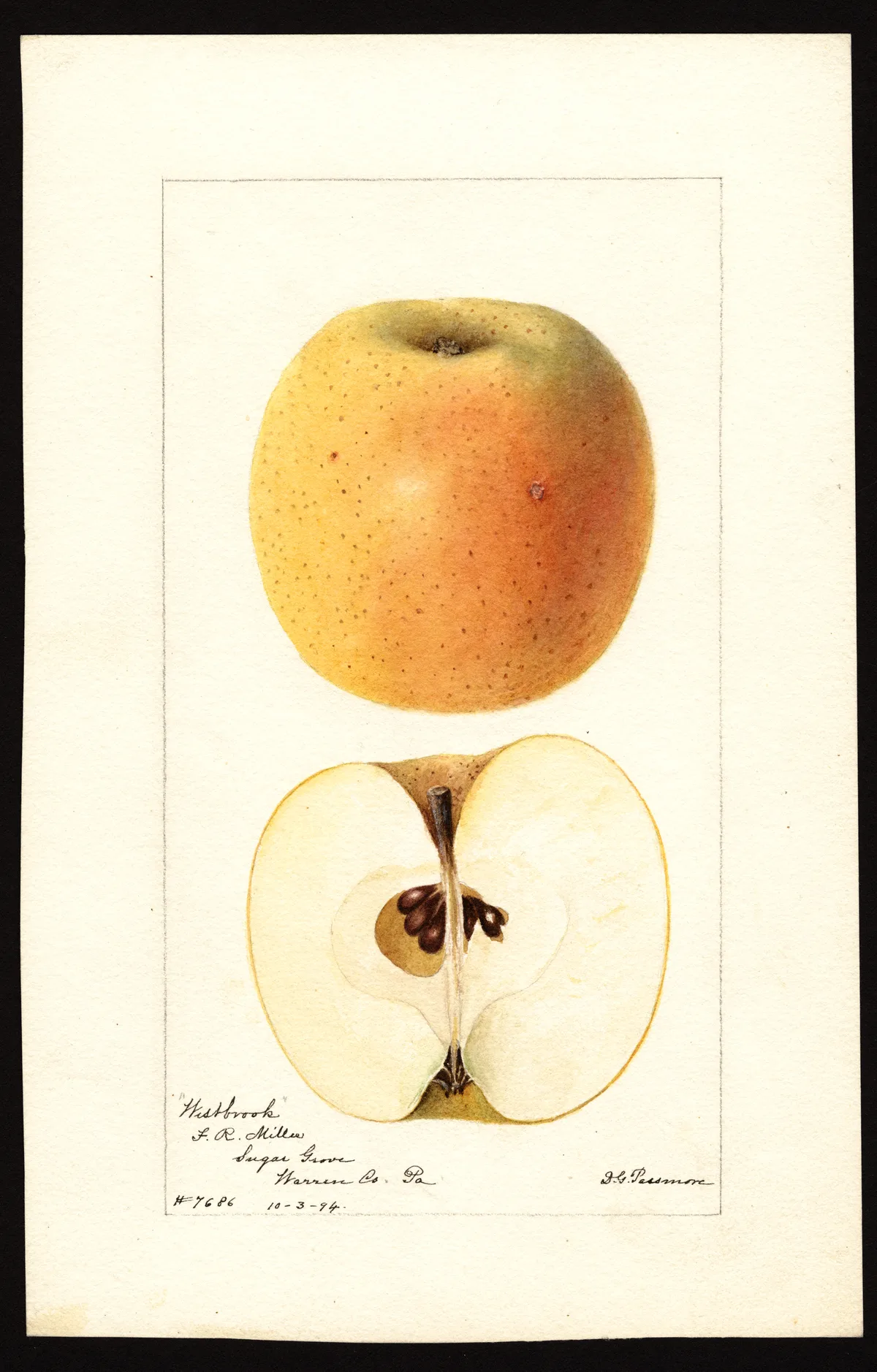
USDA Pomological Watercolor Collection
Fall Orange
Origin / History
Fall Orange originated in Holden, Massachusetts (Downing; Budd-Hansen; Hedrick). Beach notes that Fall Orange was described by Thomas in 1848 as a new or newly-introduced variety of unknown origin, and that in 1857 Downing gave its origin as Holden, Mass. Hedrick gives the date of the variety as previous to 1848. Since its introduction it has been sparingly disseminated in various parts of New York state. Although it is still listed by some nurserymen, it is now seldom planted in New York (Beach). Hedrick notes that its culture seems to be confined to New England and New York.
Thomas attributes the variety to Massachusetts.
Downing also records an additional entry under the name "Speckled" (also called Westbrook), of uncertain origin — Beach lists both Speckled and Westbrook as synonyms of Fall Orange.
Tree
A very strong, erect grower; good bearer; hardy (Downing). Young shoots smooth, dark brownish red (Downing); shoots very stout, dark colored (Thomas). Thomas describes the tree as very hardy, bearing while very young, with fruit always fair. Budd-Hansen call the tree a strong grower and early bearer. Beach describes it as thrifty, hardy, long-lived and a regular biennial cropper, often yielding pretty heavy crops. Hedrick describes it as vigorous, hardy, healthy, long-lived, productive biennially. The Central Experimental Farm catalogue (Agassiz BC, planted Spring 1893) reports the tree as a strong grower and a free bearer.
Downing's "Speckled" entry describes the tree as a rapid grower and annual bearer.
Fruit
Size
Fair, large (Downing); large (Thomas); above medium to large (Beach); medium (Budd-Hansen); large (Lowther); large (Hedrick); above medium size (Central Experimental Farm). Beach notes the fruit is fairly uniform in size but not in shape; Hedrick agrees — uniform in size but not in shape. Beach notes that with heavy crops there is apt to be a comparatively large percentage of fruit that is undersized or otherwise unmarketable.
Form
Roundish (Downing); roundish-ovate, or oval (Thomas); roundish conic, irregular (Beach); roundish, regular (Budd-Hansen); round in form (Lowther); round-conic, irregular (Hedrick); oblong, conical (Central Experimental Farm).
Downing's "Speckled" entry describes the form as roundish oblong.
Stem / Stalk
Stalk short (Downing); stalk half an inch long (Thomas); stem medium to rather short, slender (Beach); stem short (Budd-Hansen; Hedrick).
Cavity
Deep, narrow, very slightly surrounded by russet (Downing); cavity narrow (Thomas); acute to acuminate, deep, medium in width, regular or slightly compressed, often russeted and with outspreading russet rays (Beach); regular, very narrow, acute, with radiating russet (Budd-Hansen); acute, deep, regular or compressed, often russeted and with outspreading russet rays (Hedrick).
Calyx
Large, partially closed (Downing); calyx half open, segments divergent (Budd-Hansen); medium to large, open or sometimes nearly closed (Beach); large, open or closed (Hedrick).
Basin
Rather deep, narrow (Downing); even-rimmed, slightly plaited (Thomas); uneven, one side projecting higher than the other, moderately deep to deep, narrow to moderately wide, abrupt, furrowed (Beach); narrow, abrupt, smooth, small (Budd-Hansen); uneven, one side projecting higher than the other, deep, wide, abrupt, furrowed (Hedrick).
Skin / Color
Pale yellow, sometimes with a dull red cheek and sprinkled with brownish dots (Downing). Light greenish yellow, becoming pale yellow, rarely a brown cheek (Thomas). Skin pale yellow or greenish, sometimes with brownish blush (Beach). Surface a rich yellow with some thin russet net-veinings and patches, sometimes a faint bronze blush (Budd-Hansen). Color yf [yellow] (Lowther). Pale yellow sometimes with brownish blush (Hedrick). Skin yellow (Central Experimental Farm).
When well grown, Fall Orange is of good size, yellow or greenish, with occasionally a shade of red (Beach).
Downing's "Speckled" entry describes the color as yellowish white, red in the sun, with small russet dots.
Dots
Brownish dots, sprinkled (Downing). Numerous, large and small, russet or sometimes reddish, areolar (Beach). Distinct, numerous, russet (Budd-Hansen). Numerous, large and small, russet or red, areolar (Hedrick).
Flesh / Flavor
White, tender, juicy, subacid; too acid for a dessert, good for cooking (Downing). Sub-acid, tender, good, best when fresh from the tree (Thomas). Flesh white, moderately fine, crisp, rather tender, juicy, subacid, aromatic, very good (Beach). Flesh white, tender, juicy, subacid, good (Budd-Hansen). Flesh white, fine, crisp, tender, juicy, subacid, aromatic; very good (Hedrick). Flesh white, tender, juicy, sprightly, almost acid, but pleasant, quality good (Central Experimental Farm). Quality good, suited for both kitchen and market use (Lowther).
Beach notes that when well grown Fall Orange is agreeable subacid, and very good in quality for culinary use; when it becomes fully ripe so that its acidity is subdued, it is an excellent dessert apple. Hedrick takes the opposite view: the fruits of Fall Orange are scarcely good enough for dessert and are so readily bruised in handling that they are not suitable for market; several rivals in season surpass it.
Downing's "Speckled" entry describes the flesh as white, tender, subacid, good.
Core / Seeds
Core medium to rather small, axile; cells symmetrical; core lines meeting when the tube is short, clasping when it is long. Carpels elliptical to nearly cordate. Seeds not numerous, rather dark brown, medium to below, plump, obtuse (Beach). Core closed; cells round, slit; tube funnel-shaped; stamens median; seeds plump (Budd-Hansen). Core small, axile; cells symmetrical; core-lines meeting when the tube is short, clasping when it is long; carpels elliptical to cordate; seeds not numerous, dark brown, plump, obtuse (Hedrick).
Calyx Tube / Stamens
Calyx tube rather large, usually long, conical to funnel-form with fleshy pistil point projecting into the base; the lower part of the funnel cylinder is sometimes enlarged. Stamens median or below (Beach). Calyx-tube large, long, conical with fleshy point projecting into the base, the lower part of the funnel cylinder sometimes enlarged; stamens median (Hedrick). Tube funnel-shaped; stamens median (Budd-Hansen).
Season
October, November (Downing). September, October (Budd-Hansen). Early autumn (Lowther). September (Central Experimental Farm). Late September to early winter (Beach; Hedrick). Beach adds that sometimes a portion of the fruit is kept till spring.
Downing's "Speckled" entry gives the season as October, January.
Uses
Too acid for a dessert, good for cooking (Downing). Best when fresh from the tree (Thomas). Suited for both kitchen and market use (Lowther). Very good in quality for culinary use; when fully ripe so that its acidity is subdued, it is an excellent dessert apple (Beach).
Beach notes Fall Orange is not generally regarded as a good commercial variety because its color is yellow, the fruit is rather tender and a poor shipper, and with heavy crops there is apt to be a comparatively large percentage of fruit that is undersized or otherwise unmarketable. Hedrick concurs that the fruits are so readily bruised in handling that they are not suitable for market.
Distribution
Lowther reports Fall Orange from 4 stations in the Northern Division, 6 stations in the Central Division, and 2 stations in the Southern Division; the asterisk on each figure indicates the variety is reported in more than one division.
Subtypes / Variants
Not described in source.
Other
Beach notes that Fall Orange resembles Autumn Swaar considerably in general appearance, and refers the reader to the description of Autumn Swaar (pages 11, 12) for a comparison of the two varieties.
The Central Experimental Farm at Agassiz BC recorded their planting as Spring 1893.
Book Sources
Described in 6 period pomological works
Nursery Catalog Sources
Found in 3 catalogs (1900–1904) from Illinois
- Central Experimental Farm , Dominion Department of Agriculture, Agassiz, British Columbia (under test; Bulletin No. 3, Second Series) — 1900
- Benjamin Buckman (personal inventory) , Farmingdale , Illinois — 1901
- Phoenix Nursery Company (W. E. Rossney , President; Sidney Tuttle, Vice-President), Bloomington , Illinois — 1904
View original book sources (7)
— A.J. Downing, The Fruits and Fruit Trees of America (1900)Fall Orange.
Orange. Holden. Hogpen. White Graft of Virginia. Holden Pippin. Jones' Pippin. Red Cheek. Long Island.
Origin, Holden, Mass. A very strong, erect grower, good bearer, and hardy. Young shoots smooth, dark brownish red.
Fruit fair, large, roundish, pale yellow, sometimes with a dull red cheek and sprinkled with brownish dots. Stalk short, inserted in a deep, narrow cavity, very slightly surrounded by russet. Calyx large, partially closed, basin rather deep, narrow. Flesh white, tender, juicy, subacid. Too acid for a dessert, good for cooking. October, November.
[Additional entry in this volume: "Speckled", pp. 382–382]
Speckled.
Westbrook.
Origin uncertain. Tree a rapid grower and annual bearer.
Fruit large, roundish oblong, yellowish white, red in the sun, small russet dots. Flesh white, tender, subacid. Good. October, January.
— John J. Thomas, The American Fruit Culturist (1903)Fall Orange.* (Holden Pippin.) Large, roundish-ovate, or oval; light greenish yellow, becoming pale yellow, rarely a brown cheek; stalk half an inch long, cavity narrow; basin even-rimmed, slightly plaited; sub-acid, tender, good, best when fresh from the tree. Shoots very stout, dark colored. Tree very hardy, bears while very young, fruit always fair. Massachusetts.
— S.A. Beach, The Apples of New York, Vol. 2 (1905)FALL ORANGE.
REFERENCES. 1. Thomas, Cultivator, 5:246. 1848. 2. Ib., 1849:155. 3. Elliott, 1854:149. 4. Gregg, 1857:42. 5. Downing, 1857:143. 6. Am. Pom. Soc. Cat., 1862. 7. Warder, 1867:718. 8. Downing, 1869:168. 9. Ib., 1872:10 index, app. 10. Bailey, An. Hort., 1892:239. 11. Burrill and McCluer, Ill. Sta. Bul., 45:321. 1896. 12. Budd-Hansen, 1903:80. fig.
SYNONYMS. FALL ORANGE (1, 2, 4, 5, 6, 7, 8, 9, 10, 11, 12). Fall Orange (3). Hogpen (8). Holden (5, 8). Holden Pippin (8). Hoypen (5). Jones' Pippin (5, 8). Long Island (8). Long Island Graft (9). N. Y. Bell-flower (9). ORANGE (3). Orange (8). Red Check (8). Speckled (9). Westbrook (9). White Graft of Wis. (8). White Newell (9).
When well grown Fall Orange is of good size, yellow or greenish, with occasionally a shade of red, agreeable subacid, and very good in quality for culinary use. When it becomes fully ripe so that its acidity is subdued it is an excellent dessert apple. The tree is thrifty, hardy, long-lived and a regular biennial cropper, often yielding pretty heavy crops. It is not generally regarded as a good commercial variety because its color is yellow, the fruit is rather tender and a poor shipper, and with heavy crops there is apt to be a comparatively large percentage of fruit that is undersized or otherwise unmarketable. It is in season from late September to early winter; sometimes a portion of the fruit is kept till spring.
It resembles Autumn Swaar considerably in general appearance; for a comparison of the two varieties the reader is referred to the description of Autumn Swaar, pages 11, 12.
Historical. Fall Orange was described by Thomas in 1848 as a new or newly-introduced variety of unknown origin (1). In 1857 Downing gave its origin as Holden, Mass. (5). Since its introduction it has been sparingly disseminated in various parts of the state. Although it is still listed by some nurserymen (10) it is now seldom planted in New York.
FRUIT. Fruit above medium to large; fairly uniform in size but not in shape. Form roundish conic, irregular. Stem medium to rather short, slender. Cavity acute to acuminate, deep, medium in width, regular or slightly compressed, often russeted and with outspreading russet rays. Calyx medium to large, open or sometimes nearly closed. Basin uneven, one side projecting higher than the other, moderately deep to deep, narrow to moderately wide, abrupt, furrowed. Skin pale yellow or greenish, sometimes with brownish blush. Dots numerous, large and small, russet or sometimes reddish, areolar. Calyx tube rather large, usually long, conical to funnel-form with fleshy pistil point projecting into the base; the lower part of the funnel cylinder is sometimes enlarged. Stamens median or below. Core medium to rather small, axile; cells symmetrical; core lines meeting when the tube is short, clasping when it is long. Carpels elliptical to nearly cordate. Seeds not numerous, rather dark brown, medium to below, plump, obtuse. Flesh white, moderately fine, crisp, rather tender, juicy, subacid, aromatic, very good. Season late September to early winter.
— J.L. Budd & N.E. Hansen, American Horticultural Manual, Part II: Systematic Pomology (1914)Fall Orange. — Origin, Holden, Massachusetts; tree a strong grower and early bearer.
Fruit medium, roundish, regular; surface a rich yellow with some thin russet net-veinings and patches, sometimes a faint bronze blush; dots distinct, numerous, russet; cavity regular, very narrow, acute, with radiating russet; stem short; basin narrow, abrupt, smooth, small; calyx half open; segments divergent. Core closed; cells round, slit; tube funnel-shaped; stamens median; seeds plump; flesh white, tender, juicy, subacid, good. September, October.
— Granville Lowther (ed.), Encyclopedia of Practical Horticulture (1914)Fall Orange is large in size, round in form, and color yf. Its quality is good, and it is suited for both kitchen and market use. It ripens in early autumn. It is reported by 4 stations in the Northern Division, 6 stations in the Central Division, and 2 stations in the Southern Division; the asterisk on each figure indicates the variety is reported in more than one division.
— U.P. Hedrick, Cyclopedia of Hardy Fruits (1922)FALL ORANGE. New York Bellflower. The fruits of Fall Orange are scarcely good enough for dessert and are so readily bruised in handling that they are not suitable for market. Several rivals in season surpass it. The origin of the variety is given as Holden, Massachusetts, and the date as previous to 1848. Its culture seems to be confined to New England and New York.
Tree vigorous, hardy, healthy, long-lived, productive biennially. Fruit large, uniform in size but not in shape, round-conic, irregular; stem short, slender; cavity acute, deep, regular or compressed, often russeted and with outspreading russet rays; calyx large, open or closed; basin uneven, one side projecting higher than the other, deep, wide, abrupt, furrowed; skin pale yellow sometimes with brownish blush; dots numerous, large and small, russet or red, areolar; calyx-tube large, long, conical with fleshy point projecting into the base, the lower part of the funnel cylinder sometimes enlarged; stamens median; core small, axile; cells symmetrical; core-lines meeting when the tube is short, clasping when it is long; carpels elliptical to cordate; seeds not numerous, dark brown, plump, obtuse; flesh white, fine, crisp, tender, juicy, subacid, aromatic; very good; late September to early winter.
— Central Experimental Farm, Central Experimental Farm, Agassiz BC — Catalogue of Fruit Trees under Test (Bulletin No. 3, 1900) (1900)Planted Spring 1893. Tree a strong grower and a free bearer. Fruit above medium size, oblong, conical. Skin yellow. Flesh white, tender, juicy, sprightly, almost acid, but pleasant, quality good. Season September.