Autumnal Swaar
Apple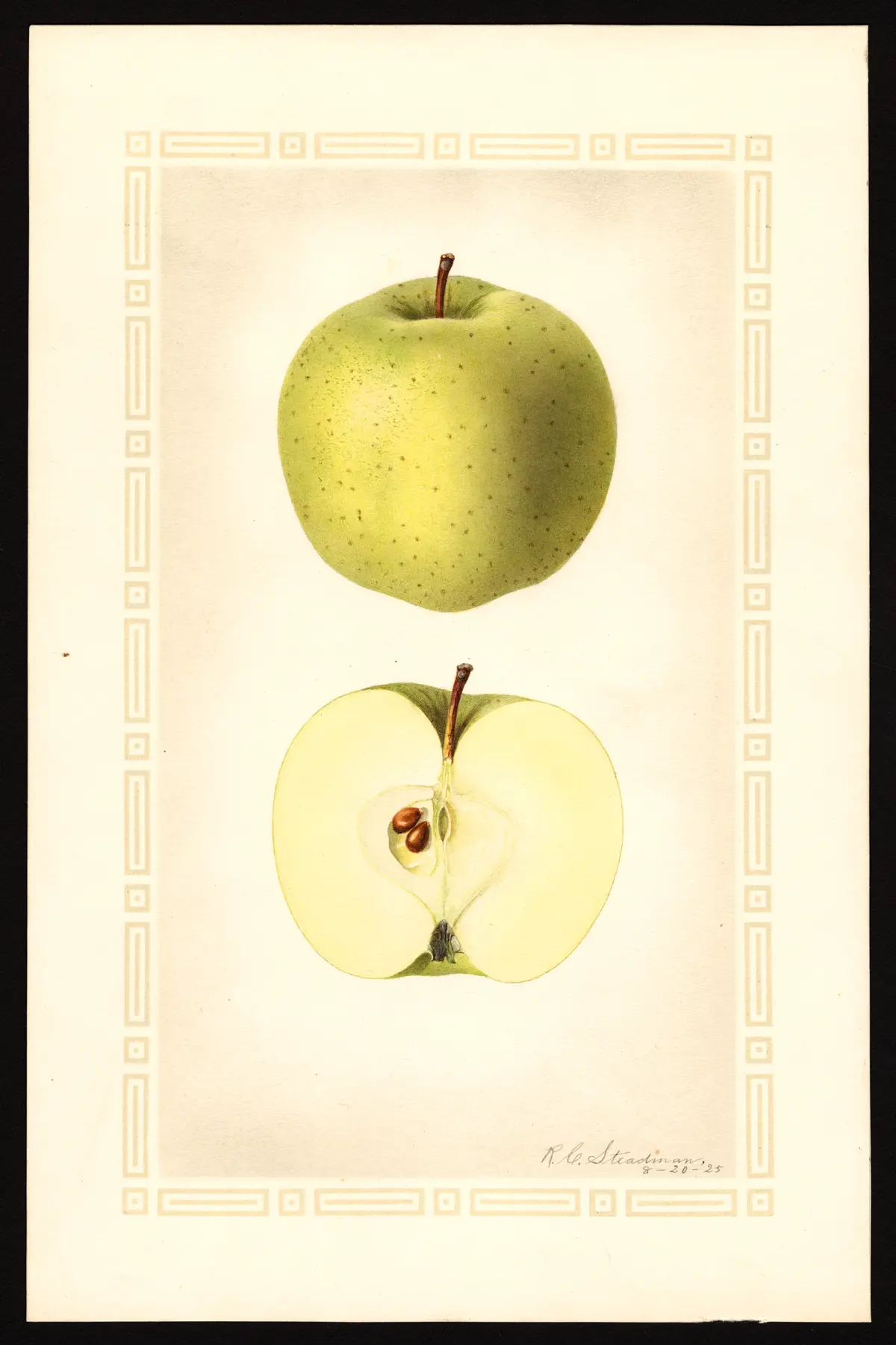
USDA Pomological Watercolor Collection
Autumnal Swaar
Origin / History
The origin of Autumnal Swaar is unknown (Downing; Warder; Beach; Budd-Hansen). It is a Western fruit (Elliott; Warder), and Warder notes that, "like many others of our Western fruits, which have been received from various sources, and often from unreliable persons, and with wrong names, we have been obliged to re-christen this." Beach places it in the Fall Orange group, observing that the fruit resembles Fall Orange very closely. Beach further records that it is occasionally found in cultivation in New York State but is now seldom or never planted. The earliest reference cited by Beach is the Genesee Farmer, 1838.
Tree
The tree is hardy, vigorous, and spreading (Downing; Beach; Budd-Hansen). Thomas describes growth as vigorous, with shoots diverging and the tree spreading. Beach notes the tree is "not satisfactorily productive" (citing Lyon, Mich. Hort. Soc. Rpt., 1890).
Fruit
Size
Sources vary on size. Elliott and Downing describe the fruit as large. Budd-Hansen also calls it large. Warder describes it as "full medium to large." Thomas calls it large. Beach states "above medium to medium, sometimes large."
Form
Sources give somewhat differing forms. Elliott and Downing describe the fruit as roundish conic. Budd-Hansen describes it as roundish conical, regular. Warder describes it as round, somewhat flattened, regular, handsome. Thomas describes it as oblate, sometimes very slightly ribbed, and separately notes that "a large, roundish-conical apple, with a good, mild, sub-acid flavor, is grown under this name at the West." Beach gives the form as oblate to roundish conic.
Stem / Stalk
The stalk is rather short (Elliott; Downing). Warder describes the stem as medium to long and knobbed. Budd-Hansen gives a medium, knobbed stem. Thomas describes the stalk as "an inch or more long, varying from long and slender, to thick and fleshy at insertion." Beach describes the stem as "often short, thick and irregularly knobbed."
Cavity
The cavity is broad and deep, slightly russeted (Elliott; Downing). Warder gives it as medium, acute, regular, green. Budd-Hansen describes it as broad, acute, regular, green and russet. Thomas describes cavity and basin as "wide and slightly ribbed." Beach describes the cavity as acute, deep, broad, often lipped or irregular, with concentric russet marks and with outspreading russet rays.
Calyx
The calyx is small and closed (Elliott; Downing; Budd-Hansen). Warder describes the eye as small and closed. Beach gives the calyx as medium to small, closed or slightly open. Beach further notes the calyx tube is funnel-form, with stamens median.
Basin
The basin is deep, abrupt, and corrugated (Elliott; Downing). Budd-Hansen describes the basin as deep, abrupt, smooth or slightly corrugated. Warder gives the basin as medium, regular. Beach describes it as medium in depth, medium to narrow, abrupt, slightly ridged. Thomas describes the basin (with the cavity) as wide and slightly ribbed.
Skin
The skin is yellow, sprinkled with star-shaped dots (Elliott). Downing describes it as orange-yellow, netted with russet, and sprinkled with star-shaped dots. Warder gives the surface as smooth, yellowish-green, with a bronzy blush, and dots that are numerous, large, gray. Budd-Hansen describes the surface as greenish yellow, becoming orange yellow, with bronze blush and russet net-veining; dots many, large, gray, stellate. Thomas describes the skin simply as rich yellow. Beach describes the skin as orange-yellow or greenish, in some cases with a decided blush but not striped, roughened by almost invisible, capillary netted russet lines which become more distinct, larger and concentric about the base and apex. Beach notes the dots as conspicuous, irregular, russet or red areolar with russet center. Beach gives the prevailing effect as yellow.
Flesh / Flavor
The flesh is yellow (Elliott; Downing; Warder; Budd-Hansen), or yellowish (Thomas). It is juicy (Elliott; Downing; Warder; Budd-Hansen; Beach), tender (Elliott; Downing; Budd-Hansen; Thomas; Beach), and breaking (Warder; Beach).
Thomas dissents on juiciness, describing the flesh as "tender, yellowish, not juicy."
The flavor is described variously: "pleasant, rich, mild, sub-acid" (Elliott); "pleasant, rich, mild, slightly aromatic subacid" (Downing); "mild sub-acid, agreeable" (Warder); "mild, pleasant, rich, subacid" (Budd-Hansen); "very sweet, spicy, agreeable" (Thomas); and "agreeable, mild subacid, decidedly aromatic, sprightly, very good" (Beach). Quality is rated good (Warder), very good (Downing; Budd-Hansen; Beach).
Core / Seeds
The core is small (Downing) or rather small (Warder), closed and clasping (Warder; Budd-Hansen). Beach describes the core as medium to rather small, nearly axile; cells partly open or closed; core lines clasp the funnel-cylinder; carpels emarginate, somewhat elliptical, tufted. Seeds are numerous, large, plump (Warder; Budd-Hansen), or numerous, large to medium, plump, tufted, brown (Beach).
Season
September (Elliott; Downing; Warder; Budd-Hansen; Beach). Thomas gives the season as mid-autumn.
Uses
Table and kitchen (Warder). Beach notes the fruit is "very good in quality for either dessert or culinary uses."
Subtypes / Variants
Not described in source.
Other
Beach provides a direct comparison between Autumn Swaar and Fall Orange: "The fruit of Fall Orange as compared with that of Autumn Swaar is larger, more inclined to conic, has smaller seeds and a fleshy pistil point projecting into the base of the calyx tube. The flesh is whiter, more acid, less aromatic and less tender. The flesh of well grown and well ripened Autumn Swaar is decidely yellower, more tender and milder with a very pleasant, peculiarly aromatic flavor."
Thomas notes that "Sweet Golden Pippin. See Autumnal Swaar," indicating a cross-reference under that name.
Book Sources
Described in 6 period pomological works
- Warder, American Pomology: Apples (1867) — listed as Fall Swaar
- Beach, The Apples of New York Vol. 2 (1905) — listed as Autumn Swaar
- Thomas, The American Fruit Culturist (1903) — listed as Autumn Swaar
- Downing, Fruits and Fruit Trees of America (1900)
- Elliott, The Western Fruit Book (1865)
- Budd & Hansen, Systematic Pomology (1914) — listed as Autumn Swaar (Fall Swaar of West)
Nursery Catalog Sources
Found in 2 catalogs (1901–1913) from Illinois
- Benjamin Buckman (personal inventory) , Farmingdale , Illinois — 1901
- Benjamin Buckman (personal inventory) , Farmingdale , Illinois — 1913
View original book sources (6)
— F.R. Elliott, The Western Fruit Book (1865)Autumnal Swaar.
Grown at the West. Fruit, large, roundish conic; skin, yellow, sprinkled with star-shaped dots; stalk, rather short; cavity, broad, deep, slightly russetted; calyx, small and closed; basin, deep, abrupt, and corrugated; flesh, yellow, juicy, tender, with a pleasant, rich, mild, sub-acid flavor. September. (Downing.)
— John A. Warder, American Pomology: Apples (1867)Fall Swaar.— [Of the West.]
The origin of this apple is unknown. Like many others of our Western fruits, which have been received from various sources, and often from unreliable persons, and with wrong names, we have been obliged to re-christen this.
Fig. 200.— FALL SWAAR.
Fruit full medium to large, round, somewhat flattened, regular, handsome; Surface smooth, yellowish-green, with a bronzy blush; Dots numerous, large, gray.
Basin medium, regular; Eye small, closed.
Cavity medium, acute, regular, green; Stem medium to long; knobbed.
Core rather small, closed, clasping; Seeds numerous, large, plump; Flesh yellow, breaking, juicy; Flavor mild sub-acid, agreeable; Quality good; Uses table and kitchen; Season September.
— A.J. Downing, The Fruits and Fruit Trees of America (1900)Autumnal Swaar. Fall Swaar of West. Origin unknown. Tree hardy, vigorous, spreading. Fruit large, roundish, conic, orange-yellow, netted with russet, and sprinkled with star-shaped dots. Stalk rather short. Cavity broad, deep, slightly russeted. Calyx small and closed. Basin deep, abrupt, and corrugated. Flesh yellow, juicy, tender, with a pleasant, rich, mild, slightly aromatic subacid flavor. Core small. Very good. September.
— John J. Thomas, The American Fruit Culturist (1903)Autumn Swaar. (Sweet Swaar.) Large, oblate, sometimes very slightly ribbed ; rich yellow; stalk an inch or more long, varying from long and slender, to thick and fleshy at insertion; cavity and basin wide and slightly ribbed; flesh tender, yellowish, not juicy, with a very sweet, spicy, agreeable flavor. Mid-autumn. Growth vigorous, shoots diverging, tree spreading. A large, roundish-conical apple, with a good, mild, sub-acid flavor, is grown under this name at the West.
[Additional entry in this volume: "Autumnal Swaar", pp. 744–744]
Sweet Golden Pippin. See Autumnal Swaar.
— S.A. Beach, The Apples of New York, Vol. 2 (1905)AUTUMN SWAAR.
REFERENCES. 1. Genesee Farmer, 1838 (cited by 10). 2. Downing, 1857:115. 3. Hooper, 1857:14. 4. Am. Pom. Soc. Cat., 1862. 5. Warder, 1867:572. fig. 6. Downing, 1869:82. 7. Lyon, Mich. Hort. Soc. Rpt., 1890:288. 8. Bailey, An. Hort., 1892:234. 9. Budd-Hansen, 1903:41. 10. Ragan, U. S. B. P. I. Bul. 56:107. 1905.
SYNONYMS. AUTUMN SWAAR (4, 7, 8, 9). AUTUMNAL SWAAR (1, 2, 3, 6). Autumnal Swaar (10). FALL SWAAR (10, of the West 5). Fall Swaar of West (6, 9, 10).
This belongs to the Fall Orange group and the fruit resembles Fall Orange very closely. It is very good in quality for either dessert or culinary uses. The tree is hardy, vigorous and spreading; not satisfactorily productive (7). It is occasionally found in cultivation in this state but is now seldom or never planted. Its origin is unknown.
FRUIT.
Fruit above medium to medium, sometimes large. Form oblate to roundish conic. Stem often short, thick and irregularly knobbed. Cavity acute, deep, broad, often lipped or irregular, with concentric russet marks and with outspreading russet rays. Calyx medium to small, closed or slightly open. Basin medium in depth, medium to narrow, abrupt, slightly ridged. Skin orange-yellow or greenish, in some cases with a decided blush but not striped, roughened by almost invisible, capillary netted russet lines which become more distinct, larger and concentric about the base and apex. Dots conspicuous, irregular, russet or red areolar with russet center. Prevailing effect yellow. Calyx tube funnel-form. Stamens median. Core medium to rather small, nearly axile; cells partly open or closed; core lines clasp the funnel-cylinder. Carpels emarginate, somewhat elliptical, tufted. Seeds numerous, large to medium, plump, tufted, brown. Flesh yellow, tender, breaking, juicy, agreeable, mild subacid, decidedly aromatic, sprightly, very good. Season September.
AUTUMN SWAAR AND FALL ORANGE COMPARED.
The fruit of Fall Orange as compared with that of Autumn Swaar is larger, more inclined to conic, has smaller seeds and a fleshy pistil point projecting into the base of the calyx tube. The flesh is whiter, more acid, less aromatic and less tender. The flesh of well grown and well ripened Autumn Swaar is decidely yellower, more tender and milder with a very pleasant, peculiarly aromatic flavor.
— J.L. Budd & N.E. Hansen, American Horticultural Manual, Part II: Systematic Pomology (1914)Autumn Swaar (Fall Swaar of West).—Origin unknown; tree hardy, vigorous, spreading.
Fruit large, roundish conical, regular; surface greenish yellow, becoming orange yellow, with bronze blush, and russet net-veining; dots many, large, gray, stellate; cavity broad, acute, regular, green and russet; stem medium, knobbed; basin deep, abrupt, smooth or slightly corrugated; calyx small, closed. Core small, closed, clasping; seeds many, large, plump; flesh yellow, juicy, tender, mild, pleasant, rich, subacid, very good. September.