Elgin Pippin
Apple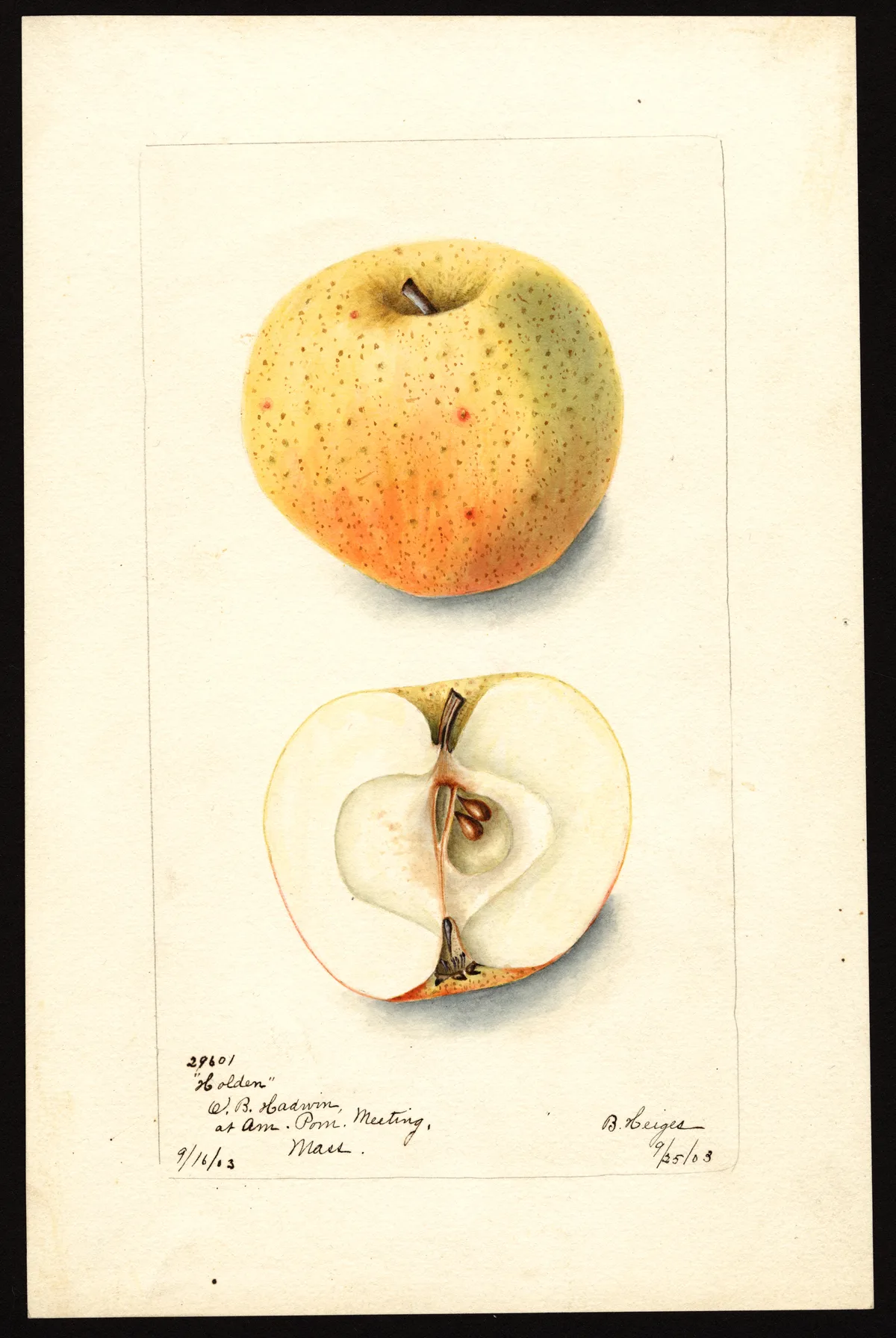
USDA Pomological Watercolor Collection
Elgin Pippin
Origin and History
The Elgin Pippin is a yellow apple of good size and attractive appearance. It originated in Alabama. The variety evidently belongs to the Fall Pippin class, though it does not closely resemble that variety and is not superior to it. Although it has considerable merit, it does not excel other varieties of its season and was not recommended for planting in New York.
Downing questioned whether it is identical with the White Spanish Reinette, but it appears to be distinct from that variety.
The variety was documented in Bailey's Annual Report of Horticulture (1892), Clayton's Alabama Station Bulletin (1893), Thomas (1897), and Beach and Clark's New York Station Bulletin (1904).
Tree
The tree is vigorous and upright, with long, moderately stout branches. The form is very much spreading and somewhat drooping, with rather dense foliage. Twigs are medium in size, curved, and stout, with long internodes. The bark is brown, tinged with olive-green, mottled with scarf-skin, and slightly pubescent. Lenticels are scattering, large, oblong, and raised. Buds are large, broad, plump, obtuse, free, and slightly pubescent. The tree is productive.
Fruit
Size and Form: Fruit is above medium to large, averaging nearly large. The form is oblate to roundish conic, distinctly ribbed, and irregular, with sides often unequal, sometimes elliptical, and not uniform.
Stem: Medium to very long and slender.
Cavity: Acute to acuminate, medium in depth to deep, rather broad to narrow. Usually with outspreading russet rays, sometimes decidedly compressed, sometimes lipped.
Calyx: Medium to large, closed; lobes often leafy, long, and acuminate.
Basin: Sometimes oblique, shallow to moderately deep, moderately wide to rather narrow, obtuse to rather abrupt. Often prominently and irregularly ribbed.
Skin: Thin and moderately tender. Color greenish yellow becoming deep yellow, sometimes with a faint bronze blush in the sun. Dots are scattering, russet, or submerged and whitish.
Calyx Tube: Rather large, moderately wide, conical or approaching funnelform. Stamens median to basal.
Core: Abaxile, medium to large; cells unsymmetrical, usually wide open; core lines meeting or slightly clasping. Carpels irregular, often somewhat ovate, much concave, tufted.
Seeds: Often abortive, dark, rather large, long, flat, acute to acuminate.
Flesh: Whitish tinged with yellow, firm, moderately fine, crisp, tender, juicy. Flavor subacid, good.
Season
September to December. Commercial limit: October.
Uses
Not described in source.
Other
Warder describes another variety under the name Elgin Pippin, which Beach and his contemporaries had not encountered.
Book Sources
Described in 1 period pomological work
Nursery Catalog Sources
Found in 1 catalog (1901) from Illinois
- Benjamin Buckman (personal inventory) , Farmingdale , Illinois — 1901
View original book sources (1)
— S.A. Beach, The Apples of New York, Vol. 2 (1905)ELGIN PIPPIN.
REFERENCES. 1. Bailey, An. Hort., 1892:238. 2. Clayton, Ala. Sta. Bul., 47:6. 1893. 3. Thomas, 1897:634. 4. Beach and Clark, N. Y. Sta. Bul., 248:118. 1904. SYNONYMS. None.
Fruit of good size and attractive appearance for a yellow apple. It evidently belongs to the Fall Pippin class but it does not closely resemble that variety and is not superior to it. Although it has much merit it does not excel other varieties of its season and is not recommended for planting in New York. The tree is a strong grower and productive.
Historical. Origin Alabama (2, 3). Downing questions whether it is identical with the White Spanish Reinette but it appears to be distinct from that variety.¹ Warder describes another variety under the name Elgin Pippin which we have not seen.²
TREE.
Tree vigorous, upright; branches long, moderately stout. Form very much spreading and somewhat drooping, rather dense. Twigs medium in size, curved, stout; internodes long. Bark brown, tinged with olive-green, mottled with scarf-skin, slightly pubescent. Lenticels scattering, large, oblong, raised. Buds large, broad, plump, obtuse, free, slightly pubescent.
FRUIT.
Fruit above medium to large, averages nearly large. Form oblate to roundish conic, distinctly ribbed, irregular; sides often unequal, sometimes elliptical, not uniform. Stem medium to very long, slender. Cavity acute to acuminate, medium in depth to deep, rather broad to narrow, usually with outspreading russet rays, sometimes decidedly compressed, sometimes lipped. Calyx medium to large, closed; lobes often leafy, long, acuminate. Basin sometimes oblique, shallow to moderately deep, moderately wide to rather narrow, obtuse to rather abrupt, often prominently and irregularly ribbed.
Skin thin, moderately tender, greenish yellow becoming deep yellow, sometimes with a faint bronze blush in the sun. Dots scattering, russet, or submerged and whitish.
Calyx tube rather large, moderately wide, conical or approaching funnelform. Stamens median to basal.
Core abaxile, medium to large; cells unsymmetrical, usually wide open; core lines meeting or slightly clasping. Carpels irregular, often somewhat ovate, much concave, tufted. Seeds often abortive, dark, rather large, long, flat, acute to acuminate.
Flesh whitish tinged with yellow, firm, moderately fine, crisp, tender, juicy, subacid, good.
Season September to December. Commercial limit, October.
¹ Downing, 1869:404. ² Warder, 1867:517.