Long Red Pearmain
Apple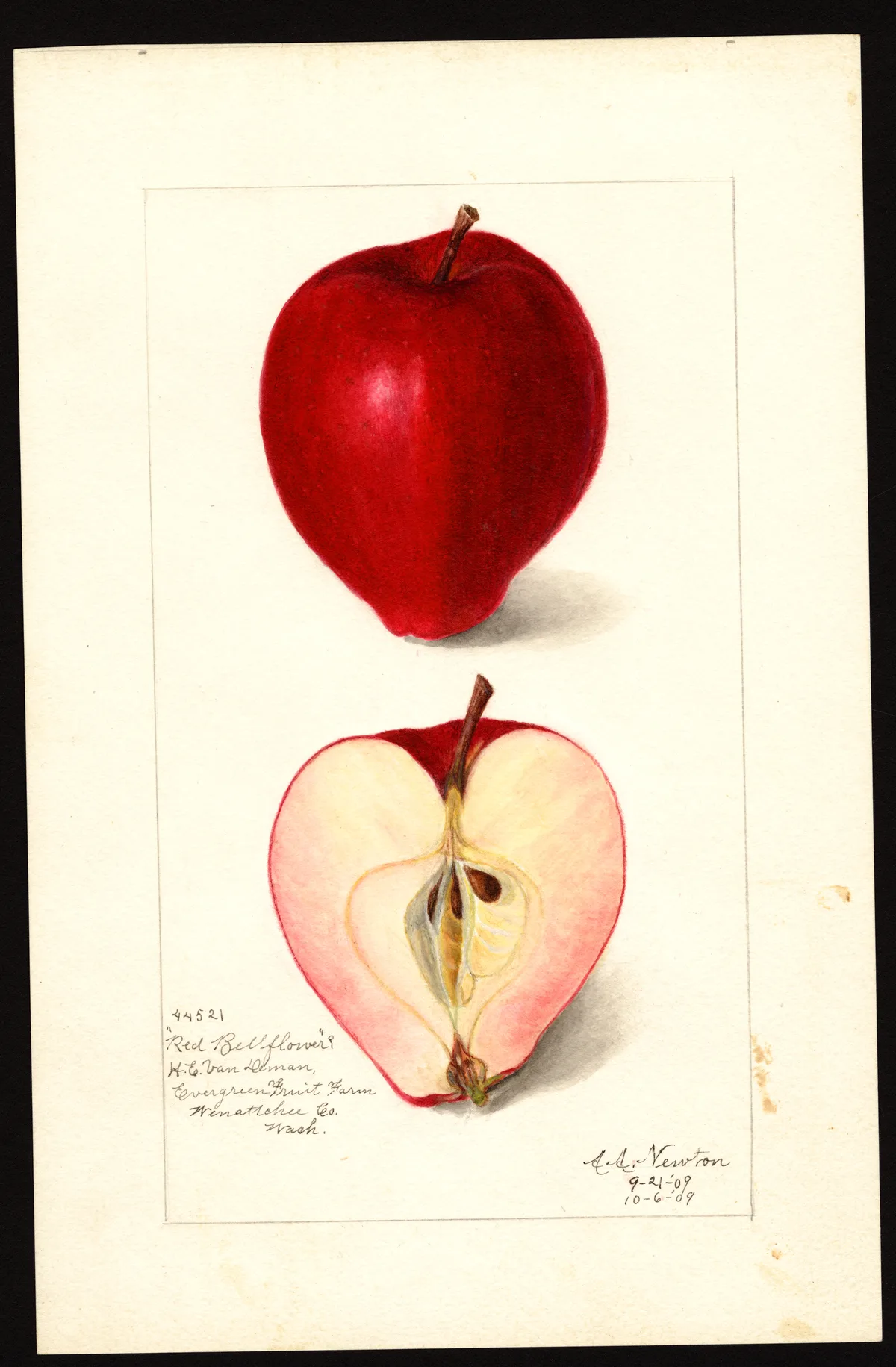
USDA Pomological Watercolor Collection
Origin/History
The Long Red Pearmain is said to have originated on the property of the Economites at New Harmony, Indiana. For many years it was considered identical with Kaighn's Spitzenburg; Downing so treated them as one in the second revised edition of his work. By 1876, however, Downing stated that experience and examination had proven them distinct, both in the growth and form of the tree and in the fruit. The true Kaighn's Spitzenburg was first described by William Coxe in his work on fruits in 1817 as having originated in Gloucester County, New Jersey, and so far as Downing knew, had no synonyms. By 1900, Downing noted that neither apple was much cultivated, better kinds having supplanted them, his object in treating them being to correct the long-standing confusion between the two varieties.
Tree
Not described in source.
Fruit
Size: Medium to large.
Form: Oblong, approaching conic.
Stem: Not described in source.
Cavity: Not described in source.
Calyx: Not described in source.
Basin: Not described in source.
Skin: Yellowish ground, shaded and striped with red.
Flesh/Flavor: Flesh coarse, pleasant subacid; quality rated good.
Core/Seeds: Not described in source.
Season
Late fall and early winter.
Uses
Not described in source.
Subtypes/Variants
Not described in source.
Other
Not described in source.
Book Sources
Described in 2 period pomological works
View original book sources (2)
— A.J. Downing, The Fruits and Fruit Trees of America (1900)Kaign's Spitzenburg and Long Red Pearmain.
For many years these have been considered identical, and Downing so makes it in the second revised edition, but experience and examination have proven them distinct, both in the growth and form of the tree, and of the fruit. The Long Red Pearmain is said to have originated on the property of the Economites at New Harmony, Indiana, many years since; The name and synonyms by which it is known in different localities are given below.
Long Red Pearmain.
Red Pearmain. Kaign's Spitzenburg, incorrectly. Long John. Red Spitzenberg. Striped Pearmain. Lady Finger, incorrectly. Winter Pearmain. Long Pearmain. Red Winter Pearmain, incorrectly. Scarlet Pearmain, incorrectly. English Pearmain, incorrectly. Red Bellflower, incorrectly. Red Pippin. Red Phoenix. Pearmain. Kentucky Gilliflower. Kentucky Bellflower. Hudson Red Streak. Sheepnose, of some. Wabash Bellflower. Russam. Park (not of Kansas). Mudhole. Pound Royal, incorrectly.
The true Kaign's Spitzenberg, so far as I know, has no synonyms, and was first described by William Coxe, in his work on Fruits, in 1817, as having originated in Gloucester county, New Jersey.
Neither of these apples are much cultivated now, as we have better kinds, the object being to correct the mistake.
— S.A. Beach, The Apples of New York, Vol. 2 (1905)LONG RED PEARMAIN.
REFERENCE. 1. Downing, 1876:55 app.
SYNONYMS. English Pearmain incorrectly (1). Hudson Red Streak (1). Kentucky Bellflower (1). Kentucky Gillflower (1). Kaighn's Spitzenburg incorrectly (1). Lady Finger incorrectly (1). Long John (1). Long Pearmain (1). Long Red Pearmain (1). Mudhole (1). Park (not of Kansas) (1). Pearmain (1). Pound Royal incorrectly (1). Red Bellflower incorrectly (1). Red Pearmain (1). Red Phoenix (1). Red Pippin (1). Red Spitzenberg (1). Red Winter Pearmain incorrectly (1). Russam (1). Scarlet Pearmain (1). Sheepnose of some (1). Striped Pearmain (1). Wabash Bellflower (1). Winter Pearmain (1).
This variety was for many years considered identical with Kaighn. See page 113. In 1876 Downing (1) stated that it was distinct from Kaighn in tree and fruit and gave the list of synonyms for it which is cited above.
The fruit is medium to large, oblong approaching conic, yellowish, shaded and striped with red; flesh coarse, pleasant subacid, good; season late fall and early winter.