HUBBARDSTON NONSUCH
Apple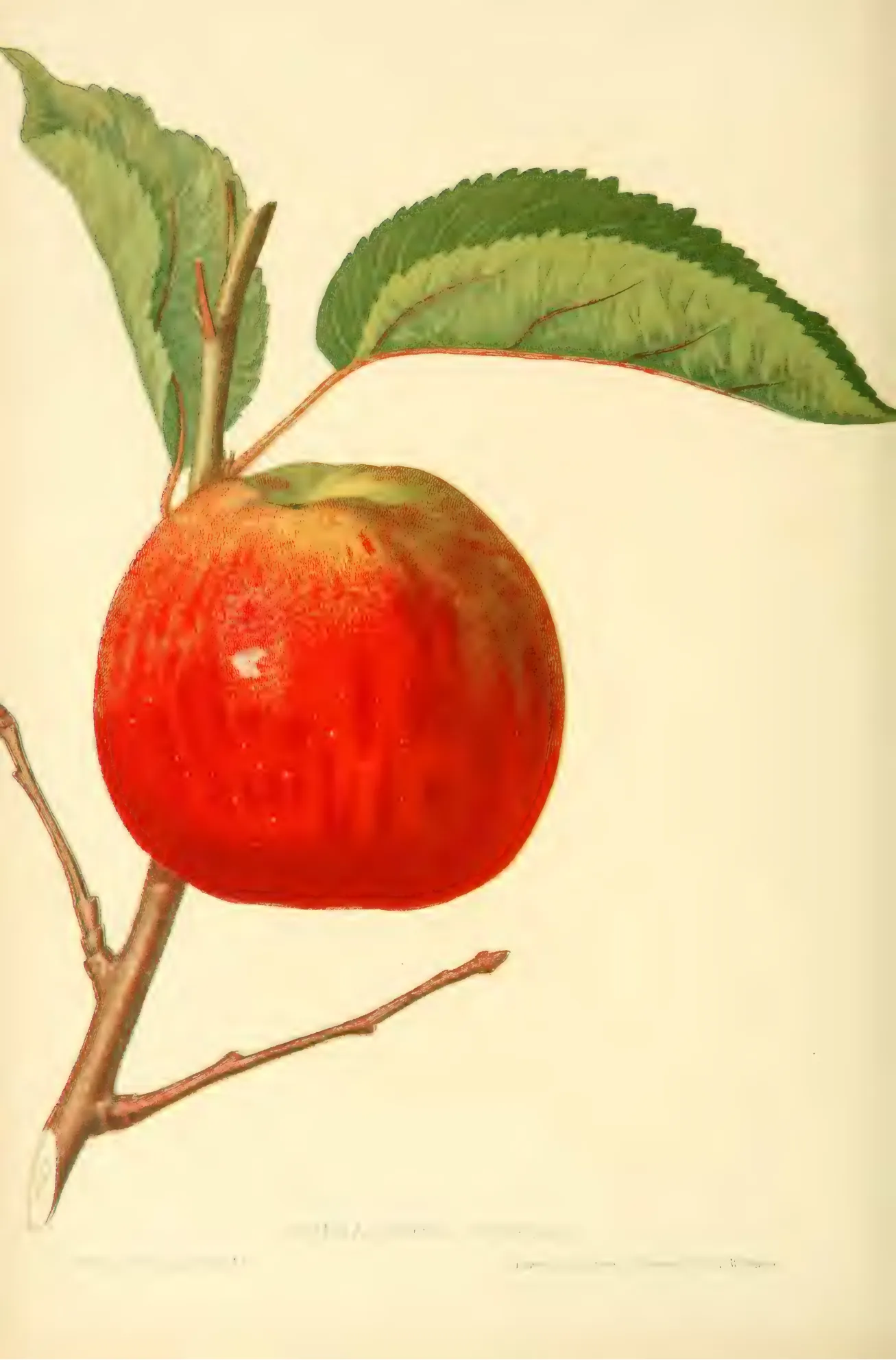
HUBBARDSTON NONSUCH
Origin/History
HUBBARDSTON NONSUCH originated in the town of Hubbardston, Massachusetts. It was introduced to notice by Capt. Hyde of Newton, one of the oldest nurserymen of his era, who procured scions and distributed a great number of trees from his nursery long before its merits were generally known — more than thirty years before Hovey's 1852 account. The variety was first described by Mr. Kenrick in the first edition of the American Orchardist (1832). By 1852, it had not yet been very extensively disseminated, though Hovey predicted it would "undoubtedly occupy a prominent place in every good orchard" as it became better known.
Hovey (1852) placed HUBBARDSTON NONSUCH in the same rank among early winter apples that the Baldwin holds among later ones, and the Porter among autumn varieties — a combination of large size, beautiful appearance, and rich flavor. In the Western states, where some New England apples suffered from bitter rot, HUBBARDSTON NONSUCH was declared "first rate in every particular." At one time, according to Warder (1867), HUBBARDSTON NONSUCH and the Baldwin were confounded and mixed in some Western collections.
Tree
The tree is vigorous, upright, with regularly curved branches, the ends erect; when full grown it makes a uniform and moderately spreading head (Hovey). Warder describes it as vigorous, healthy, productive, an early bearer, round-leaved, and branching. The Central Experimental Farm at Agassiz, BC, where trees were planted in spring 1893, also records it as a vigorous grower. Hovey notes that the tree possesses large and handsome foliage and, at every stage of growth — whether in the nursery row or at maturity — a stately and symmetrical habit. It is among the hardiest sorts, surpassing the Baldwin in this respect, and thrives in various parts of the country.
Bearing habit: In the orchard, HUBBARDSTON NONSUCH bears a full crop only in alternate (bearing) years and a small crop in intermediate years. The fruit, though always handsome, is greatly improved by high cultivation, being then unusually large and brilliantly colored.
Wood: Brownish chestnut, sprinkled with whitish specks, moderately strong, and not very long-jointed. Annual shoots rather slender, long, and very downy at the ends (Hovey).
Buds: Rather small, short, and little flattened (Hovey).
Leaves: Rather large, ovate-oblong, broadest near the middle, narrowing little to the base and tapering to the point; thick, deep shining green above, and covered with a whitish down beneath; deeply, coarsely, and unequally serrated, with prominent nerves, and folded inwards at the edges. Petioles of medium length, about one inch long, and rather stout (Hovey). Warder characterizes the leaves as round.
Flowers: Medium size; petals oblong, nearly flat, thin, somewhat wavy, and tinged with pink (Hovey).
Fruit
Size
Hovey and Warder agree the fruit is large. Hovey gives measurements of approximately three and a quarter inches broad and three inches deep. The Central Experimental Farm (1900) describes the fruit as of medium size — a divergence possibly reflecting growing conditions or the particular strain under cultivation at Agassiz.
Form
Roundish, or roundish conical, largest near the middle, narrowing towards the crown and slightly to the stem (Hovey). Warder describes it as round, somewhat ovate, tapering both ways from the middle, regular, with the surface often uneven. The CEF concurs: roundish, conical.
Stem
Medium length, about three quarters of an inch long, rather slender (Hovey). Warder gives it as medium or short.
Cavity
Broad and regular, with a brown coloration (Hovey, Warder). Warder specifies it as wide and regular.
Calyx / Eye
Hovey describes the eye as large and partially open, little sunk in the basin, with the segments of the calyx broad and very short. Warder gives the eye as medium or small and open — a conflict with Hovey on size.
Basin
Broad, open, and ribbed (Hovey). Warder describes it as abrupt, wide, regular, leather-cracked, or russeted, or both.
Skin
Fair, smooth, and glossy (Hovey). The ground color is a rich yellow (Hovey, Warder), nearly covered with deep orange red (Hovey) — Warder characterizes the overall effect as mixed red with broken stripes, presenting a rich brownish appearance, while the CEF describes the coverage as nearly covered with dark red. Hovey notes that the red is rather indistinctly striped with light crimson. The stem base is often russetted (Hovey, Warder). Dots: Hovey describes them as sparse, large russet specks; Warder as scattered, gray, and prominent; the CEF as whitish dots.
Flesh and Flavor
Hovey describes the flesh as yellowish, rather fine, crisp and tender. Warder concurs on color (yellow) and adds that it is breaking, fine-grained, and juicy. The CEF describes the flesh as white — a divergence from the yellowish/yellow of the book sources — and as juicy and tender.
Juice tolerably abundant, with a rich admixture of sweet and acid, high-flavored and excellent (Hovey). Warder characterizes the flavor as acid, sub-acid, rich, with quality very good. The CEF gives the flavor as pleasant, mildly acid, quality good.
Core and Seeds
Hovey describes the core as small and nearly close, with seeds of medium size and plump. Warder disagrees substantially: he gives the core as large, heart-shaped, regular, sometimes partially open, and clasping the eye, with seeds few and pointed.
Season
Hovey gives the season of ripening as usually November to February; the fruit may be kept in a cool cellar until March in very good condition, though at the sacrifice of most of its fine flavor. He notes it is ripe in October. Warder's season is November and December. The CEF gives January and February — consistent with late keeping rather than early ripening.
Uses
Suitable for table use when perfectly ripe and for cooking early in the season (Warder). Hovey emphasizes its excellence as a dessert apple when well grown, with high flavor. The fruit is greatly improved by high cultivation, producing unusually large and brilliantly colored specimens.
Other
Hovey's illustration was made from a specimen grown under high cultivation, which he notes represents the fruit at its finest — unusually large and brilliantly colored relative to typical orchard conditions.
Book Sources
Described in 2 period pomological works
- Warder, American Pomology: Apples (1867)
- Hovey, The Fruits of America (1852) — listed as The Hubbardston Nonsuch Apple
Nursery Catalog Sources
Found in 3 catalogs (1900–1913) from Illinois
- Central Experimental Farm , Dominion Department of Agriculture, Agassiz, British Columbia (under test; Bulletin No. 3, Second Series) — 1900
- Benjamin Buckman (personal inventory) , Farmingdale , Illinois — 1901
- Benjamin Buckman (personal inventory) , Farmingdale , Illinois — 1913
View original book sources (3)
— C.M. Hovey, The Fruits of America (1852)THE HUBBARDSTON NONSUCH APPLE.
Hubbardston Nonsuch. Kenrick's American Orchardist, 1st Ed. 1832.
The Hubbardston Nonsuch holds the same place among early winter apples, that the Baldwin does among the later ones, or the Porter among the autumn varieties. Of large size, beautiful appearance, and rich flavor, it possesses a combination of all the qualities of the finest apples. Nor does its excellence stop here; for the tree is a good grower, with large and handsome foliage, and in every stage of its growth, whether in the nursery row, or when it has attained a mature age, possesses a stately and symmetrical habit. It is also one of our hardiest sorts, surpassing, in this respect, the Baldwin; it thrives well in various parts of the country, and in the Western states, where some of our New England apples have been affected with what is called the bitter rot, the Hubbardston Nonsuch has been declared "first rate in every particular."
This fine apple was introduced to notice by Capt. Hyde, of Newton, one of our oldest nurserymen, upwards of thirty years ago, who procured scions, and distributed a great number of trees from his nursery long before its merits were generally known. It originated in the town of Hubbardston in this State, and was first described by Mr. Kenrick, in the first edition of the American Orchardist, nearly twenty years ago. It is not yet very extensively disseminated, but as it becomes better known, it will undoubtedly occupy a prominent place in every good orchard.
The Hubbardston Nonsuch in the orchard bears a full crop only in alternate, or what are usually termed bearing, years, and a small crop in the intermediate years. The fruit, though always handsome, is greatly improved by high cultivation, being then unusually large and brilliantly colored, as represented in our drawing. Its season of ripening is usually from November to February; but it may be kept in a cool cellar till March, in very good condition, though at the sacrifice of most of its fine flavor.
Tree. — Vigorous, upright, with regularly curved branches, the ends erect; when full grown, making a uniform and moderately spreading head.
Wood. — Brownish chestnut, sprinkled with whitish specks, moderately strong, and not very long-jointed; annual shoots rather slender, long, and very downy at the ends: Buds, rather small, short, and little flattened.
Leaves. — Rather large, ovate-oblong, broadest near the middle, narrowing little to the base, and tapering to the point, thick, deep shining green above, and covered with a whitish down beneath; deeply, coarsely, and unequally serrated, with prominent nerves, and folded inwards at the edges; petioles, medium length, about one inch long, and rather stout.
Flowers. — Medium size; petals oblong, nearly flat, thin, somewhat wavy, and tinged with pink.
Fruit. — Large, about three and a quarter inches broad, and three inches deep: Form, roundish, or roundish conical, largest near the middle, narrowing towards the crown, and slightly to the stem: Skin, fair, smooth, glossy, of a rich yellow, nearly covered with deep orange red, rather indistinctly striped with light crimson, often russetted around the base of the stem, and sparsely dotted on the surface with large russet specks: Stem, medium length, about three quarters of an inch long, rather slender, and moderately inserted in a broad, regular cavity: Eye, large, partially open, and little sunk in a broad, open, and ribbed basin; segments of the calyx broad and very short: Flesh, yellowish, rather fine, crisp and tender: Juice, tolerably abundant, with a rich admixture of sweet and acid, high-flavored and excellent: Core, small, nearly close: Seeds, medium size, plump.
Ripe in October, and keeps in good condition until February.
— John A. Warder, American Pomology: Apples (1867)HUBBARDSTON NONSUCH.
This fine apple originated in Hubbardston, Massachusetts. Tree vigorous, healthy, productive, early bearer, round-leaved, branching. At one time this and the Baldwin were confounded and mixed in some Western collections.
Fruit large, fair, handsome, round, somewhat ovate, tapering both ways from the middle, regular; Surface often uneven, yellow, covered with mixed red and broken stripes, presenting a rich brownish appearance; Dots scattered, gray, prominent.
Basin abrupt, wide, regular, leather-cracked, or russeted, or both; Eye medium or small, open.
Cavity wide, regular, brown; Stem medium or short.
Core large, heart-shaped, regular, sometimes partially open, clasping the eye; Seeds few, pointed; Flesh yellow, breaking, fine grained, juicy; Flavor acid, sub-acid, rich; Quality very good; Use, cooking early, table when perfectly ripe; Season, November, December.
— Central Experimental Farm, Central Experimental Farm, Agassiz BC — Catalogue of Fruit Trees under Test (Bulletin No. 3, 1900) (1900)Planted Spring 1893. Tree a vigorous grower. Fruit of medium size, roundish, conical. Skin nearly covered with dark red, and sprinkled with whitish dots. Flesh white, juicy, tender, pleasant, mildly acid, quality good. Season January and February.