Cogswell
Apple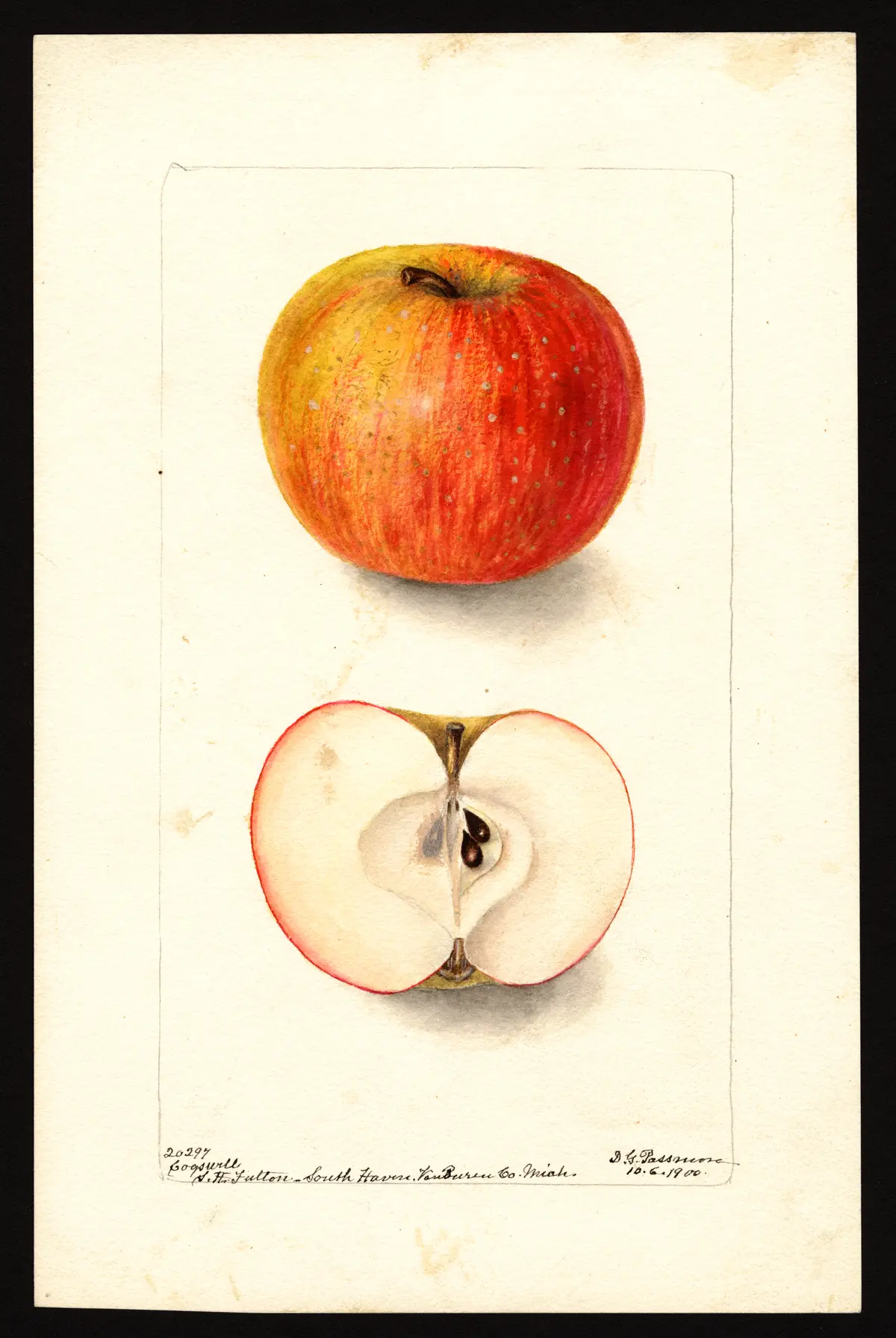
USDA Pomological Watercolor Collection
Cogswell
Origin / History
Cogswell is an American apple, native to Connecticut. It originated in the town of Griswold, near Norwich, Connecticut (Downing 1900; Budd-Hansen 1914), on a farm which came into the possession of William Cogswell about the year 1798; the original tree was then about forty or fifty years old. The fruit was first exhibited in 1816 or '18, before the Massachusetts Horticultural Society (Downing 1900). Warder (1867) likewise places the origin near Norwich, Connecticut. Beach (1905) records that it was introduced into cultivation in Connecticut about one hundred years before his writing, and notes that although it has been widely disseminated, in no section of the country has it come to occupy a prominent position as a commercial variety.
Hovey (1852) provides a fuller account of its introduction: the variety was of recent introduction to general notice at his time of writing. He first became acquainted with it through specimens exhibited from time to time by Mr. J. A. Kenrick, nurseryman, of Newton, Massachusetts, before the Massachusetts Horticultural Society — specimens which attracted much attention from their great beauty and earned a premium as one of the best winter apples. As late as February, Mr. Kenrick frequently exhibited the Cogswell in great perfection. Mr. Kenrick reported only that the scions, which he grafted into an old tree, were given to him by a friend who said he obtained them from Attleboro', Massachusetts, or vicinity, twenty years before Hovey's account. Subsequently it was learned that Cogswell was a well-known apple in the vicinity of Brooklyn, Connecticut, where some very old trees were growing and producing abundantly; E. Newbury, Esq., of that town, forwarded Hovey a barrel of the apples. Elliott (1865) confirms it has been grown in Massachusetts and Ohio.
Hovey (1852) notes that highly colored specimens greatly resemble the Hubbardston Nonsuch, but the fruit is a little flatter and ordinarily not so deeply striped. Warder (1867) remarks that the fruit has been thought to resemble the Ohio Nonpareil, but he judges it different; Elliott (1865) similarly notes that "Ohio Nonpareil" has been applied incorrectly by some to this variety. Downing (1900) calls it "an extremely valuable variety wherever grown, either for table or market purposes, a good keeper, and bears carriage to market long distances without apparent injury." Hovey (1852) calls it "undoubtedly one of the most profitable apples in cultivation."
Tree
Sources largely agree the tree is vigorous and upright. Warder (1867): vigorous, upright, productive on alternate years. Downing (1900): a vigorous, upright, spreading grower, an abundant bearer of very regular, even-sized fruit. Hovey (1852): a vigorous and upright grower, coming into bearing much earlier than most apples, a most abundant bearer with the branches loaded with fruit hanging in dense clusters; forms a fine large roundish head. In his detailed botanical notes, Hovey describes the tree as "moderately vigorous, and rather upright; annual shoots, rather long." Elliott (1865) also describes it as moderately vigorous, making rather long annual shoots. Thomas (1903): an abundant bearer every other year. Beach (1905) presents a more reserved view: "hardy and rather vigorous, but not reliably productive, although sometimes it bears heavy crops."
Wood / shoots. Young shoots dark reddish brown, somewhat downy (Downing 1900). Hovey (1852): dark reddish chestnut, sprinkled with whitish specks, moderately stout, and rather short-jointed; young wood somewhat downy; old wood dark brownish chestnut. Elliott (1865): annual shoots of a dark, reddish brown color.
Buds. Medium size, roundish; flower-buds good size (Hovey 1852).
Leaves. Medium size, roundish ovate, broadest near the base, narrowing to the point, wavy, light green above, little downy beneath, and finely and sharply serrated; petioles medium length, about one inch long, moderately stout (Hovey 1852).
Flowers. Medium size; petals roundish, cupped (Hovey 1852).
Fruit
Size. Above medium to large. Warder (1867): large, uniform, fair, beautiful. Downing (1900) and Budd-Hansen (1914): above medium. Beach (1905): about medium size. Thomas (1903): rather large. Elliott (1865): above medium size. Lowther (1914): medium. Hovey (1852) gives specific measurements: large, about three and a quarter inches broad, and two and a half deep.
Form. Roundish oblate, regular (Downing 1900; Thomas 1903; Budd-Hansen 1914; Lowther 1914). Warder (1867): round, flattened, regular. Hovey (1852): roundish oblate, very regular, largest in the middle, and little flattened at each end. Elliott (1865) notes some variability: roundish flattened, often angular, and also often on the same tree somewhat roundish conical.
Stem / Stalk. Short (Warder 1867; Elliott 1865; Hovey 1852); short, rather slender (Downing 1900; Budd-Hansen 1914); small (Thomas 1903); slender (Hovey 1852).
Cavity. Wide and brown (Warder 1867); large, thinly russeted (Downing 1900; Budd-Hansen 1914; Thomas 1903 — "cavity large, russeted"); open (Elliott 1865); very regular, open, moderately sunk (Hovey 1852). Elliott also notes some russet about the stem.
Calyx / Eye. Small, closed (Warder 1867); small, nearly closed (Downing 1900); medium, nearly closed (Elliott 1865); short (Thomas 1903); medium size, nearly closed, and slightly depressed in the basin, with broad segments (Hovey 1852).
Basin. Shallow, small (Warder 1867); small, shallow (Downing 1900; Budd-Hansen 1914; Thomas 1903); shallow (Elliott 1865); very small, shallow (Hovey 1852).
Skin / Color / Surface. Surface smooth; striped red on yellow (Warder 1867). Rich yellow, nearly covered with red, marked and streaked with bright red, pretty thickly sprinkled with areole dots (Downing 1900); Budd-Hansen (1914) repeat: surface rich yellow, nearly covered with red, marked and streaked with bright red; dots many, areole. Thomas (1903): striped rich red on yellow. Elliott (1865): rich yellow, covered with stripes, splashes, and dots of red; some russet specks and russet about the stem. Hovey (1852): fair, smooth, rich deep yellow, nearly covered with very distinct and abrupt splashes, stripes and dots of brilliant red, having a few large russet specks scattered over the surface. Beach (1905): yellowish-green more or less overlaid with red; in well colored specimens, nearly covered with red. Lowther (1914): yellow-red.
Flesh / Flavor. Yellow / yellowish (Warder 1867; Downing 1900; Elliott 1865; Hovey 1852; Thomas 1903; Budd-Hansen 1914). Tender (Warder 1867; Downing 1900; Hovey 1852; Thomas 1903; Budd-Hansen 1914). Fine-grained (Warder 1867; Downing 1900; Budd-Hansen 1914). Juicy (Warder 1867; Downing 1900; Elliott 1865; Budd-Hansen 1914) — Hovey (1852) calls the juice abundant. Compact (Thomas 1903). Crisp (Hovey 1852; Elliott 1865) — Hovey notes it is "little coarse, crisp and tender." Flavor mild sub-acid, aromatic, rich (Warder 1867); scarcely subacid, rich aromatic (Downing 1900; Budd-Hansen 1914); scarcely sub-acid, with a fine, rich, aromatic flavor (Thomas 1903); sprightly, aromatic, sub-acid (Elliott 1865); "an agreeable admixture of sweet and acid, sprightly, high flavored and excellent" (Hovey 1852).
Core / Seeds. Core small (Downing 1900; Elliott 1865; Budd-Hansen 1914); core small, nearly closed (Hovey 1852). Seeds medium size, dark brown (Elliott 1865); medium size, angular, dark brown (Hovey 1852).
Quality. Best (Warder 1867; Lowther 1914); very good to best (Downing 1900; Budd-Hansen 1914); "excellent dessert fruit" (Thomas 1903); "everything that can be required to class it as a first-rate fruit worthy of general cultivation" (Elliott 1865); "high flavored and excellent" (Hovey 1852). Beach (1905) dissents: "It is not equal to standard varieties of its season in quality and general appearance. Not recommended for planting."
Season
December to March (Warder 1867; Downing 1900; Budd-Hansen 1914). Through winter (Thomas 1903). Winter (Lowther 1914). January to March (Elliott 1865). Hovey (1852): season of maturity is early winter, but it may be kept as late as March; ripe in January, and keeps till March. Downing (1900) notes it is a good keeper and bears carriage to market long distances without apparent injury.
Uses
Table / dessert (Warder 1867; Thomas 1903 — "An excellent dessert fruit"); table or market (Downing 1900); both kitchen and market (Lowther 1914). Hovey (1852) regards it as "one of the most profitable apples in cultivation."
Subtypes / Variants
Not described in source.
Other
Lowther (1914) reports Cogswell from 5 stations in the Northern Division, 2 stations in the Central Division, and 2 stations in the Southern Division; the asterisk on each division count indicates the variety is reported as adapted to more than one division.
Book Sources
Described in 8 period pomological works
- Elliott, The Western Fruit Book (1865)
- Warder, American Pomology: Apples (1867) — listed as Coggeswell
- Beach, The Apples of New York Vol. 1 (1905)
- Budd & Hansen, Systematic Pomology (1914)
- Downing, Fruits and Fruit Trees of America (1900)
- Lowther (ed.), Encyclopedia of Practical Horticulture (1914)
- Thomas, The American Fruit Culturist (1903)
- Hovey, The Fruits of America (1852) — listed as THE COGSWELL APPLE.
Nursery Catalog Sources
Found in 1 catalog (1901) from Illinois
- Benjamin Buckman (personal inventory) , Farmingdale , Illinois — 1901
View original book sources (8)
— John A. Warder, American Pomology: Apples (1867)Coggeswell.
Origin near Norwich, Connecticut. Tree vigorous, upright, productive on alternate years.
Fruit large, uniform, fair, beautiful, round, flattened, regular; Surface smooth, striped red on yellow.
Basin shallow, small; Eye small, closed.
Cavity wide, brown; Stem short.
Flesh yellow, tender, fine-grained, juicy; Flavor mild sub-acid, aromatic, rich; Quality best; Use, table; Season, December to March.
This fruit has been thought to resemble the Ohio Nonpareil, but I think it is different.
— A.J. Downing, The Fruits and Fruit Trees of America (1900)Cogswell.
Cogswell Pearmain.
This excellent Apple originated in the town of Griswold, near Norwich, Ct., on a farm which came into the possession of William Cogswell about the year 1798. The original tree was then about forty or fifty years old. The fruit was first exhibited in 1816 or '18, before the Massachusetts Horticultural Society.
It is an extremely valuable variety wherever grown, either for table or market purposes, a good keeper, and bears carriage to market long distances without apparent injury. Tree a vigorous, upright, spreading grower, an abundant bearer of very regular, even-sized fruit. Young shoots dark reddish brown, somewhat downy.
Fruit size above medium. Form roundish oblate, regular. Color rich yellow, nearly covered with red, marked and streaked with bright red, pretty thickly sprinkled with areole dots. Stalk short, rather slender. Cavity large, thinly russeted. Calyx small, nearly closed. Basin small, shallow. Flesh yellowish, fine-grained, tender, juicy, scarcely subacid, rich aromatic. Core small. Very good to best. December to March.
— S.A. Beach, The Apples of New York, Vol. 1 (1905)COGSWELL.
REFERENCES. 1. Hovey, Mag. Hort., 15:252. 1849. fig. 2. Hovey, 2:31. 1851. col. pl. 3. Cabot, Mag. Hort., 17:69. 1851. 4. Am. Pom. Soc. Cat., 1854. 5. Clift, Mag. Hort., 22:76. 1856. 6. Downing, 1857:75. fig. 7. Elliott, 1858:469. 8. Downing, Mag. Hort., 27:59. 1861. 9. Warder, 1867:589. 10. Downing, 1872:130. fig. 11. Barry, 1883:344. 12. Thomas, 1885:232. 13. Lyon, Mich. Hort. Soc. Rpt., 1890:290. 14. Bailey, An. Hort., 1892:237. 15. Lyon, Mich. Sta. Bul., 169:170. 1899. 16. Budd-Hansen, 1903:65. fig. 17. Beach and Clark, N. Y. Sta. Bul., 248:115. 1904.
SYNONYMS. COGGESWELL (9). COGGSWELL (3). Cogswell Pearmain (2, 6, 10). Cogswell's Pearmain (7). Not identical with Ohio Nonpareil (8).
Tree hardy and rather vigorous, but not reliably productive, although sometimes it bears heavy crops. Fruit about medium size, yellowish-green more or less overlaid with red; in well colored specimens, nearly covered with red. It is not equal to standard varieties of its season in quality and general appearance. Not recommended for planting.
Historical. Introduced into cultivation in Connecticut about one hundred years ago (5). It has been widely disseminated but in no section of the country has it come to occupy a prominent position as a commercial variety.
— Granville Lowther (ed.), Encyclopedia of Practical Horticulture (1914)Cogswell. Size: medium. Form: roundish oblate. Color: yellow-red. Quality: best. Use: both kitchen and market. Season: winter. Reported by 5 stations in the Northern Division, 2 stations in the Central Division, and 2 stations in the Southern Division; the asterisk on each division count indicates the variety is reported as adapted to more than one division.
— C.M. Hovey, The Fruits of America (1852)THE COGSWELL APPLE.
Cogswell. Magazine of Horticulture, vol. xv. p. 252. Cogswell Pearmain, of Connecticut.
The Cogswell apple is of recent introduction to general notice. We first became acquainted with it from the beautiful specimens exhibited from time to time, by Mr. J. A. Kenrick, nurseryman, of Newton, Mass., before the Massachusetts Horticultural Society. From their great beauty, they attracted much attention, and were of such excellence as to merit a premium, as one of the best winter apples. As late as February, Mr. Kenrick has frequently exhibited the Cogswell in great perfection, and our drawing was made from one of his specimens. We need not commend the beauty of this fruit, as that will be apparent to all. Highly colored specimens greatly resemble the Hubbardston Nonsuch, but the fruit is a little flatter, and, ordinarily, not so deeply striped.
At the time we described this apple in the Magazine of Horticulture, in 1849, we could obtain no information of its origin, or trace it to any original source. Mr. Kenrick could give no other account of it than that the scions, which he grafted into an old tree, were given to him by a friend who said that he obtained them from Attleboro', Mass., or vicinity. This was twenty years ago. But since then, and quite recently, we have learned that the Cogswell is a well known apple in the vicinity of Brooklyn, Conn., and that some very old trees are growing there, which produce abundantly. Indeed, our friend E. Newbury, Esq., of that town, kindly forwarded us, last winter, a barrel of the apples.
The Cogswell possesses all the characteristics of a fine fruit. The tree is a vigorous and upright grower, and comes into bearing much earlier than most apples. It is a most abundant bearer, the branches being loaded with its fruit, which hang in dense clusters. Its season of maturity is early winter, but it may be kept as late as March. It is undoubtedly one of the most profitable apples in cultivation. The tree forms a fine large roundish head.
Tree. — Moderately vigorous, and rather upright; annual shoots, rather long.
Wood. — Dark reddish chestnut, sprinkled with whitish specks, moderately stout, and rather short-jointed; young wood, somewhat downy; old wood, dark brownish chestnut; buds, medium size, roundish: Flower-buds, good size.
Leaves. — Medium size, roundish ovate, broadest near the base, narrowing to the point, wavy, light green above, little downy beneath, and finely and sharply serrated; petioles, medium length, about one inch long, moderately stout.
Flowers. — Medium size; petals, roundish, cupped.
Fruit. — Large, about three and a quarter inches broad, and two and a half deep: Form, roundish oblate, very regular, largest in the middle, and little flattened at each end: Skin, fair, smooth, rich deep yellow, nearly covered with very distinct and abrupt splashes, stripes and dots of brilliant red, having a few large russet specks scattered over the surface: Stem, short, slender, and moderately sunk in a very regular, open cavity: Eye, medium size, nearly closed, and slightly depressed in a very small shallow basin; segments of the calyx, broad: Flesh, yellowish, little coarse, crisp and tender: Juice, abundant, with an agreeable admixture of sweet and acid, sprightly, high flavored and excellent: Core, small, nearly closed: Seeds, medium size, angular, dark brown.
Ripe in January, and keeps till March.
— F.R. Elliott, The Western Fruit Book (1865)Cogswell. Cogswell's Pearmain, | Ohio Nonpareil, incorrectly of some. American. Native of Connecticut. It has been grown in Mass. and Ohio, and thus far, where the variety has been fruited, it has proved everything that can be required to class it as a first-rate fruit worthy of general cultivation. The tree is a good bearer, producing always fair and even fruit. Tree, moderately vigorous, making rather long annual shoots, of a dark, reddish brown color. The fruit is above medium size, roundish flattened ; often angular ; and also often, on the same tree, somewhat roundish conical ; the color is rich yellow, covered with stripes, splashes, and dots of red ; some russet specks and russet about the stem ; stem, short ; cavity, open ; calyx, medium, nearly closed ; basin, shallow ; flesh, yellowish, crisp, juicy, sprightly, aromatic, sub-acid ; core, small ; seeds, medium size, dark brown. January to March.
— John J. Thomas, The American Fruit Culturist (1903)Cogswell. Rather large, roundish-oblate, regular; striped rich red on yellow; stalk small, cavity large, russeted; calyx short, basin small; flesh yellowish, compact, tender, scarcely sub-acid, with a fine, rich, aromatic flavor. Through winter. An excellent dessert fruit. An abundant bearer every other year. Connecticut.
— J.L. Budd & N.E. Hansen, American Horticultural Manual, Part II: Systematic Pomology (1914)Cogswell.—Origin, Griswold, Connecticut. Fruit above medium, roundish, oblate, regular; surface rich yellow, nearly covered with red, marked and streaked with bright red; dots many, areole; cavity large, thinly russeted; stem short, rather slender; basin small, shallow. Core small; flesh yellowish, fine-grained, tender, juicy, scarcely subacid, rich aromatic, very good to best. December to March.