Summer Rambo
Apple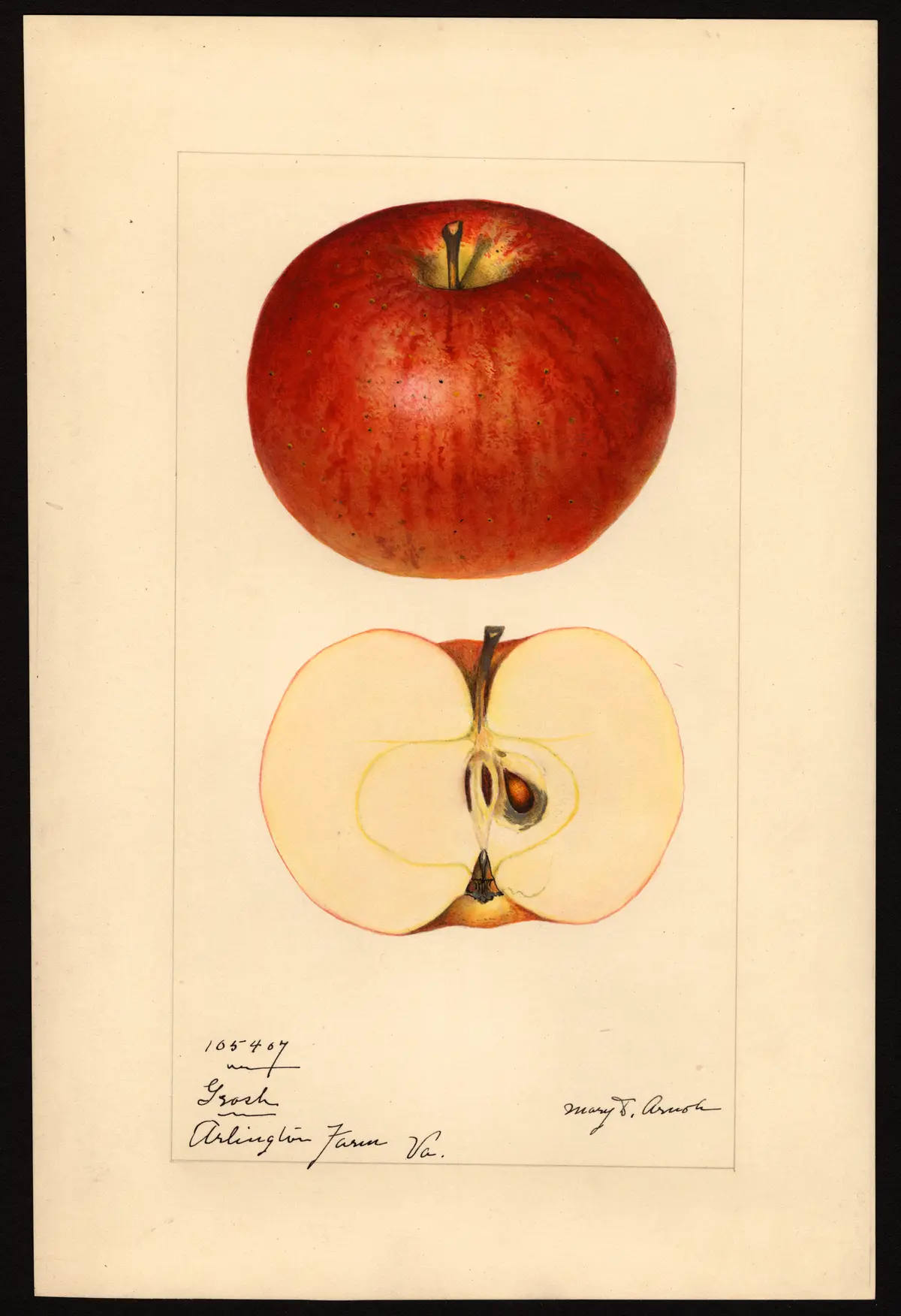
USDA Pomological Watercolor Collection
Summer Rambo
Origin / History
An old apple of French origin. Elliott, who enters it under the name Summer Rambour, lists it simply as "Foreign." Downing calls it "an old French Apple which was pretty freely distributed many years since." Beach calls it an old variety and says it is said to have originated in France, citing Leroy. His references begin with Switzer, 1725 (as cited by Floy-Lindley), followed by Duhamel, 1768, and Forsyth, 1803. Hedrick says it probably originated in France more than two centuries ago and has been grown in America since 1800.
In America it was described by Coxe in 1817 and by Kenrick in 1832. It was listed in the catalogue of the American Pomological Society under the name Rambour Franc from 1862 to 1871, and nurserymen still listed it in Beach's day. Thomas calls the name Summer Rambo "a corruption of Summer Rambour" and refers the reader to Western Beauty.
Beach writes that although it has long been known in cultivation in this country, it "has not gained much recognition among New York fruit growers." He finds it comparatively little known in New York state and more often found in cultivation in Ohio and regions farther west. Hedrick says it is now to be found, on this side of the Atlantic, only in Ohio and states to the West. Beach adds that it has been tested in many parts of the United States, but its cultivation has never become extensive. He says these facts "would indicate that it has weaknesses not apparent to the casual observer," and that "possibly it is worthy of further trial in this state."
Tree
Tree vigorous, a strong grower. Form spreading or upright spreading to roundish, open; Downing gives an open round head. The old trees everywhere prove hardy (Downing).
Twigs moderately long, curved, moderately stout; internodes medium. Bark brown, tinged with green, lightly streaked with scarf-skin; slightly pubescent. Lenticels quite numerous, medium size, round, not raised. Buds medium size, broad, plump, obtuse, free, slightly pubescent (Beach).
Comes into bearing young and bears quite regularly, yielding moderate to good crops (Beach).
Fruit
Size: A little above medium to very large, uniform in size and shape. Elliott and Downing put it above medium; Beach calls it large to very large.
Form: Flat or oblate to roundish oblate, "roundish flattened" (Elliott). Sometimes slightly ovate, sometimes faintly ribbed, pretty regular; sides often unequal (Beach). Generally evenly formed, but occasionally a little irregular (Downing).
Stem: Short to medium, rather thick (Beach).
Cavity: Nearly acuminate, medium to deep, rather broad, usually symmetrical, sometimes lipped, sometimes slightly russeted close to the stem (Beach).
Calyx: Rather large, closed or sometimes slightly open; lobes medium to short, rather narrow, acute to obtuse. Calyx tube medium in length, rather wide, broadly conical. Stamens median to marginal (Beach).
Basin: Deep to sometimes medium, wide to medium in width, abrupt, smooth, symmetrical (Beach).
Skin: Thick, tough, smooth. Ground clear bright yellow to greenish yellow or pale greenish yellow. Streaked, stained, and splashed with red, on the sunny side by Downing's account. Beach describes the red as mixed red. In well-colored specimens he finds the skin largely washed and mottled with lively pinkish-red, conspicuously marked with many broken stripes and splashes of bright carmine. Prevailing effect striped. Beach calls it "very attractive in size, form and color."
Dots: Numerous, usually small and submerged, but some scattering, large, brown or russet (Beach).
Flesh and flavor: Flesh yellowish-green, breaking, coarse, tender, somewhat aromatic, subacid: "sprightly subacid" by Downing, mildly subacid by Beach. Beach calls the flesh firm and very juicy; Downing calls it "rather soft," and Elliott "apt to be mealy." Quality "good" (Downing, Beach). In his summary Beach rates it "good to very good" and speaks of its "comparatively good quality."
Core and seeds: Core rather small, axile; cells nearly closed; core lines meeting or slightly clasping. Carpels roundish to roundish ovate, approaching elliptical. Seeds frequently abortive, rather large, wide, plump, acute, moderately dark brown (Beach).
Season
The recorded season runs from August to November. Elliott and Downing put ripening in August or early in September. Beach gives early autumn, September to November, and says it begins to ripen about a month earlier than Grosh.
Uses
Profitable for early marketing (Downing). Beach writes that its fine color and size, combined with its comparatively good quality, recommend it for home use or local market.
Subtypes / Variants
Not described in source.
Other
A fruit of the type of Grosh (Beach). Hedrick calls Grosh the better-known of the two.
Book Sources
Described in 5 period pomological works
Nursery Catalog Sources
Found in 4 catalogs (1900–1913) from Arkansas, Illinois
- Central Experimental Farm , Dominion Department of Agriculture, Agassiz, British Columbia (under test; Bulletin No. 3, Second Series) — 1900 — listed as Rambour d'Amerique
- Benjamin Buckman (personal inventory) , Farmingdale , Illinois — 1901
- Yarbrough Bros. , Stephens , Arkansas — 1901
- Benjamin Buckman (personal inventory) , Farmingdale , Illinois — 1913
View original book sources (5)
— F.R. Elliott, The Western Fruit Book (1865)Summer Rambour. Summer Rambo, | Rambour Franc, | Rambour d'Ete. Foreign. Above medium, greenish yellow, streaked with red, roundish flattened, apt to be mealy. August.
— A.J. Downing, The Fruits and Fruit Trees of America (1900)Summer Rambo. Rambour Franc. Rambour Gros. Frank Rambour. Summer Rambour. Rambour d'Ete.
This is an old French Apple which was pretty freely distributed many years since, and the old trees of which everywhere prove hardy and profitable for early marketing. Tree vigorous, spreading, open round head.
Fruit a little above medium size, flat, generally evenly formed, but occasionally a little irregular, pale greenish yellow, stained and streaked with red on the sunny side. Flesh rather soft, sprightly subacid. Good. Ripens early in September.
— John J. Thomas, The American Fruit Culturist (1903)Summer Rambo. (A corruption of Summer Rambour.) See Western Beauty.
— S.A. Beach, The Apples of New York, Vol. 2 (1905)SUMMER RAMBO.
REFERENCES. 1. Switzer, 1725 (cited by 7). 2. Duhamel, 1:28. 1768. 3. Forsyth, 1803:49. 4. Coxe, 1817:104. fig. 5. Forsyth, 1824:123. 6. Kenrick, 1832:37. 7. Floy-Lindley, 1833:12. 8. Manning, 1838:47. 9. Downing, 1845:94. 10. Thomas, 1849:141. 11. Elliott, 1854:178. 12. Am. Pom. Soc. Cat., 1862. 13. Warder, 1867:733. 14. Am. Pom. Soc. Cat., 1871:10. 15. Leroy, 1873:598. fig. 16. Mo. Hort. Soc. Rpt., 1883:76. 17. Lyon, Mich. Hort. Soc. Rpt., 1890:298. 18. Bailey, An. Hort., 1892:250. 19. (?) Revue Horticole, 66:202. 1894. 20. Taylor, Am. Pom. Soc. Rpt., 1895:199. 21. Burrill and McCluer, Ill. Sta. Bul., 45:337. 1896.
SYNONYMS. Cambour des Lorrains (15). Charmant Blanc (15). De Lorraine (15). De Rambourg (15). De Rambure (15). De Notre-Dame (15). FRANK RAMBOUR (1, 7). Frank Rambour (9). Grosh (16). Gros-Rambour d'Ete (15). Herbstbreitling (15). Lothringer Rambour d'Ete (15). Pomme de Notre-Dame (6). RAMBOUR (3). Rambour (15, 17). Rambour Blanc (15). (RAMBOUR D'AMERIQUE, 19)? RAMBOUR D'ETE (4, 8, 15). Rambour d'Ete (6, 9, 10, 11). RAMBOUR FRANC (2, 5, 6, 9, 12). Rambour Franc (4, 7, 10, 11, 15, 21). Rambourg Aigre (15). Rambour Gros (7, of the English 6). Rambour Raye (6, 15). Rambu (15). Remboure d'Ete (15). SUMMER RAMBO (13, 14, 16, 17, 18, 20, 21). Summer Rambo (11). SUMMER RAMBOUR (10, 11). Summer Rambour (4, 9).
Fruit of the type of Grosh; very attractive in size, form and color; large, oblate, yellowish-green considerably striped and splashed with mixed red, good to very good. Season early autumn. Begins to ripen about a month earlier than Grosh. The tree is a strong grower, comes into bearing young and bears quite regularly yielding moderate to good crops. Although it has long been known in cultivation in this country it has not gained much recognition among New York fruit growers. The fine color and size of this variety combined with its comparatively good quality recommend it for home use or local market. It is an old variety and has been tested in many parts of the United States but its cultivation has never become extensive. These facts would indicate that it has weaknesses not apparent to the casual observer. Possibly it is worthy of further trial in this state.
Historical. This variety is said to have originated in France (15). It has long been known in this country having been described by Coxe in 1817 and Kenrick in 1832 (4, 6). It was listed in the catalogue of the American Pomological Society under the name Rambour Franc from 1862 to 1871 (12, 14, 20). It is still listed by nurserymen (18). It is comparatively little known in New York state but is more often found in cultivation in Ohio and regions farther west.
TREE. Tree vigorous. Form upright spreading to roundish, open. Twigs moderately long, curved, moderately stout; internodes medium. Bark brown, tinged with green, lightly streaked with scarf-skin; slightly pubescent. Lenticels quite numerous, medium size, round, not raised. Buds medium size, broad, plump, obtuse, free, slightly pubescent.
FRUIT. Fruit large to very large, uniform in size and shape. Form oblate to roundish oblate, sometimes slightly ovate, sometimes faintly ribbed, pretty regular; sides often unequal. Stem short to medium, rather thick. Cavity nearly acuminate, deep to medium in depth, rather broad, usually symmetrical, sometimes lipped, sometimes slightly russeted close to the stem. Calyx rather large, closed or sometimes slightly open; lobes medium to short, rather narrow, acute to obtuse. Basin deep to sometimes medium, wide to medium in width, abrupt, smooth, symmetrical. Skin thick, tough, smooth, attractive clear bright yellow or greenish, in well colored specimens largely washed and mottled with lively pinkish-red, conspicuously marked with many broken stripes and splashes of bright carmine. Dots numerous, usually small and submerged, but some are scattering, large, brown or russet. Prevailing effect striped. Calyx tube medium in length, rather wide, broadly conical. Stamens median to marginal. Core rather small, axile; cells nearly closed; core lines meeting or slightly clasping. Carpels roundish to roundish ovate approaching elliptical. Seeds frequently abortive, rather large, wide, plump, acute, moderately dark brown. Flesh yellowish-green, firm, breaking, coarse, tender, very juicy, mildly subacid, somewhat aromatic, good. Season September to November.
— U.P. Hedrick, Cyclopedia of Hardy Fruits (1922)SUMMER RAMBO. Rambour. Summer Rambour. This apple is of the type of the better-known Grosh, differing chiefly in ripening its crop about a month earlier. The variety probably originated in France more than two centuries ago, and has been grown in America since 1800. It is now to be found, on this side of the Atlantic, only in Ohio and states to the West.
Tree vigorous, upright-spreading, open. Fruit large or very large, uniform in size and shape, oblate or round-oblate, sometimes ovate, faintly ribbed, regular, sides often unequal; stem short, thick; cavity acuminate, deep, broad, usually symmetrical, sometimes lipped, sometimes russeted near the stem; calyx large, closed or sometimes open; lobes short, narrow, acute; basin deep, wide, abrupt, smooth, symmetrical; skin thick, tough, smooth, yellow or greenish, in well-colored specimens largely washed and mottled with red, conspicuously marked with many broken stripes and splashes of carmine; dots numerous, usually small and submerged, with some large, brown or russet; prevailing effect striped; calyx-tube medium in length, wide, broadly conical; stamens median; core small, axile; cells closed; core-lines meeting; carpels round-ovate; seeds frequently abortive, or large, wide, plump, acute, dark brown; flesh yellow, firm, breaking, coarse, tender, very juicy, mild subacid, somewhat aromatic; good; September to November.