Tufts
Apple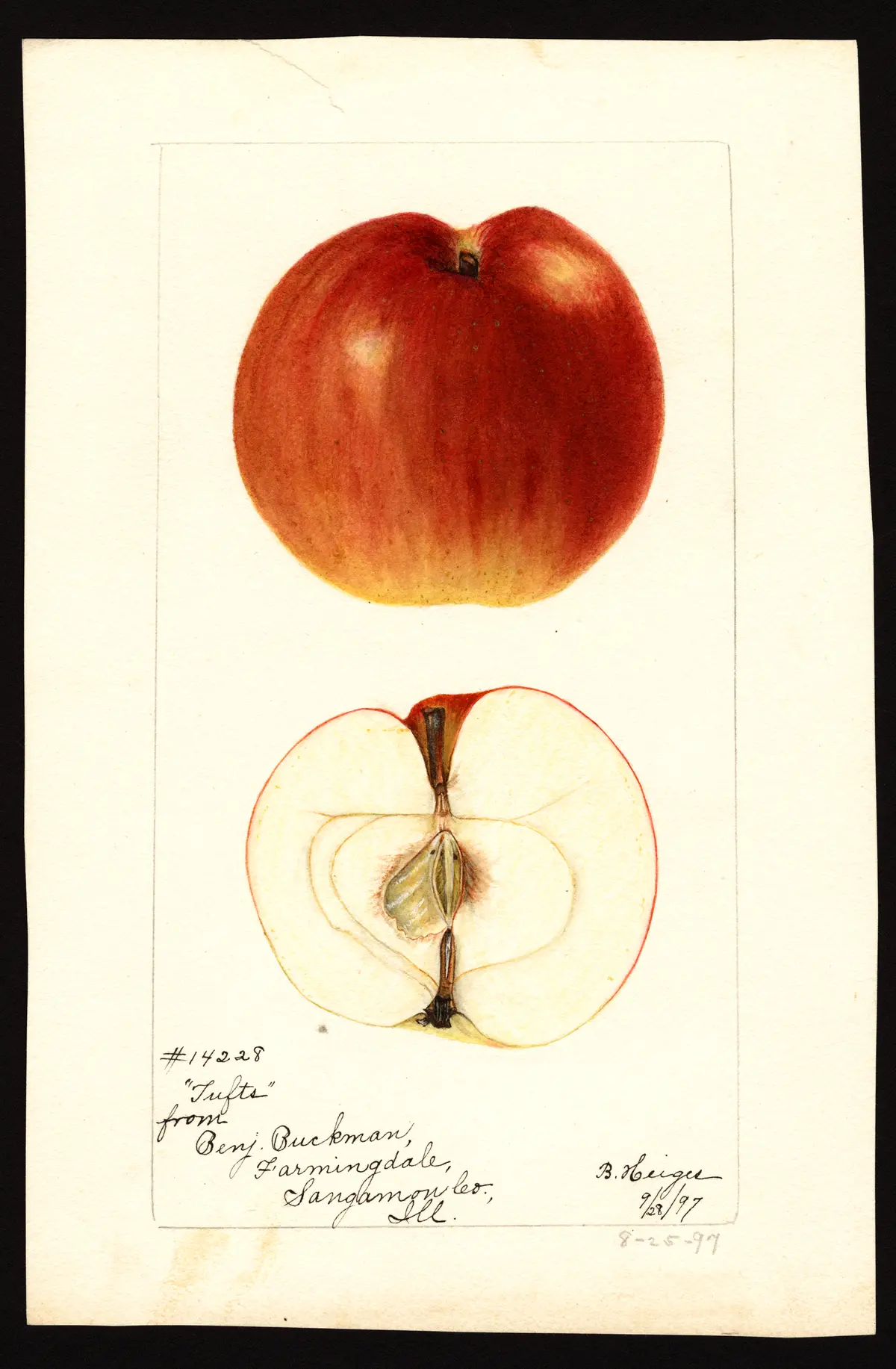
USDA Pomological Watercolor Collection
Origin/History
The Tufts apple originated about 1830 (or 1830–31) in Cambridge, Massachusetts, in the garden of the late Peter Tufts. It was first discovered among a lot of seedling stocks, where, from the size and beauty of the leaf and the vigor of the tree, it attracted the attention of the son of the owner, Mr. C. Tufts, who in the autumn removed it to a favorable situation where it might develop its growth. The tree advanced rather slowly and did not come into bearing for upwards of sixteen years; it then only bore two or three apples, the next year it produced more, the third year a larger number, and continued to increase the crop until the sixth or eighth year, when the tree was loaded with fine specimens. It was first exhibited at the annual show of the Massachusetts Horticultural Society in 1848 — Hovey gives the date of this first exhibition as 1860 by Mr. E. Tufts, where it not only attracted universal attention but obtained the prize as the best specimen offered for exhibition, and was subsequently tested by the Fruit Committee, who pronounced it a superior variety. By the early 20th century it was rarely listed by nurserymen and seldom or never planted in New York; it was chiefly to be found in New England, where it was occasionally preferred to Baldwin. It is regarded as an apple of the Baldwin group, resembling Baldwin in form, color, size, and general appearance.
Tree
Sources describe the tree somewhat differently. Downing calls the tree vigorous, forming a handsome head, and bearing annually. Hovey describes it as moderately vigorous, upright, and well shaped, not so rapid a grower as the Baldwin nor quite so erect and regular in its habit, though forming a large and well-shaped head, and a constant and abundant bearer with annual shoots of moderate length. Beach describes the tree as large, moderately vigorous, very spreading, flat, and open; it comes into bearing rather early and yields full crops biennially. Hedrick describes the tree as large, vigorous, spreading, flat, open.
Twigs/Wood. Twigs moderately long, curved, slender; internodes short. Bark brown, heavily coated with gray scarf-skin; pubescent. Lenticels scattering, medium size, oblong, not raised (Beach). Young wood dark brown (Downing). Wood dark chestnut, dotted with large white specks, moderately stout, and rather short-jointed; old wood brownish chestnut (Hovey).
Buds. Medium size, plump, obtuse, free, slightly pubescent (Beach); medium size, broad, flattened, woolly (Hovey).
Leaves. Large, oblong ovate, broadest near the base, narrowing but little to the point, which is sharply acuminate; thick, dull green, flat, rather smooth above, downy beneath; finely, obtusely and not very deeply serrated; petioles medium length, about one inch long, stout (Hovey).
Flowers. Medium size; slightly tinged with pink (Hovey).
Fruit
Size. Large, or nearly so; quite uniform in size and shape. Hovey gives dimensions of about three and a half inches broad and two and three quarters deep.
Form. Roundish to roundish oblate, sometimes with a broad protuberance above the cavity on one side, often flattened at apex, broadly ribbed; swollen on one side, somewhat uneven in outline, being slightly ribbed, and narrowing little to the crown, which is oblique (Hovey). Rounder and more flattened than Baldwin.
Stem. Long, rather slender (Beach, Hedrick); Hovey gives medium length, about three quarters of an inch long, slender, and deeply sunk.
Cavity. Acute to acuminate, medium in depth to deep, rather broad, often furrowed, usually with outspreading, irregular, greenish-russet rays (Beach, Hedrick). Downing describes a large cavity; Hovey describes a large, rather open cavity, little russeted around the stem.
Calyx. Medium to rather small (Beach) or small (Hedrick, Hovey), usually closed. Segments of the calyx short (Hovey). Calyx tube medium in length, conical or funnel-shape (Beach); conical (Hedrick). Stamens median to marginal (Beach); stamens median (Hedrick).
Basin. Rather shallow to moderately deep (Beach) or shallow (Hedrick); medium in width to wide, or wide; obtuse to somewhat abrupt; slightly wrinkled or wrinkled; somewhat ridged or ridged. Hovey describes a very broad and little furrowed basin, in which the eye is moderately sunk. Downing describes a plaited basin of moderate depth.
Skin. Moderately thin to thin, tough, smooth; of an oily touch (Hovey). Ground green or yellowish (Beach, Hedrick) or greenish yellow (Hovey) or yellowish (Downing), nearly covered with bright deep red like the Baldwin. Beach notes the color as not striped or with indistinct stripes of purplish carmine; Hedrick records indistinct stripes of purplish-carmine; Downing gives much shaded and sometimes striped with red; Hovey describes dark, dull crimson nearly covering the ground, little russeted around the stem, with the surface interspersed with a few scattered yellow specks. The skin is of a deeper and richer hue than Baldwin (Hovey). Dots: conspicuous, medium to rather small, gray or russet (Beach); inconspicuous, gray or russet (Hedrick).
Flesh/Flavor. Flesh tinged with yellow or greenish (Beach) or yellow or greenish (Hedrick) or greenish white (Hovey); firm, moderately coarse (Beach) or coarse (Hedrick), crisp, rather tender or tender, moderately juicy (Beach) or juicy (Hedrick), rather mild subacid or mild subacid; fair to good. Downing describes flesh as crisp, rather juicy, with a flavor scarcely subacid, and slightly aromatic, and rates it Good. Hovey describes juice as abundant, with a pleasant admixture of sweet and acid, high flavored and excellent, noting it possesses the same flavor and delicious admixture of sweet and acid that have made the Baldwin so popular. Beach regards it as more mild in flavor than Baldwin and less desirable for market or culinary uses. Thomas describes the flesh as dry, with a moderately good, sub-acid flavor.
Core/Seeds. Core large, axile or nearly so; cells closed or partly open; core lines clasping; carpels broadly roundish, often discolored, rather flat, emarginate (Beach, Hedrick). Hovey gives core medium size, nearly closed. Seeds often few, not well developed, dark brown, large, long, somewhat acute, slightly tufted (Beach) or tufted (Hedrick); Hovey describes seeds as medium size, mostly abortive.
Season
October to December, or October to January. In some years nearly all of the fruit is discolored at the core. The crop does not ripen evenly, and there is apt to be considerable loss from dropping of the fruit. In ordinary storage it is in season from October to January with October as the commercial limit, but in cold storage it may be held through the winter.
Uses
Considered less desirable than Baldwin for market or culinary uses (Beach). Not recommended for planting in New York. Occasionally preferred to Baldwin in New England.
Subtypes/Variants
Not described in source.
Other
Hovey places Tufts among late autumn apples, filling a gap between the end of Gravenstein and Porter and the coming-in of Hubbardston Nonsuch and Greening, and commends it as an accession to that class of native seedlings.
Book Sources
Described in 5 period pomological works
- Beach, The Apples of New York Vol. 2 (1905)
- Downing, Fruits and Fruit Trees of America (1900) — listed as Tuft's
- Hedrick, Cyclopedia of Hardy Fruits (1922)
- Thomas, The American Fruit Culturist (1903) — listed as Tuft's
- Hovey, The Fruits of America (1852) — listed as THE TUFTS APPLE.
Nursery Catalog Sources
Found in 1 catalog (1900)
- Central Experimental Farm , Dominion Department of Agriculture, Agassiz, British Columbia (under test; Bulletin No. 3, Second Series) — 1900
View original book sources (5)
— A.J. Downing, The Fruits and Fruit Trees of America (1900)Tuft's.
Tift's Baldwin.
Originated in Cambridge, Mass. The tree is vigorous, forming a handsome head, and bearing annually. Young wood dark brown.
Fruit large, roundish oblate, yellowish, much shaded and sometimes striped with red. Stalk in a large cavity. Calyx closed, in a plaited basin of moderate depth. Flesh crisp, rather juicy, with a flavor scarcely subacid, and slightly aromatic. Good. September, October.
— S.A. Beach, The Apples of New York, Vol. 2 (1905)TUFTS.
REFERENCES. 1. Mag. Hort., 14:519. 1848. 2. Cole, 1849:107. 3. Hovey, Mag. Hort., 16:496. 1850. fig. 4. Hovey, 2:23. 1851. col. pl. 5. Downing, 1857:198. 6. Warder, 1867:734. 7. Thomas, 1885:527. 8. Bailey, An. Hort., 1892:251. 9. Ib., 1892:251. 10. Beach, N. Y. Sta. An. Rpt., 11:589, 596. 1892. 11. Burrill and McCluer, Ill. Sta. Bul., 45:344. 1896. 12. Powell and Fulton, U. S. B. P. I. Bul., 48:58. 1903. 13. Beach and Clark, N. Y. Sta. Bul., 248:147. 1904.
SYNONYMS. TUFTS (3, 4, 7, 8, 10, 11, 12, 13). TUFTS BALDWIN (2, 5, 6, 9). Tufts Baldwin (7, 10, 12, of some 3 and 5). TUFTS SEEDLING (1).
An apple of the Baldwin group, somewhat like Baldwin in form, color and general appearance, but more mild in flavor and less desirable for market or culinary uses. In ordinary storage it is in season from October to January with October as the commercial limit, but in cold storage it may be held through the winter (13). In some years nearly all of the fruit is discolored at the core. The crop does not ripen evenly, and there is apt to be considerable loss from dropping of the fruit. The tree is large, a pretty good grower, comes into bearing rather early and yields full crops biennially. Not recommended for planting in New York.
Historical. This variety originated in Cambridge, Mass., about 1830. It was first exhibited at the annual show of the Massachusetts Horticultural Society in 1848 (4). It is now rarely listed by nurserymen (8, 9) and is seldom or never planted in this state.
TREE.
Tree large, moderately vigorous. Form very spreading, flat, open. Twigs moderately long, curved, slender; internodes short. Bark brown, heavily coated with gray scarf-skin; pubescent. Lenticels scattering, medium size, oblong, not raised. Buds medium size, plump, obtuse, free, slightly pubescent.
FRUIT.
Fruit large or nearly so, quite uniform in size and shape. Form roundish to roundish oblate, sometimes with a broad protuberance above the cavity on one side, often flattened at apex, broadly ribbed. Stem long, rather slender. Cavity acute to acuminate, medium in depth to deep, rather broad, often furrowed, usually with outspreading, irregular, greenish-russet. Calyx medium to rather small, usually closed. Basin rather shallow to moderately deep, medium in width to wide, obtuse to somewhat abrupt, slightly wrinkled, somewhat ridged. Skin moderately thin, tough, smooth, green or yellowish nearly covered with bright deep red like the Baldwin, not striped or with indistinct stripes of purplish carmine. Dots conspicuous, medium to rather small, gray or russet. Calyx tube medium in length, conical or funnel-shape. Stamens median to marginal. Core large, axile or nearly so; cells closed or partly open; core lines clasping. Carpels broadly roundish, often discolored, rather flat, emarginate. Seeds often few, not well developed, dark brown, large, long, somewhat acute, slightly tufted. Flesh tinged with yellow or greenish, firm, moderately coarse, crisp, rather tender, moderately juicy, rather mild subacid, fair to good.
Season October to December or January.
— C.M. Hovey, The Fruits of America (1852)THE TUFTS APPLE.
Tufts. Magazine of Horticulture, vol. xvi. p. 496. Tufts' Baldwin, of some.
Our list of late autumn apples, though very extensive, contains only a limited number of superior quality. After the Gravenstein and Porter are gone, there is only a moderate supply of fine sorts, till the Hubbardston Nonsuch, Greening, &c., come in. At that period, therefore, it is especially to be desired that accessions may be made to the number we already possess of the excellence, size and beauty of the varieties above mentioned. To supply such a desideratum, should be the effort of all who are looking up our native seedlings, or who may attempt the growth of new sorts by seeds.
The Tufts originated in 1830 or '31, in Cambridge, Mass., in the garden of the late Peter Tufts. It was first discovered among a lot of seedling stocks, and from the size and beauty of the leaf, and vigor of the tree, it attracted the attention of the son of the owner, Mr. C. Tufts, who removed it in the autumn to a favorable situation, where it might develop its growth. It advanced rather slowly, and did not come into bearing for upwards of sixteen years ; it then only bore two or three apples ; the next year it produced more ; the third year a larger number, and continued to increase the crop until the sixth or eighth year, when the tree was loaded with such specimens as our beautiful figure represents. In 1860, Mr. E. Tufts first exhibited quite a quantity of the apples at the annual show of the Massachusetts Horticultural Society, which not only attracted universal attention, but obtained the prize as the best specimen offered for exhibition. Subsequently, it was tested by the Fruit Committee, who pronounced it a superior variety.
The general appearance of the Tufts is similar to the Baldwin ; but the form is rounder and more flattened, and the skin is of a deeper and richer hue. It also possesses the same flavor, and delicious admixture of sweet and acid, which have made the Baldwin so popular a fruit. The tree is not so rapid a grower as the Baldwin, nor quite so erect and regular in its habit ; it, however, forms a large and well-shaped head. It is a constant and abundant bearer.
Tree. — Moderately vigorous, upright, and well shaped ; annual shoots of moderate length.
Wood. — Dark chestnut, dotted with large white specks, moderately stout, and rather short-jointed ; old wood, brownish chestnut ; buds, medium size, broad, flattened, woolly.
Leaves. — Large, oblong ovate, broadest near the base, narrowing but little to the point, which is sharply acuminate, thick, dull green, flat, rather smooth above, downy beneath, finely, obtusely and not very deeply serrated ; petioles, medium length, about one inch long, stout.
Flowers. — Medium size ; slightly tinged with pink.
Fruit. — Large, about three and a half inches broad, and two and three quarters deep : Form, roundish oblate, swollen on one side, somewhat uneven in its outline, being slightly ribbed, and narrowing little to the crown, which is oblique : Skin, fair, smooth, of an oily touch, with a greenish yellow ground, nearly covered with dark, dull crimson, little russeted around the stem, and the surface interspersed with a few scattered yellow specks : Stem, medium length, about three quarters of an inch long, slender, and deeply sunk in a large rather open cavity : Eye, small, closed, and moderately sunk in a very broad and little furrowed basin ; segments of the calyx short : Flesh, greenish white, fine, crisp, and tender : Juice, abundant, with a pleasant admixture of sweet and acid, high flavored and excellent : Core, medium size, nearly closed : Seeds, medium size, mostly abortive.
Ripe from October to December.
— John J. Thomas, The American Fruit Culturist (1903)Tuft's, or Tuft's Baldwin. Large, red on yellow ground, handsome; flesh dry, with a moderately good, sub-acid flavor. Autumn. Mass.
— U.P. Hedrick, Cyclopedia of Hardy Fruits (1922)TUFTS.
Tufts Baldwin. Tufts Seedling.
This apple is of the Baldwin type; the fruits are very similar in form, color, and size, but differ somewhat in flavor, being much milder. It is not so good a variety as Baldwin, but is occasionally preferred, especially in New England, where it is chiefly to be found. It originated at Cambridge, Massachusetts, about 1830.
Tree large, vigorous, spreading, flat, open. Fruit large, uniform in size and shape, round or round-oblate, sometimes with a broad protuberance above the cavity on one side, often flattened at apex, broadly ribbed; stem long, slender; cavity acute, medium in depth, broad, often furrowed, usually with outspreading, irregular, greenish-russet rays; calyx small, usually closed; basin shallow, wide, obtuse, wrinkled, ridged; skin thin, tough, smooth, green or yellow nearly covered with bright, deep red, with indistinct stripes of purplish-carmine; dots inconspicuous, gray or russet; calyx-tube medium in length, conical; stamens median; core large, axile; cells closed or partly open; core-lines clasping; carpels broadly round, often discolored, flat, emarginate; seeds few, not well developed, dark brown, large, long, somewhat acute, tufted; flesh yellow or greenish, firm, coarse, crisp, tender, juicy, mild subacid; fair to good; October to December or January.