Herefordshire Pearmain
Apple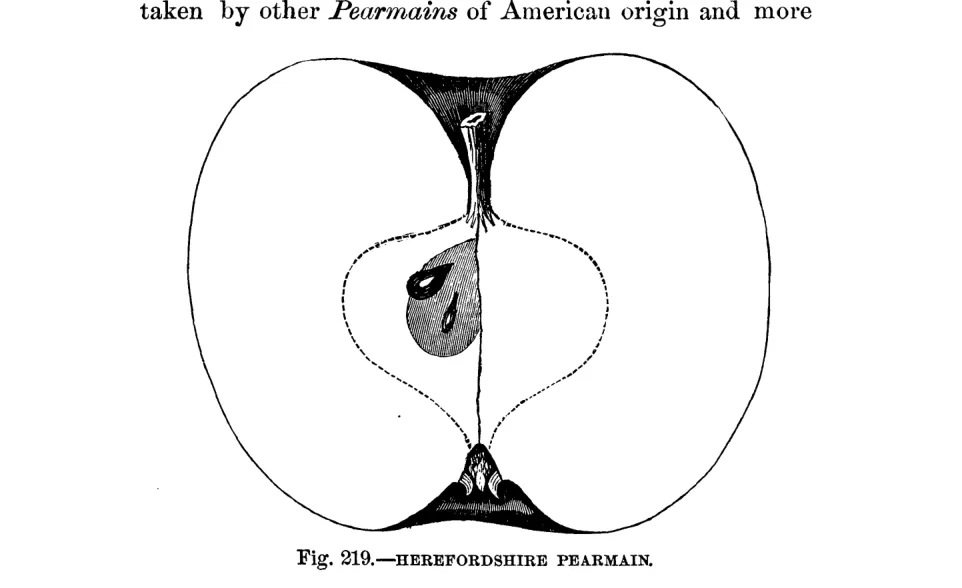
Herefordshire Pearmain
Origin / History
A very old and well-known English apple (the Herefordshire Pomona). Downing calls it "An old and popular English Apple," Elliott classes it as foreign, and Warder calls it "supposed to be an old English variety." Rea is the first to notice it, under the name Royal Pearmain: "it is a much bigger and better tasted apple than the common kind."
The Horticultural Society's catalogue calls it the Old Pearmain, and it is thereby confused with the Winter Pearmain. In some nursery gardens it is confused with the Summer Pearmain (the Herefordshire Pomona). Downing likewise notes "much confusion" between it and other Pearmains. Figured in Ronalds' Pyrus Malus Brentfordiensis, plate xxii, fig. 4.
Warder says Herefordshire Pearmain reached certain portions of the Western States from the East, "though now rarely seen there, as its place has been taken by other Pearmains of American origin and more vigor, such as the Long Island Pearmain."
Tree
Tree hardy, very hardy in the Herefordshire Pomona, attaining medium size. The Herefordshire Pomona calls it a free and vigorous grower. Downing gives a strong, vigorous, spreading growth for the variety he received and grew for many years. Warder calls it a slender and slow grower.
Shoots diverging, partially drooping (Elliott). Young shoots dull grayish brown, slightly downy, moderately strong (Downing). Thomas distinguishes it from Winter Pearmain by its stronger shoots. Very productive (Warder); bears well.
Elliott says it requires a rich, strong soil, "when the fruit is of the highest excellence," and that it is best in Northern sections. Thomas calls it best on light soils.
Fruit
Size: Small to large; most authors give medium. Warder gives small to medium. The Herefordshire Pomona alone calls it large, three inches wide and the same in height.
Form: Roundish conical. Warder gives it slightly conic and truncated sharply. The Herefordshire Pomona calls it Pearmain-shaped and slightly angular, generally with a prominent rib on one side. Thomas gives round-oblong, approaching obtuse-conical, less oblong than Winter Pearmain.
Stem: Short, half an inch to three-quarters of an inch long. Slender (Elliott); mostly short, stout, sometimes quite thick (Warder).
Cavity: Small to deep, most authors giving medium. Acuminate (Elliott), regular or wavy (Warder), lined with russet or slightly russeted. Warder alone calls it green.
Calyx: Open; partially open (Downing). Eye small (the Herefordshire Pomona), medium (Warder), or large (Thomas). Segments broad, reflexed at the tips (the Herefordshire Pomona); Warder calls the eye reflexed.
Basin: Medium to deep, abrupt or rather abrupt, regular (Warder), plaited or corrugated. Wide (Warder; the Herefordshire Pomona, "pretty deep") against narrow (Thomas).
Skin: Smooth. Ground dull, rusty, or dark dull green at first, on the shaded side, or greenish yellow (Thomas). It changes during winter to clear greenish yellow (the Herefordshire Pomona), or to yellow, rich yellow, or pale clear yellow when fully matured. Warder's rich yellow ground shows only where a leaf has shaded the fruit.
Mostly covered with red, shaded, mottled, splashed, marbled, and slightly striped. The red is brownish red (Elliott; on the sun side, with streaks of deeper red, all changing during winter to clear crimson, the Herefordshire Pomona), deep red with dark or maroon splashes (Warder), or dark red (Downing). Thomas gives indistinct stripes and soft clouds of light or fine red over most of the surface, and distinguishes it from Winter Pearmain by these soft shades and clouds. Stripes and marblings of russet from the stem (Elliott); traces of russet on the shaded side (the Herefordshire Pomona).
Dots: Numerous, small, conspicuous, thickly sprinkled. Light areole dots (Downing), yellow (Warder), grayish specks (Elliott), or many russety specks strewn over the crimson side (the Herefordshire Pomona).
Flesh and flavor: Flesh yellowish, tinged with green (the Herefordshire Pomona), deep yellow (Warder), or yellowish white (Thomas). Tender, crisp, juicy, fine-grained; Warder gives it firm, breaking, very fine-grained.
Flavor subacid, aromatic, pleasant. It is mild in Elliott and in Thomas ("pleasant, mild sub-acid, aromatic, fine flavor"), and rich and slightly aromatic in Downing. Warder gives "rich, sub-acid, aromatic, vinous, spicy, very agreeable." The Herefordshire Pomona gives "sugary, and perfumed, with a brisk and pleasant flavour."
Quality "best" (Warder); "Very good" (Downing). Elliott writes that "some regard this as first-rate, others as only second; cultivation, soil, and location, make the difference."
Core and seeds: Core medium, lying nearest the stem end (Elliott). Warder gives it wide, turbinate, closed, regular, clasping the eye. Seeds large, ovate, light brown (Elliott), against numerous, small, pointed, dark, some imperfect (Warder).
Season
The recorded season runs from November into May. Most authors give an early-winter season, November or December through February. The Herefordshire Pomona gives November to March and says it will even keep to May.
Uses
Warder calls it a dessert fruit, especially adapted to amateur collections. The Herefordshire Pomona calls it a culinary fruit of high merit.
Subtypes / Variants
Not described in source.
Other
Figured in the Herefordshire Pomona, Plate XIV, no. 1, and in Thomas, The American Fruit Culturist, Fig. 424.
Book Sources
Described in 5 period pomological works
Nursery Catalog Sources
Found in 4 catalogs (1845–1913) from England, Illinois, Massachusetts
- Winship's Nursery (Brighton Nurseries , operated by the Winship family), Brighton (Boston) , Massachusetts — 1845 — listed as Old Pearmain
- Benjamin Buckman (personal inventory) , Farmingdale , Illinois — 1901
- James Veitch & Sons , Ltd., Royal Exotic Nursery, Chelsea, London (also Coombe Wood, Langley, and Feltham) , England — 1911
- Benjamin Buckman (personal inventory) , Farmingdale , Illinois — 1913
View original book sources (5)
— F.R. Elliott, The Western Fruit Book (1865)Herefordshire Pearmain.
Winter Pearmain, erroneously, | Parmin Royal, | Royale d'Angleterre. Royal Pearmain, | Old Pearmain,
Foreign. Tree, hardy, requiring rich, strong soil, when the fruit is of the highest excellence ; some regard this as first-rate, others as only second ; cultivation, soil, and location, make the difference. It is best in Northern sections. Shoots, diverging, partially drooping.
Fruit, medium ; form, roundish conical ; color, brownish red, mottled, and slightly striped, on a dull, rusty green, or, when fully matured, yellow ground, with stripes and marblings of russet, from the stem, dotted with greyish specks ; stem, slender ; cavity, acuminate, russeted ; calyx, open ; basin, medium ; flesh, yellowish, tender, mild sub-acid, aromatic ; core, medium, laying nearest the stem end ; seeds, large, ovate, light brown. December to February.
— John A. Warder, American Pomology: Apples (1867)Herefordshire Pearmain.
This is supposed to be an old English variety which has reached certain portions of the Western States from the East, though now rarely seen there, as its place has been taken by other Pearmains of American origin and more vigor, such as the Long Island Pearmain, described on another page. Tree slender and slow grower, medium size, very productive.
Fruit small to medium, roundish, slightly conic, truncated sharply; Surface smooth, deep red, splashes dark or maroon on rich yellow, which only shows where the fruit has been shaded by a leaf; Dots numerous, small, yellow. Basin wide, regular, abrupt; Eye medium, open, reflexed. Cavity medium, regular or wavy, green; Stem mostly short, stout, sometimes quite thick.
Core wide, turbinate, closed, regular, clasping the eye; Seeds numerous, small, pointed, dark, some imperfect; Flesh deep yellow, firm, breaking, very fine-grained, juicy; Flavor rich, sub-acid, aromatic, vinous, spicy, very agreeable; Quality best; Use, dessert; Season, December to February.
Especially adapted to amateur collections.
— Woolhope Naturalists Field Club, The Herefordshire Pomona (1885)PLATE XIV.
- HEREFORDSHIRE PEARMAIN.
[Syn : Royal Pearmain ; Pearmain Royal de longue durée.]
This is a very old and well-known English apple. Rea is the first who notices it, under the name of Royal Pearmain, and he says, "it is a much bigger and better tasted apple than the common kind." In the Horticultural Society's catalogue this is called the Old Pearmain, and thus it is confused with the Winter Pearmain, as in some of the nursery gardens it is confused with the Summer Pearmain. It is figured in Ronalds' Pyrus Malus Brentfordiensis, plate xxii, fig. 4.
Description.—Fruit, large, three inches wide, and the same in height; Pearmain-shaped, and slightly angular, having generally a prominent rib on one side of it. Skin, smooth, dark, dull green at first on the shaded side, but changing during winter to clear greenish yellow, and marked with traces of russet; on the side next the sun it is covered with brownish red, and streaks of deeper red, all of which change during winter to clear crimson, strewed with many russety specks. Eye, small and open, with broad segments, which are reflexed at the tips, and set in a wide, pretty deep, and plaited basin. Stalk, from half an inch to three quarters long, inserted in a deep cavity, which is lined with russet. Flesh, yellowish, tinged with green, tender, crisp, juicy, sugary, and perfumed, with a brisk and pleasant flavour.
The Herefordshire Pearmain is a culinary fruit of high merit. It is in season from November to March, and will even keep to May.
The tree attains the middle size. It is a free and vigorous grower, very hardy, and bears well.
— A.J. Downing, The Fruits and Fruit Trees of America (1900)Herefordshire Pearmain. Royal Pearmain, of some. Parmin Royal. Old Pearmain. Royale d'Angleterre. Parmin.
An old and popular English Apple, about which, as connected with other Pearmains, there is much confusion. The variety we have received, and grown for many years, is of a strong, vigorous, spreading growth. Young shoots dull grayish brown, slightly downy, moderately strong.
Fruit medium, roundish conical. Color yellow, shaded, splashed and marbled with dark red, and thickly sprinkled with conspicuous light areole dots. Stalk short. Cavity medium, slight russet. Calyx partially open. Basin rather abrupt, deep, corrugated. Flesh yellowish, crisp, juicy, rich, slightly aromatic, subacid. Very good. November to February.
— John J. Thomas, The American Fruit Culturist (1903)Herefordshire Pearmain. (Royal Pearmain, Winter Pearmain, erroneously.) Medium in size, round-oblong, approaching obtuse-conical; surface mostly covered with indistinct stripes and soft clouds of light red on greenish yellow, which on ripening becomes a pale clear yellow; stalk half an inch long, cavity small; calyx large, open; basin narrow, plaited; flesh yellowish white, fine grained, with a pleasant, mild sub-acid, aromatic, fine flavor. Early winter. Best on light soils. Distinguished from Winter Pearmain by its stronger shoots, less oblong form, and by the soft shades and clouds of fine red, which cover the surface. Fig. 424.