Large Striped Pearmain
Apple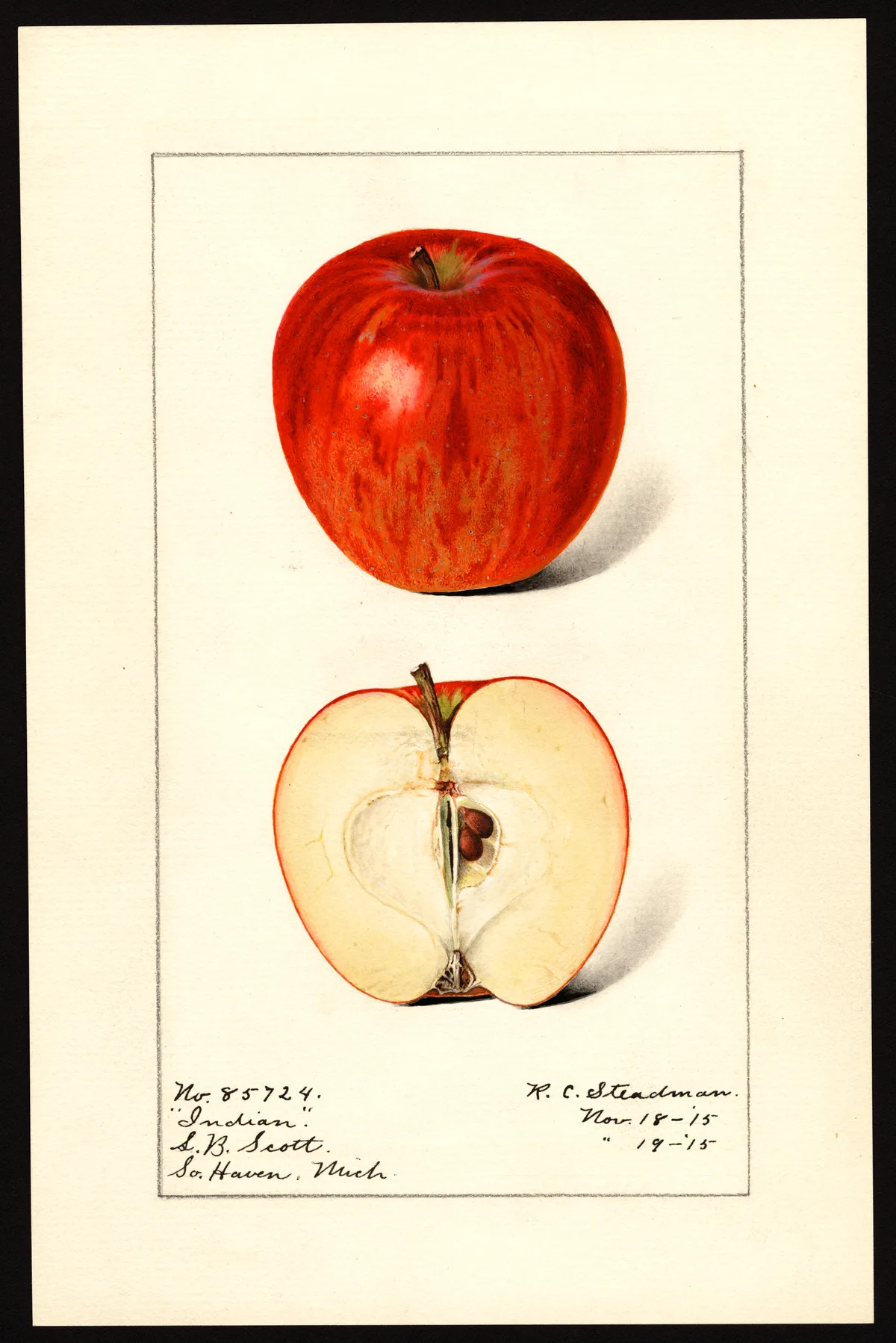
USDA Pomological Watercolor Collection
Large Striped Pearmain
Origin and History
This variety is supposed to have originated in Kentucky, possibly further south. It is now found in Eastern Ohio, Southern Indiana and Illinois, and in Missouri, where it is much grown in Kentucky. In all places it appears to be doing well and giving entire satisfaction, except that the bark bursts near the ground even in bearing trees that are root-grafted.
Tree
Vigorous, thrifty, spreading, and productive. Shoots rather slender and dark. Foliage dark green and abundant on young trees.
Fruit
Form and Size: Large, round, flattened, regular, fair, and handsome, though not as beautifully colored as some others.
Skin and Surface: Smooth. Mixed, splashed, and striped; pale purplish red on yellow, which shows through the shading. Dots minute, indented, and gray, giving the fruit a general gray appearance.
Cavity: Wide, wavy, rather deep, brown in color.
Stem: Short, medium, or rather long.
Basin: Medium, regular, sometimes cracked.
Eye: Small, closed.
Core: Roundish, medium, regular, open.
Seeds: Numerous, large, angular; some imperfect.
Flesh: Yellow, breaking, somewhat coarse-grained, juicy.
Flavor and Quality: Sub-acid. Quality quite good.
Season
December to February.
Uses
Market, kitchen, table. Highly recommended for commercial orchards, whether for shipping north or south — particularly the latter.
Subtypes and Variants
In the West, the fruit is more flattened than in Ohio, becoming in large specimens almost a flat or oblate apple.
Book Sources
Described in 1 period pomological work
View original book sources (1)
— John A. Warder, American Pomology: Apples (1867)Large Striped Pearmain.
This choice Western apple is supposed to have originated in Kentucky — possibly further South. It is now to be found in Eastern Ohio, Southern Indiana and Illinois, and in Missouri. Much grown in Kentucky. In all places it seems to be doing well, and giving entire satisfaction, excepting that the bark bursts near the ground even in bearing trees, root-grafted.
Tree vigorous, thrifty, spreading, productive; Shoots rather slender, dark; Foliage dark green, abundant on young trees.
Fruit large, round, flattened, regular, fair, handsome, though not so beautifully colored as some others; Surface smooth, mixed, splashed and striped, pale purplish red on yellow, which shows through the shading; Dots minute, indented, gray, so that the fruit has a general gray appearance.
Basin medium, regular, sometimes cracked; Eye small, closed.
Cavity wide, wavy, rather deep, brown; Stem short, medium, or rather long.
Core roundish, medium, regular, open; Seeds numerous, large, angular, some imperfect; Flesh yellow, breaking, somewhat coarse-grained, juicy; Flavor sub-acid; Quality quite good; Use, market, kitchen, table; Season, December to February.
In the West it is more flattened than in Ohio, becoming in large specimens almost a flat or oblate apple. Highly recommended for commercial orchards, whether for shipping North or South — particularly the latter.