Sutton
Apple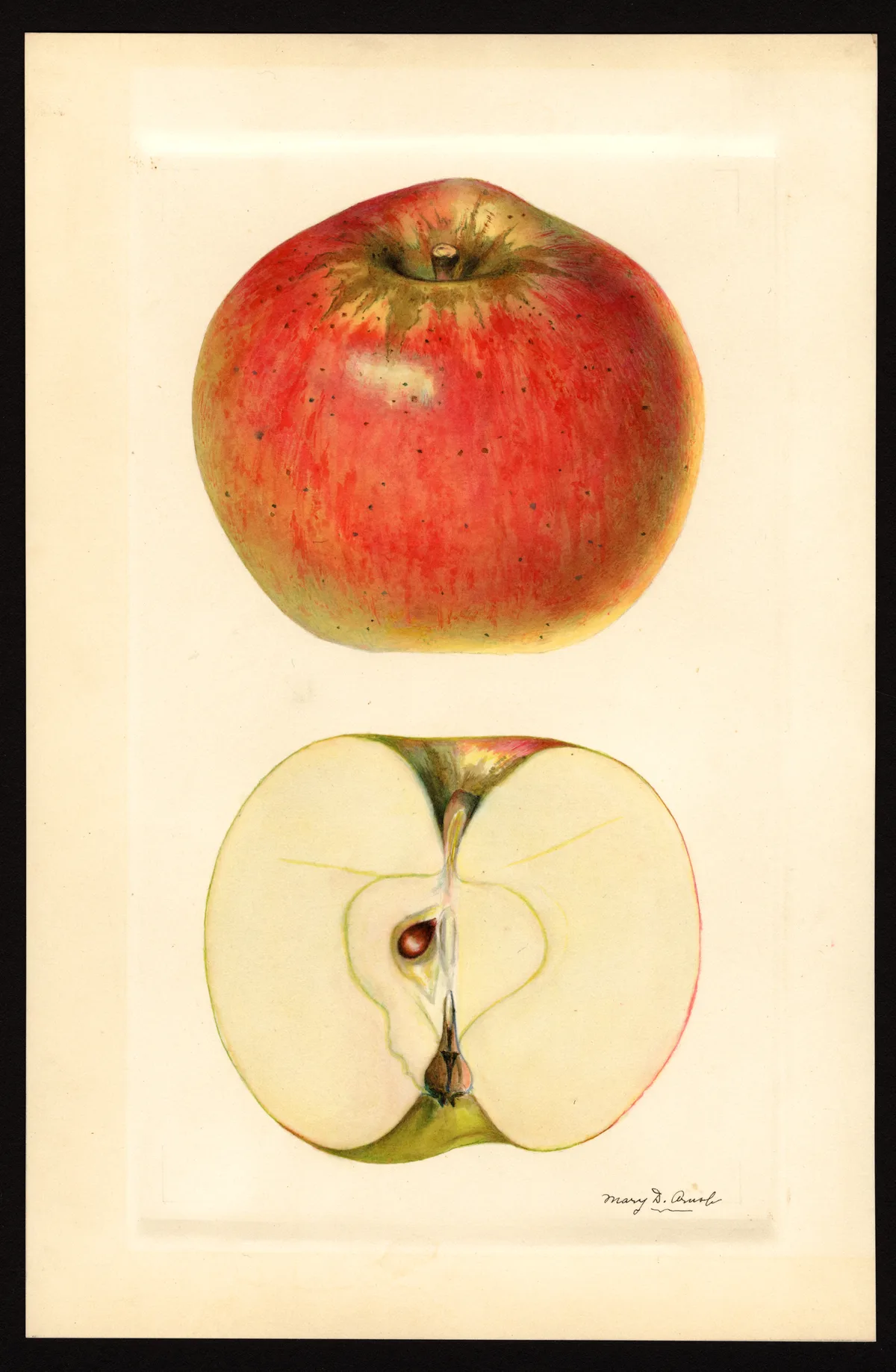
USDA Pomological Watercolor Collection
Sutton
Origin / History
Sutton originated in the town of Sutton, Massachusetts, from which it takes its name (Downing; Elliott; Beach; Hedrick). The variety arose some time previous to 1849 (Hedrick) and was brought to notice through the Worcester County Horticultural Society in 1848 (Beach). In 1849 Hovey included it in a descriptive list of select varieties in the belief that it would become a popular fruit, remarking that it had as yet been but little disseminated (Beach). It was not included in the American Pomological Society Catalogue until 1877 (Beach).
It is supposed by some to be a seedling of Hubbardston (Beach; Budd-Hansen). The tree certainly resembles Hubbardston somewhat but is much more vigorous and healthy; in color, texture, quality and season the fruit is intermediate between Hubbardston and Baldwin (Beach). Warder reports it as "an old Massachusetts apple, occasionally found in the West, where it attains increased size and beauty," and notes that his specimens came from Wm. Hampton of Northwestern Ohio; Mr. Hamilton thought it to be a seedling brought from Southern Ohio.
Sutton has been disseminated in Michigan under the name Morris Red, with Steele's Red or Steele's Red Winter of Ohio as erroneous synonyms; Ragan recognizes Morris Red as possibly identical with Sutton, and Morris Red as fruited at the New York Station from stock obtained from D. G. Edmeston of Adrian, Mich., is certainly identical with Sutton (Beach). Leroy refers to Sutton Beauty erroneously as a synonym for Wellington (Beach). Within recent years it has been planted and top-worked upon older trees to a considerable extent in New York commercial orchards, though no old trees of this variety are known in that state (Beach). Sutton is chiefly grown in New York and New England (Hedrick). Thomas (1903) calls it "coming to be one of the most profitable market varieties in the East."
Sutton has been much sought after for its attractive appearance and taste, but plantations of it have usually proved a failure because of weaknesses in the trees: the trees are very capricious as to soils, bear spasmodically — even individuals show irregularities in bearing, often a branch producing while the rest of the tree is barren — and, worse than any other fault, Sutton takes longest of all varieties to come into fruiting; by common consent it is a failure as a commercial apple but a most desirable sort for the home orchard and fancy-fruit market (Hedrick). Beach takes a more optimistic view: although it has not done well in some localities, in most parts of New York state it is regarded as one of the most promising of the newer varieties, though because the trees are still young its value for commercial planting there has not been fully determined. Its uniform size, symmetrical shape, beautiful color and pleasant quality unite to make it an excellent dessert apple, but being mild in flavor it is less desirable for culinary use; it sells well in the general market but appears especially suitable for fancy market and fruit-stand trade (Beach). It does not keep quite so long as Baldwin, hardly averages as large, and because it is more tender requires more careful handling. Although in some regions its fruit seems somewhat more subject to scab than that of the Baldwin, in many localities it has gained a reputation of being remarkably healthy in foliage and fruit. The fruit hangs well to the tree (Beach).
Tree
Tree vigorous (Beach; Hedrick), upright (Downing; Elliott; Budd-Hansen; Hedrick), thrifty (Downing; Elliott; Budd-Hansen), a strong/free grower (Beach; Thomas), and very productive (Downing; Budd-Hansen; Beach); a good bearer (Elliott). Form upright spreading, eventually becoming roundish, dense (Beach); dense, with stout branches (Beach; Hedrick). In favorable locations the tree has vigorous dark green foliage, is handsome in form, a strong grower and productive, with a marked tendency to bear biennially (Beach).
Twigs short to medium in length, straight, moderately stout to stocky; internodes short to medium. Bark dark olive-green somewhat tinged with reddish-brown, mottled and streaked with gray scarfskin, pubescent. Lenticels few, very scattering, not conspicuous, small to medium, elongated or roundish, not raised. Buds prominent, large, broad, obtuse to acute, pubescent, free. Leaves somewhat narrow, medium to large (Beach); narrow, dark green (Hedrick); foliage vigorous, dark green, healthy, rather dense (Beach).
Fruit
Size
Medium or above (Downing); medium (Elliott); medium or rarely large, pretty uniform in size and shape (Beach); rarely large, uniform in size and shape (Hedrick); above medium to large (Budd-Hansen); large (Warder; Thomas); medium-sized (Lowther). Warder notes that in the West it attains increased size and beauty.
Form
Globular, regular (Warder); roundish (Thomas); roundish oblate conic (Downing); roundish oblate conical (Budd-Hansen); roundish oblate (Lowther); roundish conical (Elliott); roundish or slightly oblong rounding toward cavity and basin, symmetrical, regular or very slightly ribbed (Beach); round or oblong, rounding toward cavity and basin, symmetrical, regular or very slightly ribbed (Hedrick); fair and regular in form, very handsome (Elliott).
Stem
Long, inclined (Warder); rather short (Downing; Budd-Hansen); medium (Elliott); medium to short, sometimes fleshy (Beach); short, sometimes fleshy (Hedrick).
Cavity
Wide, acute, wavy, brown (Warder); medium (Downing); with a slight greenish russet (Elliott); deep, wide, with greenish russet (Budd-Hansen); acute or sometimes acuminate, moderately deep to deep, moderately wide to narrow, symmetrical, often with some greenish russet (Beach); acute, wide, symmetrical, often with greenish-russet (Hedrick).
Calyx / Eye
Eye large, open; segments reflexed (Warder); calyx partially closed, set in a moderate, uneven basin (Downing); closed (Elliott); half open; segments divergent (Budd-Hansen); medium size, partly open, sometimes closed, pubescent; lobes vary from medium and obtuse to long and acuminate (Beach); partly open, sometimes closed, pubescent; lobes long, acuminate (Hedrick). Calyx tube symmetrical, conical or sometimes funnel-form; stamens median (Beach); calyx-tube symmetrical, conical; stamens median (Hedrick).
Basin
Wide, regular, russety (Warder); moderate, uneven (Downing); open, round (Elliott); shallow, abrupt, slightly wrinkled (Budd-Hansen); moderately shallow and obtuse to rather deep and abrupt, medium in width, somewhat furrowed and slightly wrinkled, sometimes compressed (Beach); shallow and obtuse to deep and abrupt, furrowed and wrinkled, sometimes compressed (Hedrick).
Skin
Surface smooth, yellow, mottled and splashed carmine; dots scattered, brown, vein-reflexed (Warder). Waxen yellow, shaded, mottled, and obscurely striped with fine crimson, and thinly sprinkled with whitish dots (Downing). Yellow, shaded and striped with fine crimson, slightly sprinkled with whitish dots (Elliott). Skin waxen yellow, striped and shaded with crimson, very handsome (Thomas). Surface smooth, waxen yellow, mottled, washed and shaded crimson, with obscure carmine splashes and stripes; dots few, large, whitish, and russet, distinct (Budd-Hansen). Striped or splashed (red) (Lowther). Moderately thin, tough, often slightly roughened toward the basin by inconspicuous, concentric broken russet lines and fine russet dots, otherwise glossy and smooth; color attractive bright red striped with carmine or purplish carmine nearly overspreading the lively yellow or greenish ground color. Prevailing effect attractive red. The less highly colored fruit has a distinctly striped appearance (Beach). Thin, tough, often roughened toward the basin by concentric russet lines and fine russet dots, otherwise glossy and smooth, bright red striped with carmine; prevailing effect red (Hedrick).
Flesh / Flavor
Whitish, tender, breaking, juicy; flavor acid, sub-acid, agreeable; quality good (Warder). Whitish, crisp, tender, juicy, sprightly subacid; very good (Downing). Whitish, crisp, tender, juicy, sub-acid; "very good" (Elliott). White, tender, sprightly, very good (Thomas). Whitish, crisp, tender, juicy, sprightly subacid, good to very good (Budd-Hansen). Slightly tinged with yellow, rather firm, moderately fine-grained, crisp, tender, juicy, mild subacid, good to very good (Beach). Yellow, firm, fine-grained, crisp, tender, juicy, mild subacid; good to very good (Hedrick). Quality very good (Lowther).
Core / Seeds
Core medium to large, closed, clasping; seeds numerous, pointed, angular, dark (Warder). Core small (Elliott). Core medium, oblate, closed, clasping; seeds many, pointed, angular (Budd-Hansen). Core medium or below, slightly abaxile; cells symmetrical, closed; core lines slightly clasping. Carpels broadly cordate approaching elliptical, emarginate, sometimes slightly tufted. Seeds rather light brown, small to above medium, plump, acute, sometimes a little tufted (Beach). Core small, abaxile; cells symmetrical, closed; core-lines clasping; carpels broadly cordate, emarginate, sometimes tufted; seeds light brown, small, plump, acute, sometimes tufted (Hedrick).
Season
December to March (Warder); November, February (Downing); November to February (Elliott); midwinter (Budd-Hansen); a late keeper (Thomas); winter (Lowther); November to March (Hedrick). Beach reports the season as intermediate between Hubbardston and Baldwin; early winter in the southern part of New York state but farther north it is in season for home use from November to March, and the commercial limit extends to February.
Uses
Table, kitchen and market (Warder); kitchen and market (Lowther); an excellent dessert apple, but being mild in flavor less desirable for culinary use; sells well in the general market but especially suitable for fancy market and fruit-stand trade (Beach); a most desirable sort for the home orchard and fancy-fruit market (Hedrick); one of the most profitable market varieties in the East (Thomas).
Subtypes / Variants
Not described in source.
Other
Not described in source.
Book Sources
Described in 8 period pomological works
- Beach, The Apples of New York Vol. 1 (1905)
- Warder, American Pomology: Apples (1867) — listed as Sutton Beauty
- Thomas, The American Fruit Culturist (1903) — listed as Sutton Beauty
- Budd & Hansen, Systematic Pomology (1914)
- Hedrick, Cyclopedia of Hardy Fruits (1922)
- Downing, Fruits and Fruit Trees of America (1900) — listed as Sutton Beauty
- Elliott, The Western Fruit Book (1865) — listed as Sutton Beauty
- Lowther (ed.), Encyclopedia of Practical Horticulture (1914) — listed as Sutton Beauty
USDA Nomenclature (1905)
From W.H. Ragan, Nomenclature of the Apple, USDA Bulletin No. 56
Possibly more than one variety included in synonyms.
Nursery Catalog Sources
Found in 17 catalogs (1884–1913) from California, Illinois, Missouri, Oregon, Virginia, Washington
- Felix Gillet , Barren Hill Nursery, Nevada City , California — 1884 — listed as Sutton Beauty
- Missouri Nursery Co. , Louisiana , Missouri — 1891 — listed as Sutton Beauty
- Stark Bros. Nurseries & Orchards Co. , Louisiana , Missouri — 1896 — listed as Sutton Beauty
- The Salem Nursery (John A. Francis , Proprietor), Salem , Virginia — 1897 — listed as Sutton Beauty
- J.V. Cotta (Cotta Nursery) , Carroll County , Illinois — 1898 — listed as Sutton Beauty
- Stark Bros. Nurseries & Orchards Co. , Louisiana , Missouri — 1898 — listed as Sutton Beauty
- Central Experimental Farm , Dominion Department of Agriculture, Agassiz, British Columbia (under test; Bulletin No. 3, Second Series) — 1900 — listed as Sutton Beauty
- Washington Nursery Co. , Toppenish , Washington — 1901 — listed as Sutton Beauty
- Benjamin Buckman (personal inventory) , Farmingdale , Illinois — 1901 — listed as Sutton Beauty
- Stark Bros. Nurseries & Orchards Co. , Louisiana , Missouri — 1906 — listed as Sutton Beauty
- Washington Nursery Company , Toppenish , Washington — 1909 — listed as Sutton Beauty
- Stark Bros. Nurseries & Orchards Co. , Louisiana , Missouri — 1910 — listed as Sutton Beauty
- Stark Bros. Nurseries & Orchards Co. , Louisiana , Missouri — 1911 — listed as Sutton Beauty
- Pacific Nursery Company , Portland , Oregon — 1912 — listed as Sutton Beauty
- Stark Bros. Nurseries & Orchards Co. , Louisiana , Missouri — 1912 — listed as Sutton Beauty
- Vineland Nurseries Company , Clarkston , Washington — 1912 — listed as Sutton Beauty
- Benjamin Buckman (personal inventory) , Farmingdale , Illinois — 1913 — listed as Sutton Beauty
View original book sources (8)
— John A. Warder, American Pomology: Apples (1867)Sutton Beauty.
An old Massachusetts apple, occasionally found in the West, where it attains increased size and beauty. My specimens were from Wm. Hampton, with many other sorts of interest grown by him in Northwestern Ohio.
Fruit large, handsome, globular, regular; Surface smooth, yellow, mottled and splashed carmine; Dots scattered, brown, vein-reflexed.
Basin wide, regular, russety; Eye large, open; Segments reflexed.
Cavity wide, acute, wavy, brown; Stem long, inclined.
Core medium to large, closed, clasping; Seeds numerous, pointed, angular, dark; Flesh whitish, tender, breaking, juicy; Flavor acid, sub-acid, agreeable; Quality good; Use, table, kitchen and market; Season, December to March.
Thought by Mr. Hamilton to be a seedling brought from Southern Ohio.
— A.J. Downing, The Fruits and Fruit Trees of America (1900)Sutton Beauty. Beauty. Origin, Sutton, Mass. Tree upright, thrifty, and very productive. Fruit medium or above, roundish oblate conic, waxen yellow, shaded, mottled, and obscurely striped with fine crimson, and thinly sprinkled with whitish dots. Stem rather short, inserted in a medium cavity, slightly surrounded by greenish russet. Calyx partially closed, set in a moderate, uneven basin. Flesh whitish, crisp, tender, juicy, sprightly subacid. Very good. November, February.
— S.A. Beach, The Apples of New York, Vol. 1 (1905)SUTTON.
REFERENCES. 1. Cole, 1849:130. 2. Hovey, Mag. Hort., 15:249. 1849. fig. 3. Elliott, 1854:85. 4. Downing, 1857:190. 5. Warder, 1867:616. fig. 6. Thomas, 1875:513. 7. Am. Pom. Soc. Cat., 1877:14. 8. Mich. Pom. Soc. Rpt., 1880:50, 184, 207. 9. Barry, 1883:355. 10. Can. Hort., 11:8. 1888. 11. Lyon, Mich. Hort. Soc. Rpt., 1890:294. 12. Can. Hort., 14:36, 274. 1891. 13. Bailey, An. Hort., 1892:250. 14. Munson, Me. Sta. Rpt., 1893:133. 15. Rural N. Y., 55:115, 181. 1896. 16. Lyon, Mich. Sta. Bul., 143:200. 1897. 17. Rural N. Y., 57:178, 239, 244. 1898. 18. Woodward, Ib., 58:264. 1899. 19. Beach, W. N. Y. Hort. Soc. Rpt., 1899:90. 20. Van Deman, Rural N. Y., 60:54, 789. 1901. 21. Can. Hort., 24:121. 1901. 22. Waugh, Vt. Sta. An. Rpt., 14:309. 1901. 23. Budd-Hansen, 1903:184. 24. Powell and Fulton, U. S. B. P. I. Bul., 48:57. 1903. 25. Farrand, Mich. Sta. Bul., 205:45. 1903. 26. Beach and Clark, N. Y. Sta. Bul., 248:145. 1904.
SYNONYMS. Beauty (4). Hubbardston Nonsuch (3) but incorrectly. MORRIS RED (8, 11, 25). MORRIS Red (16). Morris Red (19). Steele's Red (8, erroneously 11). Steele's Red Winter (8, of Ohio 19). SUTTON BEAUTY (1, 2, 4, 5, 6, 7, 9, 10, 12, 13, 15, 17, 18, 20, 21). Sutton Beauty (3, 14, 22, 23, 24, 26).
Sutton is supposed by some to be a seedling of Hubbardston (22, 23). The tree certainly resembles Hubbardston somewhat but is much more vigorous and healthy. In color, texture, quality and season the fruit is intermediate between Hubbardston and Baldwin. Its uniform size, symmetrical shape, beautiful color and pleasant quality unite to make the Sutton an excellent dessert apple, but being mild in flavor it is less desirable for culinary use. It sells well in the general market but it appears especially suitable for fancy market and fruit-stand trade. It does not keep quite so long as Baldwin, hardly averages as large and because it is more tender requires more careful handling. Although in some regions its fruit seems to be somewhat more subject to scab than that of the Baldwin, yet in many localities it has gained a reputation of being remarkably healthy in foliage and fruit. The fruit hangs well to the tree. In favorable locations the tree has vigorous dark green foliage, is handsome in form, a strong grower and productive, with a marked tendency to bear biennially.
Sutton has been practically unknown in New York state until recent years but it is now being introduced quite extensively for commercial purposes. Although it has not done well in some localities, yet in most parts of the state it is regarded as one of the most promising of the newer varieties. Because the trees of this variety are still young the value of the Sutton for commercial planting in New York has not been fully determined.
Sutton has been disseminated in Michigan under the name Morris Red with Steele's Red or Steele's Red Winter of Ohio as erroneous synonyms. Ragan recognizes Morris Red as possibly identical with Sutton. Morris Red as fruited at this Station from stock obtained from D. G. Edmeston, Adrian, Mich., who has pronounced the fruit borne by this stock to be the true Morris Red¹, is certainly identical with Sutton. Leroy refers to Sutton Beauty erroneously as a synonym for Wellington.
Historical. Sutton takes its name from the town of Sutton, Mass., in which it originated. It was brought to notice through the Worcester County Horticultural Society in 1848 (2). In 1849 Hovey included it in a descriptive list of select varieties in the belief that it would become a popular fruit and remarked that it had as yet been but little disseminated. It was not included in the American Pomological Society Catalogue till 1877 (7). Within recent years it has been planted and top-worked upon older trees to a considerable extent in New York commercial orchards, but we do not know of any old trees of this variety in this state.
TREE.
Tree vigorous with stout branches. Form upright spreading, eventually becoming roundish, dense. Twigs short to medium in length, straight, moderately stout to stocky; internodes short to medium. Bark dark olive-green somewhat tinged with reddish-brown, mottled and streaked with gray scarfskin, pubescent. Lenticels few, very scattering, not conspicuous, small to medium, elongated or roundish, not raised. Buds prominent, large, broad, obtuse to acute, pubescent, free. Leaves somewhat narrow, medium to large; foliage vigorous, dark green, healthy, rather dense.
FRUIT.
Fruit medium or rarely large, pretty uniform in size and shape. Form roundish or slightly oblong rounding toward cavity and basin, symmetrical, regular or very slightly ribbed. Stem medium to short, sometimes fleshy. ¹ letters, D. G. Edmeston, 1897. ² Leroy, 1873:864.
Cavity acute or sometimes acuminate, moderately deep to deep, moderately wide to narrow, symmetrical, often with some greenish russet. Calyx medium size, partly open, sometimes closed, pubescent; lobes vary from medium and obtuse to long and acuminate. Basin moderately shallow and obtuse to rather deep and abrupt, medium in width, somewhat furrowed and slightly wrinkled, sometimes compressed. Skin moderately thin, tough, often slightly roughened toward the basin by inconspicuous, concentric broken russet lines and fine russet dots, otherwise glossy and smooth; color attractive bright red striped with carmine or purplish carmine nearly overspreading the lively yellow or greenish ground color. Prevailing effect attractive red. The less highly colored fruit has a distinctly striped appearance. Calyx tube symmetrical, conical or sometimes funnel-form. Stamens median. Core medium or below, slightly abaxile; cells symmetrical, closed; core lines slightly clasping. Carpels broadly cordate approaching elliptical, emarginate, sometimes slightly tufted. Seeds rather light brown, small to above medium, plump, acute, sometimes a little tufted. Flesh slightly tinged with yellow, rather firm, moderately fine-grained, crisp, tender, juicy, mild subacid, good to very good. Season intermediate between Hubbardston and Baldwin; early winter in the southern part of the state but farther north it is in season for home use from November to March, and the commercial limit extends to February.
— Granville Lowther (ed.), Encyclopedia of Practical Horticulture (1914)Sutton Beauty is a medium-sized apple of roundish oblate form. Skin color is striped or splashed (red). Quality is very good. Use is both kitchen and market. Season is winter. No division reporting data is recorded.
— F.R. Elliott, The Western Fruit Book (1865)Sutton Beauty. Beauty. Originated in Sutton, Mass. Tree, upright, thrifty grower, good bearer ; fruit, very handsome, fair and regular in form. Fruit, medium, roundish conical ; yellow, shaded and striped with fine crimson, slightly sprinkled with whitish dots ; stem, medium : cavity, with a slight greenish russet ; calyx, closed : basin, open, round ; flesh, whitish, crisp, tender, juicy, sub-acid ; "very good ;" core, small. November to February.
— John J. Thomas, The American Fruit Culturist (1903)Sutton Beauty.* Fruit large, roundish; skin waxen yellow, striped and shaded with crimson, very handsome; flesh white, tender, sprightly, very good. A late keeper. Tree a free grower and productive. Coming to be one of the most profitable market varieties in the East. Massachusetts.
— J.L. Budd & N.E. Hansen, American Horticultural Manual, Part II: Systematic Pomology (1914)Sutton (Sultan Beauty). — Origin, Sutton, Massachusetts, thought to be a seedling of Hubbardston, but of more attractive appearance; tree upright, thrifty, very productive.
Fruit above medium to large, roundish oblate conical; surface smooth, waxen yellow, mottled, washed and shaded crimson, with obscure carmine splashes and stripes; dots few, large, whitish, and russet, distinct; cavity deep, wide, with greenish russet; stem rather short; basin shallow, abrupt, slightly wrinkled; calyx half open; segments divergent. Core medium, oblate, closed, clasping; seeds many, pointed, angular; flesh whitish, crisp, tender, juicy, sprightly subacid, good to very good. Midwinter.
— U.P. Hedrick, Cyclopedia of Hardy Fruits (1922)SUTTON. Morris Red. Sutton Beauty. Few apples are more attractive in appearance or better in taste than those of Sutton. In consequence, the variety has been much sought after, but plantations of it have usually proved a failure because of weaknesses in the trees. The trees are very capricious as to soils, bear spasmodically,—even individuals show irregularities in bearing, often a branch producing while the rest of the tree is barren; and, worse than any other fault, Sutton takes longest of all varieties to come into fruiting. The variety has gone through its probationary period and by common consent is a failure as a commercial apple, but the uniform size, symmetrical shape, and delectable quality of the fruit make it a most desirable sort for the home orchard and fancy-fruit market. The name commemorates the town of Sutton, Massachusetts, in which the variety originated some time previous to 1849. Sutton is chiefly grown in New York and New England. Tree vigorous, upright, dense, with stout branches. Leaves narrow, dark green. Fruit rarely large, uniform in size and shape, round or oblong, rounding toward cavity and basin, symmetrical, regular or very slightly ribbed; stem short, sometimes fleshy; cavity acute, wide, symmetrical, often with greenish-russet; calyx partly open, sometimes closed, pubescent; lobes long, acuminate; basin shallow and obtuse to deep and abrupt, furrowed and wrinkled, sometimes compressed; skin thin, tough, often roughened toward the basin by concentric russet lines and fine russet dots, otherwise glossy and smooth, bright red striped with carmine; prevailing effect red; calyx-tube symmetrical, conical; stamens median; core small, abaxile; cells symmetrical, closed; core-lines clasping; carpels broadly cordate, emarginate, sometimes tufted; seeds light brown, small, plump, acute, sometimes tufted; flesh yellow, firm, fine-grained, crisp, tender, juicy, mild subacid; good to very good; November to March.