Shiawassee
Apple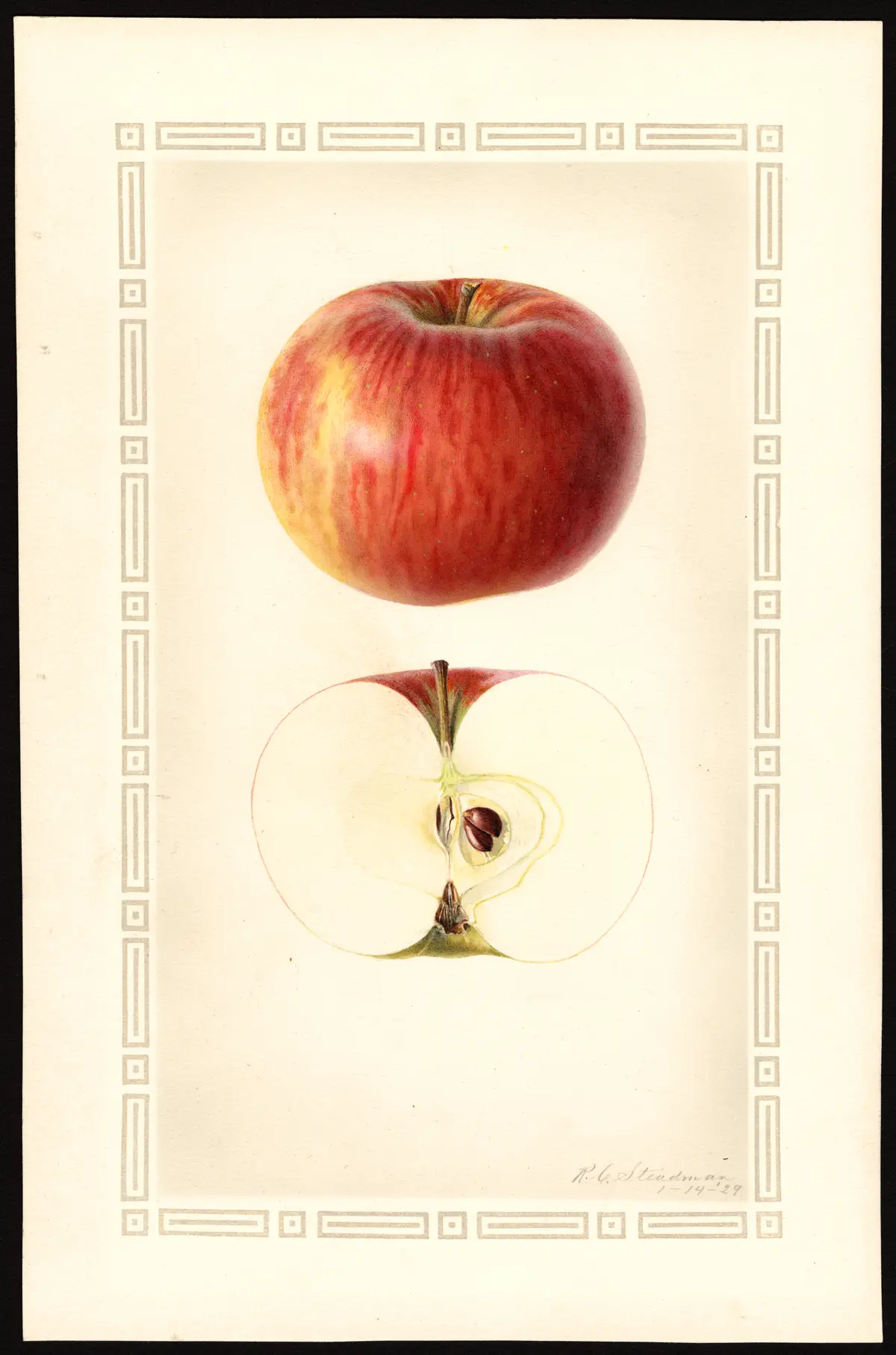
USDA Pomological Watercolor Collection
Shiawassee
Origin/History
Shiawassee originated in Shiawassee County, Michigan, as an ungrafted seedling planted in the orchard of Beebe Truesdell at Vernon, Shiawassee County. The original tree came into bearing about 1850. The variety was introduced to the American Pomological Society in 1862 by T. T. Lyon of Plymouth, Michigan, who stated that it was a seedling of the Fameuse, the faults of which it does not inherit, though possessing all the good qualities of its parent, with a healthy and productive tree (referenced in the Michigan Farmer, December 11, 1859). Its merits were first set forth in 1860. Warder (1867) called it a Michigan apple that "may well be called Beauty." Beach (1905) noted that the variety is often listed by nurserymen but is seldom planted in New York state. Hedrick (1922) described it as little grown except in the state of its nativity, observing that McIntosh and Fameuse excel it in tree and fruit, though the apples have the merit of keeping well and of adding variety in size, color, and flavor to the winter supply of fruits. Budd-Hansen (1914) called it one of the best varieties of the Fameuse type.
Tree
Tree of medium size (Beach, Hedrick) or uniform size (Beach), very hardy, vigorous, healthy and long-lived. Habit upright-spreading (Beach, Hedrick); Downing describes it as a strong upright grower until in full bearing, when it becomes partially pendent, and very productive; Thomas notes the tree is a stronger and more upright grower than Fameuse; Budd-Hansen describes it as a strong, moderately upright grower. Young wood dull reddish brown, slightly downy (Downing); Downing notes that although the variety resembles Fameuse, its wood shows its distinctiveness.
Bearing: Does not come into bearing very young; when mature, in some cases it is not a reliable cropper, but it is generally reported as yielding good to heavy crops biennially, or sometimes annually (Beach). Budd-Hansen describes it as a heavy bearer in alternate years. Beach also notes the fruit hangs pretty well to the tree.
Fruit
Size
Medium (Warder, Downing, Thomas, Budd-Hansen, Lowther); medium to nearly large (Beach); medium to large (Hedrick). Thomas notes the fruit is larger than Fameuse. Beach describes the fruit as fair and uniform.
Form
Quite flat (Warder); oblate (Downing, Thomas, Lowther — "flat"); very oblate (Budd-Hansen); oblate conic, pretty regular but sometimes elliptical (Beach); oblate-conic, regular or sometimes elliptical (Hedrick). Uniform in shape but not in size (Beach, Hedrick). Very regular (Warder); regular (Thomas, Budd-Hansen). Very handsome (Warder); quite attractive appearance (Beach).
Stem / Stalk
Short (Warder); rather short (Downing); very short, deeply sunk (Thomas); medium (Budd-Hansen); medium in length, slender to moderately thick (Beach); medium in length, slender (Hedrick).
Cavity
Wide, wavy (Warder); large (Downing); obtuse, wide, regular, with stellate russet (Budd-Hansen); acute, varying from nearly acuminate to somewhat obtuse, deep, broad, rather symmetrical, sometimes compressed, often with outspreading russet rays (Beach); acute, deep, broad, symmetrical, sometimes compressed, often with outspreading russet rays (Hedrick).
Calyx / Eye
Eye medium, closed; calyx reflexed (Warder). Calyx small, closed (Downing, Hedrick); calyx small to below medium, closed or slightly open (Beach); calyx closed or open, segments divergent (Budd-Hansen). Lobes rather short, moderately narrow (Beach); lobes short, narrow (Hedrick).
Basin
Wide, folded (Warder); large, open, slightly corrugated (Downing); small, regular (Thomas); smooth, wide, shallow (Budd-Hansen); rather shallow to moderately deep, rather wide, obtuse to somewhat abrupt, somewhat furrowed and wrinkled, often compressed (Beach); shallow, wide, obtuse, somewhat furrowed and wrinkled, often compressed (Hedrick).
Skin / Surface
Surface very smooth, pale yellow, mixed and distinctly striped carmine (Warder); whitish, shaded, marbled, splashed, and striped with rich red (Downing); smooth; deep brilliant red on greenish yellow ground (Thomas); surface polished, yellow, almost wholly covered with brilliant dark crimson, with obscure splashes (Budd-Hansen); rather pale yellow, usually entirely overspread with attractive red, irregularly splashed and striped with carmine (Beach); pale yellow, overspread with red, irregularly splashed and striped with carmine (Hedrick). Lowther summarizes the skin as red-yellow.
Dots
Scattered, minute (Warder); few light dots (Downing); distinct, few, large, yellow (Budd-Hansen); small to medium, grayish (Beach); small, gray (Hedrick).
Flesh / Flavor
Flesh very white, fine-grained, tender, breaking; flavor sub-acid, aromatic; quality good to very good (Warder). Flesh firm, very white, tender, juicy, brisk, refreshing subacid; very good (Downing). Flesh white, tender, crisp, sub-acid and aromatic (Thomas). Flesh firm, very white, tinged with red, brisk, pleasant subacid, very good (Budd-Hansen). Flesh white, fine, crisp, tender, juicy, pleasant subacid, aromatic, rather sprightly, good to very good (Beach); flesh white, fine, crisp, tender, juicy, pleasant subacid, aromatic, sprightly; good to very good (Hedrick). Beach further characterizes the fruit as of pleasant dessert quality with a flavor and aroma somewhat similar to that of McIntosh, adding that probably McIntosh would be preferred to Shiawassee by most fruit growers.
Core / Seeds
Core wide, regular, somewhat open, meeting the eye; seeds plump, short, dark (Warder). Core half open, meeting; cells ovate, slit; tube conical; stamens median or basal; seeds few, plump, pointed (Budd-Hansen). Core below medium size, widely abaxile; cells symmetrical, usually open; core lines meeting or slightly clasping; carpels cordate to broadly ovate; calyx tube medium size, moderately wide, conical to short funnel-shape; stamens median to nearly basal; seeds rather dark brown, medium size, rather narrow, plump, acute (Beach). Core small, widely abaxile; cells symmetrical, usually open; core-lines meeting; carpels cordate; calyx-tube wide, conical; stamens median (Hedrick).
Season
October to January (Warder, Beach, Hedrick); October, January (Downing); October and November (Thomas); early winter (Budd-Hansen); ripening in winter (Lowther). Beach states it ripens in October, and some portion of the fruit may be held till January. Hedrick notes the apples have the merit of keeping well.
Uses
Dessert and market (Warder); pleasant dessert quality (Beach); suited for both kitchen and market use (Lowther).
Subtypes/Variants
Not described in source.
Other
Lowther (1914) reports the variety from 3 stations in the Northern Division and 1 station in the Central Division of the American Pomological Society, with an asterisk on both division counts indicating the variety is reported in more than one of the three divisions; the Southern Division reported no stations.
Book Sources
Described in 7 period pomological works
- Beach, The Apples of New York Vol. 2 (1905)
- Warder, American Pomology: Apples (1867)
- Budd & Hansen, Systematic Pomology (1914)
- Downing, Fruits and Fruit Trees of America (1900)
- Lowther (ed.), Encyclopedia of Practical Horticulture (1914)
- Hedrick, Cyclopedia of Hardy Fruits (1922)
- Thomas, The American Fruit Culturist (1903) — listed as Shiawasse Beauty
Nursery Catalog Sources
Found in 2 catalogs (1901–1913) from Illinois
- Benjamin Buckman (personal inventory) , Farmingdale , Illinois — 1901
- Benjamin Buckman (personal inventory) , Farmingdale , Illinois — 1913
View original book sources (7)
— John A. Warder, American Pomology: Apples (1867)Shiawassee Beauty.
This Michigan apple may well be called Beauty. It was introduced at the meeting of the American Pomological Society in 1862, by T. T. Lyon, of Plymouth, Mich., who stated that it was a seedling of the Fameuse, the faults of which it does not inherit, though possessing all the good qualities of its parent, with a healthy and productive tree. (See Michigan Farmer, Dec. 11, 1859.)
Fruit medium, very handsome, very regular, quite flat; Surface very smooth, pale yellow, mixed and distinctly striped carmine; Dots scattered, minute. Basin wide, folded; Eye medium, closed; Calyx reflexed. Cavity wide, wavy; Stem short. Core wide, regular, somewhat open, meeting the eye; Seeds plump, short, dark; Flesh very white, fine-grained, tender, breaking; Flavor sub-acid, aromatic; Quality good to very good; Use dessert and market; Season October to January.
— A.J. Downing, The Fruits and Fruit Trees of America (1900)Shiawassee Beauty. Michigan Beauty. Originated in Shiawassee Co., Mich. Tree a strong upright grower until in full bearing, when it becomes partially pendent, very productive. Young wood dull reddish brown, slightly downy. This variety resembles Fameuse, but its wood shows its distinctiveness. Fruit medium, oblate, whitish, shaded, marbled, splashed, and striped with rich red, few light dots. Stalk rather short. Cavity large. Calyx small, closed. Basin large, open, slightly corrugated. Flesh firm, very white, tender, juicy, brisk, refreshing subacid. Very good. October, January.
— John J. Thomas, The American Fruit Culturist (1903)Shiawasse Beauty. Medium, oblate, regular, smooth; deep brilliant red on greenish yellow ground; stalk very short, deeply sunk; basin small, regular; flesh white, tender, crisp, sub-acid and aromatic. October and November. Resembles Fameuse, but tree a stronger and more upright grower and fruit larger. Michigan.
[Additional entry in this volume: "Shiawassee", pp. 339–339]
Shiawasse Beauty. Medium, oblate, regular, smooth; deep brilliant red on greenish yellow ground; stalk very short, deeply sunk; basin small, regular; flesh white, tender, crisp, sub-acid and aromatic. October and November. Resembles Fameuse, but tree a stronger and more upright grower and fruit larger. Michigan.
— S.A. Beach, The Apples of New York, Vol. 2 (1905)SHIAWASSEE.
REFERENCES. 1. Lyon, Mag. Hort., 26:64. 1860. 2. Hovey, Ib., 27:67. 1861. fig. 3. Ib., 29:126. 1863. 4. Warder, 1867:459. fig. 5. Downing, 1869:351. 6. Mich. Pom. Soc. Rpt., 1872:459. fig. 7. Thomas, 1875:204. 8. Am. Pom. Soc. Cat., 1875:12. 9. Lyon, Mich. Hort. Soc. Rpt., 1881:220. 10. Barry, 1883:354. 11. Cook, Rural N. Y., 45:257. 1886. 12. Can. Hort., 11:43. 1888. 13. Lyon, Mich. Hort. Soc. Rpt., 1890:296. 14. Ib., Amer. Gard., 12:244. 1891. 15. Can. Hort., 15:117. 1892. 16. Bailey, An. Hort., 1892:249. 17. Miller, Rural N. Y., 53:278. 1894. 18. Hoskins, Amer. Gard., 15:299. 1894. 19. Munson, Me. Sta. Rpt., 1896:72. 20. Burrill and McCluer, Ill. Sta. Bul., 45:341. 1896. 21. Van Deman, Rural N. Y., 56:839. 1897. 22. Macoun, Can. Dept. Agr. Rpt., 1899:77. 23. Waugh, Vt. Sta. Bul., 83:92. 1900. 24. Ib., Vt. Sta. An. Rpt., 14:308. 1901. 25. Macoun, Can. Dept. Agr. Bul., 37:41. 1901. 26. Munson, Me. Sta. An. Rpt., 18:84, 90, 95. 1902. 27. Farrand, Mich. Sta. Bul., 205:46. 1903. 28. Powell and Fulton, U. S. B. P. I. Bul., 48:56. 1903. 29. Budd-Hansen, 1903:174. 30. Beach and Clark, N. Y. Sta. Bul., 248:144. 1904.
SYNONYMS. Michigan Beauty (5). SHIAWASSE (21). SHIAWASSE BEAUTY (1, 7, 8, 20). SHIAWASSEE (14, 26). SHIAWASSEE BEAUTY (1, 2, 4, 5, 6, 9, 10, 11, 12, 16, 17, 18, 19, 22, 25). Shiawassee Beauty (27). Shiawassee Beauty (23, 24, 28, 29, 30). SHIAWASSIE BEAUTY (15).
Fruit of the Fameuse type, of good size, quite attractive appearance and pleasant dessert quality. It has a flavor and aroma somewhat similar to that of McIntosh. Probably McIntosh would be preferred to Shiawassee by most fruit growers. The fruit of Shiawassee is fair, uniform and hangs pretty well to the tree. It ripens in October, and some portion of the fruit may be held till January. The tree is of uniform size, very hardy, vigorous, upright spreading, healthy and long-lived. It does not come into bearing very young, and when mature in some cases it is not a reliable cropper, but it is generally reported as yielding good to heavy crops biennially, or sometimes annually.
Historical. The original tree was planted as an ungrafted seedling in the orchard of Beebe Truesdell, in Vernon, Shiawassee county, Mich., and came into bearing about 1850 (1). The variety is often listed by nurserymen but is seldom planted in this state.
FRUIT.
Fruit medium to nearly large, uniform in shape but not in size. Form oblate conic, pretty regular but sometimes elliptical. Stem medium in length, slender to moderately thick. Cavity acute, varying from nearly acuminate to somewhat obtuse, deep, broad, rather symmetrical, sometimes compressed, often with outspreading russet rays. Calyx small to below medium, closed or slightly open; lobes rather short, moderately narrow. Basin rather shallow to moderately deep, rather wide, obtuse to somewhat abrupt, somewhat furrowed and wrinkled, often compressed. Skin rather pale yellow, usually entirely overspread with attractive red, irregularly splashed and striped with carmine. Dots small to medium, grayish. Calyx tube medium size, moderately wide, conical to short funnel-shape. Stamens median to nearly basal. Core below medium size, widely abaxile; cells symmetrical, usually open; core lines meeting or slightly clasping. Carpels cordate to broadly ovate. Seeds rather dark brown, medium size, rather narrow, plump, acute. Flesh white, fine, crisp, tender, juicy, pleasant subacid, aromatic, rather sprightly, good to very good. Season October to January.
— J.L. Budd & N.E. Hansen, American Horticultural Manual, Part II: Systematic Pomology (1914)Shiawassee (Shiawassee Beauty). — Originated in Shiawassee Co., Mich., one of the best varieties of the Fameuse type; tree a strong, moderately upright grower; a heavy bearer in alternate years. Fruit medium, very oblate, regular; surface polished, yellow, almost wholly covered with brilliant dark crimson, with obscure splashes; dots distinct, few, large, yellow; cavity obtuse, wide, regular, with stellate russet; stem medium; basin smooth, wide, shallow; calyx closed or open; segments divergent. Core half open, meeting; cells ovate, slit; tube conical; stamens median or basal; seeds few, plump, pointed; flesh firm, very white, tinged with red, brisk, pleasant subacid, very good. Early winter.
— Granville Lowther (ed.), Encyclopedia of Practical Horticulture (1914)Shiawassee (Beauty) is a medium-sized, flat fruit with red-yellow skin of very good quality, suited for both kitchen and market use, ripening in winter. It was reported by 3 stations in the Northern Division and 1 station in the Central Division; the asterisk on both division counts indicates the variety is reported in more than one of the three divisions of the American Pomological Society. The Southern Division reported no stations.
— U.P. Hedrick, Cyclopedia of Hardy Fruits (1922)SHIAWASSEE. Shiawassee Beauty.
This is another Fameuse seedling, and one well deserving general recognition, were it not that McIntosh and Fameuse excel it in tree and fruit. The apples have the merit of keeping well and of adding variety in size, color, and flavor to the winter supply of fruits. The variety originated in the orchard of Beebe Truesdell, Vernon, Michigan; it is little grown except in the state of its nativity. Its merits were first set forth in 1860.
Tree of medium size, very hardy, vigorous, upright-spreading, healthy and long-lived. Fruit medium to large, uniform in shape but not in size, oblate-conic, regular or sometimes elliptical; stem medium in length, slender; cavity acute, deep, broad, symmetrical, sometimes compressed, often with outspreading russet rays; calyx small, closed; lobes short, narrow; basin shallow, wide, obtuse, somewhat furrowed and wrinkled, often compressed; skin pale yellow, overspread with red, irregularly splashed and striped with carmine; dots small, gray; calyx-tube wide, conical; stamens median; core small, widely abaxile; cells symmetrical, usually open; core-lines meeting; carpels cordate; flesh white, fine, crisp, tender, juicy, pleasant subacid, aromatic, sprightly; good to very good; October to January.