Shiawassee Beauty
Apple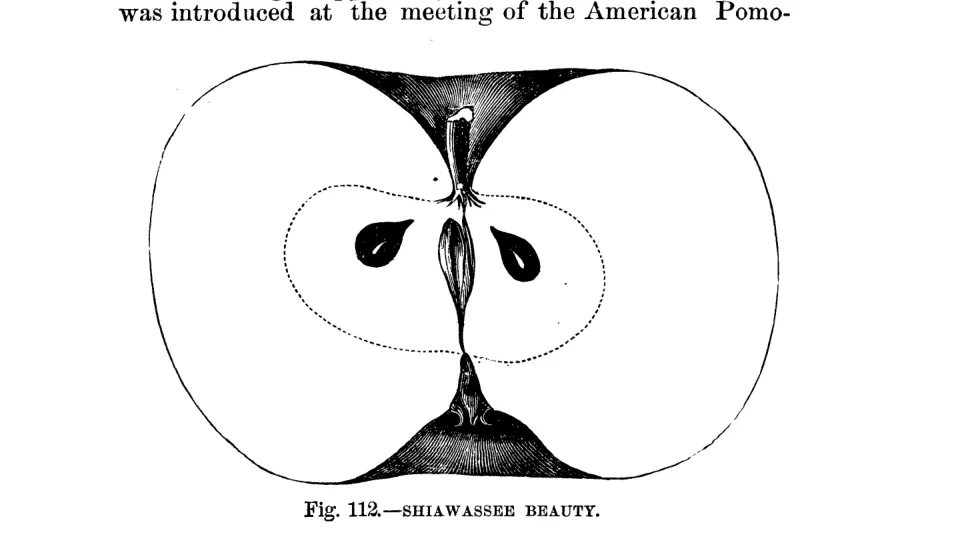
Shiawassee Beauty
Origin/History
Originated in Shiawassee County, Michigan. Introduced at the meeting of the American Pomological Society in 1862 by T. T. Lyon of Plymouth, Michigan, who stated that it was a seedling of the Fameuse, the faults of which it does not inherit, though possessing all the good qualities of its parent, with a healthy and productive tree. (See Michigan Farmer, Dec. 11, 1859.) Also known as Michigan Beauty (Downing). The variety resembles the Fameuse, but its wood shows its distinctiveness (Downing).
Tree
Strong upright grower until in full bearing, when it becomes partially pendent; very productive. Young wood dull reddish brown, slightly downy (Downing). Warder describes the tree simply as healthy and productive.
Fruit
Size: Medium.
Form: Very regular, quite flat (Warder); oblate (Downing). Very handsome (Warder).
Stem: Short (Warder); rather short (Downing).
Cavity: Wide and wavy (Warder); large (Downing).
Calyx: Reflexed (Warder); small and closed (Downing). The eye is medium and closed (Warder).
Basin: Wide and folded (Warder); large, open, and slightly corrugated (Downing).
Skin: Surface very smooth (Warder). Ground color pale yellow (Warder) or whitish (Downing), mixed, marbled, splashed, and distinctly striped with carmine (Warder) or rich red (Downing). Dots scattered, minute (Warder); few light dots (Downing).
Flesh and Flavor: Very white. Fine-grained, tender, and breaking (Warder); firm, tender, and juicy (Downing) — the two sources differ on texture, Warder emphasizing a breaking quality and Downing describing firmness. Flavor brisk, refreshing subacid (Downing); sub-acid and aromatic (Warder). Quality good to very good (Warder); very good (Downing).
Core and Seeds: Core wide, regular, somewhat open, meeting the eye. Seeds plump, short, and dark (Warder). Not described in Downing.
Season
October to January.
Uses
Dessert and market (Warder). Not described in Downing beyond implied dessert quality.
Subtypes/Variants
Not described in source.
Other
Not described in source.
Book Sources
Described in 2 period pomological works
View original book sources (2)
— John A. Warder, American Pomology: Apples (1867)Shiawassee Beauty.
This Michigan apple may well be called Beauty. It was introduced at the meeting of the American Pomological Society in 1862, by T. T. Lyon, of Plymouth, Mich., who stated that it was a seedling of the Fameuse, the faults of which it does not inherit, though possessing all the good qualities of its parent, with a healthy and productive tree. (See Michigan Farmer, Dec. 11, 1859.)
Fruit medium, very handsome, very regular, quite flat; Surface very smooth, pale yellow, mixed and distinctly striped carmine; Dots scattered, minute. Basin wide, folded; Eye medium, closed; Calyx reflexed. Cavity wide, wavy; Stem short. Core wide, regular, somewhat open, meeting the eye; Seeds plump, short, dark; Flesh very white, fine-grained, tender, breaking; Flavor sub-acid, aromatic; Quality good to very good; Use dessert and market; Season October to January.
— A.J. Downing, The Fruits and Fruit Trees of America (1900)Shiawassee Beauty. Michigan Beauty. Originated in Shiawassee Co., Mich. Tree a strong upright grower until in full bearing, when it becomes partially pendent, very productive. Young wood dull reddish brown, slightly downy. This variety resembles Fameuse, but its wood shows its distinctiveness. Fruit medium, oblate, whitish, shaded, marbled, splashed, and striped with rich red, few light dots. Stalk rather short. Cavity large. Calyx small, closed. Basin large, open, slightly corrugated. Flesh firm, very white, tender, juicy, brisk, refreshing subacid. Very good. October, January.